
Seltmann Weiden Porcelain
German Porcelain Identification · Bavaria · Marks · Patterns · Tableware
Seltmann Weiden Porcelain: Marks, Bavaria, Dating, Patterns & Value Guide
Last Updated: September 30, 2026 | The Old Antiquarian
Seltmann Weiden is a German porcelain manufacturer founded in Weiden, Bavaria, in 1910. Collectors encounter a long sequence of factory backstamps including early C.S. WEIDEN marks, crowned-S Seltmann Weiden marks, pre-war variants, U.S. Zone wording from the immediate post-war period, Bavaria, W. Germany, Germany and modern Made in Germany marks. “Bavaria” identifies the geographic region of manufacture—it is not a pattern name and not a separate maker. Reliable dating requires the exact mark, country wording, pattern or line name, form, decoration, numbers, condition and documented comparisons to agree.
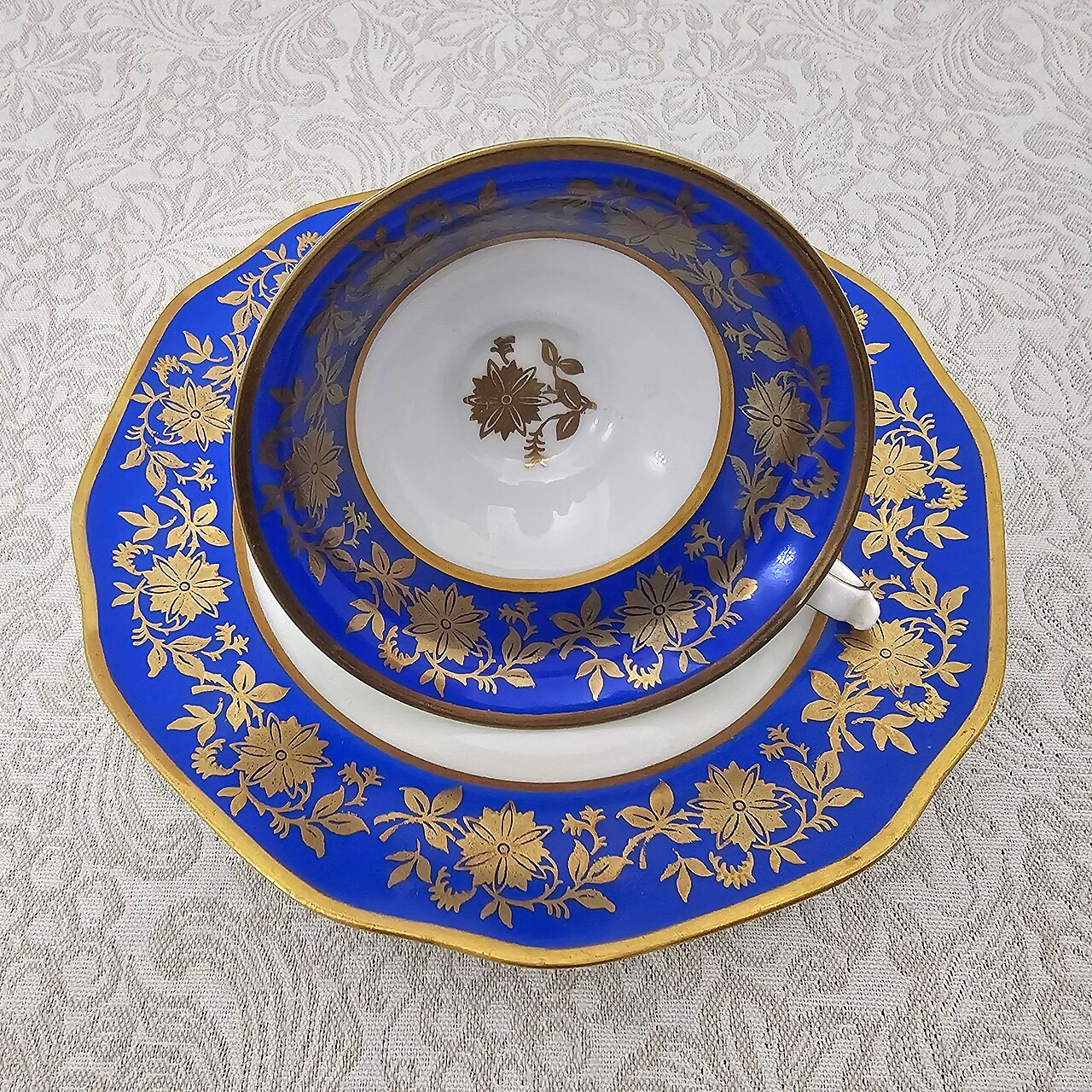
Seltmann Weiden at a Glance
| Feature | Collector Reference |
|---|---|
| Manufacturer | Porzellanfabriken Christian Seltmann GmbH / Seltmann Weiden. |
| Founded | 1910. |
| Founder | Christian Seltmann. |
| Historic centre | Weiden in der Oberpfalz, Bavaria, Germany. |
| Material | Hard porcelain; the company continues to describe its core production as hard porcelain. |
| Important historic wording | C.S. WEIDEN, Seltmann Weiden, Bavaria, Bayr. Ostmark, U.S. Zone Germany, W. Germany, Germany, Made in Germany. |
| Key collecting areas | Dinnerware, tea and coffee services, floral patterns, hotel porcelain, serving pieces, vintage tableware and decorative porcelain. |
| Useful pattern clue | A line or pattern name such as Marie Luise may appear separately from the regional wording. |
| Current production | The company states that porcelain is currently produced in Germany at its Weiden and Erbendorf sites. |
| Main identification principle | Read the complete backstamp, then verify it against the whole object. |
| Value factors | Exact pattern, period, form, decoration, rarity, completeness, condition and comparable completed sales. |
The mark is the beginning of the research – not its end.
A Seltmann Weiden backstamp can suggest a period, but it does not prove an exact production year or market value by itself.
Seltmann Weiden belongs to the broader history of
German porcelain,
but its collecting profile is different from eighteenth-century court manufactories such as Meissen or Nymphenburg. Seltmann is especially important for twentieth-century and later household porcelain, dinner services, tea and coffee wares, hospitality porcelain and decorative tableware.
In This Guide
- What is Seltmann Weiden porcelain?
- History of Seltmann Weiden
- Seltmann Weiden marks & backstamps
- Early and pre-war marks
- U.S. Zone marks
- What does Bavaria mean?
- W. Germany marks
- Germany & modern marks
- Marie Luise and pattern names
- Numbers & secondary marks
- How to date Seltmann Weiden
- How to identify genuine Seltmann Weiden
- 20 types of Seltmann porcelain
- Hotel and hospitality porcelain
- Decoration and patterns
- Vintage vs modern production
- Condition
- Seltmann Weiden value
- Collector checklist
- FAQ
- Sources
What Is Seltmann Weiden Porcelain?
Seltmann Weiden is a Bavarian German porcelain manufacturer whose history begins in Weiden in der Oberpfalz in 1910.
For collectors, the name is most strongly associated with practical and decorative porcelain made for the home, restaurants, hotels and institutional use. Depending on the period, surviving pieces can include dinner plates, cups, saucers, coffee pots, teapots, tureens, serving dishes, bowls, vases and complete coordinated services.
Seltmann Weiden marks + Bavaria + U.S. Zone + W. Germany + patterns + dinnerware + vintage tableware + condition + value.
Because the company has continued in business for more than a century, the phrase “Seltmann Weiden porcelain” can refer to objects separated by many decades. An early piece from the 1910s, a pre-war Marie Luise service, a U.S. Zone cup, a West German dinner set and contemporary Made in Germany hotel porcelain should not be dated or valued in the same way.
History of Seltmann Weiden
The Porzellanfabriken Christian Seltmann enterprise was founded in Weiden in 1910. Its location in Bavaria placed the company within one of Germany’s major porcelain-producing regions.
During the twentieth century the manufacturer developed a broad range of household and professional porcelain. Its backstamps changed with company practice, export requirements, regional wording and Germany’s changing political context.
The factory begins production in Weiden. Early collector references document marks such as C.S. WEIDEN and early versions of the Seltmann name and crowned-S identity.
A wider range of tableware, services and decorative porcelain appears. Several backstamp families are documented, including the classic Seltmann Weiden identity and line-specific wording.
Following World War II, some pieces were marked with wording such as U.S. Zone Germany or related USZ forms, creating one of the most useful broad dating windows for collectors.
Backstamps can include Bavaria, Germany, W. Germany and Weiden-E wording depending on period, line and export destination. The company supplied extensive domestic and export markets.
Following German reunification, Germany or Made in Germany wording becomes common on later production, though mark design varies across collections and product lines.
The manufacturer remains active. Its current official information states that porcelain is produced at Weiden and Erbendorf and is 100% Made in Germany.
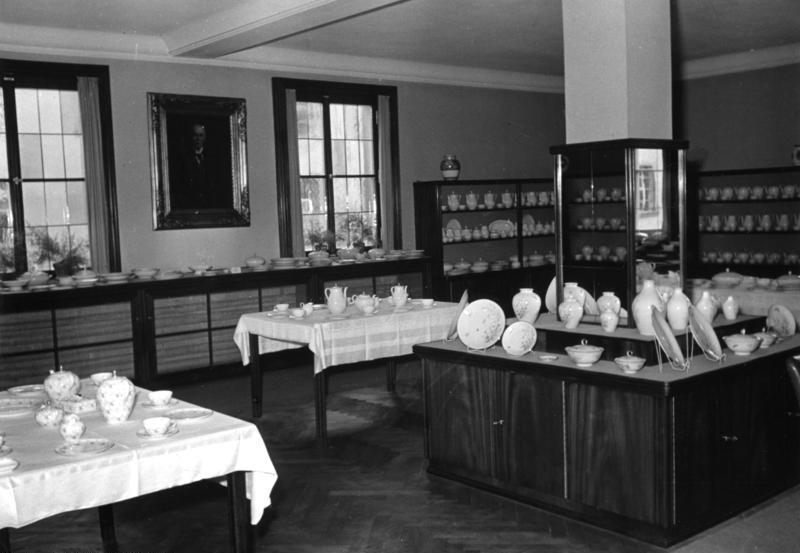
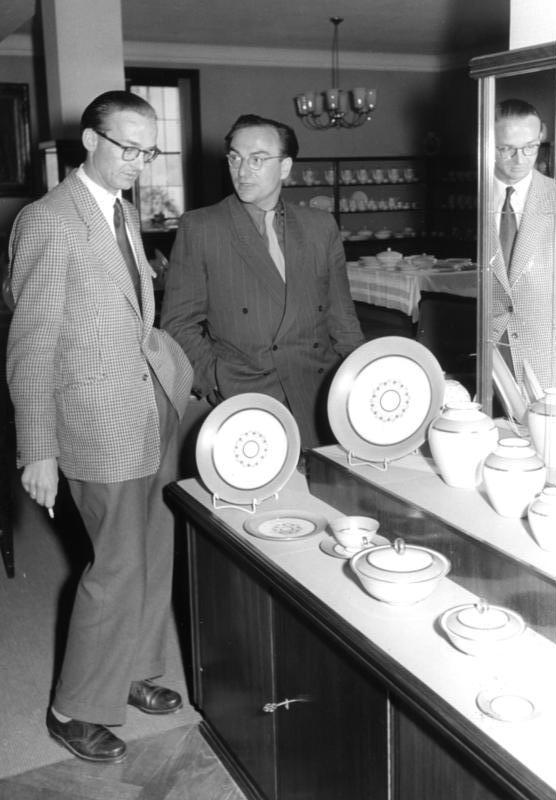
Seltmann Weiden Porcelain Marks & Backstamps
Backstamps are central to Seltmann Weiden research because the manufacturer used different designs and wording across more than a century of production.
A mark may contain several independent clues:
Before attempting a Seltmann-specific date, it is useful to understand the wider method in our
Porcelain Marks & Backstamps Guide.
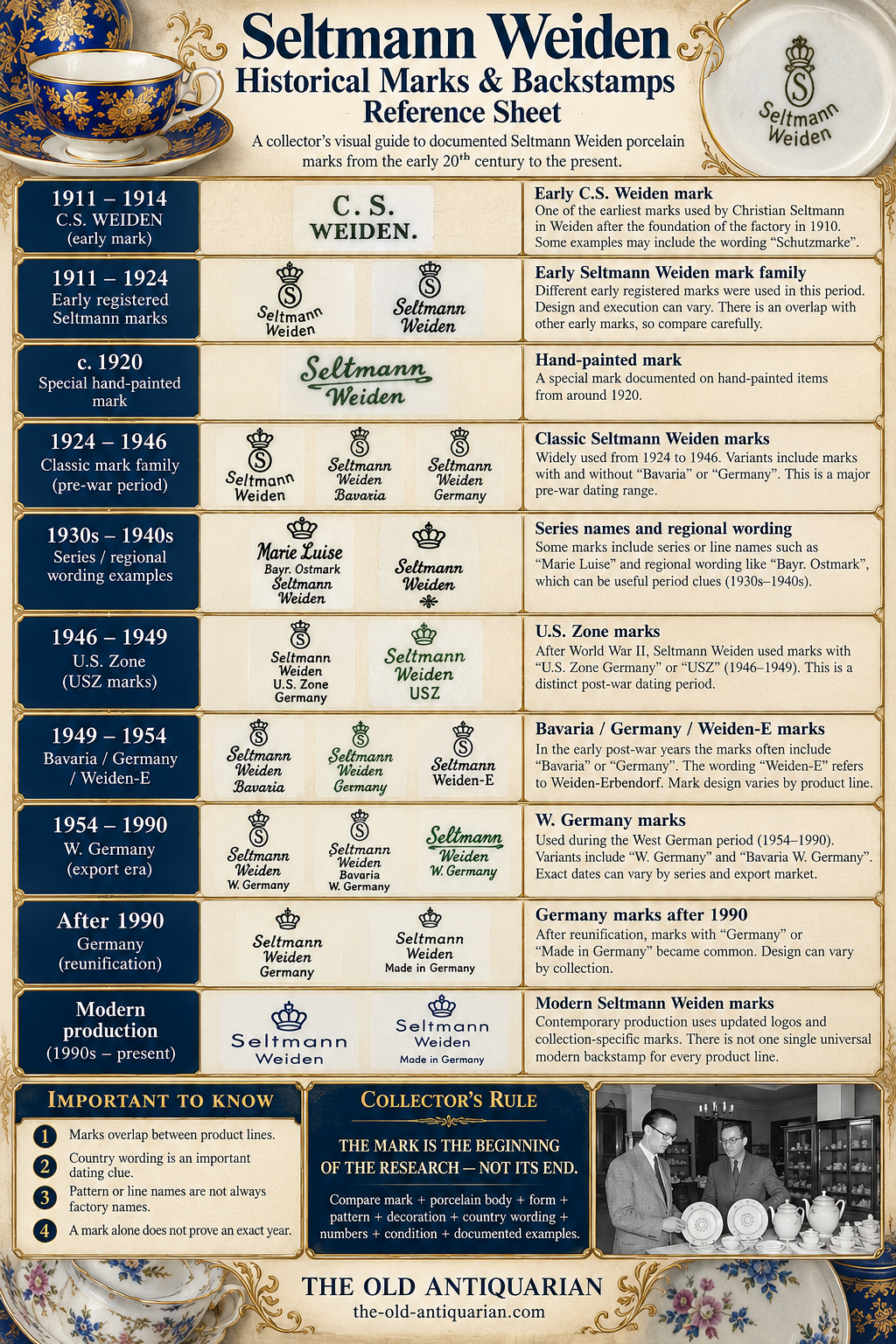
Seltmann Weiden used overlapping mark families across different products and markets. Specialist references support important broad ranges such as 1924–1946 for one classic mark family and 1946–1949 for U.S. Zone marks, but later Bavaria, Germany and W. Germany variants should not be treated as universal day-to-day changeover dates.
Early C.S. Weiden and Pre-War Seltmann Marks
One of the earliest documented Seltmann marks is the simple C.S. WEIDEN wording. Specialist references place this mark in the early 1910s.
Later early marks develop the more familiar Seltmann identity, frequently incorporating a crown, an S monogram and the Seltmann Weiden name.
| Mark Family | Broad Period | Collector Interpretation |
|---|---|---|
| C.S. WEIDEN | Early 1910s. | Important early factory wording; compare carefully with early forms and decoration. |
| Early crowned-S / Seltmann Weiden | 1910s–1920s variants. | Early registered and transitional marks occur in more than one design. |
| Special hand-painted Seltmann marks | Documented around the early twentieth century. | Can appear on more decorative wares; execution should be compared with references. |
| Classic crowned-S mark family | One important form documented 1924–1946. | A major pre-war dating clue, but exact design still matters. |
Bayr. Ostmark and Pre-War Regional Wording
Some pre-war pieces use regional wording such as Bayr. Ostmark. This can be especially useful when it appears together with the factory name and a known line such as Marie Luise.
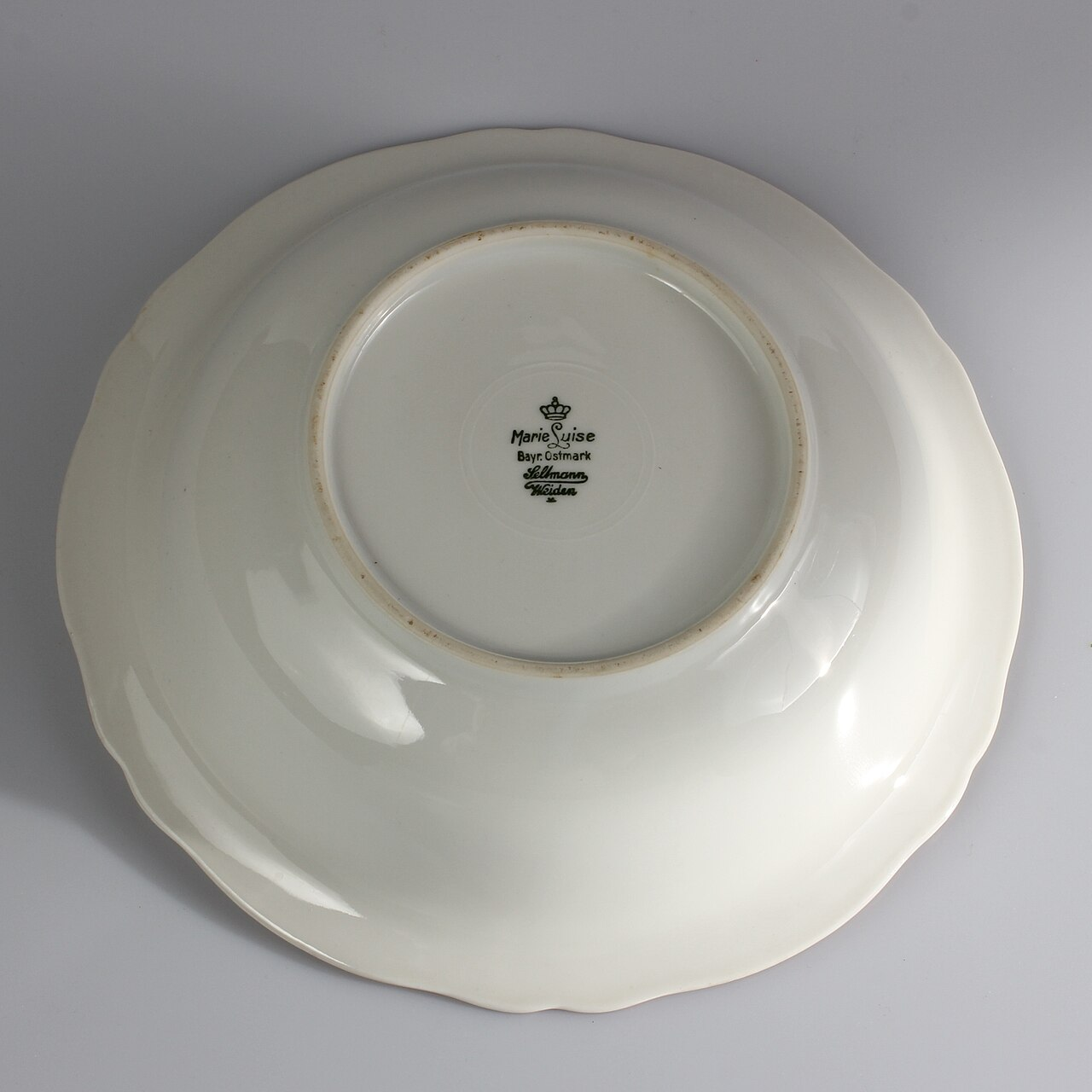
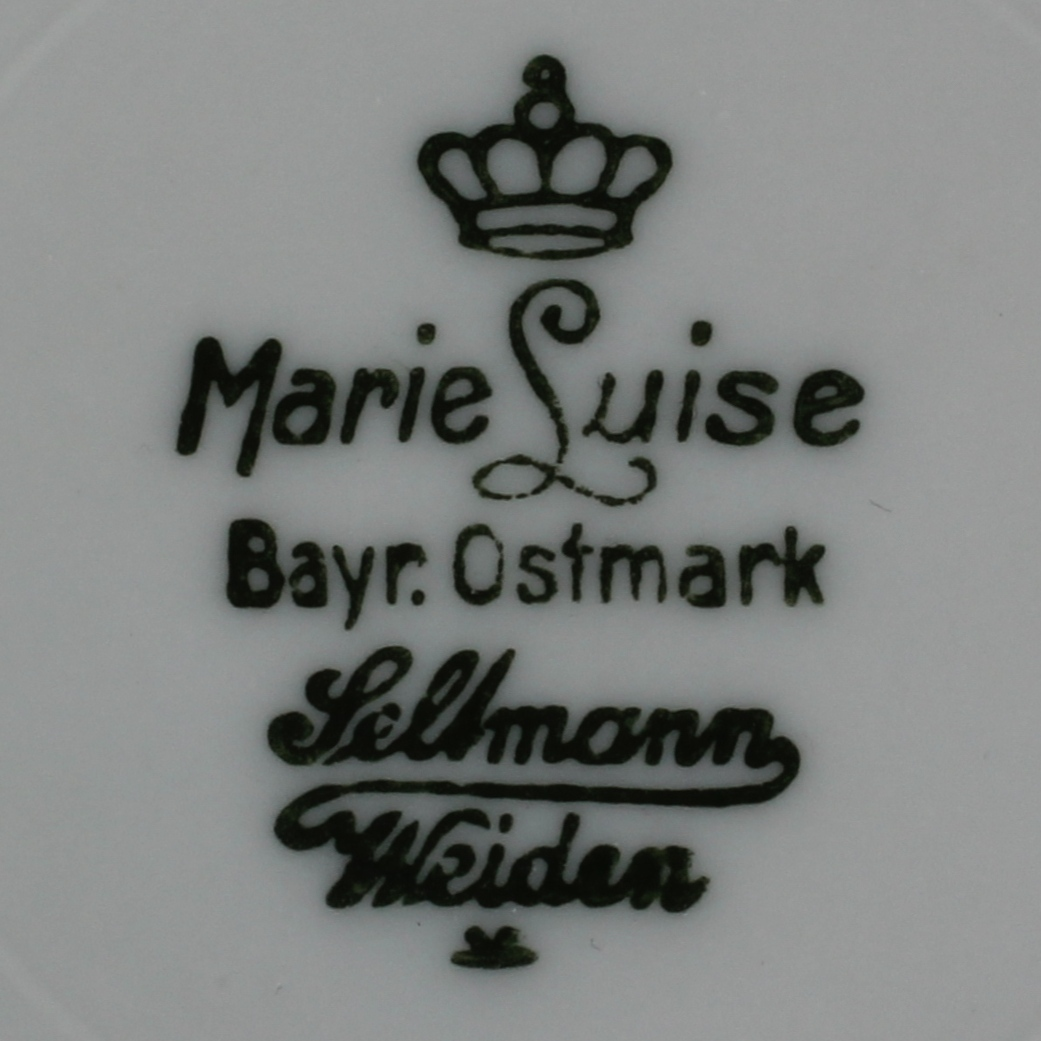
Marie Luise = line or pattern identity.
Bayr. Ostmark = regional wording.
Seltmann Weiden = manufacturer.
Seltmann Weiden U.S. Zone Marks: 1946–1949
U.S. Zone wording is one of the most useful broad chronological clues on post-war Seltmann porcelain.
Specialist mark references document Seltmann Weiden U.S. Zone and related U.S. Zone Germany wording during approximately 1946–1949.
Unlike a generic “Bavaria” mark that can appear across a broader range of production, explicit U.S. Zone wording points to the immediate post-World War II occupation period and therefore provides a comparatively narrow dating clue.
However, the correct method is still to check whether the porcelain body, pattern, shape and decoration make sense for the late 1940s.
Seltmann Weiden Bavaria – What Does the Mark Mean?
This is one of the most commonly misunderstood Seltmann questions.
On Seltmann Weiden porcelain, Bavaria means geographic origin. It refers to Bavaria in Germany. It does not mean that Bavaria is the pattern, the model name or a second manufacturer.
Many other German porcelain makers also used Bavaria wording, which is why an unidentified “Bavaria” backstamp should always be narrowed to the actual manufacturer.
For the broader regional question, see our
Bavaria Porcelain Identification Guide.
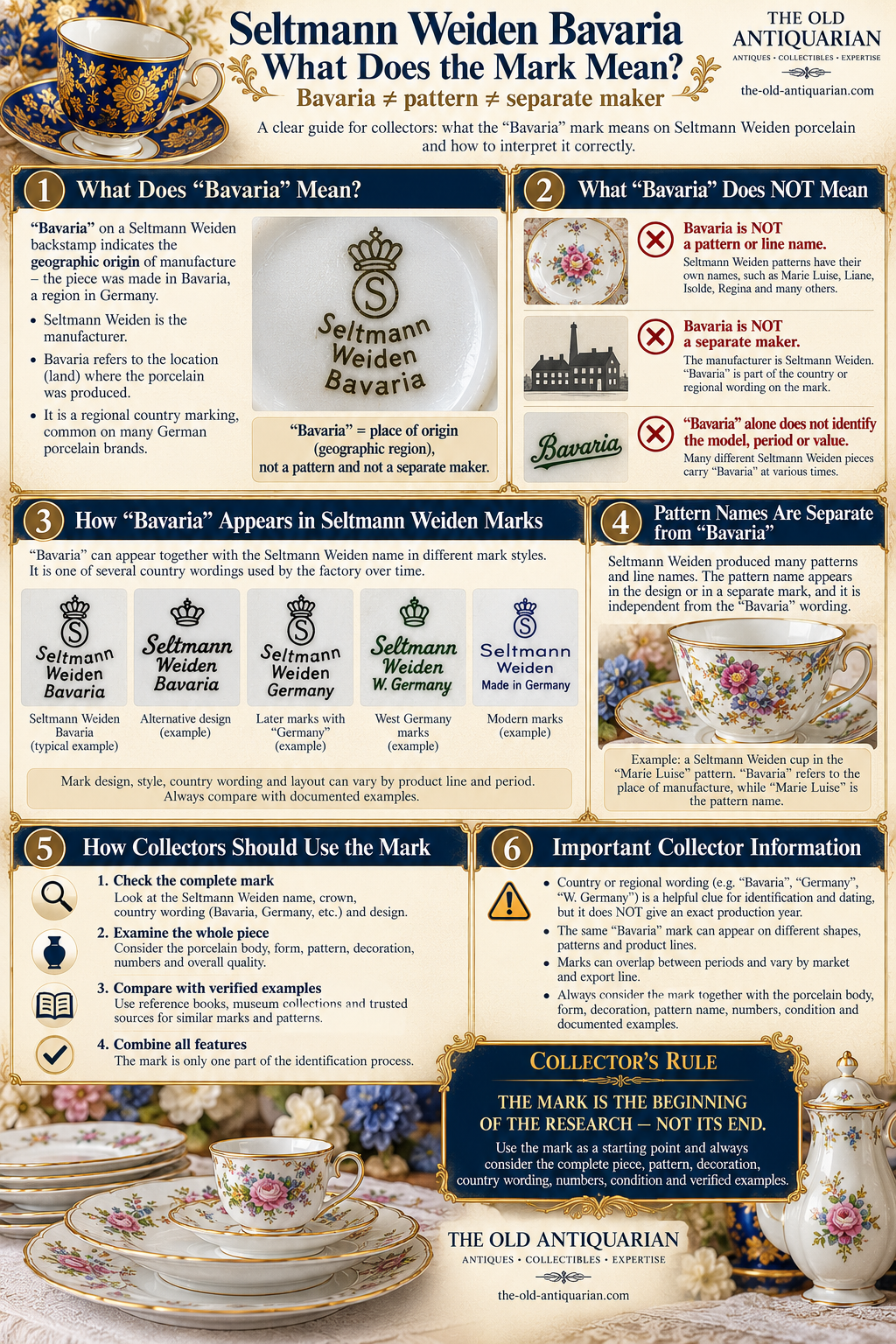
| Backstamp Wording | What It Means | What It Does Not Mean |
|---|---|---|
| Seltmann Weiden | Manufacturer identity. | Does not by itself give an exact year. |
| Bavaria | Regional origin in Bavaria, Germany. | Not a pattern or separate factory. |
| Marie Luise | Line / pattern designation on documented pieces. | Not the manufacturer. |
| Germany | Country wording. | Not automatically post-1990 unless the complete mark supports that period. |
| W. Germany | West German country wording useful for broad dating. | Not a single exact production year. |
| U.S. Zone Germany | Immediate post-war occupation-zone wording. | Not a pattern name. |
Seltmann Weiden W. Germany Marks
W. Germany or West Germany wording is particularly useful when studying export-era Seltmann tableware.
Specialist mark references place important Seltmann W. Germany variants broadly within the second half of the twentieth century, often using approximately 1954–1990 as a practical range for certain marks.
This does not mean every Seltmann object marked Bavaria but lacking W. Germany must be earlier. Different markets, lines and backstamp layouts can overlap.
Then compare the exact logo, form, decoration, pattern and numbers with documented examples.
Germany, Made in Germany & Modern Seltmann Marks
After German reunification, later Seltmann Weiden production commonly uses wording such as Germany or Made in Germany.
Modern marks may use updated logos and cleaner typography, and different collections can carry different layouts.
The manufacturer’s current official information states that production remains at its German locations in Weiden and Erbendorf and that its porcelain is 100% Made in Germany.
Age and quality are different questions. Contemporary Seltmann may be technically excellent while having a different collector market from scarce early or vintage lines.
Marie Luise, Pattern Names & Line Names
The name Marie Luise is especially useful for understanding how to read a Seltmann backstamp correctly.
A collector may see several lines of text and mistakenly treat all of them as part of one factory name. Instead, separate each function:
| Element | Example | Research Question |
|---|---|---|
| Manufacturer | Seltmann Weiden | Who made the object? |
| Pattern / line | Marie Luise | Which service or design family? |
| Region | Bavaria / Bayr. Ostmark | Where was it associated geographically? |
| Political / export wording | U.S. Zone / W. Germany / Germany | Which broad historical context? |
| Secondary number | Painted or impressed number | Could this relate to shape, decoration or production control? |
Pattern identification is important because Seltmann manufactured extensive coordinated services. A pattern name can help locate matching pieces, understand production longevity and distinguish a decorative series from the factory itself.
Seltmann Weiden Numbers, Codes & Secondary Marks
The factory backstamp is not always the only information on the underside.
Collectors can encounter painted numbers, impressed numbers, decoration references or other production marks. Their meaning depends on the line and period.
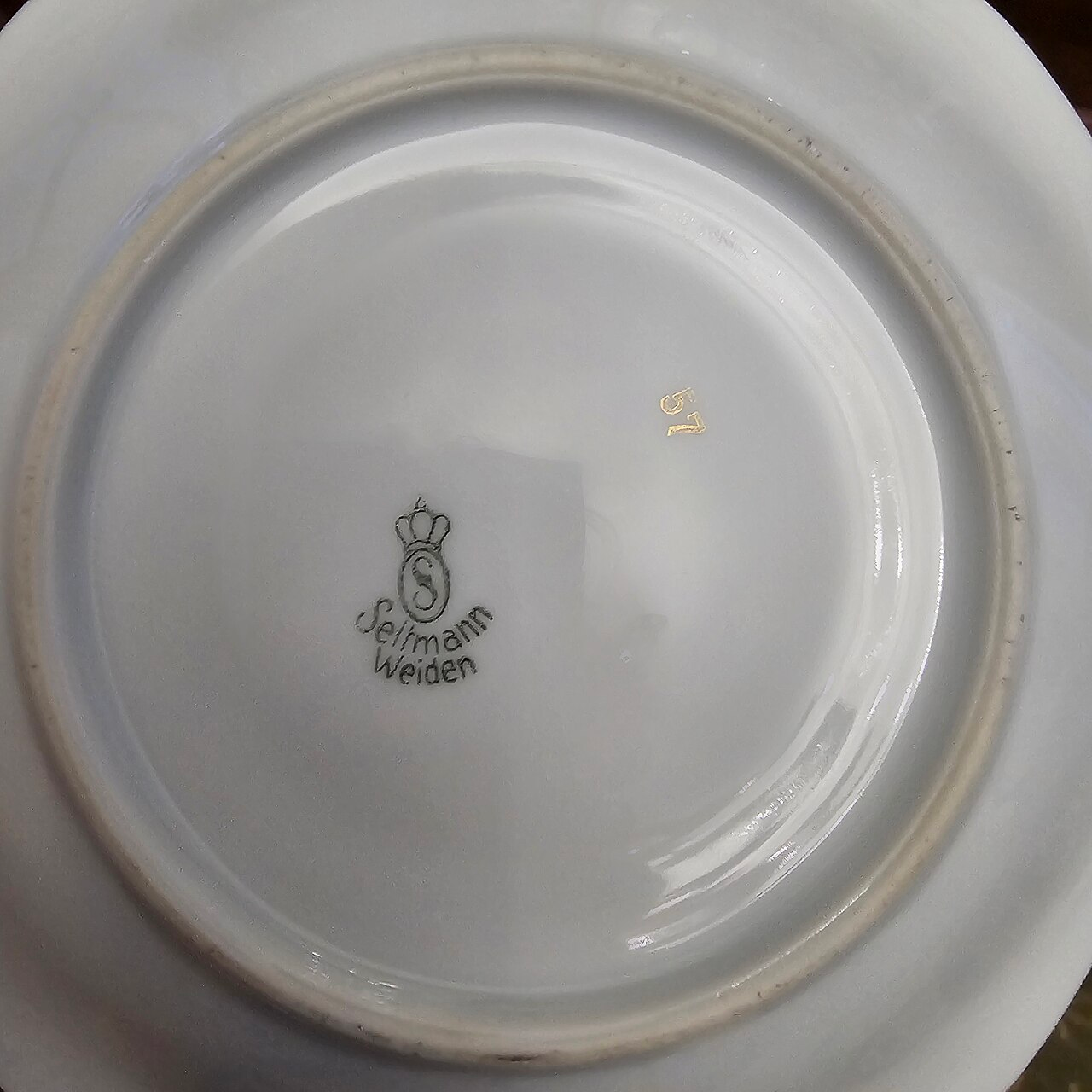
A number may refer to a form, pattern, decoration, production batch or another internal system. Interpret it only after comparing the specific line with documented examples.
How to Date Seltmann Weiden Porcelain
Dating Seltmann Weiden is usually a process of narrowing the object into a reliable period rather than assigning one exact year.
For the general multi-factor method, see
How to Date Antique Porcelain.
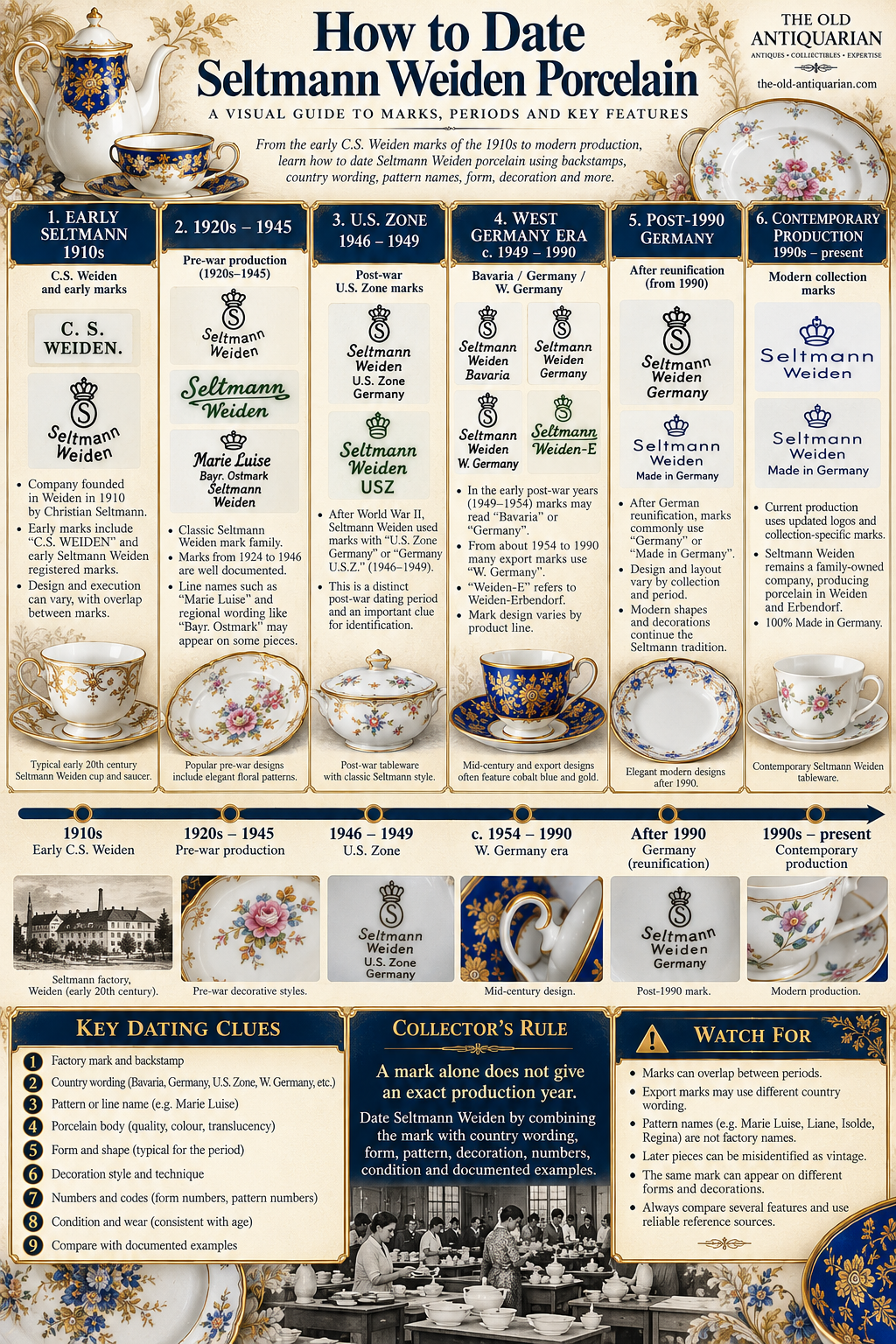
Early C.S. WEIDEN and early Seltmann mark families.
Pre-war services, classic crowned-S marks and line-specific wording.
U.S. Zone / USZ wording.
Bavaria, Germany and W. Germany export-related variants.
Germany, Made in Germany and modern collection-specific marks.
| Dating Clue | What to Ask | Reliability |
|---|---|---|
| Exact backstamp | Can this exact logo and wording be tied to a documented range? | High when well documented. |
| Country wording | Does it say U.S. Zone, W. Germany, Germany or Bavaria? | Strong supporting evidence. |
| Pattern / line | Was this service produced over one period or for several decades? | Potentially high. |
| Form | Do handle, rim, foot and proportions fit the proposed period? | Supporting. |
| Decoration | Does the style fit pre-war, mid-century or later production? | Supporting. |
| Numbers | Can the form or decoration number be identified? | Variable. |
| Condition | Is wear consistent with the proposed age? | Supporting only. |
| Documented comparison | Can the same mark and form be found in reliable references? | Very high. |
exact mark + country wording + line/pattern + form + decoration + numbers + condition + documented comparison
How to Identify Genuine Seltmann Weiden Porcelain
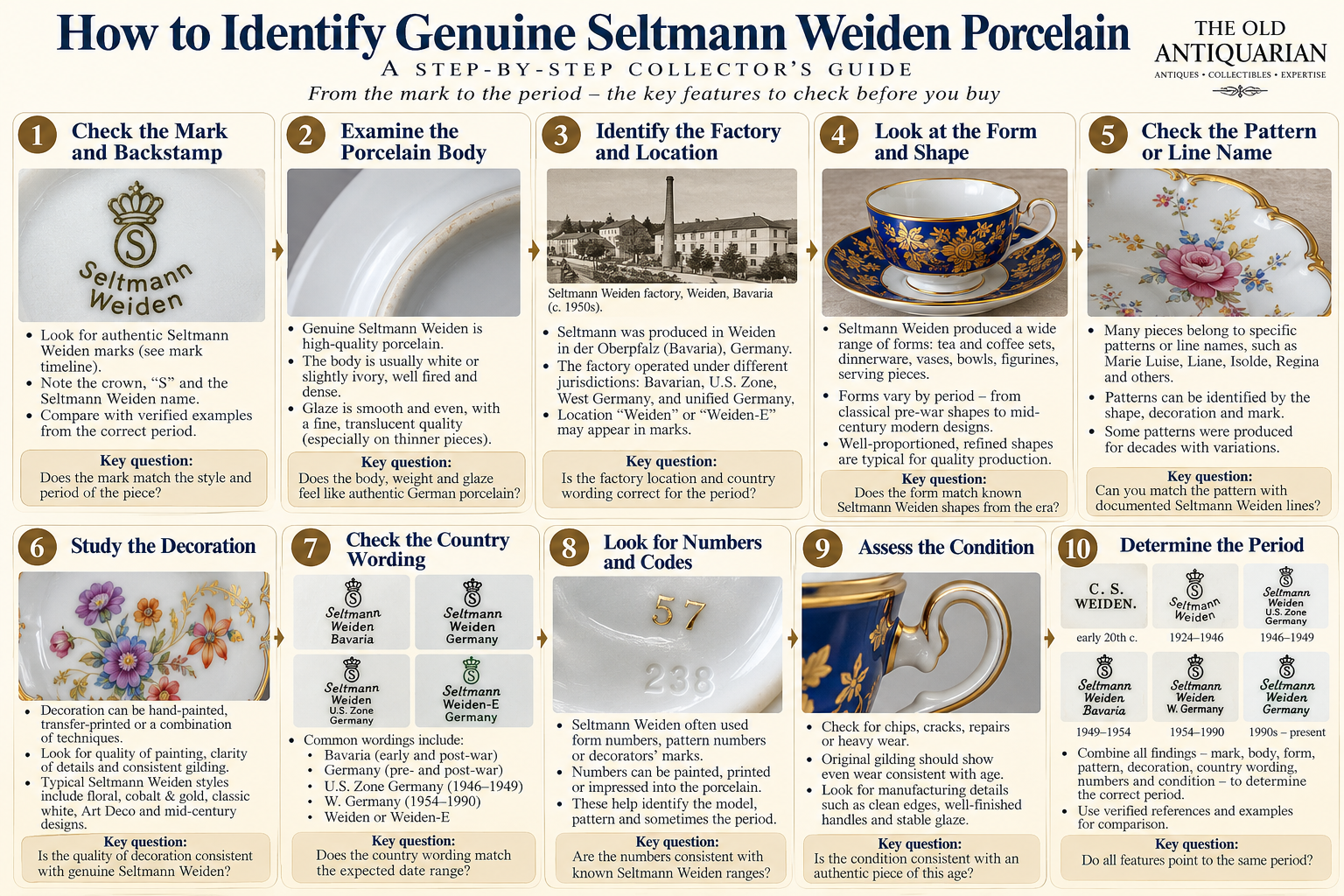
Do not crop out regional wording, pattern names or small secondary numbers.
Check colour, density, translucency where applicable, glaze and foot-rim finishing.
Look for Seltmann, Weiden, Weiden-E or other wording that fits documented company marks.
Determine whether the object is a plate, cup, saucer, coffee pot, tureen, serving piece, vase or professional hotel form.
Look for a printed line name, known decorative design or matching service pieces.
Assess floral painting, transfer decoration, cobalt grounds, gilding, borders and modern printed designs.
Bavaria, Bayr. Ostmark, U.S. Zone, W. Germany and Germany provide useful historical context.
Do not discard apparently minor painted or impressed information.
Look for chips, cracks, staining, glaze wear, worn gilding, repairs and replacements within a service.
The mark, pattern, form, decoration and condition should all support the same broad date range.
The same whole-object approach applies across European ceramics; see
How to Identify Antique Porcelain
for the broader method.
20 Types of Seltmann Weiden Porcelain
Unlike manufacturers known primarily for figurines, Seltmann Weiden is particularly important for tableware and coordinated services.
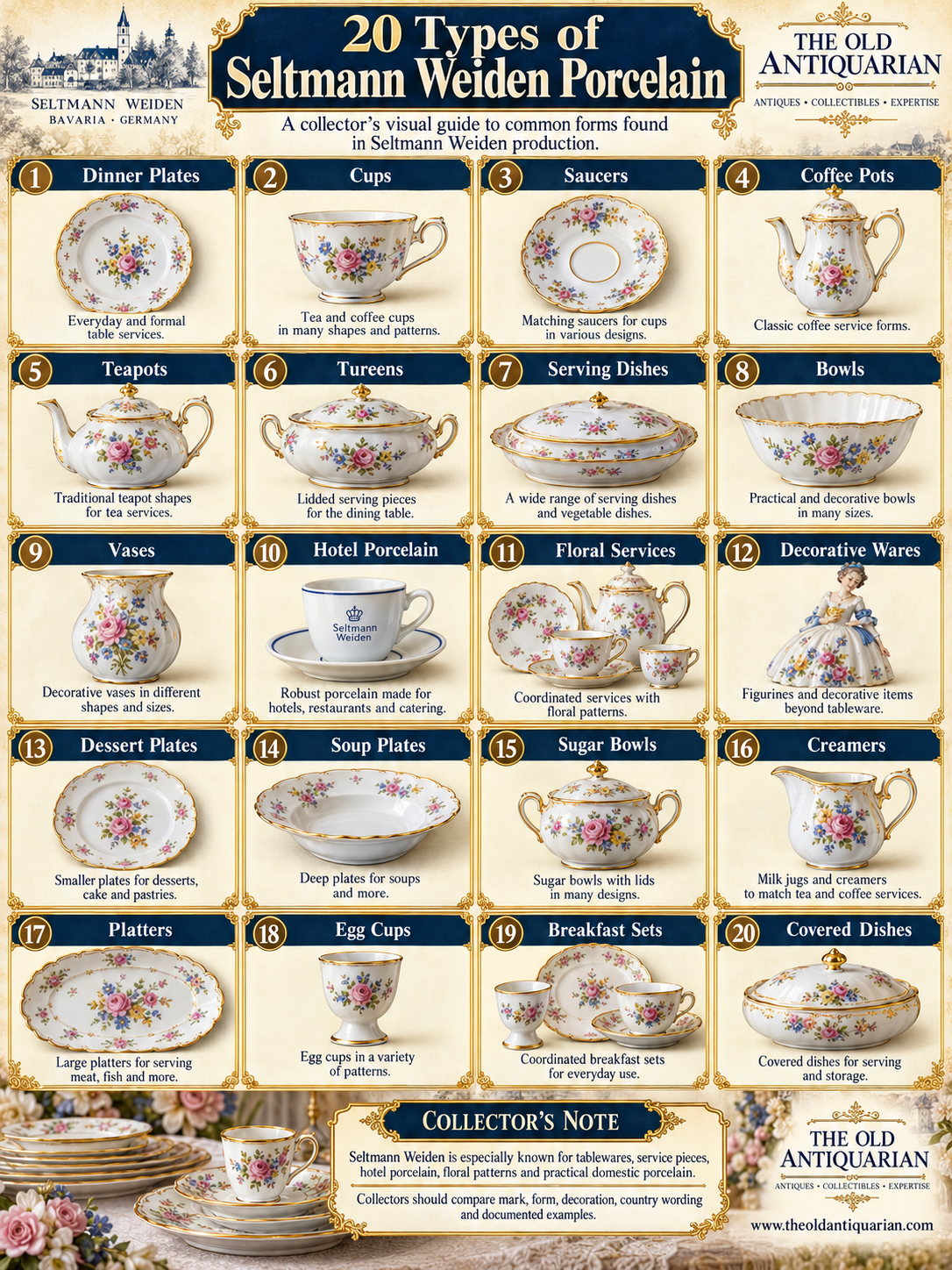
| Tableware | Serving & Decorative Forms |
|---|---|
| Dinner plates | Coffee pots |
| Cups | Teapots |
| Saucers | Tureens |
| Dessert plates | Serving dishes |
| Soup plates | Platters |
| Bowls | Covered dishes |
| Egg cups | Sugar bowls |
| Breakfast sets | Creamers / milk jugs |
| Floral dinner services | Decorative vases |
| Hotel porcelain | Decorative wares |
The illustrated forms are category examples rather than a catalogue of exact historical Seltmann models. For model identification, compare the actual shape and backstamp with documented factory pieces.
Seltmann Weiden Hotel & Hospitality Porcelain
Professional porcelain is an important part of the Seltmann identity.
The company’s current official information describes household porcelain and hospitality / food-service porcelain as major areas of its business.
Hotel porcelain often prioritises durability, stackability, functional proportions and repeatable service systems. This means collector interest can differ from ornate floral domestic services.
| Domestic Service | Hotel / Professional Porcelain |
|---|---|
| Decoration may be a major selling point. | Function and durability may dominate. |
| Often collected by pattern. | Often identified by line, form and service function. |
| Gilding and floral decoration may be prominent. | Decoration may be simpler or highly durable. |
| Complete family services can matter. | Restaurant or hotel provenance may add context. |
Floral Patterns, Cobalt Blue, Gold & Decorative Seltmann
Seltmann Weiden produced porcelain across changing fashions, so decoration can range from restrained white professional ware to elaborate floral and gilded services.
Floral Services
Vintage floral tableware is one of the most recognisable collecting areas. When researching a floral pattern, do not rely on flowers alone. Similar roses, bouquets and scattered flowers appear across many Bavarian factories.
Use the complete backstamp, shape and pattern identity.
Cobalt Blue and Gold
Deep blue grounds combined with rich gilding create an especially decorative appearance, but cobalt and gold were used by many European makers.
The Seltmann identity must still be confirmed from the base.
Hand Decoration vs Transfer Decoration
Depending on the line and period, decoration may be hand painted, printed, transferred, gilded or produced using combined techniques.
Look closely at repeated motifs. Perfectly identical flowers across multiple pieces can indicate printed or transfer decoration, while hand-applied work often shows natural variation.
Vintage vs U.S. Zone vs West Germany vs Modern Seltmann
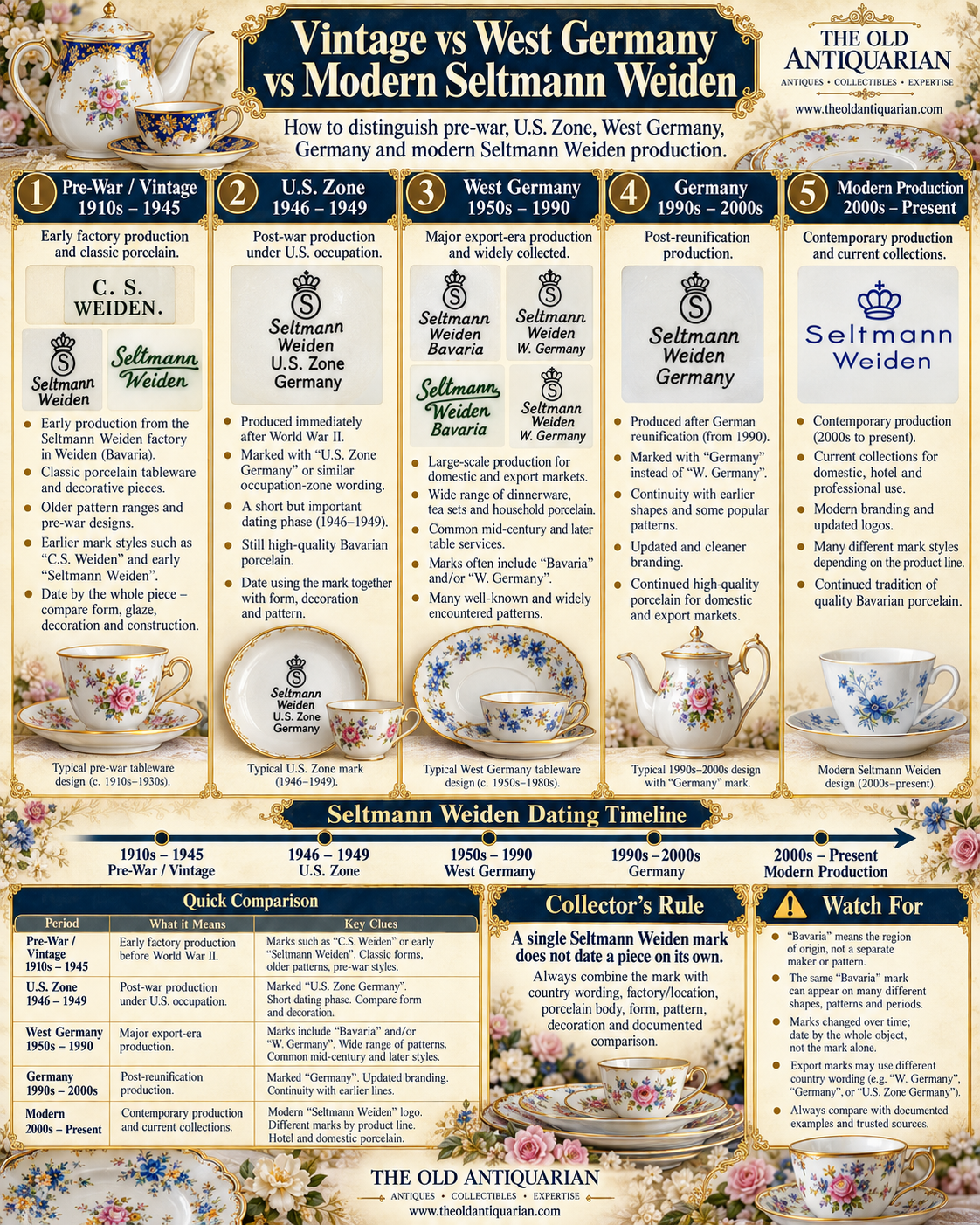
| Broad Category | Typical Clues | Collector Approach |
|---|---|---|
| Early / Pre-War | C.S. WEIDEN, early crowned-S marks, Bayr. Ostmark, older line names and period forms. | Compare exact mark and pattern carefully; early pieces can be significantly older than typical vintage tableware. |
| U.S. Zone | Explicit U.S. Zone / USZ wording. | A valuable narrow post-war dating clue, broadly 1946–1949. |
| West Germany | Bavaria, Germany and W. Germany variants, export-era tableware. | Use the exact mark plus pattern and form; do not date from Bavaria alone. |
| Post-1990 Germany | Germany / Made in Germany, updated branding and continued lines. | Separate later production from visually similar older services. |
| Modern | Contemporary Seltmann logos, professional and domestic collections. | Identify collection and current product context rather than treating modern marks as vintage. |
Period matters, but value ultimately depends on pattern, rarity, completeness, condition, demand and genuinely comparable sales.
Condition: What Matters on Seltmann Weiden Porcelain?
Condition is particularly important when valuing complete or partial services.
| Condition Issue | Why It Matters |
|---|---|
| Chips | Rim and foot chips reduce usefulness and collector desirability. |
| Hairline cracks | Can worsen with use and materially affect value. |
| Crazing | Evaluate whether the glaze condition is typical for the specific body and period. |
| Gilding wear | Especially important on cobalt-and-gold and formal services. |
| Utensil marks | Heavy scratching can affect display quality. |
| Staining | Tea, coffee and food staining can be difficult to remove safely. |
| Mismatched replacements | Check whether all pieces share the same mark period, form and decoration. |
| Restoration | Less common on ordinary tableware than on art porcelain, but repaired handles and lids still matter. |
Turn over several pieces—not just one. Long-running patterns may contain replacement pieces manufactured years or decades apart, and backstamp differences can reveal this.
Seltmann Weiden Porcelain Value
There is no single value for Seltmann Weiden porcelain.
A common single saucer, an early marked piece, a complete Marie Luise service, a scarce decorative pattern, an intact coffee set and commercial hotel ware represent different markets.
Use genuinely comparable completed sales rather than unsold marketplace listings.
exact mark + period + pattern / line + form + decoration + rarity + completeness + condition + provenance + current demand + comparable completed sales
| Value Factor | Why It Matters |
|---|---|
| Period | Early, pre-war, U.S. Zone and later production have different collector contexts. |
| Pattern / line | Some services are more sought after or harder to complete. |
| Form | Coffee pots, tureens and serving pieces may be harder to replace than plates or saucers. |
| Decoration | Elaborate cobalt grounds, gilding or uncommon decoration may affect demand. |
| Completeness | A coherent service can be more useful and desirable than unrelated individual pieces. |
| Condition | Chips, cracks, worn gold and staining usually reduce value. |
| Backstamp consistency | Mixed production periods may be acceptable but should be disclosed. |
| Rarity | Scarce patterns, unusual forms and early pieces can attract specialist interest. |
| Comparable sales | Actual sold results are stronger evidence than asking prices. |
For the wider valuation methodology, see
Professional Antique Valuation.
Are Old Seltmann Weiden Pieces Valuable?
Some can be, but age alone is not enough.
The strongest pieces combine an identifiable historical period with a desirable pattern, uncommon form, excellent condition, completeness and current collector demand.
Is a U.S. Zone Mark Valuable?
A U.S. Zone mark makes the production period particularly interesting because it points to a relatively narrow post-war window. That can add historical interest, but the actual market value still depends on the object itself.
Does “Bavaria” Increase Value?
Not automatically.
“Bavaria” primarily tells you about geographic origin. It is not a rarity designation or quality grade.
Seltmann Weiden Collector Checklist
- Photograph the complete object.
- Photograph the entire underside.
- Record the exact factory mark.
- Record every regional or country word.
- Separate the maker name from the pattern or line name.
- Do not treat Bavaria as a pattern.
- Check for U.S. Zone or USZ wording.
- Check whether W. Germany appears.
- Record all painted and impressed numbers.
- Identify the object form.
- Compare handles, rims, feet and lids with matching pieces.
- Determine whether decoration is painted, printed or mixed.
- Check gilding for wear or later touch-up.
- Inspect cups for hairlines around handles.
- Inspect plates for edge chips and utensil wear.
- Compare several pieces within a service for backstamp changes.
- Do not date a piece from visible wear alone.
- Compare exact marks rather than only the crowned S symbol.
- Use documented references before marketplace descriptions.
- Research completed sales only after identification is secure.
Do You Have Seltmann Weiden Porcelain?
Send clear photographs of the complete piece or service, the underside of several items, all backstamps and numbers, the pattern decoration, dimensions and any damage. For a large dinner service, include the number of pieces and a photograph showing the full set together.
Seltmann Weiden · Bavaria Porcelain · German Tableware · U.S. Zone · W. Germany
Seltmann Weiden FAQ
When was Seltmann Weiden founded?
Seltmann Weiden was founded in Weiden, Bavaria, in 1910 as Porzellanfabriken Christian Seltmann.
What does Seltmann Weiden Bavaria mean?
Seltmann Weiden is the manufacturer. Bavaria is the geographic region in Germany associated with the porcelain’s origin. Bavaria is not the pattern name or a separate maker.
What does U.S. Zone mean on Seltmann Weiden porcelain?
U.S. Zone wording is associated with the immediate post-World War II American occupation period. Specialist mark references date documented Seltmann U.S. Zone marks broadly to 1946–1949.
What does W. Germany mean on Seltmann Weiden?
W. Germany identifies production associated with West Germany. It is a useful broad dating clue, but the exact mark design, pattern, form and other evidence are needed to narrow the period.
Is Marie Luise the manufacturer?
No. Marie Luise is a Seltmann Weiden line or pattern designation found on documented pieces. Seltmann Weiden is the manufacturer.
Is Bavaria a Seltmann Weiden pattern?
No. Bavaria is regional wording. Pattern or line names are separate from the Bavaria designation.
How can I date Seltmann Weiden porcelain?
Compare the exact factory backstamp, country wording, pattern or line name, porcelain body, form, decoration, secondary numbers and condition with documented examples.
Are all crowned-S marks the same age?
No. The crowned S was used in different designs over a long period. Compare the exact crown, S, typography, wording and layout rather than matching only the main symbol.
What does Weiden-E mean?
Specialist mark references identify Weiden-E wording with Weiden-Erbendorf. It should still be interpreted together with the full mark and object.
Is Seltmann Weiden still made in Germany?
Yes. The company currently states that its porcelain production is located in Germany at Weiden and Erbendorf and describes its production as 100% Made in Germany.
What is Seltmann Weiden best known for?
Collectors commonly encounter Seltmann Weiden dinnerware, tea and coffee services, floral tableware, serving pieces, hotel porcelain, decorative porcelain and coordinated household services.
What determines Seltmann Weiden porcelain value?
Value depends on the exact period, pattern, form, decoration, rarity, completeness, condition, provenance, current collector demand and genuinely comparable completed sales.
Related Guides
Sources & Further Research
-
Seltmann Weiden – Official Website
– current company information on porcelain production, family ownership, German manufacturing and the Weiden and Erbendorf production sites. -
Seltmann Weiden – Made in Germany
– official information on current German production and manufacturing locations. -
City of Weiden – Seltmann Weiden
– local reference confirming the company’s Weiden origins in 1910. -
Seltmann Weiden Shop – Company History
– historical overview of the company’s development from the Porzellanfabriken Christian Seltmann enterprise founded in 1910. -
Porcelain Marks & More – Seltmann Dating Corrections
– specialist correction noting a documented Seltmann mark period of 1924–1946 and the U.S. Zone addition for 1946–1949. -
The Old Stuff – Seltmann Weiden Marks
– specialist backstamp reference covering C.S. WEIDEN, pre-war marks, Marie Luise, U.S. Zone, Bavaria, W. Germany, Germany and later variants. -
Wikimedia Commons – Seltmann Weiden
– archival and object photography used for visual research; individual image licence and attribution requirements should be retained.
The infographics in this guide are educational orientation tools. Seltmann Weiden marks can overlap across products, export markets and collections, and typography or wording can vary. When a visual chart conflicts with stronger factory documentation or a securely documented individual example, use the documented evidence rather than forcing an object into a simplified timeline.
About The Old Antiquarian
The Old Antiquarian combines more than 35 years of practical experience with antiques and collecting with historical, factory, museum and comparative research.
When identifying Seltmann Weiden porcelain, we treat the backstamp as one piece of evidence within a larger system: porcelain body, factory wording, pattern, form, decoration, numbers, production period, condition and documented comparisons.
Continue with our
Bavaria Porcelain Guide
or explore the
Complete Antique Porcelain Guide.
Conclusion: Read the Entire Seltmann Weiden Backstamp
Seltmann Weiden porcelain is especially rewarding to research because its long production history intersects with major twentieth-century changes in German political geography, export wording, tableware design and industrial manufacturing.
The most useful collector clues are therefore rarely found in one word alone.
“Bavaria” tells you about region. “Marie Luise” can identify a line. “U.S. Zone” can sharply narrow a post-war period. “W. Germany” places the object within a broad West German context. Numbers may provide additional production information.
The strongest identification is one in which the mark, country wording, pattern, porcelain body, form, decoration, numbers, condition and documented historical context all support the same conclusion.
Read the complete mark → identify the line → establish the historical period → examine the porcelain and form → study decoration → record numbers → check condition → compare documented examples → then research value.
