
Royal Tettau & Royal Bayreuth: Marks, Dating, Patterns & Value
German Porcelain · Bavaria · Tettau · Royal Bayreuth · Royal Tettau · Marks · Figurals
Royal Bayreuth and Royal Tettau belong to the long porcelain history of
Tettau, Bavaria, where the royal-privileged manufactory was
established in 1794. Royal Bayreuth became the best-known
collector name for many decorative, figural and novelty wares associated with
Tettau, while Royal Tettau appears on later export marks.
The date 1794 on a backstamp normally refers to the foundation of the
factory—not the production date of the individual piece. Reliable
identification combines the exact mark, porcelain body, form, decoration,
pattern, production period, condition and documented historical comparisons.
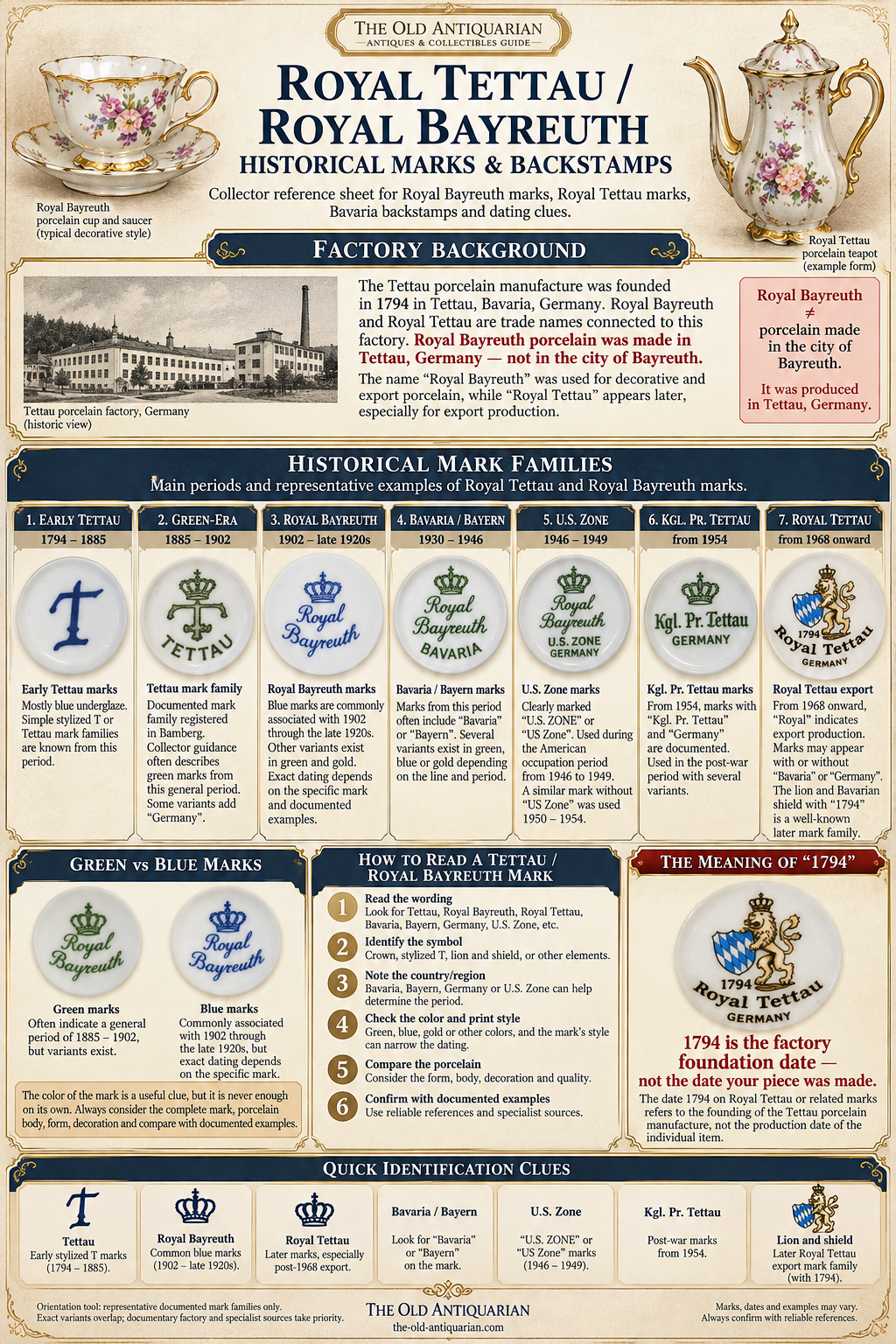
including early Tettau, green and blue Royal Bayreuth, Bavaria, U.S. Zone,
Kgl. Pr. Tettau and later Royal Tettau export marks.
Graphic reconstructions are collector orientation tools; documentary sources take priority.
| Royal Tettau / Royal Bayreuth at a Glance | Collector Reference |
|---|---|
| Historic factory | Königlich privilegierte Porzellanmanufaktur Tettau |
| Location | Tettau, Bavaria, Germany |
| Factory foundation | 1794 |
| Early mark period | Multiple marks documented from 1794–1885, mostly blue underglaze |
| Late 19th-century mark family | 1885–1902 |
| Royal Bayreuth | Important collector / commercial wording associated with Tettau decorative porcelain |
| U.S. Zone marks | 1946–1949 |
| Kgl. Pr. Tettau | Documented from 1954 onward |
| Royal Tettau export marks | Documented after 1968 |
| Factory closure | May 2018 |
| Important collecting areas | Figurals, novelty porcelain, Rose Tapestry, scenic wares, SunBonnet Babies, animal forms, shoes and shells |
| Key dating warning | 1794 is the foundation date, not automatically the date of the object |
The mark is the beginning of the research – not its end.
Royal Bayreuth and Royal Tettau should be identified through the complete
backstamp together with the porcelain body, form, decoration, pattern,
production period, condition and documented comparisons.
Royal Bayreuth is one of the most distinctive collector names in German
porcelain. Its appeal extends well beyond conventional dinnerware:
collectors actively seek unusual pitchers, creamers, animals, shoes,
shells, figural forms, scenic decoration and elaborate novelty porcelain.
The name is also a frequent source of confusion.
Despite the word Bayreuth, the historic porcelain associated with
classic Royal Bayreuth collecting was produced at Tettau in Bavaria,
not in the German city of Bayreuth.
If you are beginning with an unidentified piece marked only Bavaria,
start with our discreet overview of
Bavaria porcelain marks and manufacturers
before assigning it to Royal Bayreuth or Royal Tettau.
What Is Royal Tettau / Royal Bayreuth Porcelain?
Royal Tettau and Royal Bayreuth are best understood through the history of
the porcelain manufactory at Tettau in Bavaria.
The factory received royal permission to operate on
December 28, 1794, beginning more than two centuries
of porcelain production at the site.
Tettau itself is the factory location and historic manufacturing identity.
Royal Bayreuth became particularly important as commercial and collector
wording on decorative porcelain associated with the Tettau tradition.
Royal Tettau appears prominently in later export mark families.
Tettau is the historic factory and production centre.
Royal Bayreuth is a famous collector and commercial name associated especially
with decorative and novelty porcelain linked to Tettau.
Royal Tettau appears on later export production.
They should therefore be researched within one connected factory history,
not as two completely unrelated porcelain manufacturers.
The Royal Bayreuth Collectors Club identifies Tettau as the historic production
centre for the classic porcelain collected under the Royal Bayreuth name.
History of the Tettau Porcelain Factory
The origins of the factory are connected with naturalist and explorer
Alexander von Humboldt, who supported Tettau as a suitable
location for porcelain manufacture. Johann Friedrich Paul Schmidt and the
Greiner brothers received permission to establish the works in late 1794.
The factory first concentrated on practical household porcelain and coffee,
tea and cocoa services, but its production soon expanded to complete dinner
services and increasingly decorative wares.
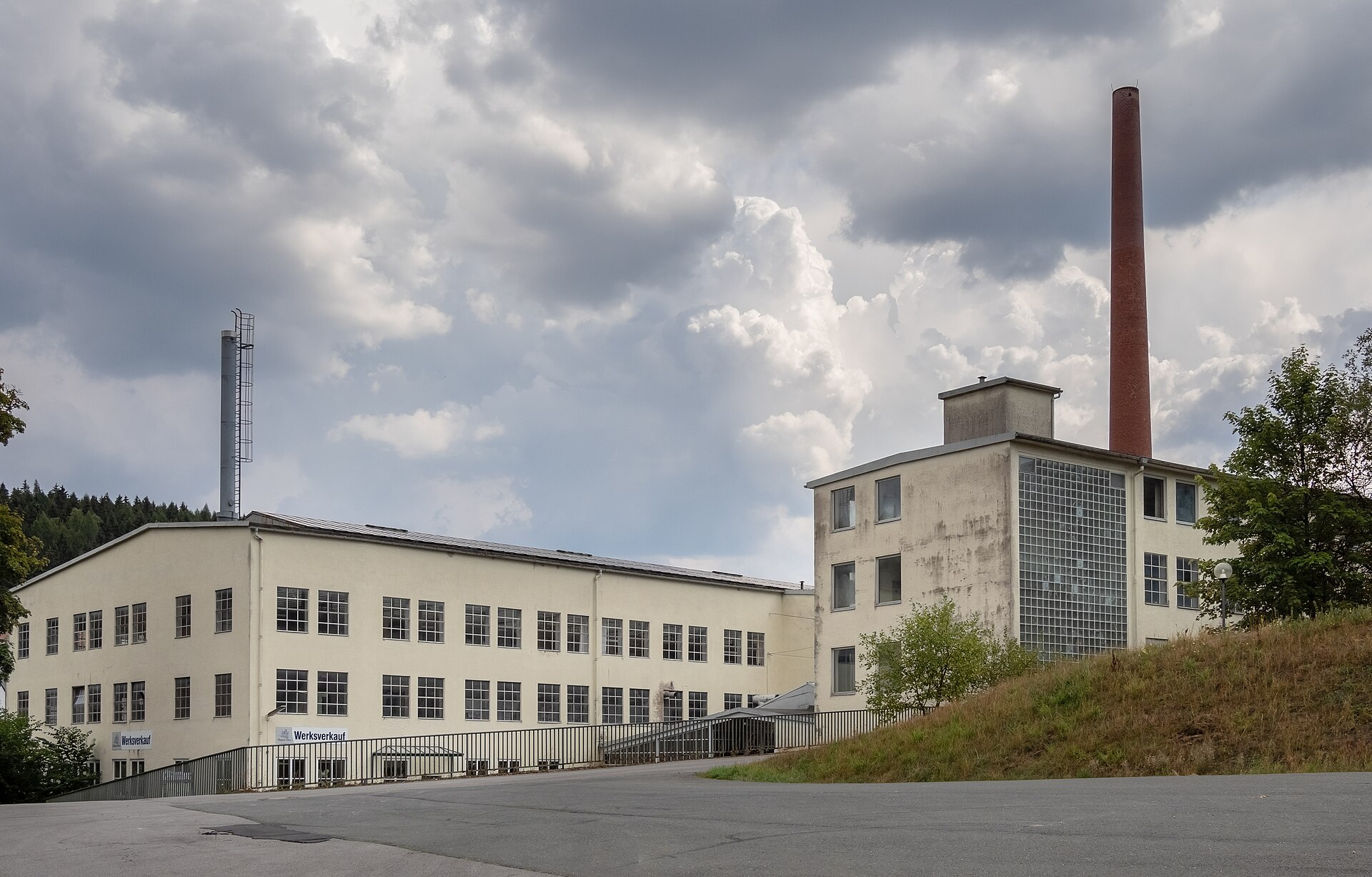
Königlich privilegierte Porzellanmanufaktur Tettau.
Original photograph: Reinhold Möller (Ermell), Wikimedia Commons, CC BY-SA 4.0.
| Period | Historical Development | Why It Matters to Collectors |
|---|---|---|
| 1794–1852 | Königlich privilegierte Porzellanmanufaktur Tettau, Schmidt & Greiner | Earliest Tettau production and early underglaze marks |
| 1852–1866 | Ferdinand Klaus takes over the company | Earlier marks and product traditions continue |
| 1866–1879 | Sontag & Birkner | Later nineteenth-century ownership phase |
| 1879–1902 | Sontag & Maisel | Includes the 1897 factory fire and reconstruction |
| 1902–1915 | Sontag & Söhne | Important early twentieth-century decorative and export period |
| 1915–1958 | Porzellanmanufaktur Tettau AG | Large-scale restaurantware, hotel porcelain, export and later post-war tableware |
| 1946–1949 | Immediate post-war U.S. Zone period | U.S. Zone wording can provide a relatively narrow dating clue |
| From 1954 | Kgl. Pr. Tettau mark family | Important post-war mark wording |
| 1957–1958 | Wilhelm Seltmann becomes major shareholder and the company enters the Seltmann Weiden group | Important for understanding later Tettau corporate history |
| After 1968 | Later Tettau mark families include “Royal” export wording | Royal Tettau becomes especially important for later export identification |
| May 2018 | Porcelain production at Tettau closes | Ends more than 220 years of manufacturing at the site |
Ownership changes and historical milestones help establish context,
but the exact backstamp, porcelain body, form and decoration must still
support the proposed date of an individual object.
The later connection with Seltmann Weiden is useful when researching
twentieth-century Tettau production. For that wider company history, see our
Seltmann Weiden porcelain guide
.
Royal Tettau vs Royal Bayreuth – What Is the Difference?
Royal Tettau and Royal Bayreuth are often treated as interchangeable search
terms, but they describe different layers within the same broader porcelain history.
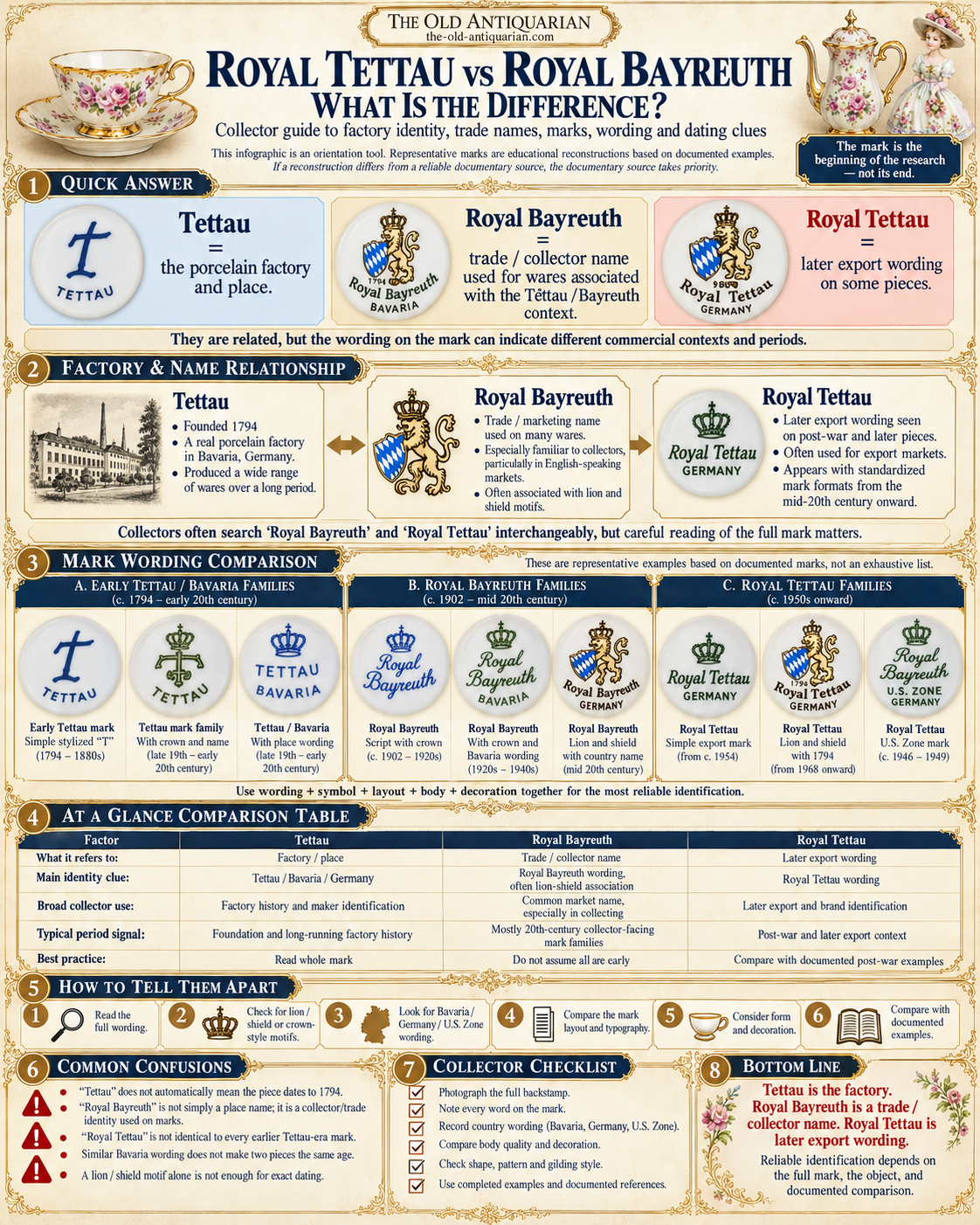
a practical collector comparison of factory identity, commercial wording,
export marks and dating clues.
| Name | What It Refers To | Collector Meaning |
|---|---|---|
| Tettau | The historic factory and production location in Bavaria | The foundation for researching factory history and marks |
| Royal Bayreuth | Commercial / collector wording strongly associated with decorative Tettau porcelain | Especially important for early twentieth-century figurals, novelty and decorative wares |
| Royal Tettau | Later wording found on documented export marks | Useful particularly for later twentieth-century production |
| Bayreuth | A separate German city | Should not be assumed to be the manufacturing location of classic Royal Bayreuth porcelain |
| 1794 | Foundation year of the Tettau manufactory | A historical reference, not automatically the date of the object |
the Royal Bayreuth Collectors Club notes that some post-war dinnerware carrying
Royal Bayreuth wording was produced at other factories.
For later tableware, therefore, the complete backstamp and manufacturing context
matter more than the Royal Bayreuth name alone.
Royal Bayreuth & Royal Tettau Marks and Backstamps
Tettau used many different marks during its long history.
Some early marks are relatively simple, while later backstamps may combine
crowns, factory wording, Bavaria or Bayern, Germany, U.S. Zone,
Kgl. Pr. Tettau, Royal wording, a lion and the blue-and-white Bavarian shield.
The safest approach is to compare the exact version of a mark
rather than searching only for a general Royal Bayreuth logo.
Small differences in wording, colour, symbols and country designations
can substantially change the likely period.
| Mark / Backstamp Family | Documented Period | Collector Use |
|---|---|---|
| Early Tettau marks | 1794–1885 | Several related marks, mostly blue underglaze |
| Gold overglaze early variant | 1866–1885 | Shows why colour must be read together with mark design |
| Late 19th-century registered mark family | 1885–1902 | Important family, including a version with Germany wording |
| Royal Bayreuth / post-1902 families | From 1902 onward | Gold, blue and green variants are documented |
| Bayern wording | 1930–1946 on a documented mark | Can help narrow a specific mark family |
| Art Department mark family | 1930–1968, excluding 1946–1949 | Requires exact comparison with the documented mark |
| U.S. Zone | 1946–1949 | One of the strongest post-war chronological clues |
| Related mark without U.S. Zone | 1950–1954 | Useful for immediate post-occupation dating |
| Kgl. Pr. Tettau | From 1954 onward | Important post-war factory mark family |
| Royal export marks | After 1968 | “Royal” is documented as export wording; Bavaria and Germany variants occur |
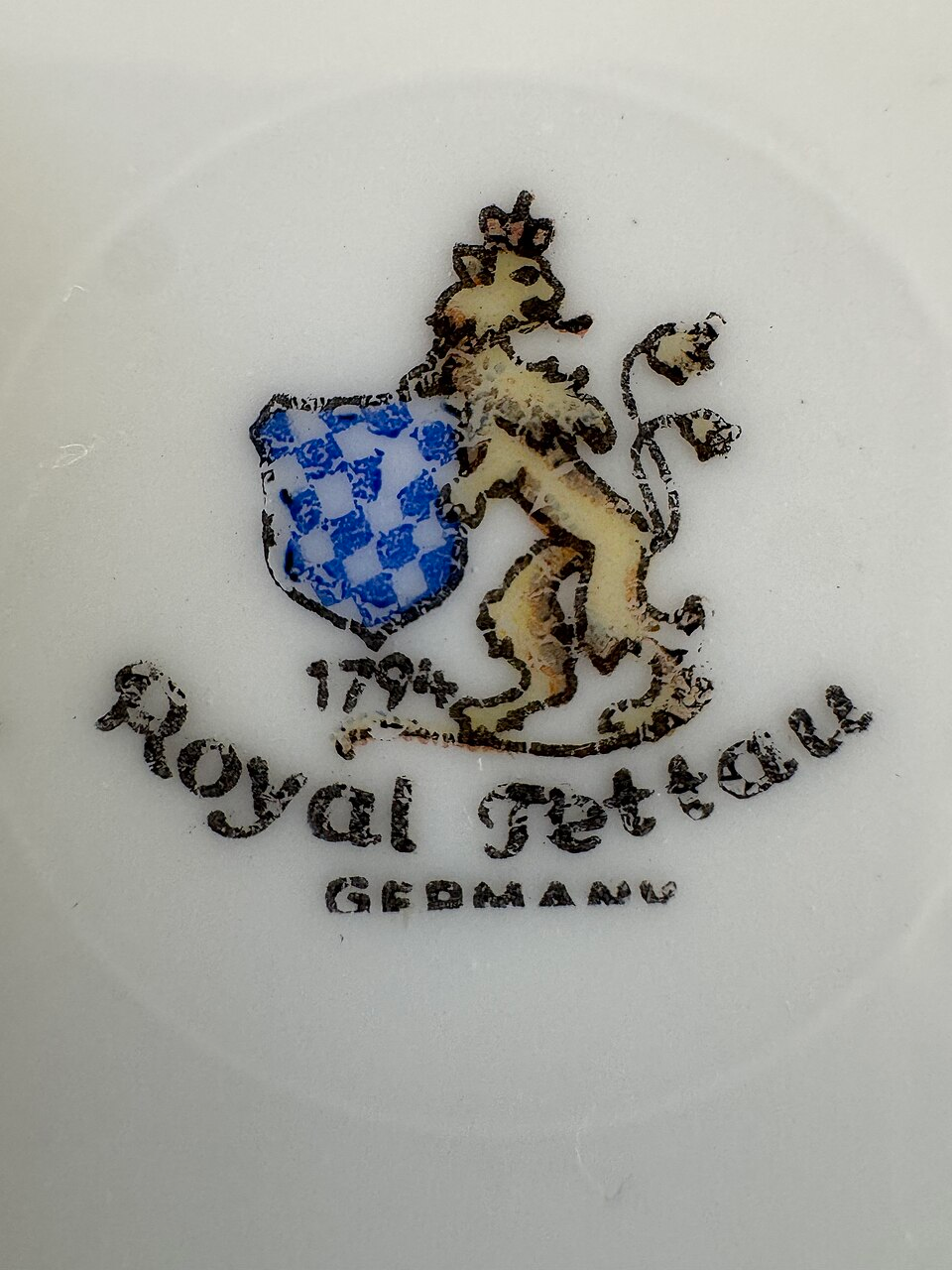
and the 1794 foundation date. The number 1794 refers to the historical
foundation of the Tettau manufactory, not the manufacturing year of this object.
Original photograph: Msnchz1, Wikimedia Commons, CC0.
A crown, lion, shield or the word Bavaria should never be isolated from
the rest of the backstamp. Record every word, symbol, number and colour.
For the wider method used to interpret factory symbols, country wording,
impressed numbers and secondary stamps, continue with our
Porcelain Marks & Backstamps Guide
.
Royal Bayreuth Green Marks vs Blue Marks
One of the most common Royal Bayreuth searches is whether a green or blue mark
can establish the date of a piece.
The answer is useful—but more complicated than a simple colour chart.
Green Royal Bayreuth Marks
Collector guidance commonly associates green marks with approximately
1885–1902. This is a useful first orientation,
especially for late nineteenth-century material.
Blue Royal Bayreuth Marks
The most familiar blue marks are commonly associated by collectors with
1902 through the late 1920s, particularly on classic
early twentieth-century Royal Bayreuth wares.
Specialist factory-mark research documents green marks after 1902
and multiple post-1902 blue, green and gold variants.
The exact symbol, wording and object must take priority over a simple
“green before blue” rule.
Does “1794” Mean My Royal Tettau Porcelain Was Made in 1794?
No. This is one of the most important points in Royal Tettau and Royal Bayreuth
identification.
The number 1794 on a Royal Tettau or Royal Bayreuth-related mark
does not automatically mean that the individual porcelain object
was manufactured in 1794.
Later marks can display 1794 prominently because the date celebrates
the historical foundation of the Tettau manufactory.
Specialist mark references also document later wording such as
gegr. 1794 — an abbreviation meaning “established 1794.”
A twentieth-century object can therefore carry the number 1794
without being an eighteenth-century antique.
The exact mark family must still be identified.
“1794” should not be copied directly into a listing as the manufacturing year.
Doing so can misdate a later Royal Tettau piece by more than a century.
How to Date Royal Tettau / Royal Bayreuth Porcelain
The most reliable method is to establish a defensible production range
from several independent features rather than assign an exact year from
one word, colour or symbol.
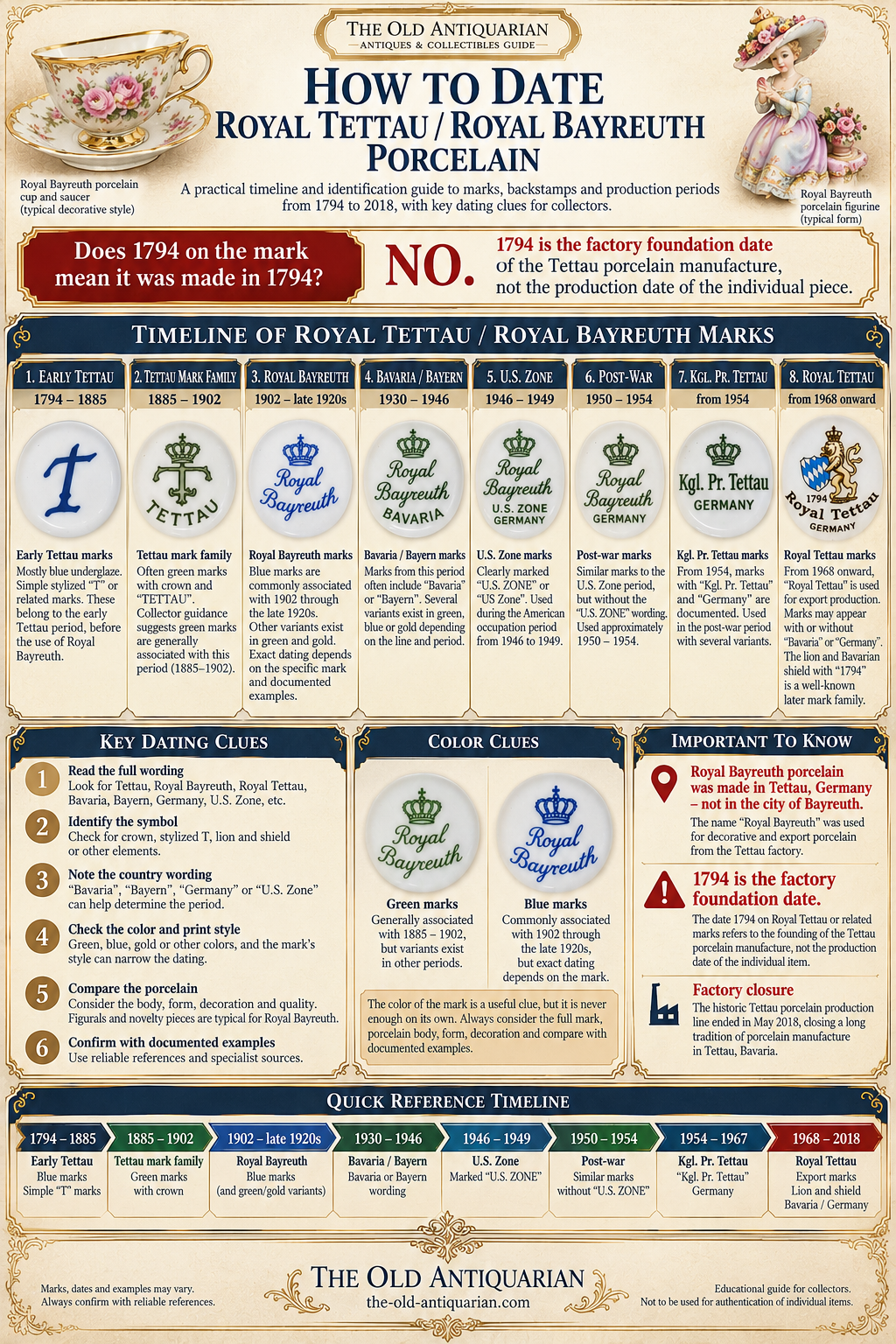
from the 1794 factory foundation through Royal Bayreuth,
U.S. Zone, Kgl. Pr. Tettau and later Royal Tettau export marks.
Include every word, number, symbol and secondary mark.
Note Tettau, Royal Bayreuth, Royal Tettau, Bavaria, Bayern, Germany, U.S. Zone and other additions.
Compare the stylized T, crown, lion, shield and other graphic details.
Check colour, fineness, translucency, glaze and the foot.
A figural creamer, novelty shoe and post-war dinner plate belong to different contexts.
Use specialist mark references and established collector literature.
exact mark + wording + symbol + country designation + porcelain body +
form + decoration + pattern + condition + documented comparison
For the broader dating system used across European porcelain,
see
How to Date Antique Porcelain
.
Royal Tettau U.S. Zone & Post-War Marks
Post-war country wording is particularly useful because several Tettau mark
families can be placed within relatively narrow ranges.
| Mark Clue | Documented Period | Collector Interpretation |
|---|---|---|
| U.S. Zone / US Zone | 1946–1949 | Immediate post-war American occupation period |
| Same related mark without U.S. Zone | 1950–1954 | Useful transitional post-war dating evidence |
| Kgl. Pr. Tettau + Germany | From 1954 | Important post-war factory mark family |
| gegr. 1794 | After 1968 on a documented later mark | Means established in 1794, not made in 1794 |
| Royal + Bavaria / Germany | After 1968 on documented export marks | Later export production rather than eighteenth-century porcelain |
Bavaria, Bayern, Germany and U.S. Zone become powerful dating clues only
when combined with the exact factory mark and the object itself.
Royal Bayreuth Figurals & Novelty Porcelain
Royal Bayreuth has a particularly strong collector identity because the factory
produced much more than conventional plates and cups.
Figural and novelty objects are among the categories most strongly associated
with serious Royal Bayreuth collecting.
According to the Royal Bayreuth Collectors Club, the majority of the figural
pieces most familiar to collectors were produced and sold from approximately
the 1890s through the 1920s.
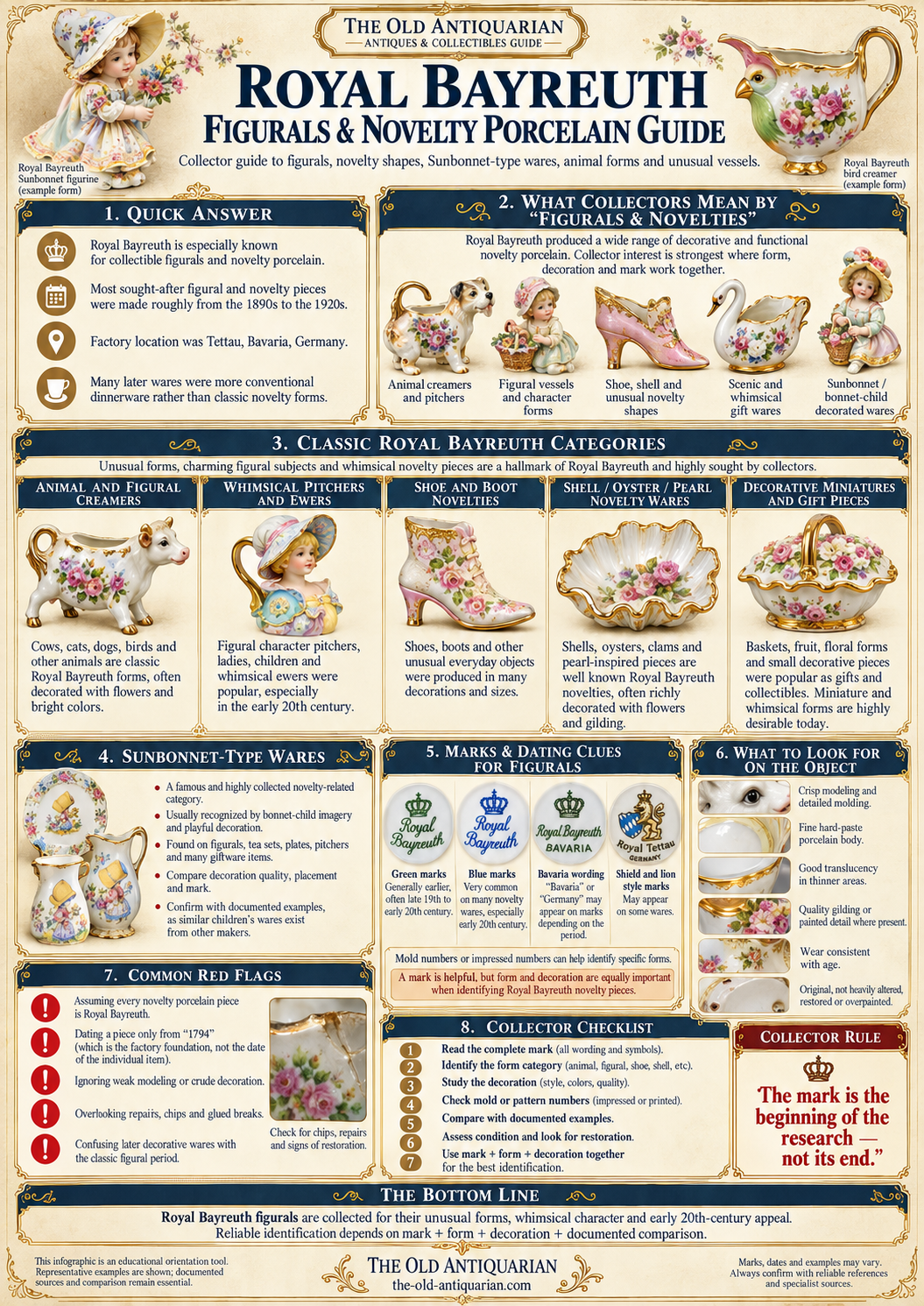
including animal forms, figural pitchers, shoes, shells,
SunBonnet-related wares and unusual novelty vessels.
Illustrated forms are orientation examples rather than documentary object photographs.
| Collector Category | Typical Examples | What to Examine |
|---|---|---|
| Animal forms | Creamers, pitchers and vessels shaped as animals or birds | Modelling quality, porcelain body, decoration and mark |
| Figural pitchers & vessels | Human, child and character-shaped forms | Facial detail, moulding, handle construction and restoration |
| Shoes & boots | Novelty footwear in different sizes and decorative treatments | Exact mould, colourway, gilding and documented variants |
| Shell / oyster / pearl forms | Marine-inspired novelty porcelain | Crisp moulding, glaze quality and damage to projecting edges |
| SunBonnet Babies | Character scenes based on the popular SunBonnet imagery | Scene, object form, mark and quality of decoration |
| Fruit, flower & vegetable forms | Whimsical pitchers, creamers and serving forms | Colourway, modelling and comparison with collector references |
| Miniatures & unusual vessels | Small baskets, salts, toothpick holders and decorative novelties | Rarity, completeness, size and exact form |
Animal, fruit, shoe and shell forms were also made by other factories.
The porcelain body, mould quality, decoration and mark must support the attribution.
Collectors interested in German figurines can compare this identification method
with our
Goebel Porcelain & Figurines Guide
.
Royal Bayreuth Patterns & Decorative Styles
Royal Bayreuth collecting is not organised around one universal pattern system.
Instead, collectors encounter named decorative families, scenic subjects,
floral decoration, blue-and-white wares, gilding,
figural forms and numerous variations of the same mould.
Important specialist collecting terms include
Rose Tapestry, scenic wares and
SunBonnet Babies, all of which are specifically documented
within Royal Bayreuth collector literature.
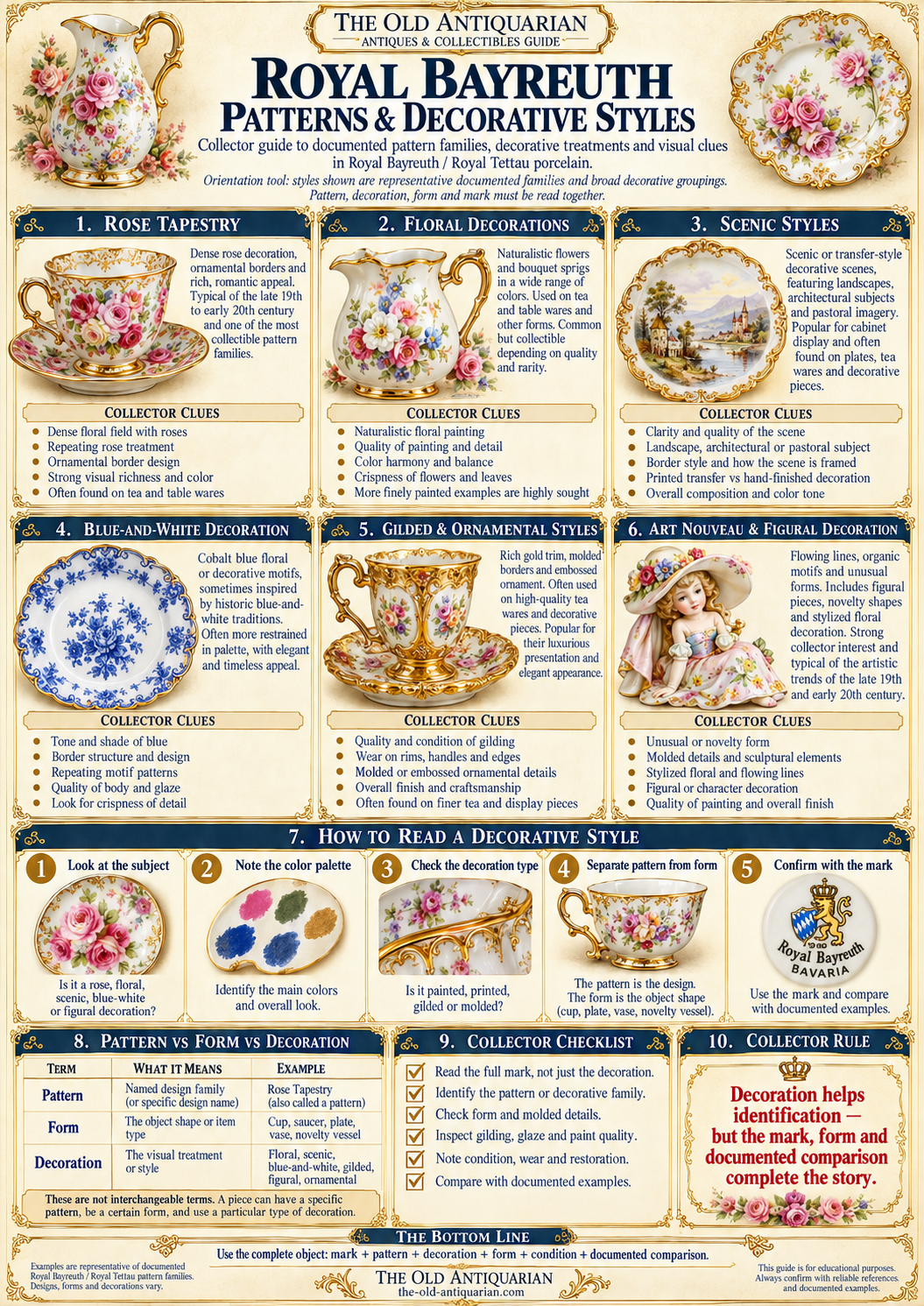
including Rose Tapestry, floral, scenic, blue-and-white,
gilded and figural or Art Nouveau-related decoration.
| Pattern / Decorative Style | Typical Characteristics | Collector Check |
|---|---|---|
| Rose Tapestry | Rose imagery with a distinctive richly textured or tapestry-like effect | Compare exact form, colourway, border and mark with documented pieces |
| Floral decoration | Naturalistic flowers, bouquets, sprigs and ornamental borders | Study placement, painting quality and colour palette |
| Scenic wares | Landscape, architectural and pictorial scenes | Examine image quality, border treatment and gilding |
| Blue-and-white | Blue floral or ornamental decoration on white porcelain | Decoration style alone does not identify the manufacturer |
| Gilded ornament | Gold borders, accents and moulded ornament | Originality and preservation of gilding matter |
| Figural / organic decoration | Sculptural forms, flowers, animals and flowing natural motifs | Compare mould, body and decoration as one object |
| Novelty decoration | Unusual colourways applied to shoes, animals, shells, fruit or other forms | Variant and colourway can affect rarity and collector interest |
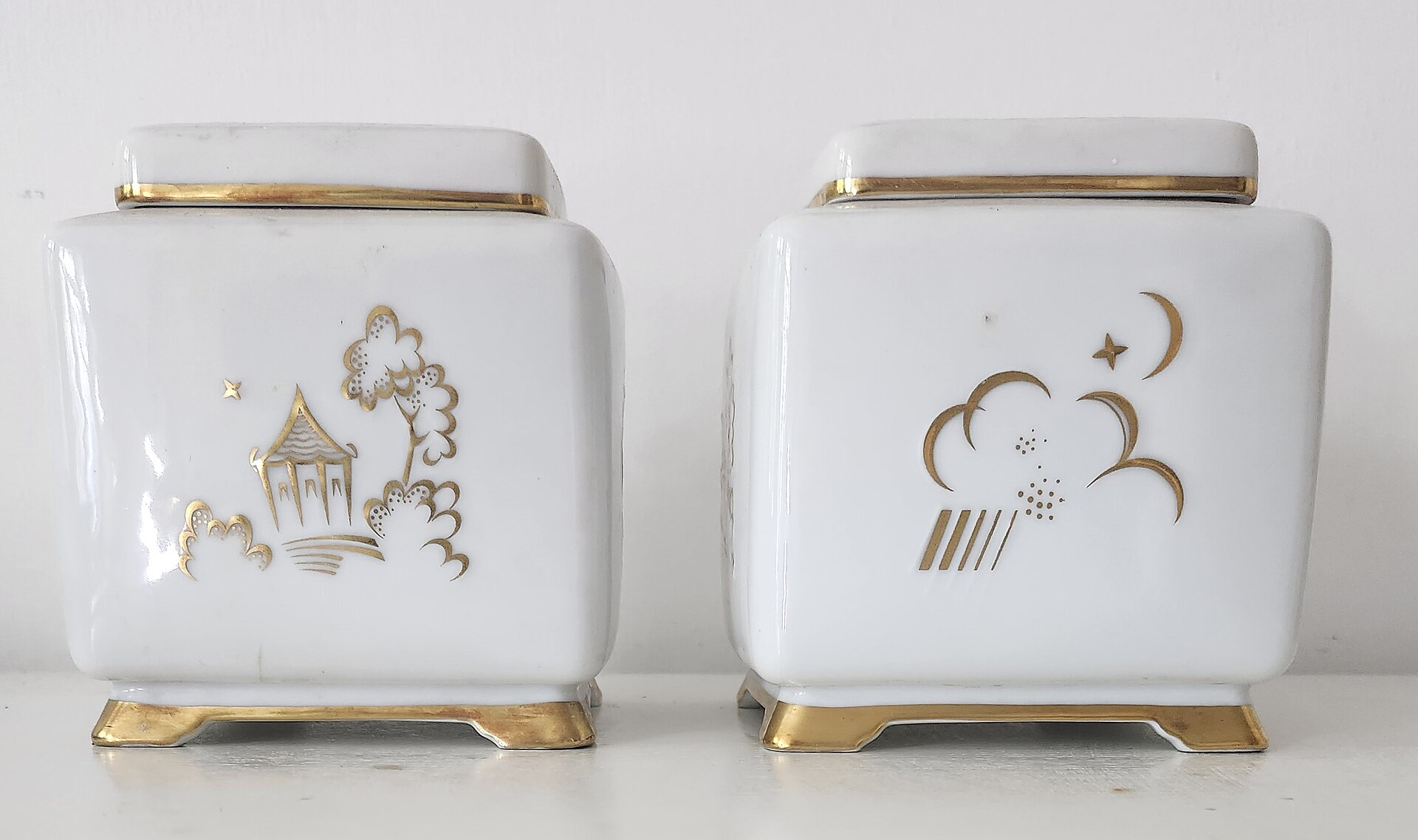
illustrating later decorative production associated with the Tettau factory.
Original photograph: Fraxinus2, Wikimedia Commons, CC BY-SA 4.0.
The pattern describes a repeatable decorative family;
the form is the physical shape of the object;
the decoration describes the surface treatment.
Reliable identification uses all three with the mark.
How to Identify Genuine Royal Bayreuth / Royal Tettau Porcelain
A backstamp should never be considered in isolation.
The most convincing attribution is one in which several independent
characteristics all point toward the same factory and period.
| Identification Clue | What to Examine | Why It Matters |
|---|---|---|
| Complete backstamp | Royal Bayreuth, Royal Tettau, Tettau, Bavaria, Germany, U.S. Zone, symbols and colour | Places the object within a possible historical mark family |
| Porcelain body | Colour, refinement, weight, translucency, glaze and foot | Should be compatible with the proposed factory and form |
| Form | Handle, spout, rim, foot, sculptural modelling and proportions | Especially important with novelty and figural porcelain |
| Decoration | Hand painting, transfer work, gilding, colour and surface texture | Quality should agree with documented examples |
| Pattern / subject | Rose Tapestry, scenic, floral, SunBonnet or other collector categories | Can link the piece to specialist reference literature |
| Mould / secondary numbers | Impressed, stamped or painted letters and numbers | May relate to form, retailer inventory or production control |
| Production period | Does the object make sense for the date suggested by the mark? | Prevents later wares from being described as early Royal Bayreuth |
| Condition | Chips, cracks, restoration, repainting and regilding | Important for authenticity research and market value |
For the wider method of combining material, form, mark, decoration and
manufacturing evidence, see our
Complete Antique Porcelain Guide
.
Royal Bayreuth Copies, Fake Marks & Misattribution
Royal Bayreuth can be difficult to authenticate because popular novelty
forms have been copied and because many visually similar German porcelain
objects are incorrectly attributed to Royal Bayreuth.
The Royal Bayreuth Collectors Club also warns collectors that modern
knock-offs exist and that many pieces offered as Royal Bayreuth are not
correctly attributed.
A stamp can be copied more easily than the porcelain body,
moulding quality and historic decoration.
If the object contradicts the mark, investigate further.
| Check | More Reassuring Evidence | Possible Red Flag |
|---|---|---|
| Porcelain body | Fine, relatively light and appropriately translucent porcelain | Coarse, unusually heavy ceramic body |
| Moulding | Crisp details and carefully resolved forms | Soft, crude or poorly finished modelling |
| Decoration | Controlled painting, transfer and gilding appropriate to the form | Blurry, crude or mechanically inconsistent decoration |
| Mark | Complete mark agrees with documented typography and layout | Correct-looking logo on an object that otherwise makes little historical sense |
| Chronology | Mark, form and decoration fit the same period | Later export wording on a piece advertised as c.1900 |
| Condition | Wear and restoration are understandable for the object’s history | Artificial wear or undisclosed repainting |
Collector research reports that some genuine Royal Bayreuth pieces can be unmarked.
An unmarked object needs stronger evidence from body, mould, decoration,
form and documented comparison.
Condition, Damage & Restoration
Condition can be especially important with Royal Bayreuth novelty porcelain.
Projecting ears, tails, feet, spouts, handles, shell edges and figural details
are vulnerable to damage and old repair.
| Condition Issue | Where to Look | Collector Significance |
|---|---|---|
| Small chips | Rims, ears, tails, feet, petals and projecting details | Can materially reduce desirability on common pieces |
| Hairline cracks | Handles, necks, feet and structural joins | May be difficult to detect but important for value |
| Restoration | Heads, handles, limbs, spouts, lids and old breaks | Extent and quality should always be disclosed |
| Regilding | Rims, handles and ornamental borders | Can alter originality and collector comparison |
| Overpainting | Faces, flowers, scenic details and repaired areas | May conceal original wear or restoration |
| Missing parts | Lids, stoppers, paired objects and applied decoration | Completeness can substantially affect value |
Before cleaning, gluing or retouching an inherited piece, read
What Not to Do to an Antique Before Valuation or Sale
.
Royal Bayreuth Value: What Is It Worth?
There is no meaningful universal price list for Royal Bayreuth or Royal Tettau.
An ordinary later dinner plate, a Rose Tapestry vessel, an animal creamer
and a scarce figural novelty belong to very different collector markets.
Value should therefore be assessed only after the object has been correctly
identified by maker, period, form and decorative category.
Compare genuinely similar completed sales:
same maker + form + subject + size + mark period + decoration +
condition + restoration + completeness.
| Value Factor | How It Affects Collector Interest |
|---|---|
| Exact attribution | A correctly identified Royal Bayreuth piece is more meaningful than a generic “Bavaria” attribution |
| Mark / period | Earlier and historically important mark families can attract specialist interest |
| Form | Unusual figurals and novelty moulds can be more desirable than ordinary tableware |
| Rarity | Scarce subjects, sizes and colourways may attract stronger competition |
| Decorative category | Established collecting areas such as Rose Tapestry, scenic or SunBonnet-related wares can have focused demand |
| Decoration quality | Painting, transfer quality, gilding and colour can distinguish stronger examples |
| Condition | Chips, hairlines, missing parts and restoration influence comparability |
| Completeness | Original lids, stoppers, paired pieces and complete sets matter |
| Provenance | Old labels, receipts, auction tags and collection history can strengthen context |
| Comparable sales | Recent completed transactions are more useful than unsold asking prices |
A common Royal Tettau dinner plate should not be valued against a scarce
Royal Bayreuth figural pitcher simply because both names are connected
with Tettau porcelain.
When the form, mark or rarity is uncertain, use our
Professional Antique Valuation
service before relying on online asking prices.
Royal Tettau / Royal Bayreuth Collector Checklist
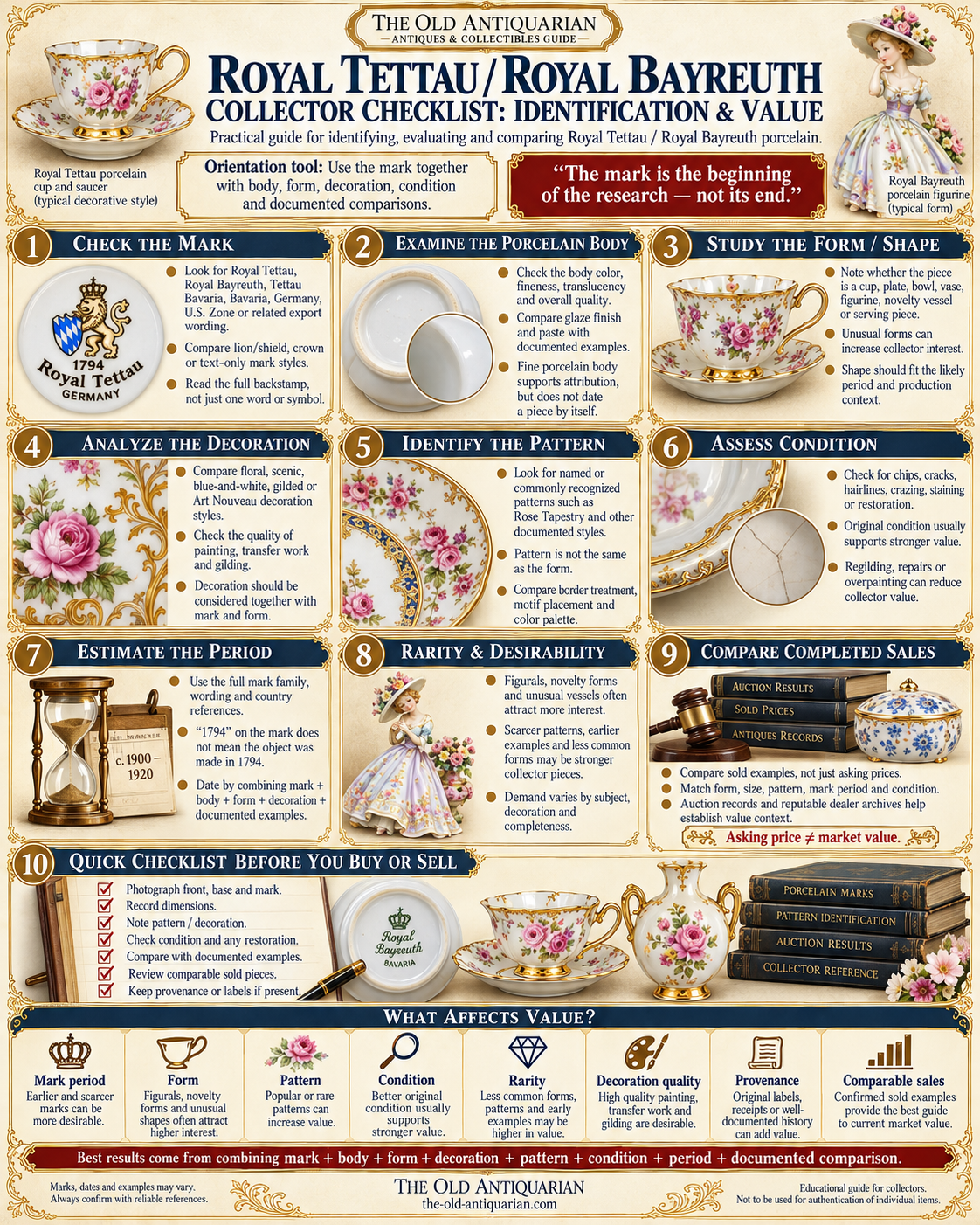
mark, porcelain body, form, decoration, pattern, condition,
period, rarity and comparable completed sales.
Include front, reverse, sides and complete profile.
Do not crop the foot, backstamp, numbers or secondary marks.
Record Royal Bayreuth, Royal Tettau, Tettau, Bavaria, Bayern, Germany and U.S. Zone exactly.
Determine whether it is tableware, a figural, animal, shoe, shell, novelty vessel or another category.
Record floral, scenic, tapestry, blue-and-white, gilded or figural decoration.
Look at weight, refinement, translucency, glaze and foot construction.
Look for chips, cracks, restored projections, repainting and regilding.
Combine the exact mark with form, decoration and factory chronology.
Compare completed sales only after maker, form and period are reasonably secure.
Do You Own Royal Tettau or Royal Bayreuth Porcelain?
Send clear photographs of the complete object, base, mark, molded details,
decoration, dimensions and any damage or restoration.
The Old Antiquarian can help with identification,
period research and market orientation.
Request a Professional Antique Valuation
Sell Porcelain & Ceramics
Frequently Asked Questions About Royal Tettau & Royal Bayreuth
Is Royal Tettau the same as Royal Bayreuth?
They belong to the same wider Tettau porcelain history, but the wording
was not used in exactly the same way in every period.
Royal Bayreuth is strongly associated with decorative and collector wares,
while Royal Tettau appears on later export marks.
Was Royal Bayreuth porcelain made in the city of Bayreuth?
Classic Royal Bayreuth collector porcelain was associated with the
Tettau factory in Bavaria, not with porcelain production in the city of Bayreuth.
What does 1794 mean on a Royal Tettau mark?
1794 is the foundation year of the Tettau porcelain manufactory.
It does not automatically mean that the individual object was manufactured in 1794.
When was the Tettau porcelain factory founded?
Johann Friedrich Paul Schmidt and the Greiner brothers received permission
to establish the porcelain factory on December 28, 1794.
How old is a green Royal Bayreuth mark?
Collector guidance commonly associates green marks with approximately 1885–1902,
but specialist factory-mark research also documents green variants after 1902.
The exact mark therefore matters more than colour alone.
How old is a blue Royal Bayreuth mark?
The best-known blue Royal Bayreuth marks are commonly associated by collectors
with 1902 through the late 1920s, but exact dating requires comparison
with the complete mark and object.
What does U.S. Zone mean on Tettau porcelain?
Documented Tettau U.S. Zone backstamps were used from 1946 to 1949
during the immediate post-war occupation period.
What does Kgl. Pr. Tettau mean?
Kgl. Pr. Tettau is a documented post-war factory mark family
used from 1954 onward. Versions can include additional Germany
or export wording.
When was Royal Tettau wording used?
Specialist mark research documents post-1968 marks in which
“Royal” identifies export production, with Bavaria,
Germany and other variations also encountered.
How old are Royal Bayreuth figurals?
The Royal Bayreuth Collectors Club reports that the majority of the
figural pieces familiar to collectors were produced and sold from
approximately the 1890s through the 1920s.
What Royal Bayreuth pieces are collectible?
Important collecting areas include figurals, animal forms,
novelty pitchers, shoes, shells, Rose Tapestry, scenic wares,
SunBonnet Babies and unusual decorative vessels.
Can Royal Bayreuth marks be fake?
Yes. Collector sources report modern knock-offs and incorrect attributions.
The mark should therefore be checked against the porcelain body,
form, mould quality, decoration and documented examples.
Is Royal Bayreuth porcelain valuable?
Some examples have strong collector interest, particularly scarce figurals,
novelty forms and desirable decorative variants.
Value depends on exact attribution, form, period, rarity, condition,
restoration, completeness, provenance and current completed-sale evidence.
Related Guides
Sources & Further Research
| Source | Used For |
|---|---|
| Porcelain Marks & More – Tettau | 1794 foundation, ownership chronology, early marks, 1885–1902 marks, post-1902 variants, Bayern, U.S. Zone, Kgl. Pr. Tettau, later Royal export marks, Seltmann ownership and May 2018 closure. |
| Royal Bayreuth Collectors Club – FAQ | Meaning of 1794, green and blue mark guidance, Tettau versus Bayreuth, figural dating, modern knock-offs, post-war dinnerware and collector identification. |
| Royal Bayreuth Collectors Club – History & References | Factory background, Royal Bayreuth collecting categories, figurals, Rose Tapestry, scenic wares, SunBonnet Babies and specialist reference books. |
| Joan & Marvin Raines, A Guide to Royal Bayreuth Figurals (1973) and Book II (1977) | Specialist Royal Bayreuth figural reference literature listed by the Royal Bayreuth Collectors Club. |
| Mary J. McCaslin, Royal Bayreuth: A Collector’s Guide (1994) and Book II (2000) | Major collector reference works listed by the Royal Bayreuth Collectors Club. |
| Douglas Congdon-Martin & Robert Bernstein, Popular Royal Bayreuth for Collectors (2005) | Additional collector reference for Royal Bayreuth forms and collecting categories. |
| Wikimedia Commons – Tettau Porzellanfabrik | Factory photograph by Reinhold Möller / Ermell. CC BY-SA 4.0. |
| Wikimedia Commons – Royal Tettau Germany Mark | Real Royal Tettau backstamp photograph by Msnchz1. CC0. |
| Wikimedia Commons – Tettau Porcelain | Decorative Tettau porcelain photograph by Fraxinus2. CC BY-SA 4.0. |
the Royal Bayreuth Collectors Club provides a useful shorthand of
green marks around 1885–1902 and common blue marks from 1902 into the late 1920s.
Porcelain Marks & More documents additional overlapping post-1902 green,
blue and gold variants. For precise identification, the exact documented
mark takes priority over colour alone.
the infographics in this article are educational orientation tools.
If a reconstructed mark, figural form or decorative example conflicts
with a documented historical backstamp, specialist reference or securely
identified object, the documentary source takes priority.
About The Old Antiquarian
The Old Antiquarian combines more than 35 years of practical experience
with antiques and collecting with historical, museum and comparative research.
When researching porcelain we examine the manufacturer, complete mark,
porcelain body, form, moulding, decoration, pattern, production period,
condition, restoration, provenance and documented comparisons as connected evidence.
Conclusion
Royal Bayreuth and Royal Tettau are best understood through the long history
of porcelain production at Tettau, Bavaria.
The factory was established in 1794 and continued through numerous owners,
mark families and commercial periods until production ended in 2018.
Royal Bayreuth became especially important to collectors because of the
factory’s imaginative decorative and novelty porcelain:
figurals, animal forms, shoes, shells, scenic wares,
Rose Tapestry and SunBonnet-related pieces.
Later Royal Tettau marks belong to another important chapter
in the same wider factory tradition.
The most reliable identification follows the complete evidence chain:
mark → wording → symbol → porcelain body → form → decoration →
pattern → production period → condition → documented comparison.
The number 1794, a crown, a blue or green mark, or the word Bavaria
can all provide useful clues—but none should be used alone.
Only after the object has been correctly identified and dated should rarity
and comparable completed sales be used to estimate its current market value.
