
Goebel Porcelain: Marks, Figurines, Dating & Value Guide
German Porcelain & Figurine Identification Guide
Last Updated: September 29, 2026 | The Old Antiquarian
Goebel is a historic German manufacturer founded in 1871 by Franz Detleff and William Goebel. Its first porcelain factory opened in 1878 at Oeslau-Rödental, and around 1905 the crown over the intertwined WG monogram became an important factory identity. Collectors encounter Goebel birds, animals, character figurines, artist-designed figures, tableware, vases, boxes and decorative wares as well as the historically famous M.I. Hummel line. However, Goebel and Hummel are not synonymous. A Goebel mark identifies the manufacturer or factory tradition; it does not automatically make an object a Hummel. Reliable Goebel identification combines the exact mark, material, model or mould number, form, decoration, country wording, condition and documented period.
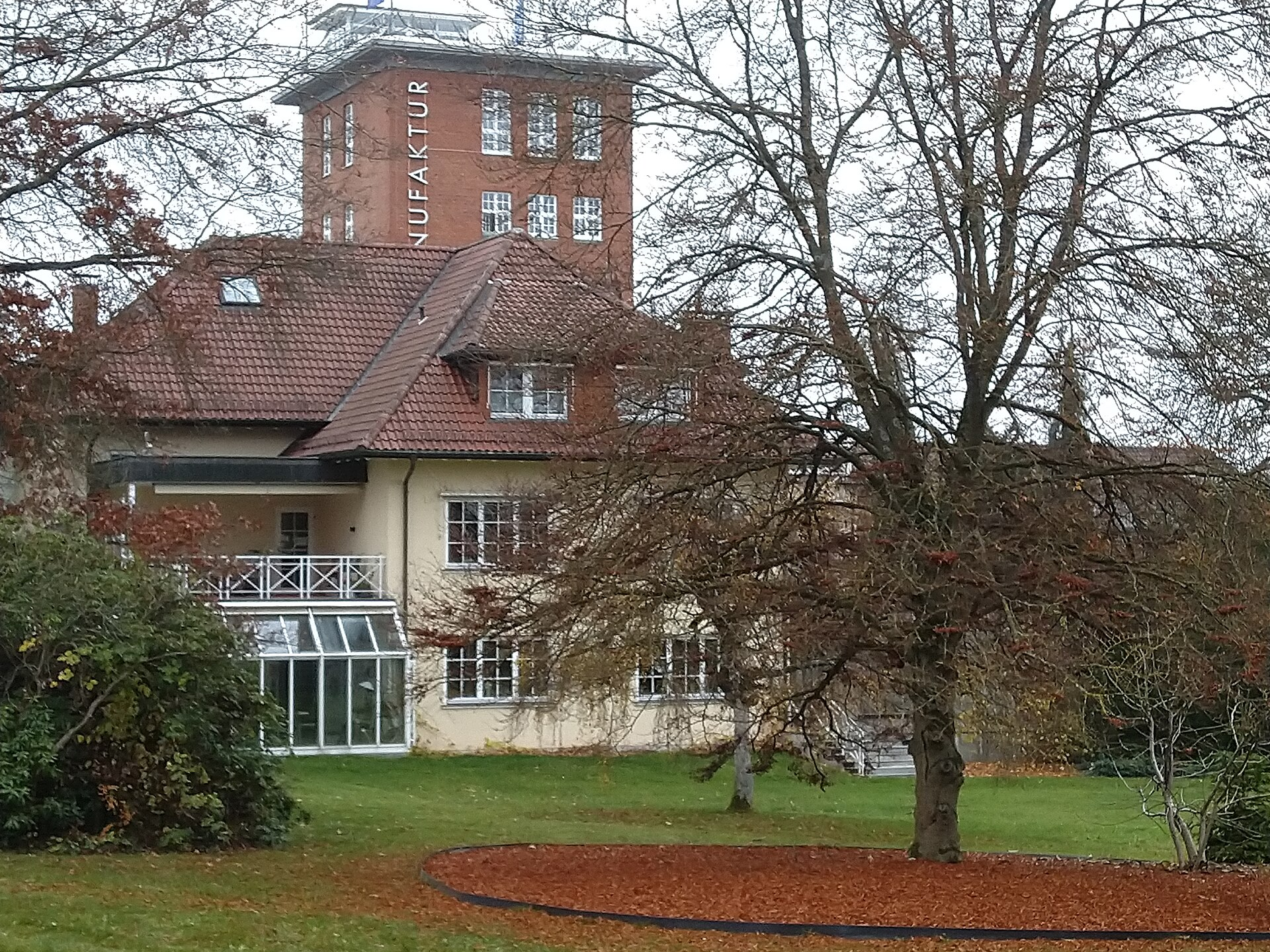
Goebel Porcelain at a Glance
| Feature | Collector Reference |
|---|---|
| Company founded | January 30, 1871. |
| Founders | Franz Detleff Goebel and William Goebel. |
| First porcelain factory | Established in 1878 and later known as Wilhelmsfeld. |
| Historic location | Oeslau-Rödental near Coburg, Bavaria, Germany. |
| Important early trademark | Crown above the intertwined WG monogram, documented by Goebel around 1905. |
| Collectible categories | Birds, animals, character figures, artist-designed series, religious subjects, tableware, vases, boxes and decorative objects. |
| Materials | Goebel production includes porcelain as well as other ceramic bodies. Material must be identified object by object. |
| Important mark clues | Crown WG, U.S. Zone wording, Bee/V families, W. Germany, Germany and later product-line marks. |
| Main identification risk | Assuming every Goebel-marked object is an M.I. Hummel figurine. |
| Main value factors | Product line, exact model, period, material, artist or designer, rarity, size, condition, completeness, provenance and completed comparable sales. |
The mark is the beginning of the research — not its end.
Goebel mark ≠ Hummel identification, exact date or market value.
Goebel and Hummel: Two Different Search Intents
This Goebel Guide Covers
Goebel company history, general factory marks, Crown WG, U.S. Zone, Bee/V marks on non-Hummel production, W. Germany and Germany wording, Goebel birds and animals, Charlot Byj, Friar Tuck, Co-Boy, tableware, decorative porcelain, dating, condition and non-Hummel value.
Our Hummel Guide Covers
M.I. Hummel signatures, HUM model numbers, Hummel-specific trademark periods, individual Hummel model identification, Hummel dating and Hummel figurine value.
Goebel belongs within the much wider story of
German porcelain,
but unlike an eighteenth-century royal manufactory such as Meissen or Nymphenburg, its collector market is especially broad because it spans historic porcelain, commercial figurines, artist collaborations, decorative ceramics and modern production.
In This Guide
- What is Goebel porcelain?
- History of Goebel
- Is every Goebel piece porcelain?
- Goebel marks & backstamps
- Crown WG mark
- U.S. Zone Germany marks
- Bee / V marks
- W. Germany marks
- Germany & later marks
- How to date Goebel
- How to identify genuine Goebel
- Goebel figurines
- Goebel birds & animals
- Charlot Byj
- Friar Tuck
- Co-Boy
- Tableware & decorative porcelain
- Goebel vs Hummel
- Vintage vs later Goebel
- Condition & restoration
- Goebel value
- Collector checklist
- FAQ
- Sources
What Is Goebel Porcelain?
“Goebel porcelain” is the common collector term for porcelain and decorative ceramic objects associated with the historic German company Goebel.
The wording is useful for searching, but it should not be interpreted to mean that every Goebel object has the same ceramic body. Over its long history the company has produced porcelain and other ceramic materials across many different product lines.
That distinction matters particularly with figurines. Before identifying an object solely from its appearance or factory mark, determine what material is actually present.
A Goebel mark may appear on a bird, animal, character figure, vase, plate, box, cup, artist-designed object or another decorative ceramic product.
History of Goebel: From 1871 to a Global Collecting Brand
The Goebel story began on January 30, 1871, when Franz Detleff Goebel and his son William established F. & W. Goebel.
The first porcelain factory was built in 1878. It later became known as Wilhelmsfeld and established the company’s long association with Oeslau-Rödental near Coburg.
In 1893 the company passed to William Goebel. Around 1905, the crown positioned above the intertwined letters WG became an important trademark associated with the business.
During the following decades, Goebel developed a wide range of ceramic and decorative production and worked with sculptors, illustrators and artists to translate two-dimensional designs into three-dimensional objects.
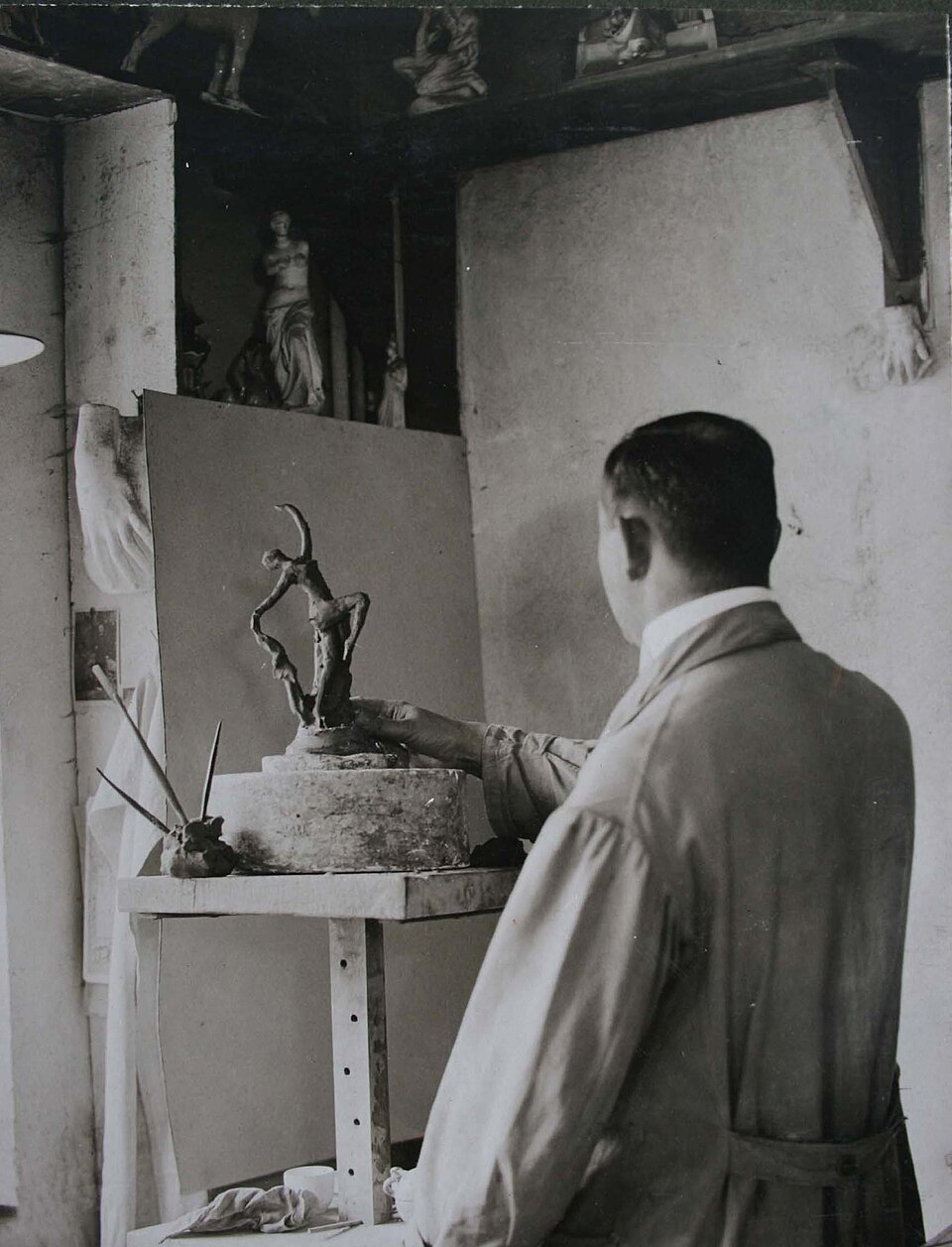
This workshop photograph is important because it illustrates something that marks alone cannot show: collectible Goebel figures began with a sculptural model. For attribution and value, the modeller, model number and original design can therefore matter just as much as the factory backstamp.
Goebel Before the Famous Licensed Figurine Lines
Collectors sometimes encounter a misleading assumption that Goebel’s history began with its best-known twentieth-century licensed figures. It did not.
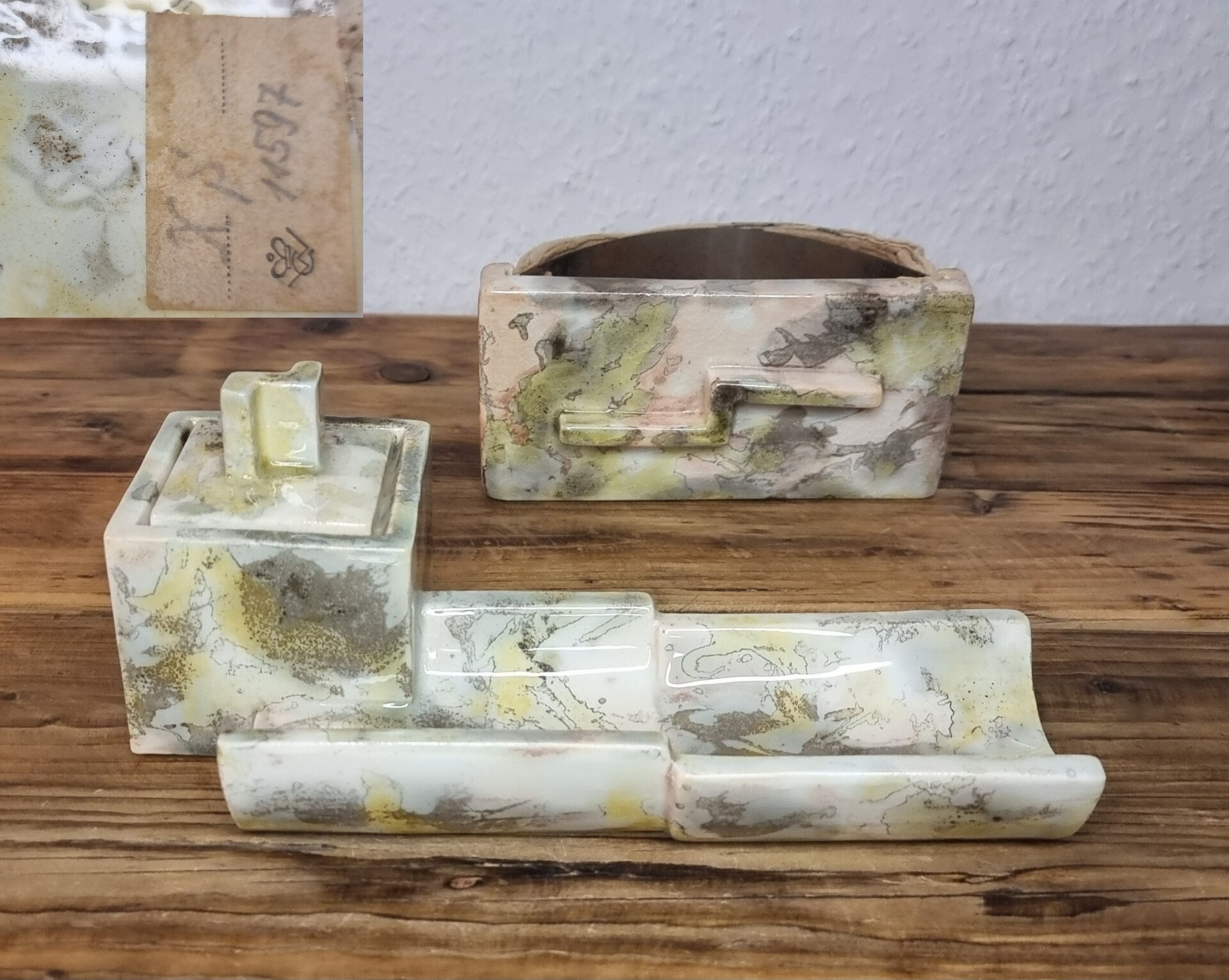
The company had already produced porcelain, ceramic objects and figurative work for decades. Earlier Goebel pieces can include dolls and doll-related porcelain, decorative ware, desk objects, tableware and figures.
Is Every Goebel Figurine Made of Porcelain?
No. This is one of the most useful distinctions a collector can make.
Goebel worked with multiple ceramic bodies, and the material can vary by series and production period. Some objects are porcelain, while others may be earthenware or another ceramic body.
Even modern official Goebel ranges include both porcelain and Steingut products, which reinforces the need to identify material rather than treating “Goebel porcelain” as a universal technical description.
| Material Question | What to Examine |
|---|---|
| Body colour | Look at an unglazed area or exposed foot where possible. |
| Density | Porcelain is generally dense and highly fired; other ceramic bodies can feel different. |
| Translucency | Useful on some porcelain bodies, but not a universal test. |
| Glaze | Assess gloss, thickness, consistency and relationship with the underlying body. |
| Factory documentation | The strongest evidence where the exact model or series is known. |
Do not describe a Goebel object as porcelain simply because it carries a Goebel mark.
Goebel Porcelain Marks & Backstamps
Goebel used numerous marks during its long history. Some were printed, some impressed or incised, and some appeared together with model numbers, artist references, country wording or additional stamps.
The safest method is to photograph the entire underside, not only the central logo.
For the general methodology of reading maker’s marks, use our
Porcelain Marks & Backstamps Guide.
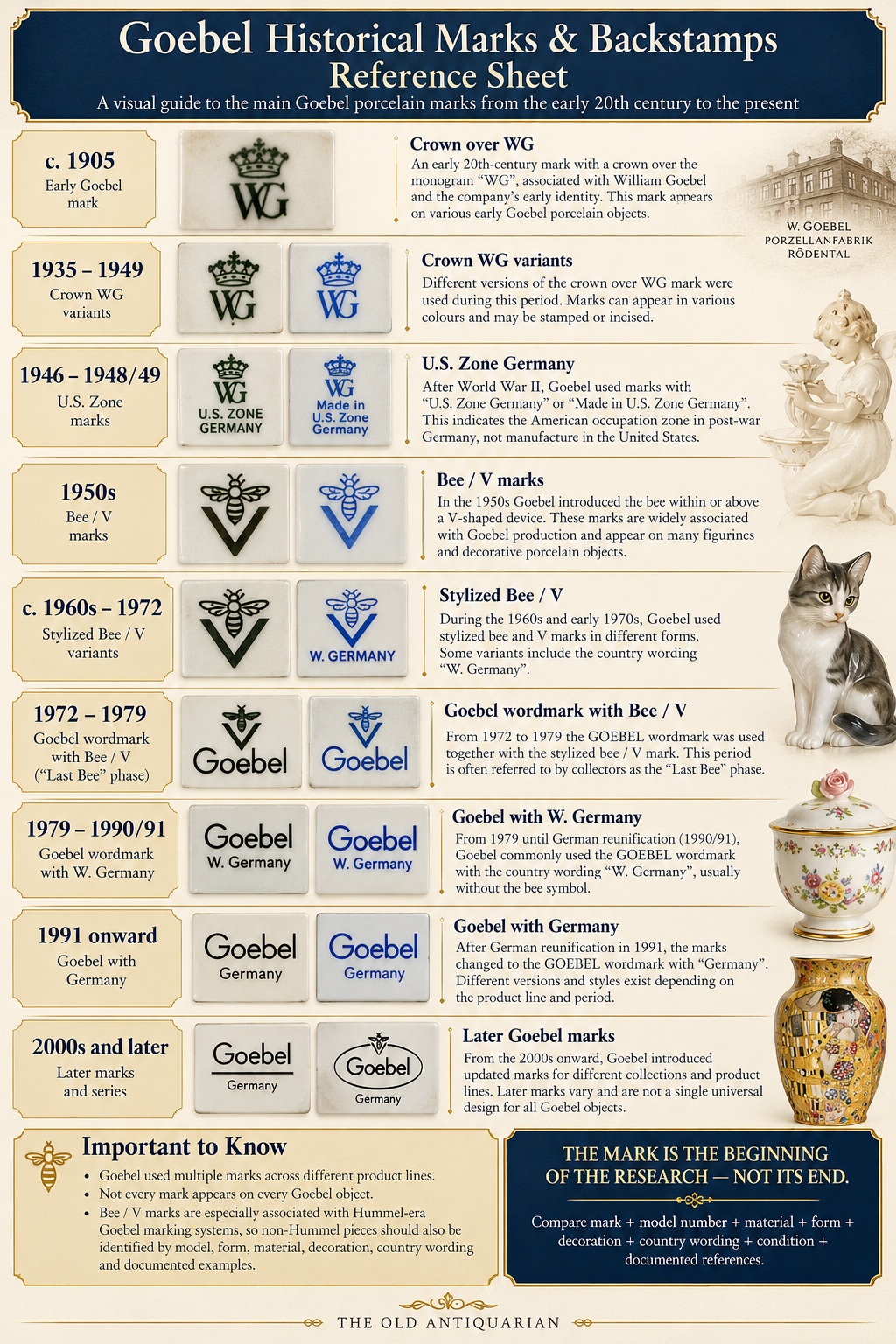
Goebel mark timelines are more complicated than a single linear chart suggests. Different product lines can overlap, and historical collector systems often use dates developed for M.I. Hummel objects. When dating a non-Hummel Goebel piece, use the exact backstamp together with the model, material, country wording and documented Goebel examples.
| Mark Family | Broad Context | Collector Interpretation |
|---|---|---|
| Early pre-Crown marks | Late 19th / early 20th century | Require specialist comparison. Do not assume every early Goebel object carries Crown WG. |
| Crown over WG | Introduced around 1905; important throughout early 20th-century Goebel history | WG relates to William Goebel. Exact period should be confirmed from object and mark variant. |
| U.S. Zone Germany | Post-Second World War occupation period | Strong chronological clue for post-war export production. |
| Bee / V families | Especially associated with mid-20th-century Goebel production | Can appear on non-Hummel Goebel objects. Bee/V alone does not identify Hummel. |
| W. Germany / West Germany | Post-war West German period before reunification | Useful broad chronological evidence, but not an exact year. |
| Goebel / W. Germany | Later 20th-century mark families | Common on many figurines and decorative objects. |
| Goebel / Germany | Post-reunification production | Consistent with production after West Germany ceased to be the country designation. |
| Later series-specific marks | Modern Goebel production | Research the individual product line rather than relying on one universal chart. |
The Goebel Crown WG Mark
One of the best-known early Goebel marks shows a crown above the intertwined letters WG.
Official Goebel history places this trademark identity at around 1905 and connects it with the transfer of the company to William Goebel in 1893.
Collectors should therefore avoid two opposite mistakes:
Mistake 2: assuming the Crown WG was the company’s universal mark from its foundation in 1871.
A Crown WG backstamp can support early twentieth-century Goebel attribution, but the individual mark variant, object type, model number and country wording should still be checked.
What Does “U.S. Zone Germany” Mean on Goebel?
After the Second World War, goods produced in the American occupation zone of Germany could carry wording such as U.S. Zone Germany or Made in U.S. Zone Germany.
Goebel collector documentation places these additional export markings principally in the late 1940s.
U.S. Zone wording is far more useful than a generic “old-looking” style because it connects the object with a specific post-war political and export context.
Even here, the country wording should be read together with the main factory mark and model information.
What Does the Goebel Bee / V Mark Mean?
The bee within or around a V-shaped device became one of the most recognisable Goebel-era marks of the mid-twentieth century.
It is also one of the most misunderstood.
Goebel used shared factory marks on multiple product lines before the trademark systems diverged.
A non-Hummel Goebel bird, animal or character figure can therefore carry a mark visually familiar to collectors of Hummel figurines.
If your object actually belongs to the M.I. Hummel line, identification should then move to the specialised evidence: M.I. Hummel signature, HUM model number and documented Hummel model.
Those subjects are intentionally covered in our
M.I. Hummel Figurines: Marks, Identification, Dating & Value Guide
rather than repeated here.
Goebel W. Germany & West Germany Marks
Country wording can be a valuable dating clue.
Goebel objects produced during the West German period may include forms such as W. Germany, West Germany or related wording depending on the product and mark.
This wording should normally be interpreted as a broad chronological bracket rather than a precise production year.
| Wording | Broad Interpretation | Do Not Assume |
|---|---|---|
| Germany | Can occur in different historical contexts and must be interpreted with the full mark. | That every “Germany” mark is post-1990. |
| U.S. Zone Germany | Post-war occupation/export context. | That the wording identifies a specific Goebel product line. |
| W. Germany / West Germany | West German production context before reunification. | An exact manufacturing year. |
| Goebel Germany | Commonly consistent with later, post-reunification production when seen in modern Goebel mark forms. | That every object with “Germany” belongs to the same decade. |
Goebel Germany Marks After Reunification
German reunification changed the political wording seen on many exported goods. On later Goebel products, collectors commonly encounter the company name together with Germany rather than W. Germany.
This period also requires an important separation between general Goebel production and M.I. Hummel production.
The Hummel line developed its own trademark system, while other Goebel products could carry different marks.
Modern Goebel production includes multiple artistic and decorative collections, so late marks are often best researched by product line + model/reference number + mark.
How to Date Goebel Porcelain & Figurines
The best Goebel date is usually an approximate production range supported by several independent clues.
Start with the backstamp, but do not stop there.
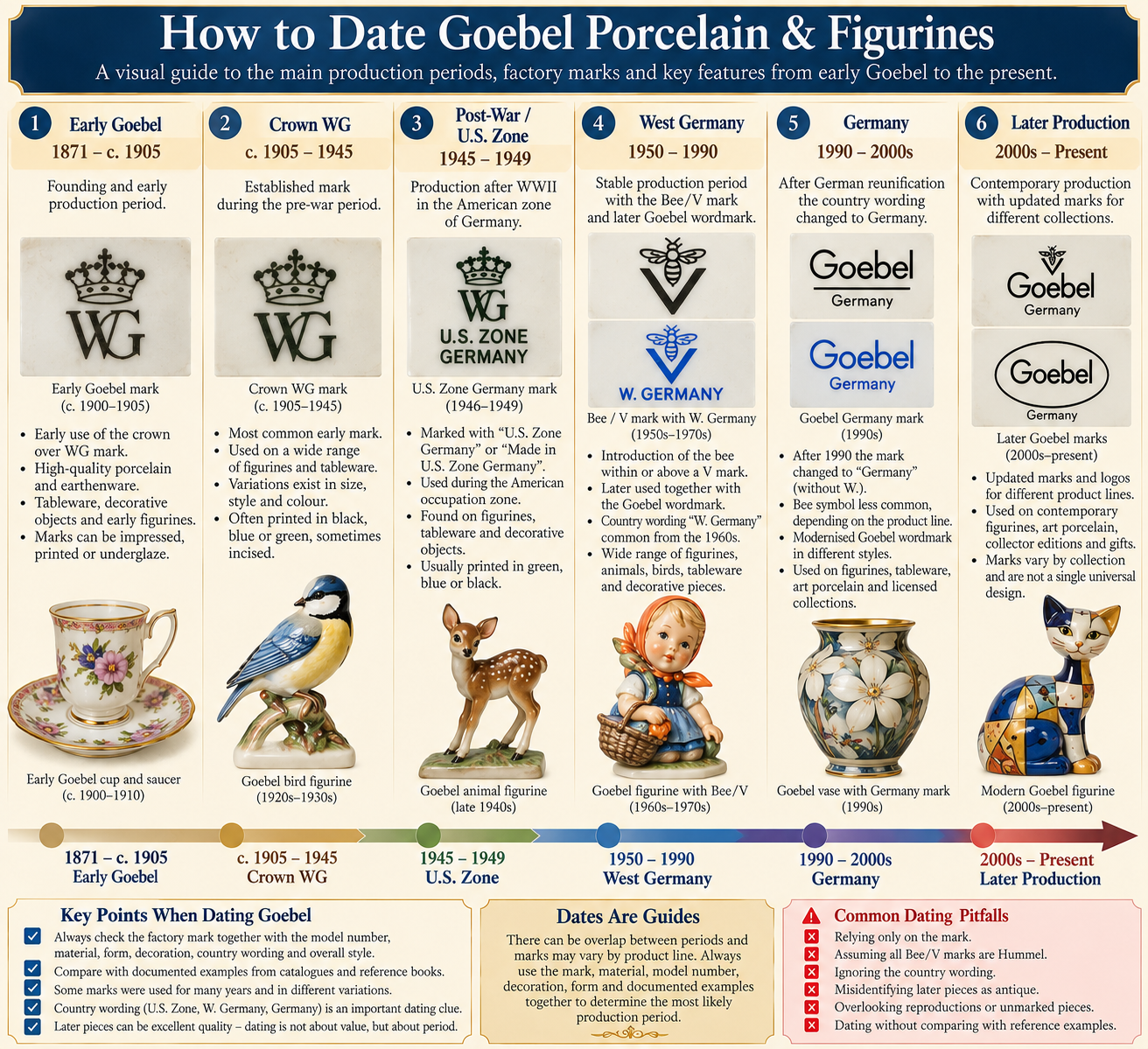
Record crown, WG initials, bee/V device, Goebel name and every additional line of text.
Germany, U.S. Zone Germany, W. Germany and later Germany wording can provide chronological context.
Do not discard slashes, suffixes, letters or impressed numbers.
Dating a Goebel bird, Charlot Byj figure or Friar Tuck character is not necessarily the same process as dating another Goebel series.
Confirm whether the object is porcelain or another ceramic body.
Compare pose, base, proportions, facial modelling, feathers, fur, drapery and applied elements.
Look for hand painting, transfers, gilding, decals, printed elements and later repainting.
Repairs can obscure marks, numbers and original surfaces.
A documented example of the same model and mark is much more useful than a visually similar marketplace listing.
For the broader methodology, see
How to Date Antique Porcelain.
How to Identify Genuine Goebel Porcelain & Figurines
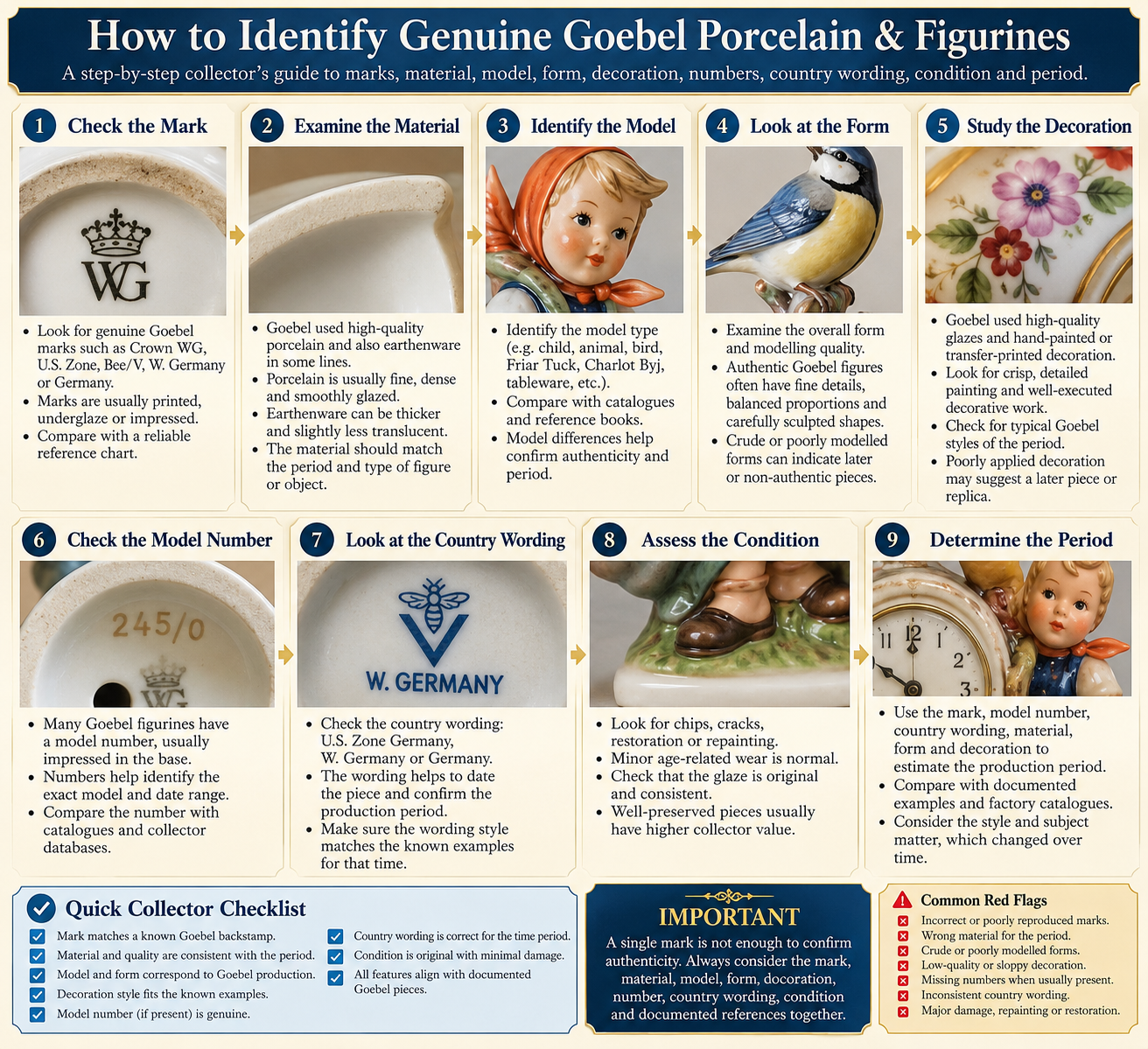
| Evidence | What to Check | Why It Matters |
|---|---|---|
| Factory mark | Exact symbol, typography, colour and application method. | Establishes likely manufacturer and period. |
| Material | Porcelain or another ceramic body. | Must match the product line and period. |
| Model number | Impressed, incised, printed or painted references. | Can identify the exact model or family. |
| Form | Pose, proportions, base, handles, rims and silhouette. | Helps match a documented Goebel design. |
| Modelling | Face, hands, feathers, fur, clothing and sculptural detail. | Poorly modelled copies may differ noticeably from documented pieces. |
| Decoration | Painting, print, transfer, gilding and surface quality. | Should make sense for the model and period. |
| Country wording | Germany, U.S. Zone, W. Germany or later wording. | Provides chronological context. |
| Condition | Chips, cracks, crazing, repainting and restoration. | Affects both attribution and value. |
| Documentation | Catalogues, factory references and known examples. | Stronger than visual resemblance alone. |
mark + material + model + form + decoration + numbers + country wording + condition + documented comparison
For the complete whole-object approach, continue to
How to Identify Antique Porcelain.
Goebel Figurines: More Than One Famous Line
Goebel produced a broad range of figurative subjects, and this is where the company becomes particularly interesting for collectors.
Depending on the period and series, collectors may encounter children, women and men, monks, religious subjects, animals, birds, character figures, seasonal pieces, artist-designed works and small decorative miniatures.
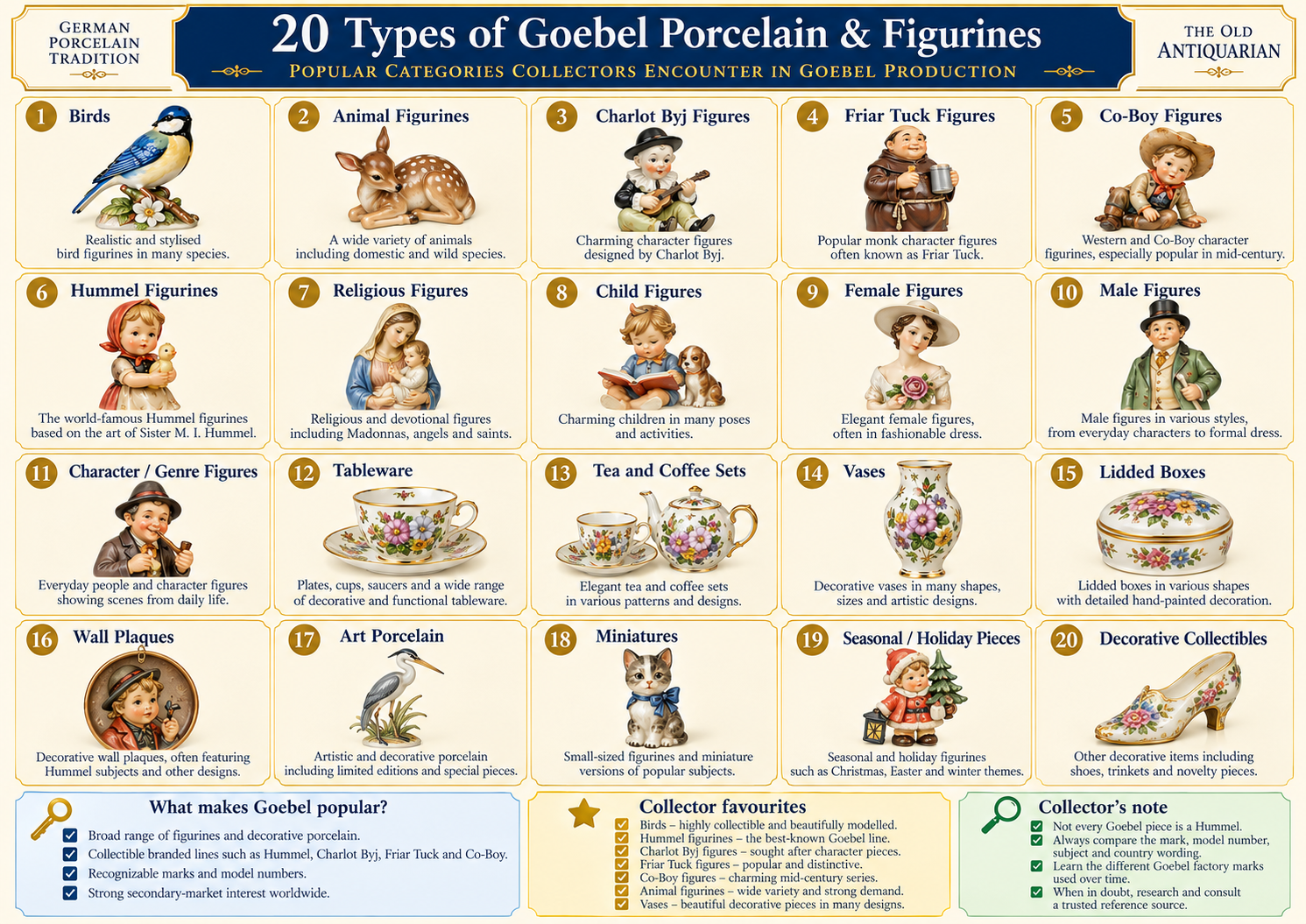
Goebel Birds & Animal Figurines
Birds and animals form an important non-Hummel area of Goebel collecting.
Collectors encounter birds, cats, dogs, deer, horses and many other subjects. Identification should focus on the exact model rather than the species alone.
What to Check on a Goebel Bird
Pay particular attention to beaks, tails, wing tips and thin legs because these areas are vulnerable to damage and restoration.
What to Check on Goebel Animals
For dogs, deer, horses and other mammals, inspect ears, legs, antlers, tails and projecting accessories. Compare the exact pose and dimensions with documented examples of the model.
The exact model, size, production period and condition determine which comparable sales are relevant.
Charlot Byj Goebel Figurines
Charlot Byj is an important name within non-Hummel Goebel collecting.
Her character designs, especially children with distinctive personalities and styling, became the basis of a recognised Goebel figurine line.
When researching a Charlot Byj piece, record the complete model reference, character, hair colour or variation where relevant, dimensions, mark and condition.
A Charlot Byj figure is Goebel, but it is not Hummel. Its model identity and market should therefore be researched within the Charlot Byj / Goebel collecting category.
Goebel Friar Tuck Figures
Friar Tuck is another well-known Goebel character tradition and illustrates why the manufacturer deserves its own specialist guide.
Collectors can encounter monk figures in different forms and functions, including figurines and decorative or useful objects.
For identification, compare facial modelling, clothing, pose, accessory, base, model number and factory mark.
Goebel Co-Boy Figures
Co-Boy figures form another distinctive character series associated with Goebel’s twentieth-century production.
These small character figures can represent different occupations and personalities. Their value should be researched by exact character and model rather than simply under the broad keyword “Goebel figurine.”
Goebel Tableware, Vases, Boxes & Decorative Porcelain
Goebel is not solely a figurine manufacturer.
Collectors also encounter cups, saucers, plates, tea and coffee pieces, vases, lidded boxes, plaques and decorative giftware.
| Object | Useful Identification Clues |
|---|---|
| Cups & saucers | Matching form, pattern, rim decoration, backstamp and factory numbers. |
| Tea & coffee sets | Completeness, matching marks, pattern and replacement pieces. |
| Vases | Shape number, decorator or series, gilding, rim and base. |
| Lidded boxes | Original matching lid, finial, fit, decoration and model number. |
| Wall plaques | Subject, series, mould number and mounting condition. |
| Art porcelain | Named artist, series, edition information and documentation. |
| Modern collectibles | Collection name, item reference, edition status and original packaging. |
Modern Goebel Art Porcelain
Goebel remains active in artist-led decorative production. Current ranges include art and design collaborations applied to porcelain, glass and related decorative materials.
This is another reason why a modern Goebel mark should not be mistaken for proof of antique age.
A contemporary Goebel object can be completely genuine and collectible without being vintage or antique.
Goebel vs Hummel: What Is the Difference?
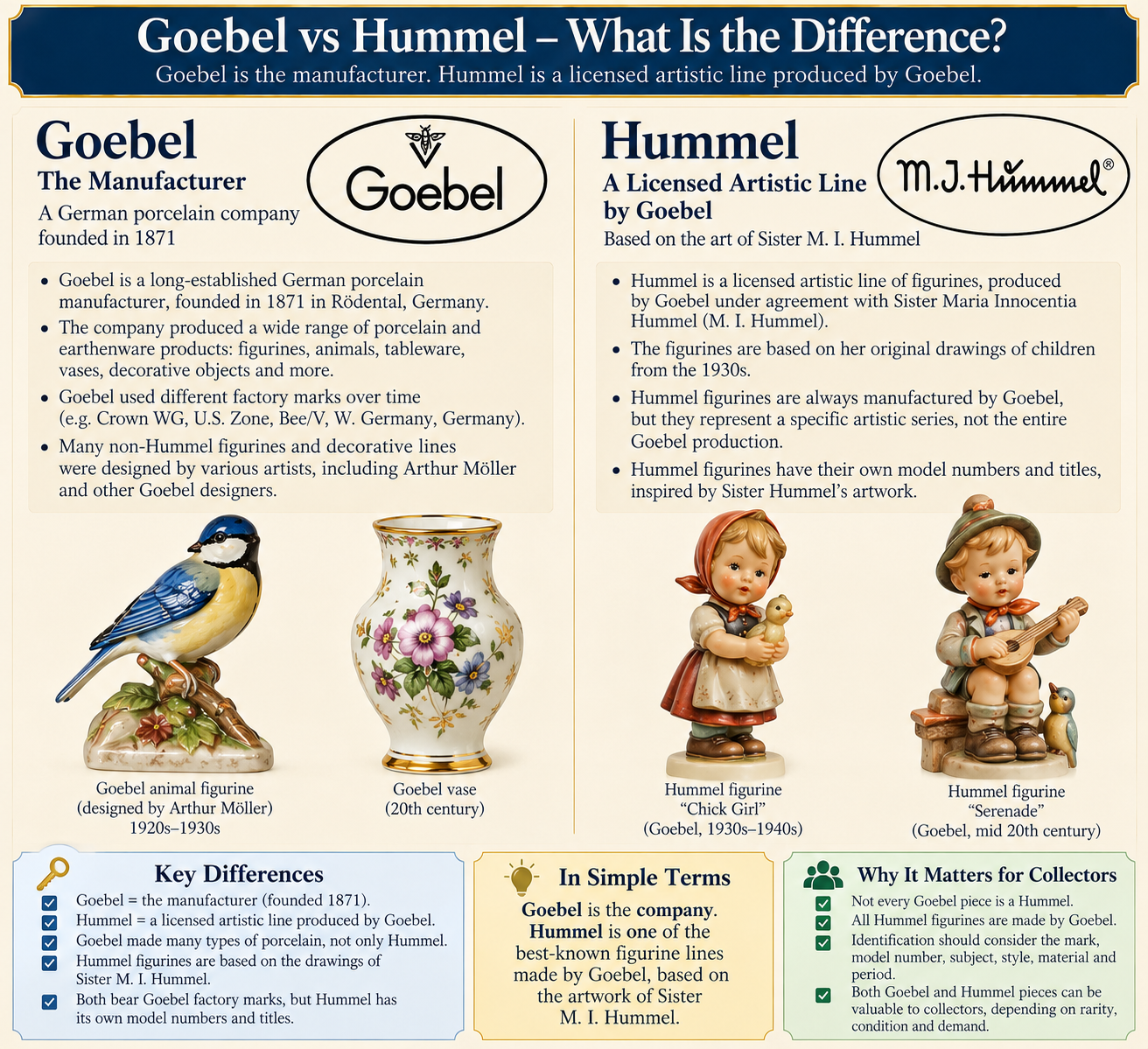
| Goebel | M.I. Hummel |
|---|---|
| Historic German manufacturer founded in 1871. | A specific artistic figurine tradition based on the work of Maria Innocentia Hummel. |
| Produced many different ceramic and decorative product lines. | One famous licensed line within historic Goebel production. |
| Includes birds, animals, character figures, tableware, vases and art objects. | Primarily identified through Hummel-specific model and artistic evidence. |
| A Goebel factory mark may occur on non-Hummel products. | A Goebel mark alone does not prove Hummel identity. |
| General Goebel identification uses mark, model, material, series and period. | Classic Hummel identification additionally relies heavily on the M.I. Hummel signature and HUM model system. |
The infographic uses the simplified phrase “Hummel is a licensed artistic line produced by Goebel.” That accurately describes the historic Goebel-era relationship, beginning with the first Goebel Hummel figures in 1935. Goebel ended its Hummel production in 2008; later M.I. Hummel manufacture continued under successor companies in Rödental. For current and Hummel-specific dating, use the dedicated Hummel guide.
We deliberately do not reproduce a Hummel TMK chart, HUM-number system or Hummel value table here. Those subjects belong to the
specialist Hummel guide.
Vintage vs Later Goebel Production
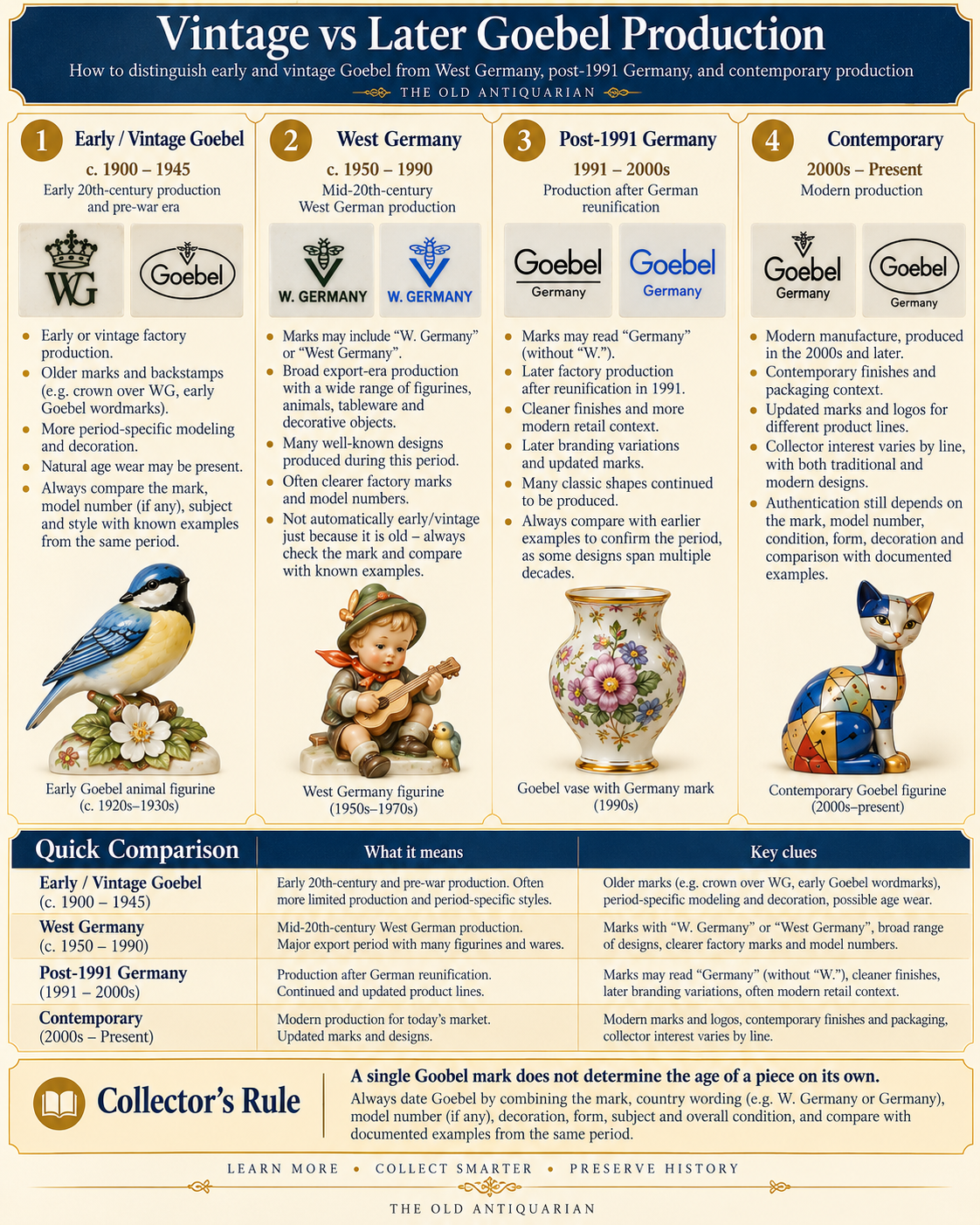
| Category | Broad Context | Useful Clues |
|---|---|---|
| Early / vintage Goebel | Late 19th and early 20th-century company history. | Early marks, Crown WG variants, historic forms, model numbers and period documentation. |
| Post-war Goebel | Late 1940s. | U.S. Zone wording and post-war factory context. |
| West Germany period | Mid to late 20th century before reunification. | Bee/V families, Goebel marks and W. Germany wording depending on period and line. |
| Post-1991 Goebel | Reunified Germany. | Germany wording and later Goebel-specific marks. |
| Contemporary Goebel | Modern art, decorative and giftware production. | Current collection name, item reference, artist, edition and packaging. |
A traditional-looking Goebel figure or vase may be later production. Date the individual object, not the style it imitates.
Goebel Condition & Restoration
Condition can have a major effect on collector value, particularly for figurines with projecting details.
| Area | Common Problem | Why It Matters |
|---|---|---|
| Birds | Beak, tail or wing-tip damage. | Small repairs can be difficult to see in photographs. |
| Animals | Ears, antlers, tails and legs. | Completeness strongly affects desirability. |
| Figures | Fingers, hats, flowers, accessories and thin limbs. | Frequently restored areas. |
| Gilding | Wear or later regilding. | Originality matters for many decorative wares. |
| Paint | Retouching or repainting. | Can hide repairs and alter collector value. |
| Base | Grinding, filling or label removal. | May destroy important identification evidence. |
| Lids & sets | Replacements or mismatched parts. | Completeness is important to value. |
Use ultraviolet light, magnification and careful side lighting when examining a potentially valuable figure, particularly around repaired extremities.
Goebel Porcelain & Figurines Value
There is no useful universal price for “a Goebel figurine.”
The market for an early Goebel object, a Charlot Byj character, an animal model, a West German series figure and a modern art porcelain edition can be completely different.
Compare genuinely similar completed sales whenever possible.
product line + exact model + production period + material + artist / modeller + size + variation + condition + restoration + completeness + provenance + completed comparable sales
| Value Factor | Why It Matters |
|---|---|
| Product line | A bird, Charlot Byj figure, Friar Tuck and tableware piece belong to different markets. |
| Exact model | Model identity is often more important than the general subject. |
| Production period | The same or related model may exist under different marks. |
| Artist / modeller | Documented authorship can increase specialist interest. |
| Material | Porcelain and other ceramic bodies should not be compared indiscriminately. |
| Size | Similar designs may exist in multiple dimensions. |
| Variation | Colourways, decoration and production differences can matter. |
| Condition | Chips, cracks and missing details usually reduce desirability. |
| Restoration | Repainting and structural repairs can materially affect value. |
| Completeness | Sets, boxes, original lids and accessories may command stronger interest when complete. |
| Original packaging | Can matter for limited editions and recent collectibles. |
| Market evidence | Recent completed sales are more meaningful than unsold asking prices. |
Are Old Goebel Figurines Always More Valuable?
No.
Age is only one factor. An older but common or damaged figure can be less desirable than a later scarce model in excellent condition.
Likewise, a Crown WG mark does not by itself create high value. The exact model and market demand must still be established.
Do Bee Marks Make Goebel More Valuable?
Not automatically.
A Bee/V mark can help establish a historical production period, but value depends on the object itself. Rarity, model, condition and collector demand are more important than the presence of a familiar logo alone.
For the broader valuation methodology, use our
Complete Antique Porcelain Guide
and
Professional Antique Valuation.
Goebel Collector Checklist
- Photograph the whole object from several angles.
- Photograph the complete underside.
- Record the entire Goebel mark.
- Do not crop country wording.
- Record every impressed, incised or painted number.
- Look for original paper or foil labels.
- Identify the ceramic material.
- Identify the product line before researching value.
- Do not assume Bee/V means Hummel.
- Do not use Hummel TMK terminology automatically for non-Hummel Goebel.
- Check Crown WG variants carefully.
- Record U.S. Zone wording if present.
- Record W. Germany / West Germany wording exactly.
- Check the model against documented examples.
- Measure the object accurately.
- Inspect fingers, wings, tails, ears and accessories.
- Look for glue, repainting and regilding.
- Check sets for missing or mismatched components.
- Keep original boxes and certificates with later collectibles.
- Compare completed sales rather than asking prices alone.
Do You Have a Goebel Figurine or Porcelain Object?
Send clear photographs of the complete object, the entire underside, every mark and number, dimensions and any visible damage or restoration. If the piece belongs to a named Goebel series, include any original label, box or certificate.
Goebel · German Porcelain · Figurines · Decorative Arts · Private Collections
Goebel Porcelain & Figurines FAQ
When was Goebel founded?
Goebel traces its history to January 30, 1871, when Franz Detleff and William Goebel founded F. & W. Goebel. The first porcelain factory followed in 1878.
What is the Goebel Crown WG mark?
The mark shows a crown above intertwined WG initials associated with William Goebel. Official Goebel history places the important crown-over-WG identity at around 1905.
Does a Bee / V mark mean a figurine is Hummel?
No. Goebel used factory trademarks on multiple product lines before 1991. A Bee/V mark can therefore appear on genuine non-Hummel Goebel objects.
What does U.S. Zone Germany mean on Goebel?
It is post-Second World War occupation-zone wording used on exported goods during the late 1940s. It can be a useful chronological clue when interpreted with the main factory mark.
What does W. Germany mean on Goebel?
It indicates a West German production context and generally places the object before German reunification. The exact production range should still be determined from the full mark and model.
Are all Goebel figurines porcelain?
No. Goebel produced objects in porcelain and other ceramic bodies. Material should be identified for the individual model rather than assumed from the manufacturer name.
Are all Goebel figurines Hummel?
No. M.I. Hummel is only one artistic tradition historically produced by Goebel. The company also produced birds, animals, character figures, artist-designed series, religious figures and many other decorative objects.
How can I date a Goebel figurine?
Compare the exact factory mark with the country wording, model number, product line, material, form, decoration and documented examples. Marks normally establish a production range rather than one exact year.
What do the numbers on a Goebel figurine mean?
Numbers can relate to a model, mould, size, variation or production system. Their meaning should be established from the relevant Goebel series rather than guessed from the number alone.
How do I know if my Goebel figurine is valuable?
Identify the exact model and production period first. Then assess rarity, size, artist or modeller, condition, restoration, completeness, provenance and recent completed sales for genuinely comparable examples.
Are modern Goebel pieces collectible?
Yes. Modern Goebel continues to produce artist-related and decorative collections, including limited and specialist series. Collectibility depends on the individual line, edition, design, condition and market demand rather than age alone.
Related Guides
Sources & Further Research
The historical dates, trademark context and distinction between Goebel and Hummel used in this guide were checked against official company information, specialist trademark research and current manufacturer sources.
-
Goebel – Official Company History
– founding in 1871, first porcelain factory in 1878, Oeslau-Rödental and the Crown WG identity around 1905. -
Goebel – Official Shop and Current Collections
– current figurines, porcelain, artist collections, decorative objects and contemporary production. -
Antique Trader – Historical Goebel / Hummel Trademark Research
– U.S. Zone wording, Bee/V development and the important distinction between shared pre-1991 Goebel marks and later Hummel-specific trademarks. -
Hummel Manufaktur – Official History
– first Goebel Hummel figures in 1935 and the modern continuation of the M.I. Hummel tradition under Hummel Manufaktur.
The infographics in this guide are educational orientation tools. Goebel used many mark variants, and some collector dating systems were originally developed around the M.I. Hummel line. Exact non-Hummel dating should therefore follow the documented mark variant, model, material, country wording and product-line history. The article text and primary historical sources take priority over simplified infographic timelines.
About The Old Antiquarian
The Old Antiquarian combines more than 35 years of practical experience with antiques and collecting with historical, museum and comparative research.
When identifying Goebel, we do not treat a familiar logo as a complete answer. Manufacturer, model, material, form, decoration, country wording, condition, restoration and documented comparisons should support one another.
Continue with our
German Porcelain Guide
or explore the
Complete Antique Porcelain Guide.
Conclusion: Identify the Goebel Piece, Not Just the Goebel Mark
Goebel’s long history makes it an excellent collecting field, but also a category in which shortcuts easily lead to mistakes.
The company produced far more than one famous figurine line. Birds, animals, named artist series, character figures, tableware, vases, boxes and modern art porcelain all belong to the wider Goebel story.
A Crown WG mark, Bee/V symbol or W. Germany backstamp can narrow the research, but none of them establishes the complete identity or value of an object by itself.
The strongest attribution is one in which the factory mark, material, model, product line, form, decoration, country wording, condition and documented production history all support the same conclusion.
Identify the mark → identify the product line → identify the material → match the model → establish the period → inspect condition → compare documented examples → then research value.
