
How to Identify Porcelain Marks: The Complete Guide to Porcelain Backstamps and Maker’s Marks
Last Updated: September 16, 2026 | By The Old Antiquarian
Quick Answer
A porcelain mark can help identify the maker, country or region, approximate production period, pattern, model, decorator or factory system—but a mark alone does not prove authenticity, exact age or market value.
The safest method is to read the complete backstamp and then test it against the material + form + glaze + decoration + numbers + manufacturing technique + condition + documented examples. Once you have identified a likely maker, continue to the dedicated manufacturer guide rather than trying to date the object from a general marks page.
How This Guide Fits the Porcelain Library
This article is the practical step-by-step guide to identifying porcelain marks and backstamps. For definitions and mark terminology, use
What Are Porcelain Marks?.
For exact factory timelines, mark variants and dating systems, use the dedicated manufacturer guides linked below.

At a Glance
Porcelain Marks – Collector Reference
| Question | Collector Answer |
|---|---|
| What can a mark identify? | Maker, brand, region, country, pattern, model, decorator, production system or approximate period. |
| Does a mark prove authenticity? | No. The object must support the mark. |
| Can a mark give an exact year? | Sometimes, if the factory used a documented date code. Many marks only establish a broad production range. |
| Are numbers always dates? | No. They may be pattern, shape, model, mould, decorator, batch or control numbers. |
| Does a country name identify the factory? | No. Bavaria, Limoges and Dresden, for example, can refer to regions or traditions rather than one single manufacturer. |
| Best next step after identifying a maker? | Move to the dedicated factory guide for documented mark variants, dating clues, models, patterns and historical context. |
Collector Rule
THE OBJECT MUST CONFIRM THE MARK
mark + material + form + glaze + decoration + numbers + technique + condition + documented comparison
Definition
What Are Porcelain Marks, Backstamps and Makers’ Marks?
A porcelain mark is a symbol, name, logo, number, inscription or production code associated with a manufacturer, decorating workshop or production system. Marks are most often found on the underside of an object, but additional information may also appear inside lids, beneath removable parts or in less visible areas.
Collectors commonly use the terms porcelain mark, backstamp, factory mark and maker’s mark interchangeably. In practice, however, not every symbol on the base has the same purpose.
| Mark Type | Possible Function |
|---|---|
| Factory / maker mark | Identifies a manufacturer, brand or factory. |
| Country wording | Provides origin or export information. |
| Pattern number | May identify a decorative pattern or service. |
| Model / shape number | May identify a mould, figure or form. |
| Decorator / painter mark | May identify an individual decorator or workshop. |
| Quality / production code | May refer to factory grading, batches or internal controls. |
For a terminology-first explanation, see
What Are Porcelain Marks?.
This page focuses instead on how to investigate an unknown mark step by step.
Mark Application
Types of Porcelain Marks
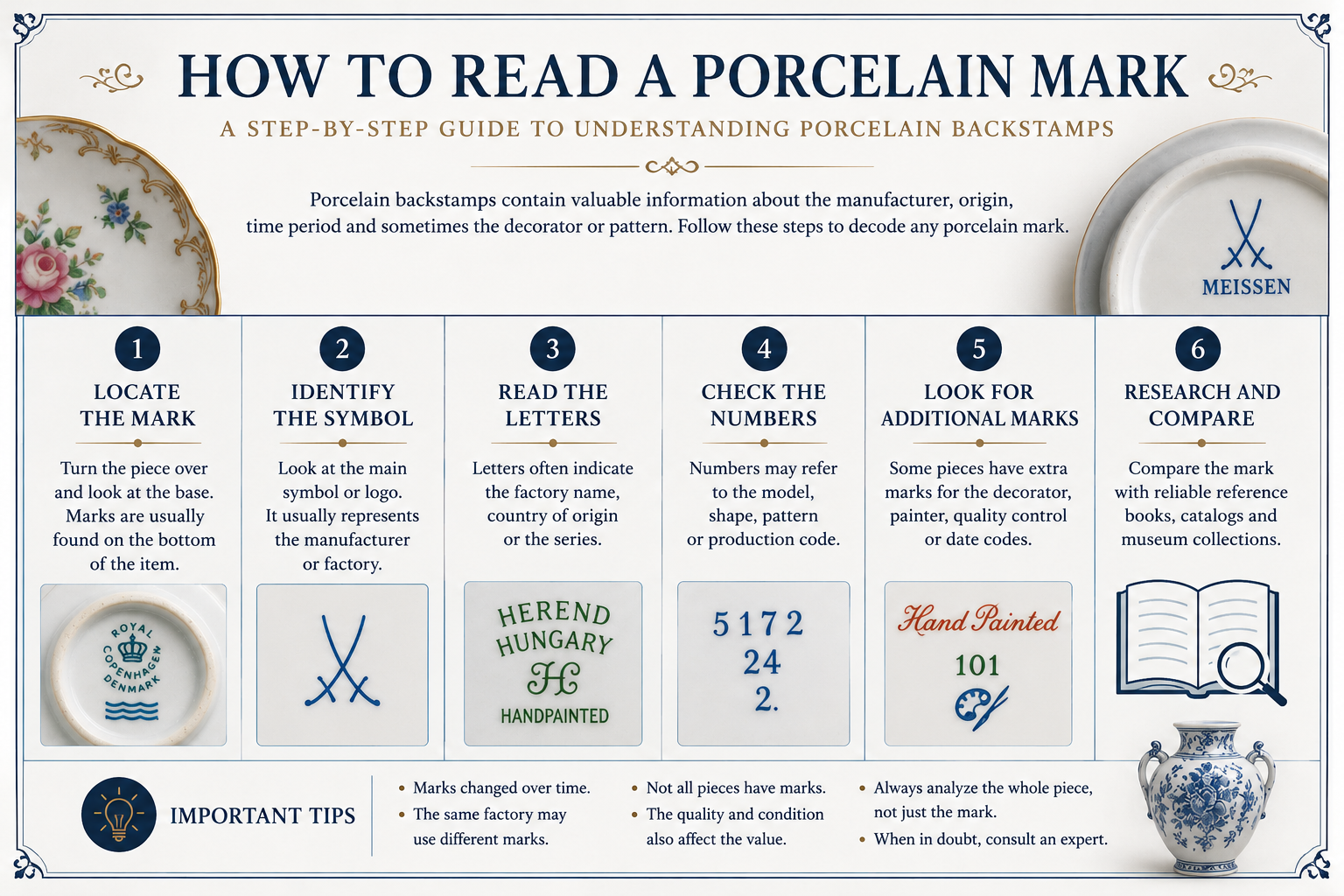
How a mark was applied can provide useful evidence about manufacturing technique and production period. Do not assume that every legitimate factory mark should look printed, crisp or identical.
Underglaze Marks
Underglaze marks are applied before the glaze firing and are protected beneath the glaze. They can be highly durable, but their exact appearance still depends on factory technique and firing.
Overglaze Marks
Overglaze marks are applied on top of the glazed surface. They may include factory information, decorator marks, retailer marks or additional production details and can show more surface wear.
Printed or Transfer Marks
Printed marks became increasingly widespread with industrial ceramic production. Typography, colour, wording and layout can all matter when comparing different periods from the same manufacturer.
Hand-Painted Marks
Painted initials, symbols, pattern numbers and signatures may relate to decorators, artists, workshops or factory systems. They should not be attributed to a named person without documentation.
Impressed and Incised Marks
Impressed or incised marks are physically pressed or cut into the body. They may identify a factory, mould, model or production system and can remain visible even when printed decoration has worn.
Identification Method
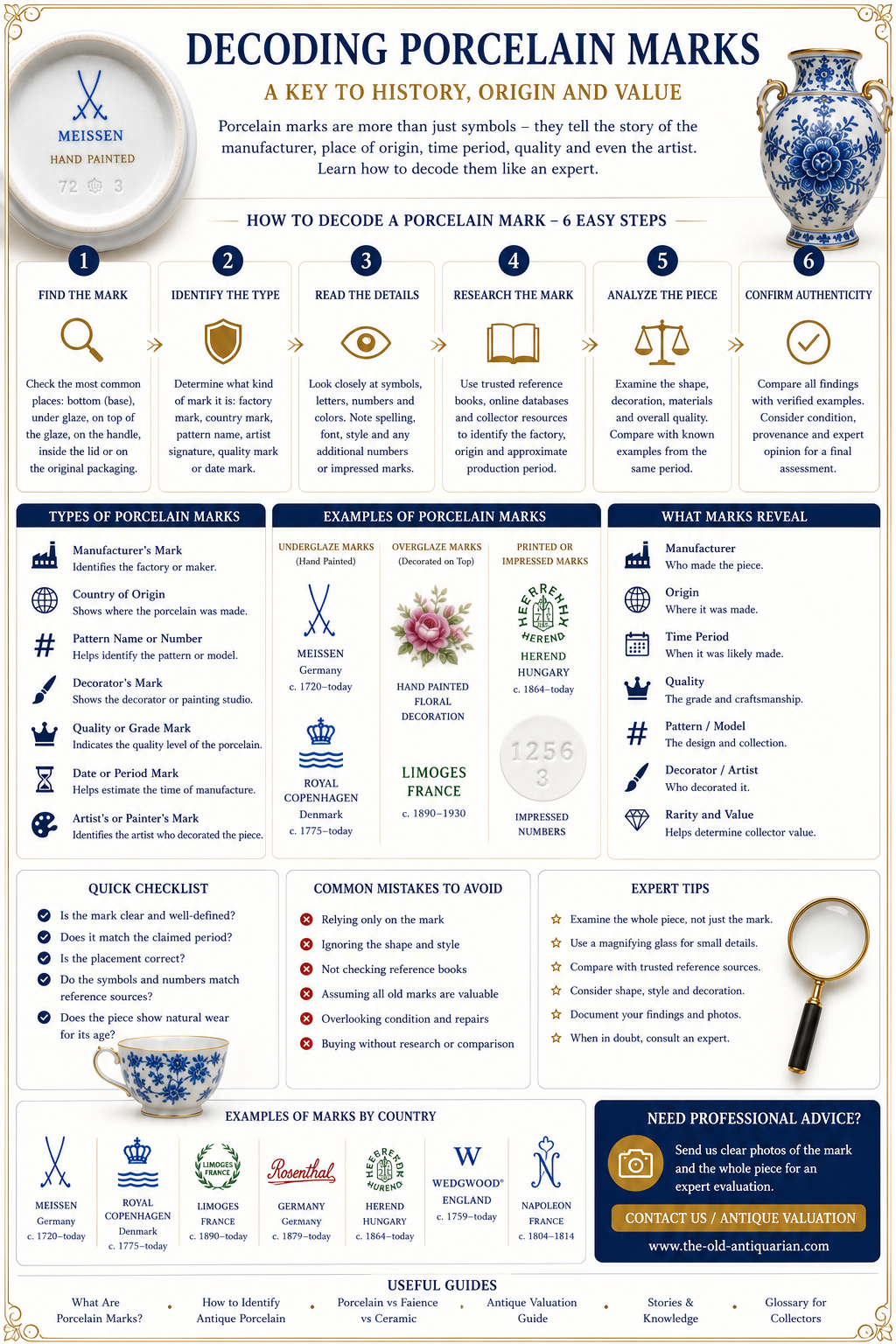
How to Read and Identify a Porcelain Mark Step by Step
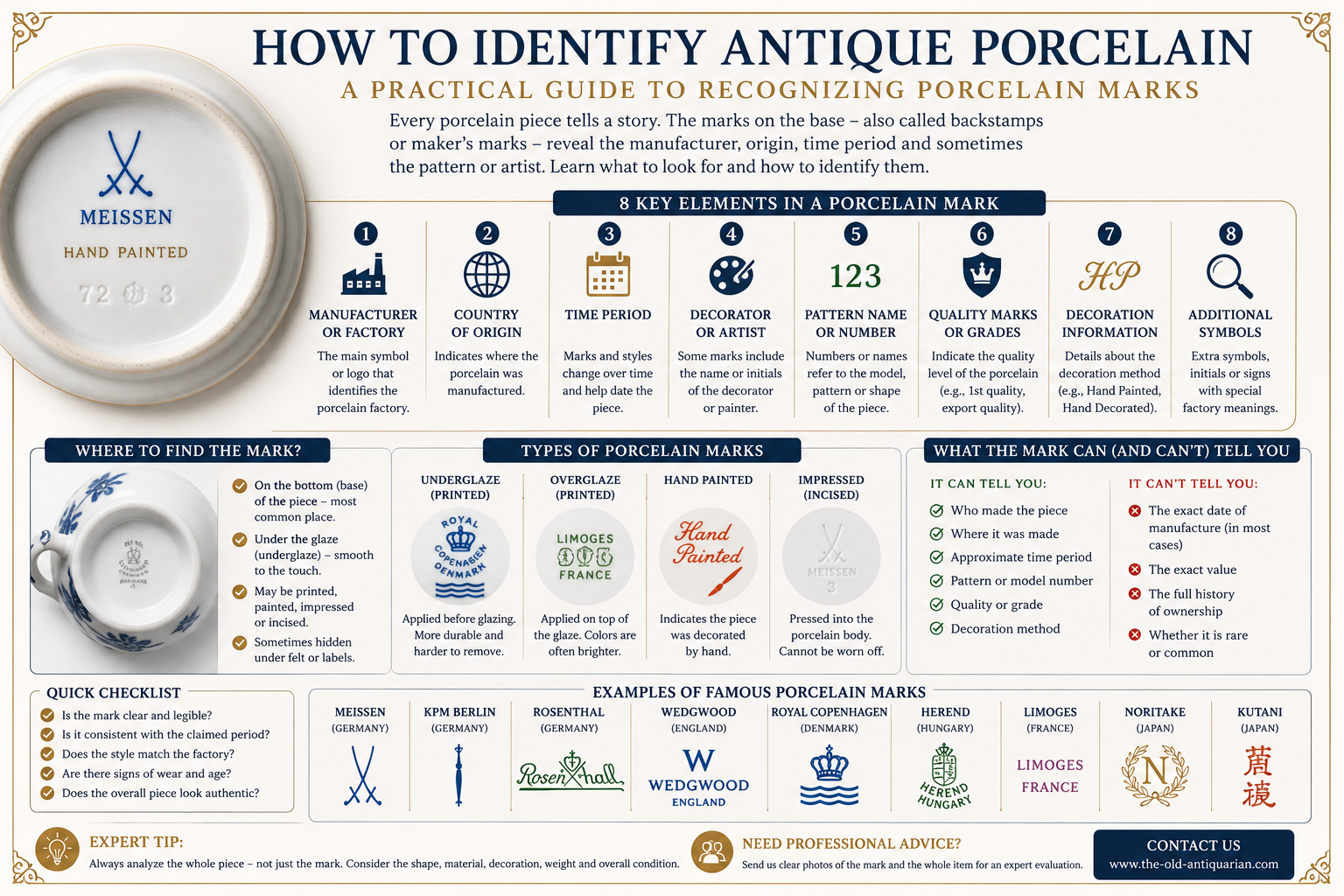
A mark should be decoded systematically. Begin with what is physically visible, record it exactly, and only then compare it with reliable references.
1. Photograph the Complete Base
Do not crop only the central logo. Include the entire foot rim, printed wording, handwritten numbers, impressed characters, secondary marks and natural wear.
2. Identify the Main Name or Symbol
Look for a factory name, monogram, crown, shield, crossed swords, waves, sceptre, anchor, animal, initials or another recurring symbol. Treat the symbol as a clue—not proof.
3. Record Every Word Exactly
Country names, factory locations, royal appointment wording, material descriptions and export wording can all help narrow a period. Do not paraphrase the mark before researching it.
4. Record Every Number
Numbers may refer to patterns, models, moulds, shapes, decorators, batches or factory controls. Never assume that a number is a production year unless the manufacturer’s documented system supports that interpretation.
5. Determine How the Mark Was Applied
Printed, painted, impressed, incised, underglaze and overglaze marks can belong to different production systems or periods.
6. Identify the Material
A mark must agree with the object itself. Determine whether the piece is porcelain, bone china, earthenware, stoneware, faience or another ceramic body before assuming that a familiar name, country or regional tradition means porcelain. This is especially important in broader fields such as Greek, Ottoman/Turkish, Beswick, Villeroy & Boch and Arabia Finland ceramics.
7. Examine Shape and Decoration
Compare the form, handle, foot, moulding, glaze, painting, transfer decoration and gilding with documented examples from the proposed factory and period.
8. Move to the Specialist Factory Guide
Once you have a likely maker, stop relying on generic mark charts. Use the factory-specific guide and compare the complete object with documented examples from the relevant production period.
base photograph → exact wording → symbol → numbers → application method → material → form → decoration → factory guide → documented comparison
What a Porcelain Mark Can—and Cannot—Tell You
| A Mark May Help Establish | A Mark Cannot Establish by Itself |
|---|---|
| Likely maker or factory | Authenticity of the entire object |
| Country or regional context | Exact market value |
| Possible production period | Whether hidden restoration exists |
| Pattern or model reference | How rare the object is |
| Decorator or production information | Whether every component is original |
| Possible export or market wording | Complete provenance or ownership history |
Manufacturer Routing Directory
Porcelain Marks by Maker – Continue to the Specialist Guide
The directory below is intentionally concise. It does not reproduce full mark timelines. Its purpose is to help you move from an unknown backstamp to the correct manufacturer-specific article, where exact mark variants, dating systems, patterns and factory history can be studied without duplicating that information here.
| Maker / Tradition | Region | Specialist Guide |
|---|---|---|
| Germany, Bavaria & Central European Traditions | ||
| Meissen | Germany / Saxony | Meissen Identification Guide |
| KPM Berlin | Germany / Berlin | KPM Berlin Guide |
| Rosenthal | Germany / Bavaria | Rosenthal Identification Guide |
| Nymphenburg | Germany / Bavaria | Nymphenburg Porcelain Guide |
| Hutschenreuther | Germany / Bavaria | Hutschenreuther Marks & Dating Guide |
| Bavaria Porcelain | Germany / regional | Bavaria Porcelain Identification Guide |
| Dresden Porcelain | Germany / Saxony | Dresden Porcelain Guide Dresden is a regional decorating and porcelain tradition, not one single factory. |
| Villeroy & Boch | Germany / Luxembourg | Villeroy & Boch Guide Production includes porcelain, stoneware, earthenware and other ceramic bodies. |
| Royal Vienna / Vienna Porcelain | Austria / Vienna | Royal Vienna Porcelain Identification “Royal Vienna” is a collector/market term and should not automatically be treated as one factory attribution. |
| England – Porcelain, Fine Bone China & Related British Ceramics | ||
| English Porcelain | England / national hub | English Porcelain Guide |
| Wedgwood | England / Staffordshire | Wedgwood Identification Guide |
| Royal Worcester | England / Worcester | Royal Worcester Guide |
| Spode | England / Staffordshire | Spode Porcelain Guide |
| Minton | England / Staffordshire | Minton Porcelain Guide |
| Royal Crown Derby | England / Derby | Royal Crown Derby Guide |
| Coalport | England | Coalport Porcelain Guide |
| Aynsley | England / Staffordshire | Aynsley Porcelain Guide |
| Shelley China | England / Staffordshire | Shelley China Guide |
| Paragon China | England / Staffordshire | Paragon China Guide |
| Royal Albert | England / Staffordshire | Royal Albert Bone China Guide |
| Royal Doulton | England | Royal Doulton Guide |
| Chelsea Porcelain | England / London | Chelsea Porcelain Guide |
| Beswick | England / Staffordshire | Beswick Figurines & Ceramics Guide A broader British ceramics field; not every Beswick object is porcelain. |
| Denmark | ||
| Royal Copenhagen | Denmark | Royal Copenhagen Guide |
| Bing & Grøndahl | Denmark | Bing & Grøndahl Guide |
| Other Important Porcelain & Ceramic Guides | ||
| Herend | Hungary | Herend Identification Guide |
| Limoges | France / regional tradition | Limoges Identification Guide |
| Arabia Finland | Finland / Helsinki | Arabia Finland Porcelain & Ceramics Guide Arabia used porcelain, faience and other ceramic bodies. |
| Capodimonte | Italy | Capodimonte Guide |
| Lladró | Spain | Lladró Identification Guide |
| Precious Moments | Modern collectible figurines | Precious Moments Figurines Identification Included as a modern collectible identification route rather than as a historic European porcelain manufactory. |
| Russian & Soviet Porcelain | Russia / USSR | Russian & Soviet Porcelain Identification Guide Factory names, state symbols and production marks changed across Imperial, revolutionary and Soviet periods. |
| Romanian Porcelain | Romania | Romanian Porcelain Identification Guide |
| Yugoslav Porcelain | Former Yugoslavia | Yugoslav Porcelain Identification Guide Country wording and factory location should be read in their historical political context. |
| Bulgarian Porcelain | Bulgaria | Bulgarian Porcelain – Manufacturers, Marks & Collecting Guide |
| Greek Porcelain & Ceramics | Greece | Greek Porcelain & Ceramics Identification Guide Greek collecting includes porcelain and important non-porcelain ceramic traditions. |
| Ottoman & Turkish Porcelain | Ottoman Empire / Turkey | Ottoman & Turkish Porcelain Identification Guide Late Ottoman porcelain, especially Yıldız, should be distinguished from İznik, Kütahya and other ceramic traditions. |
A general marks guide should help identify the correct research path. Exact Paragon backstamp periods, Nymphenburg shield variants, Hutschenreuther marks, Royal Vienna attribution problems and other factory-specific details belong in their dedicated pages. Keeping those details there reduces duplication and makes each page’s search intent clearer.
Marks by Country & Region
How Country and Regional Wording Helps Identify Porcelain
Country wording is useful context, but it is not an exact dating code. Political borders, export requirements, factory ownership and regional names changed over time. Always combine country wording with the actual factory mark and the object itself.
German Porcelain Marks
Germany has one of Europe’s richest porcelain traditions. Important makers and regional traditions include
Meissen,
Rosenthal,
KPM Berlin,
Nymphenburg,
Hutschenreuther,
Dresden porcelain
and
Villeroy & Boch.
A backstamp reading Bavaria usually identifies a region rather than one factory. Use the
Bavaria Porcelain Guide
to narrow the actual maker.
English Porcelain Marks
English manufacturers used printed, painted and impressed marks, factory names, royal devices, country wording, pattern numbers and other codes. If the exact factory is unknown, start with the
English Porcelain Guide.
Once the maker is known, move to the specialist article in the directory above.
Important names include Wedgwood, Royal Worcester, Spode, Minton, Royal Crown Derby, Coalport, Aynsley, Shelley, Paragon, Royal Albert, Royal Doulton and Chelsea. Beswick also belongs to the wider British ceramics field, but the material of each Beswick object should be identified individually.
Danish Porcelain Marks
The two major Danish routes in this library are
Royal Copenhagen
and
Bing & Grøndahl.
Both used changing factory marks together with additional production information that should be interpreted within the manufacturer’s own system.
Austrian & Vienna Porcelain Marks
Vienna porcelain requires particular caution because Royal Vienna is widely used as a collecting and market term. A shield or so-called “beehive” style mark should not be treated as proof of one specific factory attribution without supporting evidence from the object.
Continue with the
Royal Vienna Porcelain Identification Guide.
Finnish Porcelain & Ceramic Marks
Finnish collecting is strongly associated with Arabia Finland. Arabia produced porcelain, faience and other ceramic bodies, so the mark should always be interpreted together with the material, shape, pattern and designer or decorator information.
Russian & Soviet Porcelain Marks
Russian and Soviet porcelain marks can reflect major political and institutional changes. Imperial factory names, revolutionary transitions, Soviet state symbols, factory abbreviations and later export wording may all provide chronological clues, but exact dating requires the documented mark system of the individual factory.
Continue with the
Russian & Soviet Porcelain Identification Guide.
Romanian Porcelain Marks
Romanian twentieth-century porcelain and ceramics include several manufacturers and changing factory marks. Manufacturer names, logos, country wording, model references and production details should be interpreted together rather than treated as a universal Romanian dating system.
See the
Romanian Porcelain Identification Guide.
Yugoslav Porcelain Marks
Yugoslav porcelain marks require historical geography. A mark may refer to a factory that is now located in Serbia, Croatia, Slovenia, North Macedonia or another successor state. City names, manufacturer marks and the wording “Yugoslavia” should therefore be read together.
Continue with the
Yugoslav Porcelain Identification Guide.
Bulgarian Porcelain Marks
Bulgarian porcelain and fine ceramics are primarily a twentieth-century collecting field. Factory marks may include manufacturer names or symbols, country wording, model or series numbers and other production information.
For manufacturer histories, marks, bone china and collecting context, use the
Complete Guide to Bulgarian Porcelain.
Greek Porcelain & Ceramic Marks
Greek collecting includes porcelain as well as earthenware, stoneware and other ceramic traditions. Marks should therefore be used first to identify the maker and material, rather than assuming that every Greek ceramic object is porcelain.
Continue with the
Greek Porcelain & Ceramics Identification Guide.
Ottoman & Turkish Porcelain Marks
Late Ottoman porcelain is especially associated with Yıldız Imperial Porcelain, while İznik and much Kütahya production belong to different ceramic traditions. A Turkish or Ottoman attribution should therefore begin by identifying the ceramic body and workshop or factory context.
See the
Ottoman & Turkish Porcelain Identification Guide.
French Porcelain Marks
France includes both famous manufactories and major regional traditions. Limoges is a region, not one single factory, so a Limoges attribution should identify the actual manufacturer whenever possible.
See the
French Porcelain Guide
and
Limoges Identification Guide.
Hungarian Porcelain Marks
Hungarian porcelain includes important makers such as Herend and other historic factories. Mark interpretation should combine logos with pattern numbers, painter or decorator information and documented factory references.
Japanese Porcelain Marks
Japanese marks may use kanji, studio seals, kiln marks, family crests or Latin export wording. Regional traditions such as Arita, Kutani, Imari and Kakiemon require specialist context rather than direct comparison with European backstamps.
Continue with the
Japanese Porcelain Guide.
Chinese Porcelain Marks
Chinese porcelain may carry reign marks, dynasty references, workshop seals or later marks made in homage to earlier periods. A reign mark does not automatically mean the object was produced during the reign named on the base.
Use the
Chinese Porcelain Guide
for the broader identification framework.
Authenticity
Original, Later, Copied and Misleading Porcelain Marks
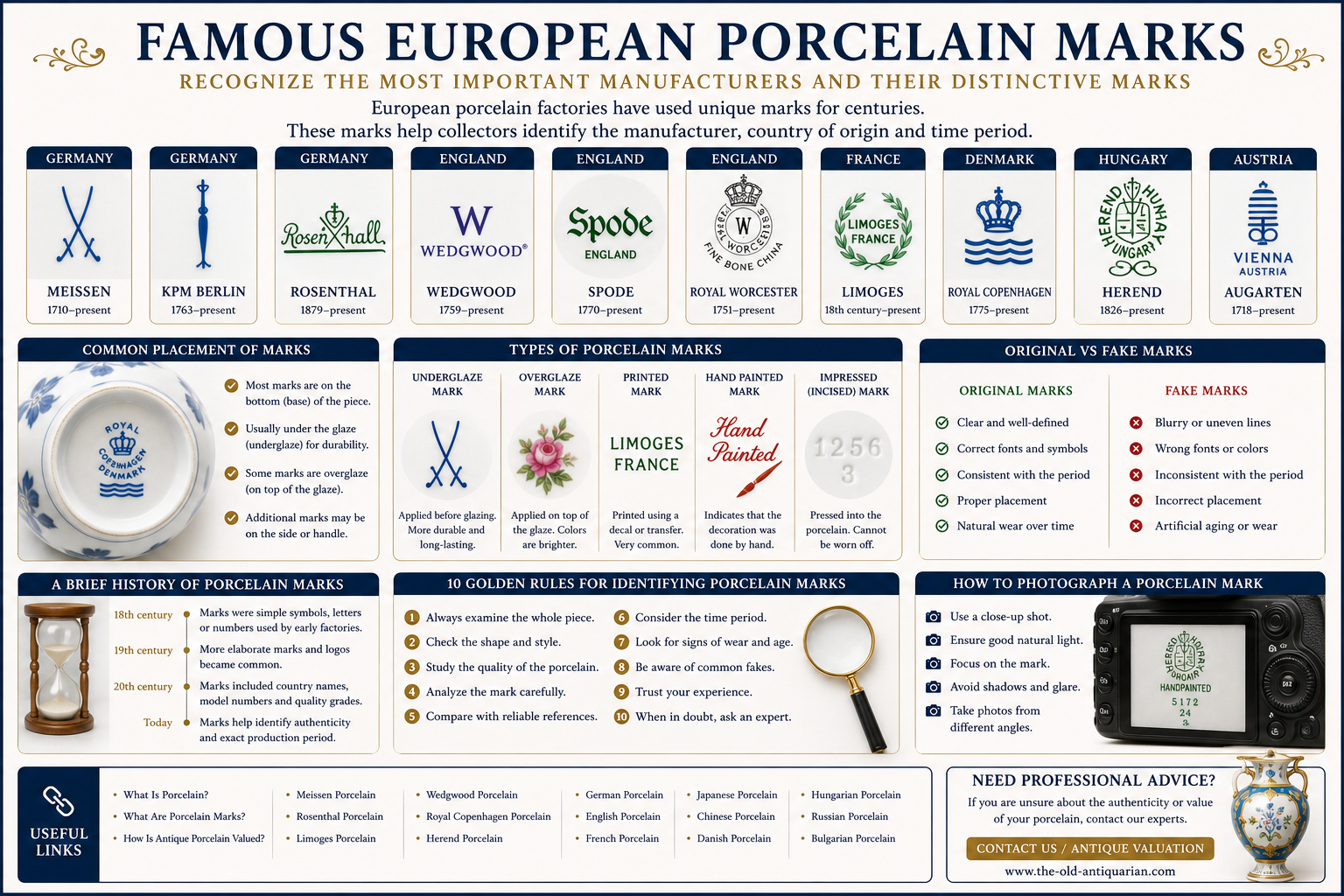
A convincing-looking backstamp is not the same thing as an authenticated object. Famous factory symbols may be copied, imitated, revived, misunderstood or placed on later production. Genuine factories may also reuse historic names or design elements over long periods.
What to Check
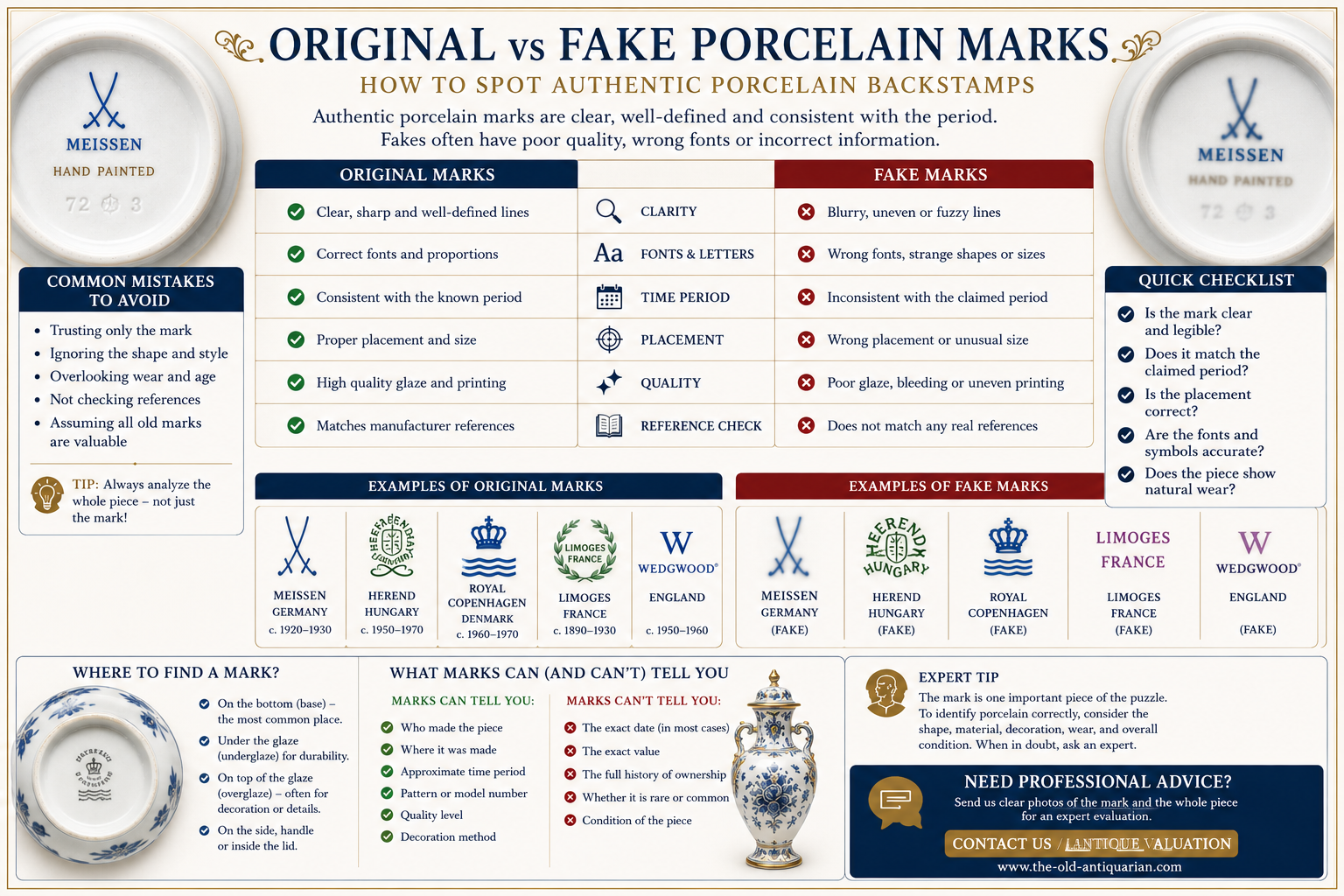
- Is the material historically appropriate for the proposed maker and period?
- Is the form documented for the factory?
- Does the decoration technique fit the proposed date?
- Does the complete wording of the mark exist in documented references?
- Are the typography, proportions and application method consistent?
- Do pattern, model or production numbers make sense for that maker?
- Does the physical wear correspond with the rest of the object?
- Is there evidence of later decoration, regilding, restoration or alteration?
There is no universal visual rule that separates every authentic mark from every copied mark. A slightly blurred or irregular mark is not automatically fake, and a crisp mark is not automatically genuine. Factory method, firing, wear and documented comparison all matter.
Common Mistakes When Identifying Porcelain Marks

Treating a Region as a Factory
Limoges, Bavaria and Dresden can all create confusion because regional wording may be mistaken for the name of one manufacturer.
Assuming Every Number Is a Date
Numbers frequently identify patterns, models, moulds, shapes or internal production systems. Exact interpretation depends on the factory.
Assuming a Crown Means Royal Production
Crowns and royal-style devices can be part of branding. They should not automatically be interpreted as evidence of a Royal Warrant, royal ownership or court manufacture.
Assuming “Hand Painted” Means Antique
Hand painting describes a decorative technique, not the age of the object. Modern ceramics may also be hand decorated.
Ignoring the Ceramic Body
A maker may have produced several ceramic materials. Wedgwood, Beswick, Villeroy & Boch and Arabia Finland are especially useful reminders that a familiar factory name does not automatically mean porcelain.
Relying on One Marketplace Photo
Online listings can contain incorrect dates, copied descriptions and misidentified marks. Compare museum records, factory histories, specialist references and multiple documented examples.
How Porcelain Marks Changed Over Time
Porcelain marks evolved alongside industrial production, branding, international export and company ownership. Early marks may be painted or impressed; nineteenth-century production increasingly used factory names and printed devices; twentieth-century marks often include more standardised logos, country wording, pattern information and production codes.
These are broad tendencies rather than universal dating rules. Individual factories must be studied through their own documented chronology.
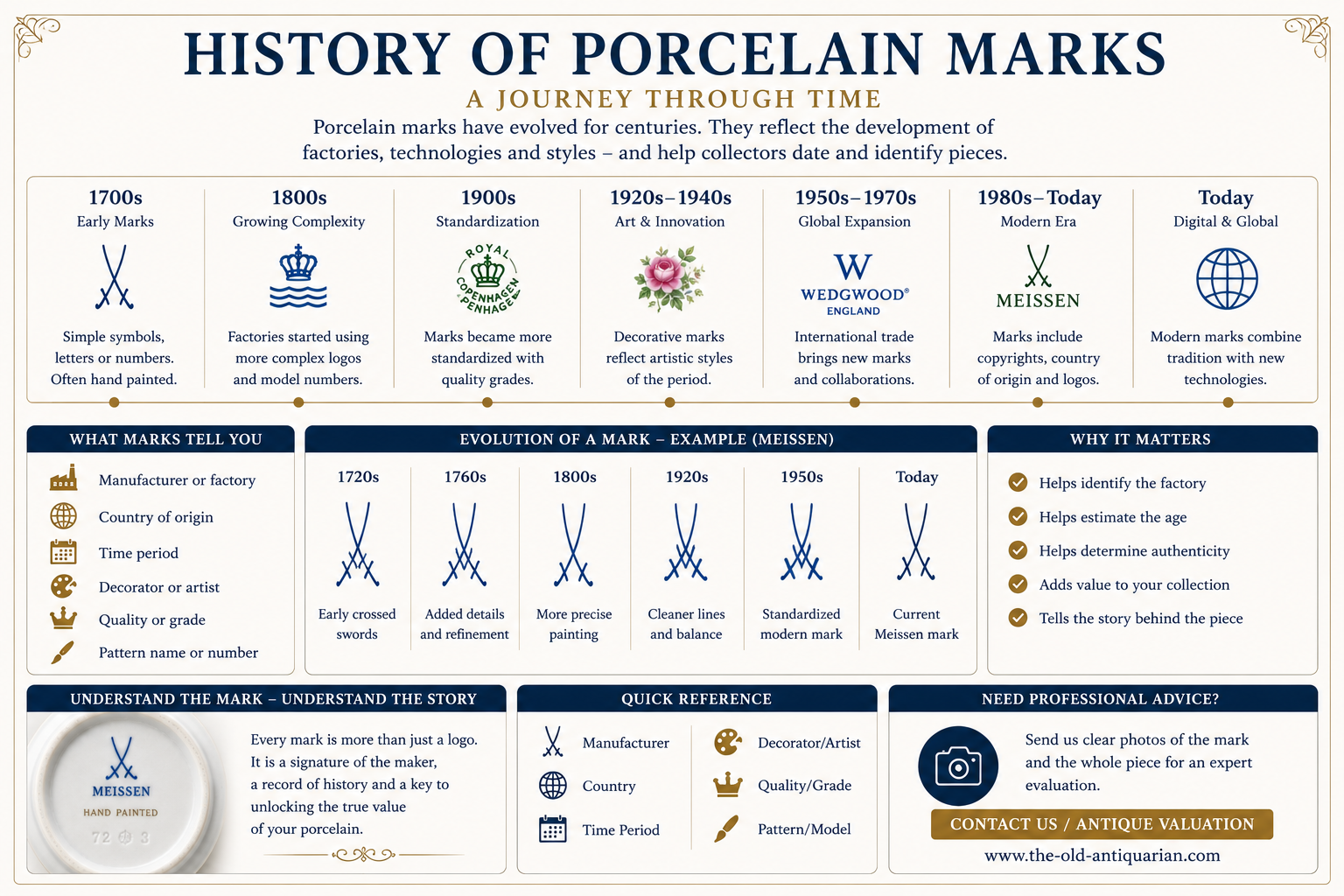
| Period | Broad Development | Collector Caution |
|---|---|---|
| 18th century | Painted symbols, initials, impressed marks and factory-specific systems. | Unmarked pieces also exist; attribution requires the object itself. |
| 19th century | Expanded use of factory names, printed backstamps, export wording and registration information. | Mark systems vary greatly by factory and market. |
| 20th century | Increasingly standardised trademarks, pattern/model data, production codes and export branding. | Historic logos may continue or be revived, so “old-looking” branding is not an age guarantee. |
Understanding Common Porcelain Markings
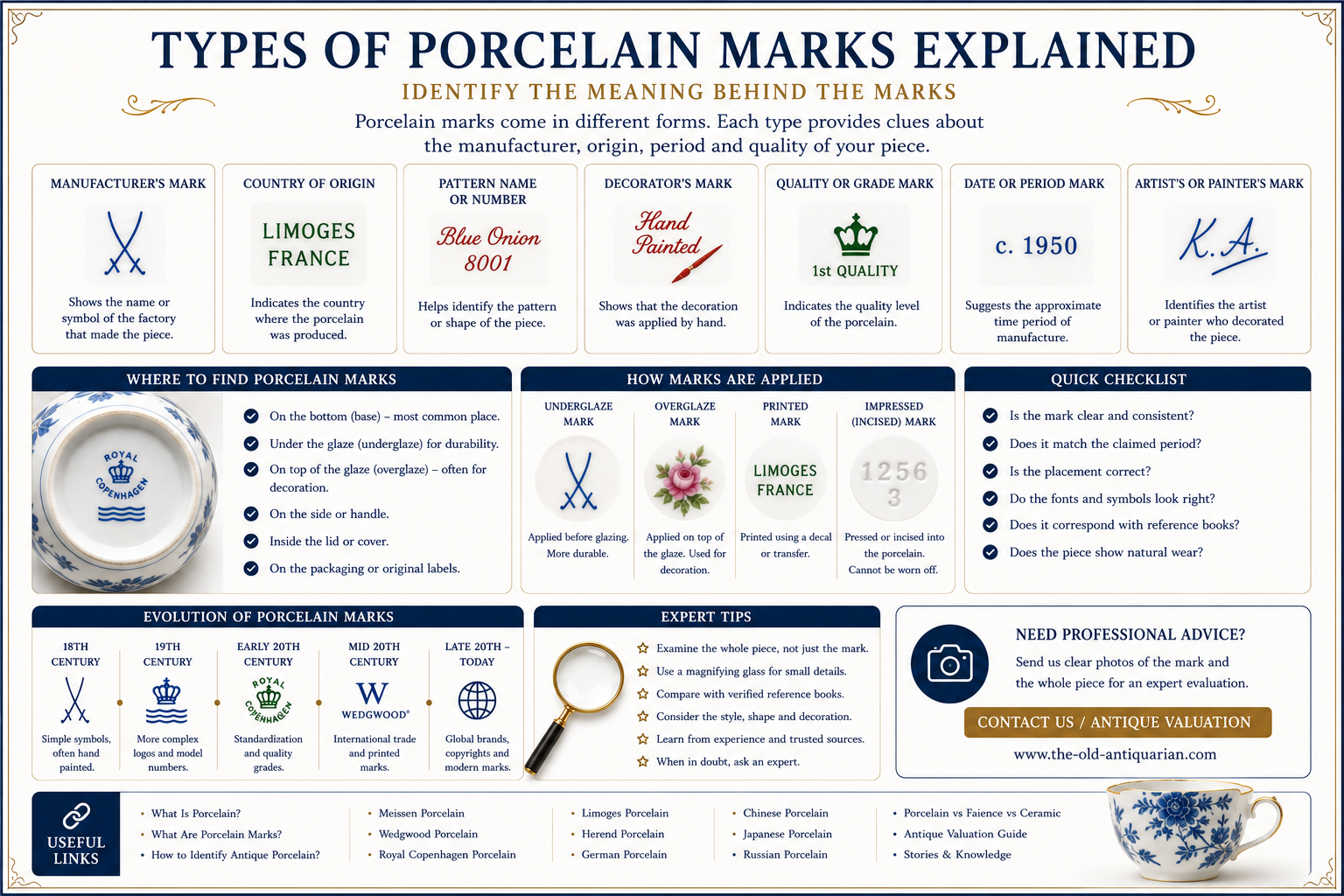
| Marking | What It Usually Indicates | Caution |
|---|---|---|
| Made in England | Country-of-origin wording | Not an exact date by itself |
| Germany | Country wording | Used across many factories and periods |
| Bone China | A porcelain body containing bone ash | Does not identify one manufacturer |
| Hand Painted | Decoration applied by hand | Does not prove age |
| Pattern No. | Decorative pattern reference | Pattern may span multiple periods |
| Shape / Model No. | Form, mould or model reference | Meaning depends on factory system |
| Limited Edition | A stated restricted production | Does not automatically mean rare or valuable |
10 Golden Rules for Identifying Porcelain Marks

- Photograph the whole object before focusing on the mark.
- Photograph the entire underside, not only the logo.
- Transcribe every word, letter and number exactly.
- Identify how the mark was applied.
- Determine the ceramic material.
- Do not assume every number is a date.
- Do not treat a regional name as a single factory.
- Compare form and decoration with documented examples.
- Move to the dedicated manufacturer guide once the likely maker is known.
- Use multiple reliable references before making a narrow attribution.
Documentation
How to Photograph Porcelain Marks for Identification
Good photographs often determine whether an online identification attempt is useful. A close-up of the logo alone is rarely enough.
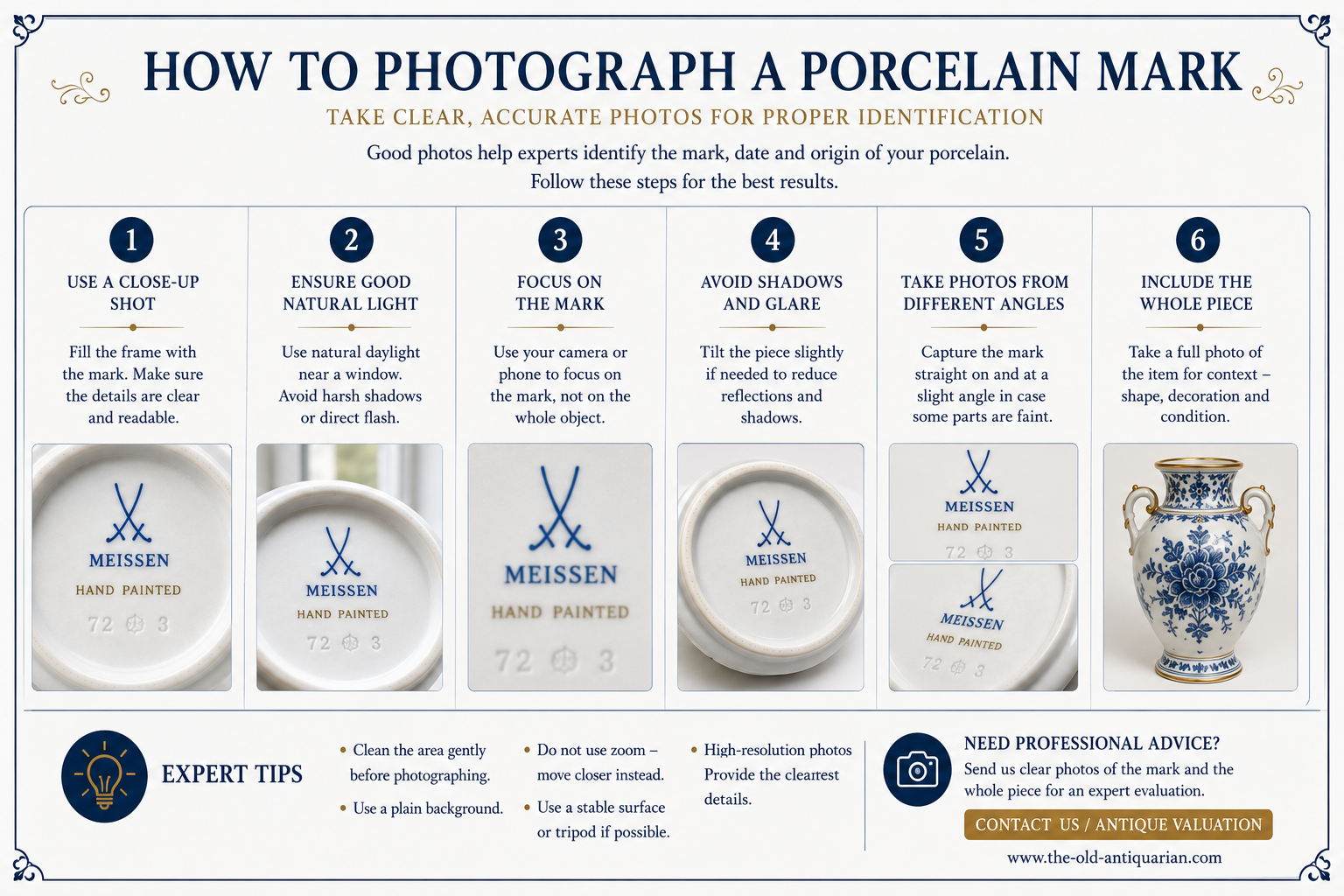
Front, back, sides, handles, lid, foot and important decorative details.
Include foot wear, secondary marks, numbers and handwriting.
Keep typography, small symbols and fine lines in focus.
Photograph chips, cracks, restoration, staining and worn decoration.
For impressed marks, side lighting can help reveal shallow relief. Avoid strong flash reflections on glossy glaze.
Marks & Market Value
Does a Famous Porcelain Mark Make a Piece Valuable?
No. A mark can help establish identity and historical context, but market value depends on the exact object.
ASKING PRICE ≠ MARKET VALUE
Use completed comparable sales for the same or closely related maker + model/pattern + period + size + decoration/colourway + condition + restoration + completeness.
| Valuation Factor | Why It Matters |
|---|---|
| Exact maker | Defines the relevant specialist market. |
| Period | Different production periods can have very different collector demand. |
| Pattern / model / form | Demand often differs dramatically within one factory. |
| Decoration / colourway | Some variants are more desirable or less common than others. |
| Condition & restoration | Damage and repair can materially affect demand. |
| Completed comparable sales | Provide practical evidence of current market behaviour. |
For the broader process, use
How Is Antique Porcelain Valued?.
Collector Checklist
Before You Identify a Porcelain Mark
| ☐ Photograph the complete object | ☐ Photograph the complete underside |
| ☐ Take a sharp mark close-up | ☐ Record all letters and wording |
| ☐ Record every number | ☐ Note printed / painted / impressed method |
| ☐ Identify the ceramic material | ☐ Examine form and construction |
| ☐ Examine glaze and decoration | ☐ Inspect condition and restoration |
| ☐ Identify likely maker / region | ☐ Move to the specialist factory guide |
Frequently Asked Questions
Porcelain Marks FAQ
Can a porcelain mark tell me exactly when a piece was made?
Sometimes, when a factory used a documented date code or a mark with a tightly established production range. Many marks only narrow the object to a broader period and must be combined with form, decoration and other evidence.
Does a famous mark prove authenticity?
No. A mark supports an attribution only when the material, form, decoration, manufacturing method and period are consistent with documented factory production.
Can valuable porcelain be unmarked?
Yes. Some early porcelain, studio ceramics, decorated blanks and regional production can be unmarked. Lack of a factory backstamp does not automatically mean lack of historical or market interest.
What do numbers on porcelain mean?
They may be pattern, shape, model, mould, decoration, decorator, batch or control numbers. Their meaning must be established from the specific manufacturer’s system.
Is Limoges one porcelain factory?
No. Limoges is a major French porcelain-producing region associated with multiple manufacturers and decorating businesses. Identify the specific factory whenever possible.
Does Bavaria identify a porcelain manufacturer?
Usually not. Bavaria is a region. A Bavarian backstamp should be examined for the actual factory name, symbol, town or other identifying information.
Is Dresden one porcelain factory?
No. Dresden is associated with a broader porcelain and decorating tradition. Exact attribution requires identification of the individual maker or decorating studio.
Does “Royal Vienna” identify one factory?
Not necessarily. “Royal Vienna” is widely used in collecting and market descriptions. Vienna-style objects and shield or beehive-type marks require careful comparison with documented production.
Are all Wedgwood, Beswick, Arabia or Villeroy & Boch pieces porcelain?
No. These manufacturers or brands are associated with multiple ceramic bodies. Identify the material of the individual object before describing it as porcelain.
Should I identify a mark using Google Images alone?
No. Image search can help generate possibilities, but a reliable attribution should be checked against museum records, official factory histories, specialist publications and documented examples.

The Old Antiquarian
Do You Have a Porcelain Mark You Cannot Identify?
Send clear photographs of the complete object, the entire underside, the factory mark and every visible number, together with dimensions and information about damage or restoration.
Continue Exploring
Porcelain Identification Library
Antique Porcelain Guide – History, Identification, Makers & Collecting
How to Identify Antique Porcelain
Sources & Further Research
How Porcelain Marks Should Be Verified
Reliable mark identification should prioritise documentation connected to the actual manufacturer and period. Useful sources include:
- official factory histories and manufacturer mark archives;
- museum collection records and object catalogues;
- historic factory catalogues, pattern books and price lists;
- specialist reference books on individual factories and regions;
- documented exhibition and collection catalogues;
- archival advertisements and trade material;
- well-documented auction records for comparison.
Mark dates can overlap. Factory names can change. Regional terms can survive political borders. Historic designs can remain in production for decades, and later pieces may reuse earlier visual language. Strong identification therefore relies on several independent clues rather than one logo or date chart.
About the Author
The Old Antiquarian
The Old Antiquarian combines more than 35 years of practical experience with antiques and collecting with historical, museum and comparative research. Our porcelain identification method treats the mark as one part of a larger body of evidence that includes material, form, glaze, decoration, pattern or model, condition, restoration and documented comparison.
Conclusion: Identify the Mark, Then Verify the Object
Porcelain marks are among the most useful clues available to collectors, but they are most powerful when used as part of a structured identification process.
Begin by photographing the complete base and recording every symbol, word and number. Identify the material and examine the shape, glaze and decoration. Use country or regional wording to narrow the possibilities, then move to the relevant manufacturer guide for factory-specific mark variants and dating evidence.
This approach avoids two common errors: treating one mark as automatic proof of authenticity, and trying to force every manufacturer into a single generic porcelain-mark chart.
Final Collector Principle
Recognise the mark. Identify the maker. Verify the complete object.
