
Frankenthal Porcelain: Marks, Figurines & Value
German Porcelain Identification & Collector Guide
Last Updated: September 29, 2026 | The Old Antiquarian
Frankenthal was an important German hard-paste porcelain manufactory established in 1755 in the Electoral Palatinate by Paul Anton Hannong with the permission of Elector Carl Theodor. The factory became celebrated for refined Rococo figurines, allegorical and mythological groups, tableware and richly painted services. After Carl Theodor acquired the manufactory in 1762, the crowned CT monogram became its best-known factory mark. Production declined after the French Revolutionary occupation in 1794, effectively ceased in 1799, and the historic manufactory was officially closed in 1800. A Frankenthal mark alone does not prove authenticity, an exact date or market value: reliable identification combines the mark with the hard-paste porcelain body, form, modelling, decoration, secondary signs, condition and documented museum examples.
Frankenthal Porcelain at a Glance
| Feature | Collector Reference |
|---|---|
| Historic manufactory | Frankenthal Porcelain Manufactory. |
| Founded | 1755; privilege granted on May 26, 1755. |
| Founder | Paul Anton Hannong, a Strasbourg ceramic manufacturer. |
| Region | Electoral Palatinate; present-day Frankenthal, Rhineland-Palatinate, Germany. |
| Material | Hard-paste porcelain. |
| Early management | Hannong family; Karl Hannong initially managed the factory, followed by Joseph Adam Hannong after Karl’s death in 1757. |
| Electoral ownership | Carl Theodor acquired the manufactory on February 1, 1762. |
| Best-known mark | Crowned intertwined CT monogram associated with Carl Theodor. |
| Important modellers | Johann Friedrich Lück, Franz Konrad Linck, Karl Gottlieb von Lück and later Johann Peter Melchior. |
| Collecting focus | Rococo figurines, allegories, mythological groups, couples, chinoiserie subjects, cups, plates, tea and coffee wares. |
| Decline | Accelerated by the Revolutionary wars and occupation beginning in 1794. |
| Production ceased | 1799; official closure followed in 1800. |
| Major identification risk | Later reproductions, copied CT marks, Nymphenburg reissues from old Frankenthal moulds and unrelated twentieth-century Frankenthal production. |
The mark is the beginning of the research – not its end.
A crowned CT alone does not prove eighteenth-century Frankenthal, an exact year or market value.
Frankenthal belongs within the broader history of
German porcelain,
alongside Meissen, Fürstenberg, Nymphenburg, Höchst and other important eighteenth-century manufactories. Because Frankenthal operated for only a few decades, however, its surviving historical production can often be studied within a relatively concentrated chronology.
In This Guide
- What is Frankenthal porcelain?
- History of Frankenthal
- The Hannong period
- Carl Theodor period
- Frankenthal marks
- What does the CT mark mean?
- Secondary marks & numbers
- How to date Frankenthal
- Porcelain body & workmanship
- How to identify genuine Frankenthal
- Frankenthal figurines
- Franz Konrad Linck
- The Lück modellers
- Tableware & decoration
- Types of Frankenthal objects
- Frankenthal vs Meissen vs Höchst
- Later reproductions & misattributions
- Condition & restoration
- Frankenthal porcelain value
- Collector checklist
- FAQ
- Sources
What Is Frankenthal Porcelain?
Frankenthal porcelain is the hard-paste porcelain produced by the historic manufactory established at Frankenthal in the Electoral Palatinate in 1755.
Its artistic importance is disproportionately large compared with its short life. The historic factory existed for roughly forty-four years of effective production, yet developed some of the most sophisticated figure modelling and tableware made in eighteenth-century Germany.
Frankenthal collectors especially value the interaction between three elements:
The Metropolitan Museum of Art identifies documented Frankenthal examples as hard-paste porcelain, the same broad technical family that made the rise of
Meissen porcelain
so important earlier in the eighteenth century.
History of the Frankenthal Porcelain Manufactory
Paul Anton Hannong had already experimented successfully with hard-paste porcelain while operating ceramic works in Strasbourg. French restrictions on competing porcelain production made continued manufacture there difficult, and Hannong turned to the Electoral Palatinate.
On May 26, 1755, Elector Carl Theodor granted permission for the establishment of a porcelain manufactory at Frankenthal.
Paul Anton Hannong founded the enterprise. His eldest son Karl managed the new factory, Peter Hannong assisted, and Johann Wilhelm Lanz worked as an early modeller.
Karl Hannong died in 1757. His brother Joseph Adam took over the business and brought the former Meissen modeller Johann Friedrich Lück to Frankenthal. Financial pressure continued.
Carl Theodor, the factory’s principal creditor, acquired the manufactory on February 1, 1762. The crowned CT mark became the central factory identity, and Frankenthal reached a high artistic level under court patronage.
The Revolutionary wars and occupation caused severe disruption. Production and administration passed through late leasing arrangements, including the van Recum period.
Production had effectively ended in 1799. A rescript dated May 27, 1800 formally closed the historic manufactory.
The Hannong Period: 1755–1762
The earliest Frankenthal porcelain retains strong connections with the Hannong family’s Strasbourg experience. Early decoration can be spacious, delicate and distinctly French in character, while forms frequently show sophisticated Rococo sensibility.
Paul Hannong and the Early Factory
Early Frankenthal production was not simply a new German factory beginning from nothing. Workers, knowledge, moulds and artistic experience arrived from the Hannong operation in Strasbourg.
That continuity helps explain why sophisticated porcelain appears very early in the Frankenthal chronology.
Joseph Adam Hannong and Johann Friedrich Lück
After Karl Hannong’s death in 1757, Joseph Adam Hannong took control. One of the most important artistic decisions of this period was the engagement of Johann Friedrich Lück, who had previously worked within the wider Meissen tradition.
The years 1759–1762 should be treated as the Joseph Adam Hannong period, not as the mature Carl Theodor / crowned CT period. Carl Theodor acquired the manufactory in 1762.
Frankenthal under Carl Theodor: From 1762
Financial problems forced the Hannong family to sell the manufactory. Carl Theodor, Elector Palatine and its principal creditor, acquired it on February 1, 1762.
This began the period most collectors immediately associate with Frankenthal: the crowned CT mark, courtly artistic patronage and some of the factory’s most celebrated figures and groups.
The manufactory’s artistic development involved several important names. Adam Bergdoll held an administrative role; Simon Feylner later became inspector and then director; court sculptors Franz Konrad Linck and Karl Gottlieb Lück supplied models; and in 1779 Johann Peter Melchior, previously associated with Höchst, became model master.
Frankenthal Porcelain Marks & Backstamps
Frankenthal porcelain marks are one of the strongest identification clues available to collectors, but they must be interpreted within the correct historical period.
For the wider methodology of reading factory signs, secondary numbers and workmen’s marks, first see our
Porcelain Marks Identification Guide.
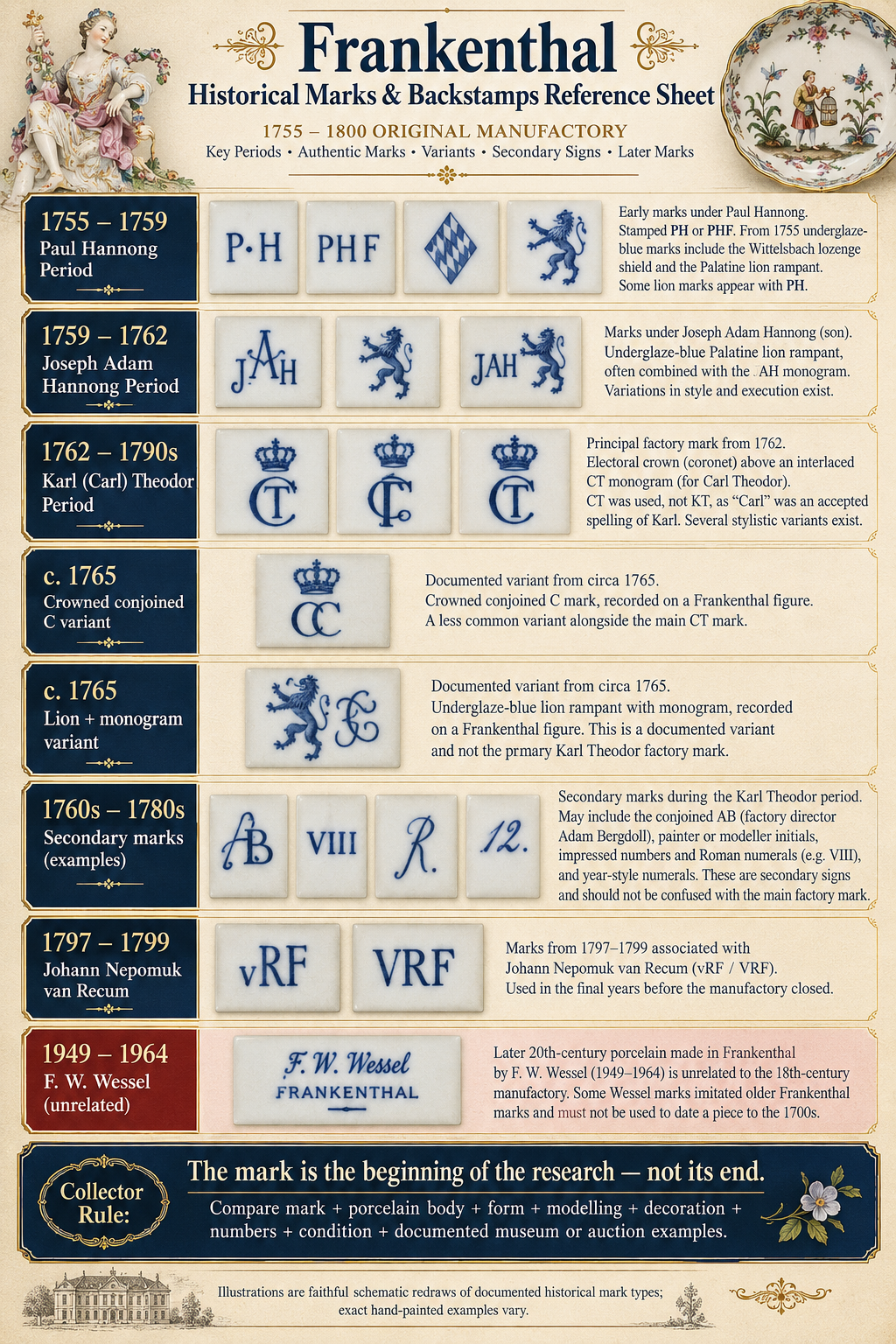
The historic Frankenthal manufactory is the 1755–1800 factory discussed in this guide. The separate F. W. Wessel concern was a twentieth-century business in Frankenthal and was not a continuation of the original manufactory. Current Erkenbert-Museum material documents Wessel production in Frankenthal from 1949 to 1958; some older collector references give broader end dates. Do not use a Wessel mark to attribute a piece to eighteenth-century Frankenthal.
Early Hannong Marks
Historical mark references document several early signs associated with the Hannong years, including stamped initials such as PH / PHF, heraldic devices and lion marks, together with monograms associated with the Hannong family.
These early marks can vary considerably in execution. They should therefore be checked against the body, form and decoration of genuine 1750s and early 1760s pieces.
| Mark Family | Broad Context | Collector Use |
|---|---|---|
| PH / PHF | Early Paul Hannong period. | Potentially important early attribution clue; compare exact form with historical references. |
| Heraldic / lion signs | Early Hannong production. | May occur in several variants and combinations. |
| JAH monogram | Joseph Adam Hannong period. | Supports pre-1762 attribution when consistent with the object. |
| Crowned CT | Electoral factory under Carl Theodor from 1762. | The best-known Frankenthal factory mark. |
| Secondary letters / numbers | Mainly Electoral-period production systems. | Can help refine dating, painter, modeller or workshop context. |
| VR / VRF / related late signs | Final van Recum years. | Useful for separating very late Frankenthal production from the classic CT period. |
Frankenthal CT Mark – What Does It Mean?
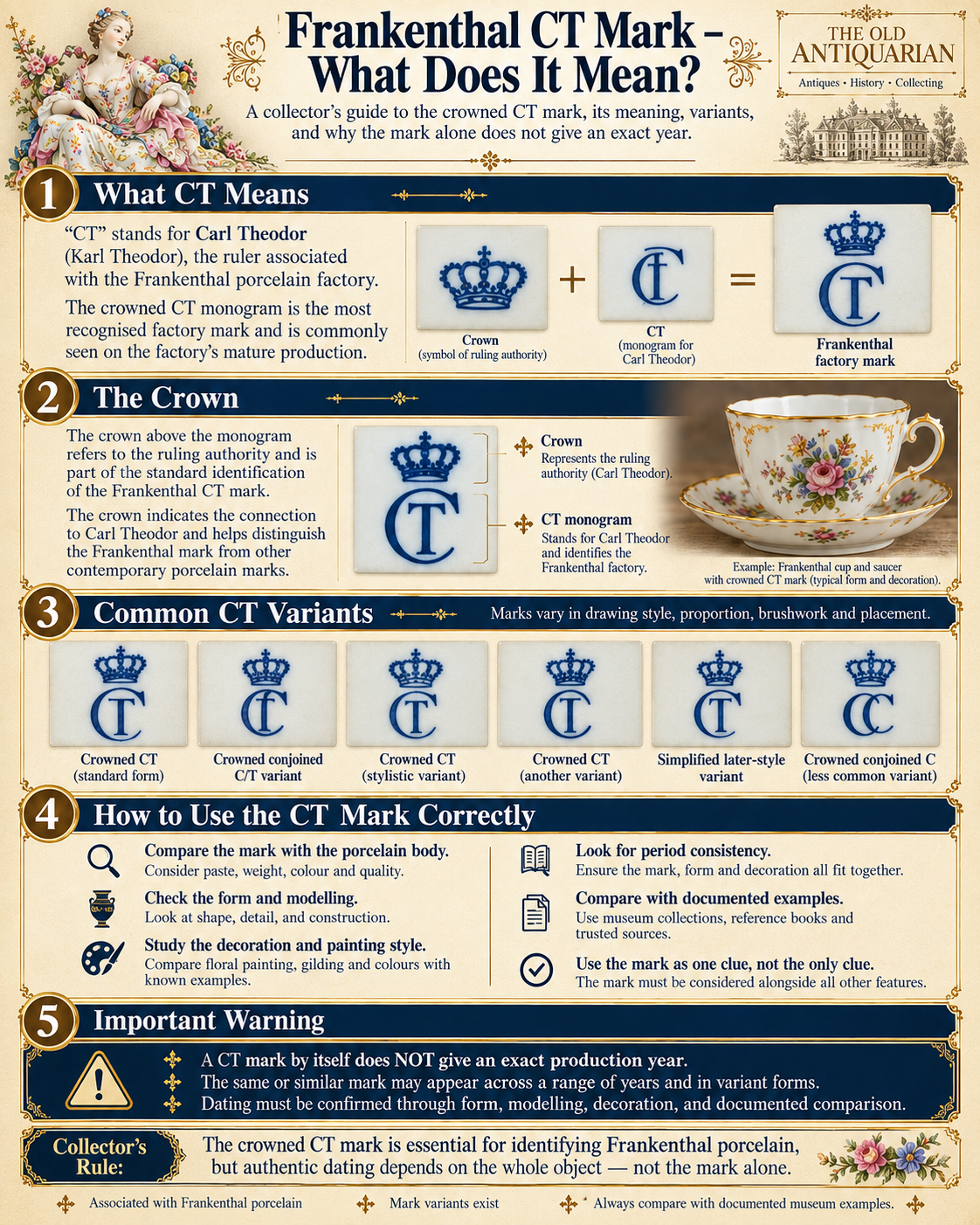
The letters CT refer to Carl Theodor, the Elector who acquired the factory in 1762.
English-language sources often spell his name Karl Theodor, but contemporary Frankenthal factory usage employed CT rather than KT. The Metropolitan Museum of Art notes that “Carl” was an accepted form of the ruler’s name.
It does not mean that every crowned CT mark belongs to one precise year, one modeller or one form.
Why Crowned CT Marks Vary
Eighteenth-century marks were hand applied and can differ in proportion, brushwork, colour density, crown shape and the precise relationship between the letters.
Documented pieces may also carry additional signs or numbers.
Date the object from the complete evidence: mark + body + form + modelling + decoration + secondary signs + documented comparison.
Frankenthal Secondary Marks, Numbers & Workmen’s Signs
A base can contain much more information than the main CT mark.
Specialist references document additional initials, Roman numerals, year-style numbers, impressed or incised signs and painter or modeller marks. These are especially useful when a known combination can be connected with a documented period.
| Secondary Evidence | Possible Meaning | Collector Warning |
|---|---|---|
| Painted initials | Painter, modeller, administrator or production-related sign. | Do not assign a person without documented comparison. |
| Roman numerals | Period-specific secondary factory notation on some pieces. | Not necessarily a date. |
| Arabic numbers | Can function as year-style, production or workshop signs depending on context. | Never assume every number is a literal year. |
| Incised signs | Can relate to moulding, forming or production control. | Often require specialist catalogues. |
| AB | Documented on some Electoral-period pieces and associated in specialist research with Adam Bergdoll. | Must be read together with the CT mark and the complete object. |
How to Date Frankenthal Porcelain
The most reliable Frankenthal date is usually a supported production range, not a single year.
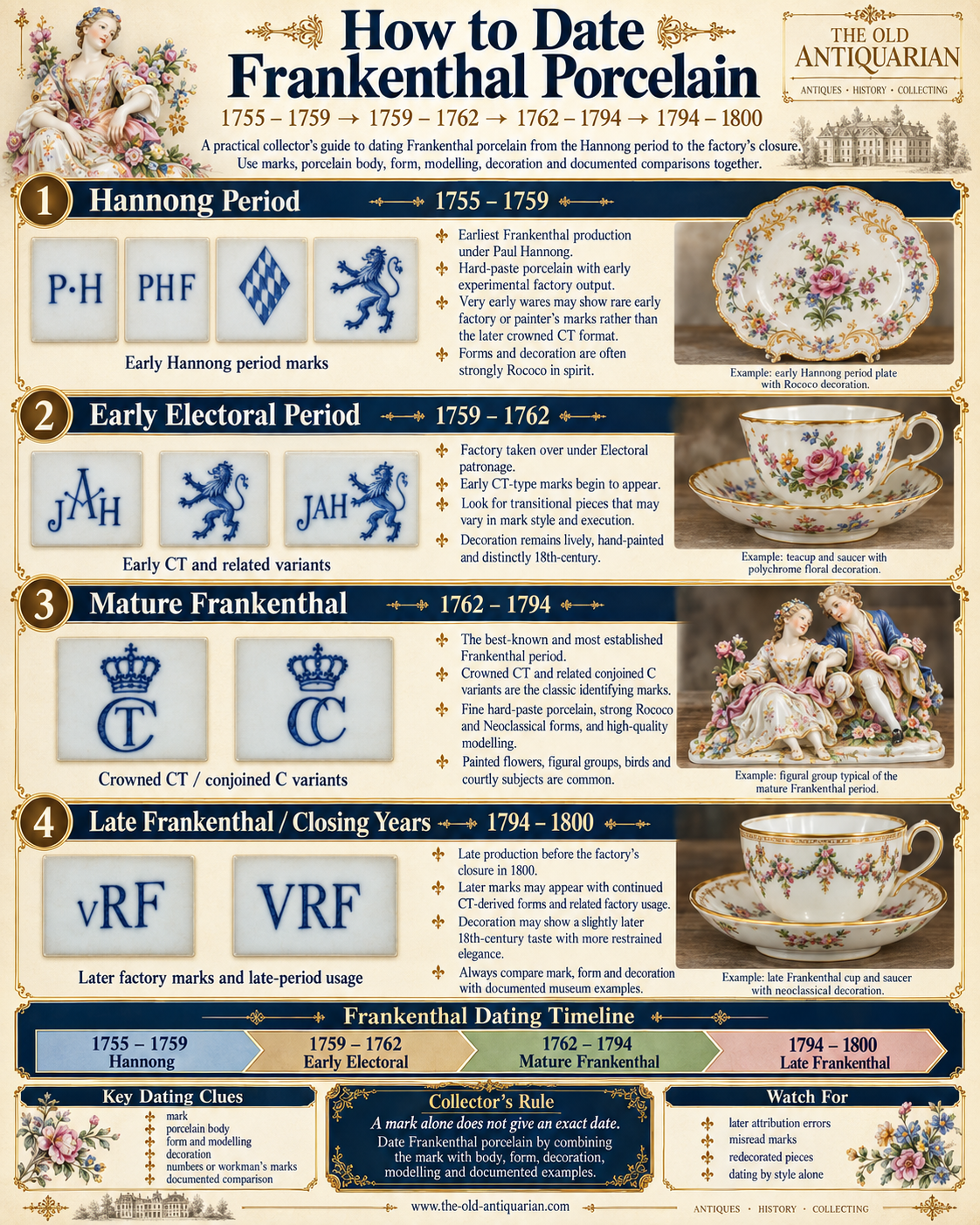
In the visual guide, read 1759–1762 as the Joseph Adam Hannong / transitional Hannong period. The mature crowned CT system belongs to Carl Theodor’s ownership beginning in 1762.
| Period | Historical Context | Useful Dating Clues |
|---|---|---|
| 1755–1757 | Foundation under Paul Anton Hannong; Karl Hannong manages the factory. | Earliest marks, French-influenced decoration, early tableware and Rococo forms. |
| 1757–1762 | Joseph Adam Hannong period. | Hannong marks, Johann Friedrich Lück modelling, transitional artistic development. |
| 1762–1770s | Early and mature Carl Theodor period. | Crowned CT, court models, high-quality figural sculpture, secondary marks. |
| 1770s–1780s | Mature Electoral production. | CT variants, documented numerical and workshop signs, Rococo transitioning toward Neoclassical taste. |
| 1794–1799 | Revolutionary disruption and final production. | Late factory administration, transitional marks, Directoire / classical taste. |
| 1800 | Official termination of the historic manufactory. | Objects claimed to be original Frankenthal after this date require another explanation. |
For a broader methodology that applies across European manufacturers, see
How to Date Antique Porcelain.
Frankenthal Hard-Paste Porcelain Body
Museum-documented eighteenth-century Frankenthal pieces are hard-paste porcelain.
When examining a proposed period object, look beyond translucency alone. Study the density of the body, firing quality, exposed foot, glaze, moulding and finishing of hidden areas.
| Feature | What to Examine |
|---|---|
| Body | Fine, dense hard-paste porcelain consistent with eighteenth-century European production. |
| Glaze | Quality, consistency, interaction with moulded detail and natural wear. |
| Foot / underside | Manufacturing traces, firing signs, old labels, marks and restoration. |
| Modelling | Controlled anatomical detail, drapery, faces, hands, flowers and rocaille elements. |
| Decoration | Brushwork, enamels, gilding, palette and stylistic consistency with the proposed date. |
How to Identify Genuine Frankenthal Porcelain
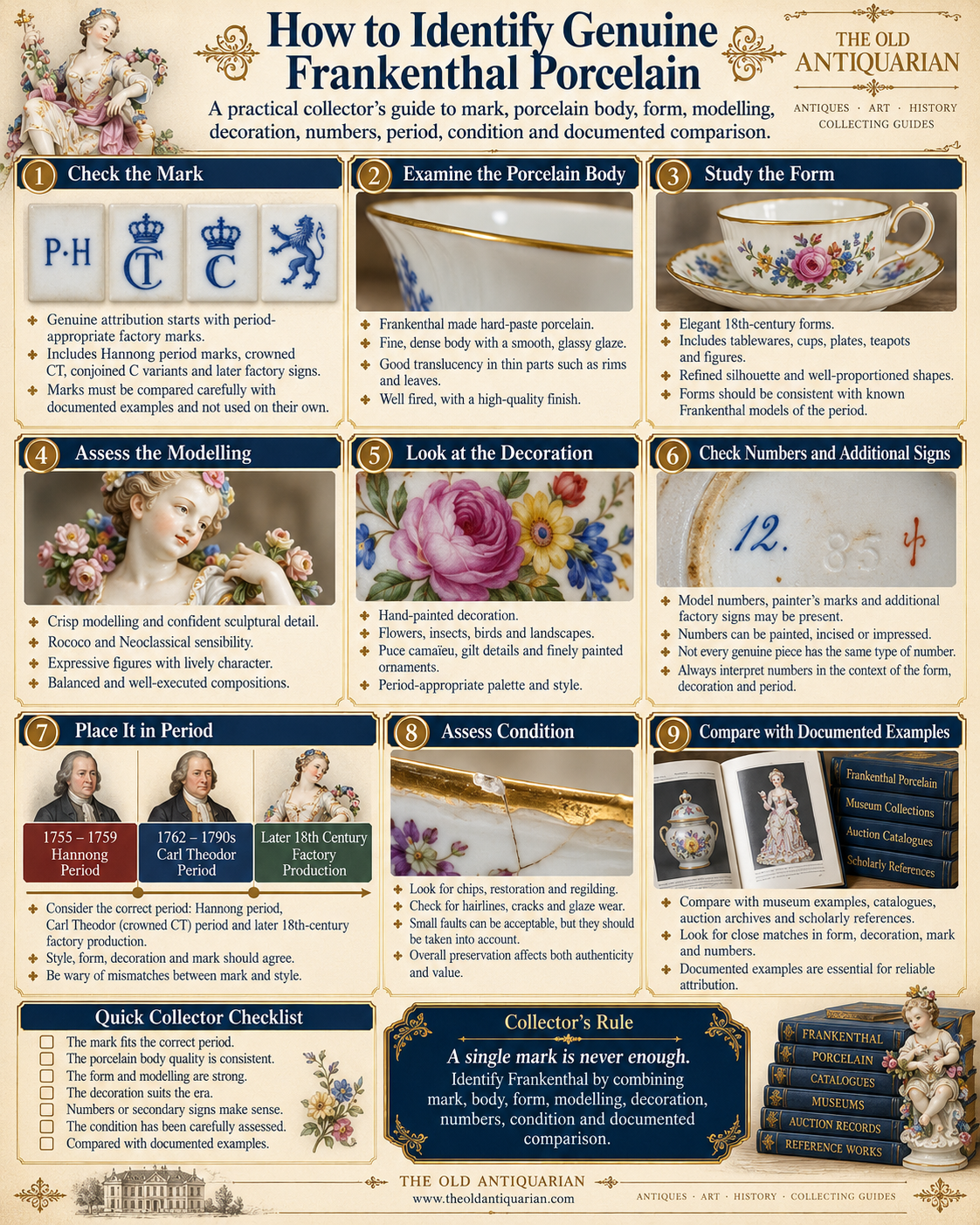
Include the main factory sign, every letter, painted numeral, impressed sign and old label.
The material should be consistent with documented Frankenthal hard-paste porcelain.
Determine whether the object is a figure, group, cup, plate, teabowl, jug, service component or another documented form.
Faces, hands, drapery, flowers, foliage, animals and rocaille work should show convincing eighteenth-century sculptural quality.
Compare floral painting, chinoiserie, landscapes, gilding and colour palette with museum examples.
Numbers and initials can help refine attribution, but they must be interpreted rather than guessed.
Ask whether the mark, form and decoration all agree with Hannong, Electoral or late Frankenthal production.
Repairs can conceal original construction, modelling and factory evidence.
Museum examples of the same or closely related models carry more evidentiary weight than anonymous online listings.
mark + hard-paste body + form + modelling + decoration + secondary signs + period + condition + documented comparison
For the general whole-object method, continue to
How to Identify Antique Porcelain.
Frankenthal Figurines & Figural Groups
Figural porcelain is one of the strongest areas of Frankenthal collecting.
The factory produced elegant couples, mythological subjects, allegories, shepherds, merchants, religious figures, theatrical and courtly characters, putti, animals and elaborate multi-figure groups.
These pieces were not simply ornaments. At eighteenth-century courts, porcelain figures and table sculptures formed part of sophisticated dining and display culture.
Franz Konrad Linck and Frankenthal Sculpture
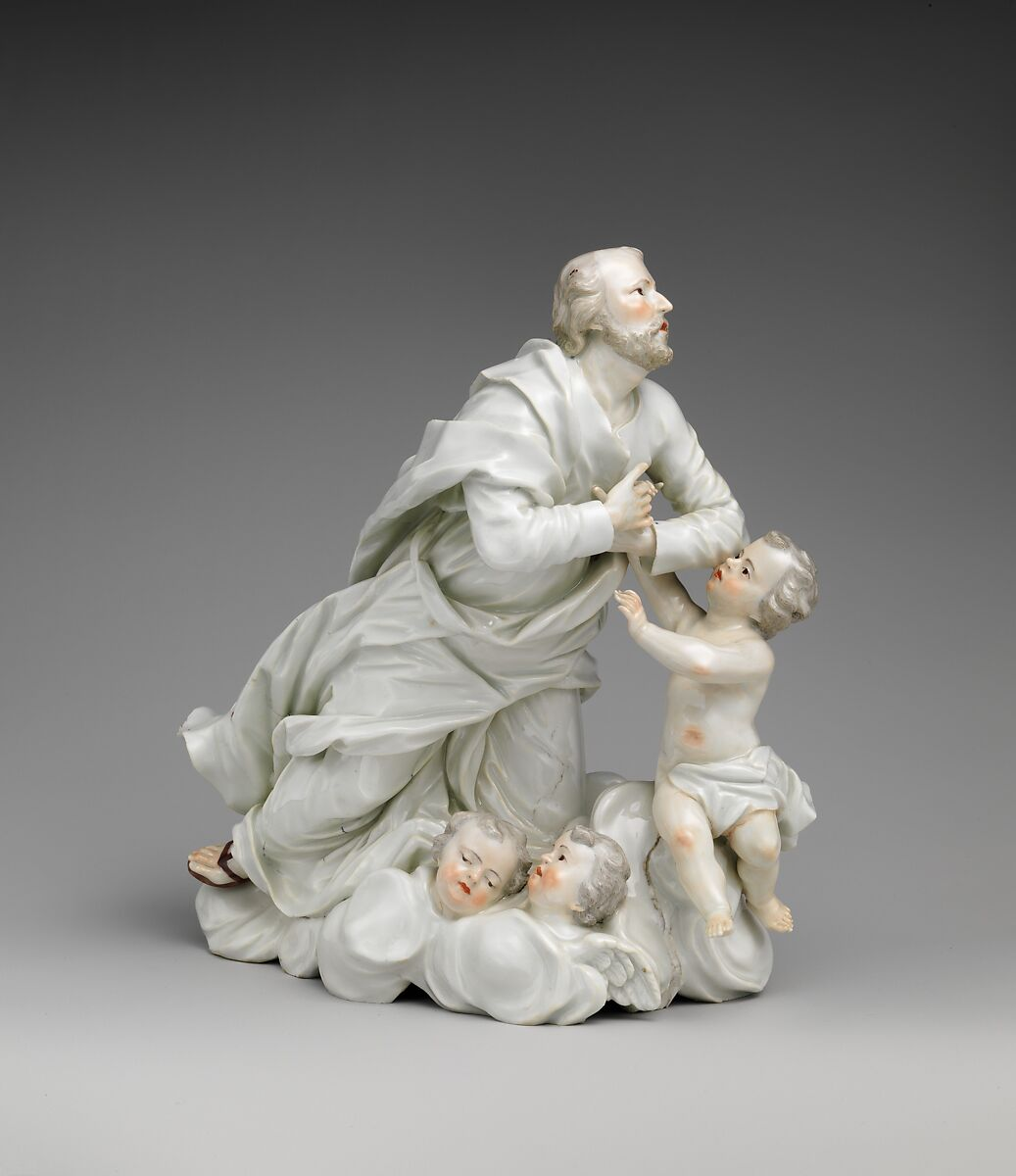
Franz Konrad Linck is one of the central names in mature Frankenthal sculpture.
The Met documents Linck as active at Frankenthal from 1762 to 1766. His work demonstrates how ambitious the manufactory became during the early Carl Theodor period.
The Four Continents
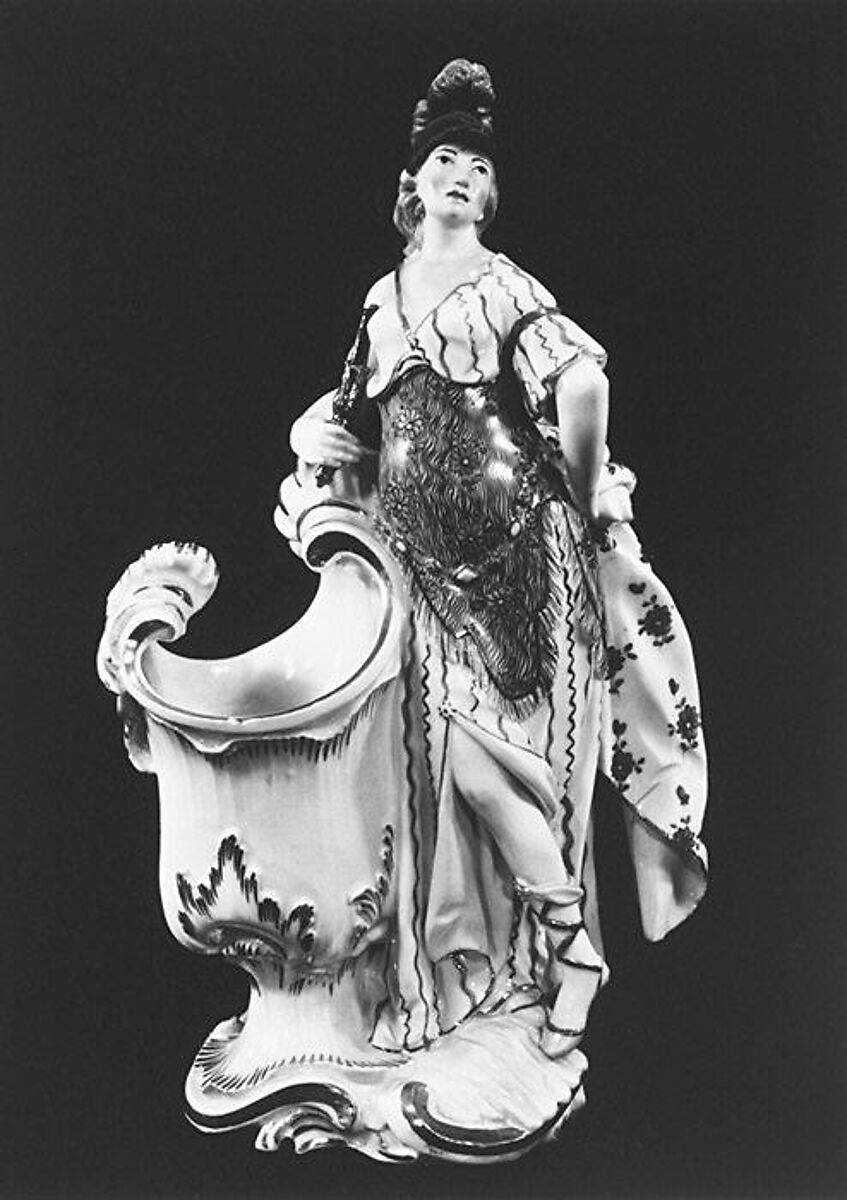
Linck modelled allegorical figures representing the continents, including the museum-documented figure Europe of circa 1765.
Such subjects combined courtly display with geography, mythology and allegory – exactly the type of intellectual conversation piece suited to an eighteenth-century ceremonial table.
Three Fates – 1773
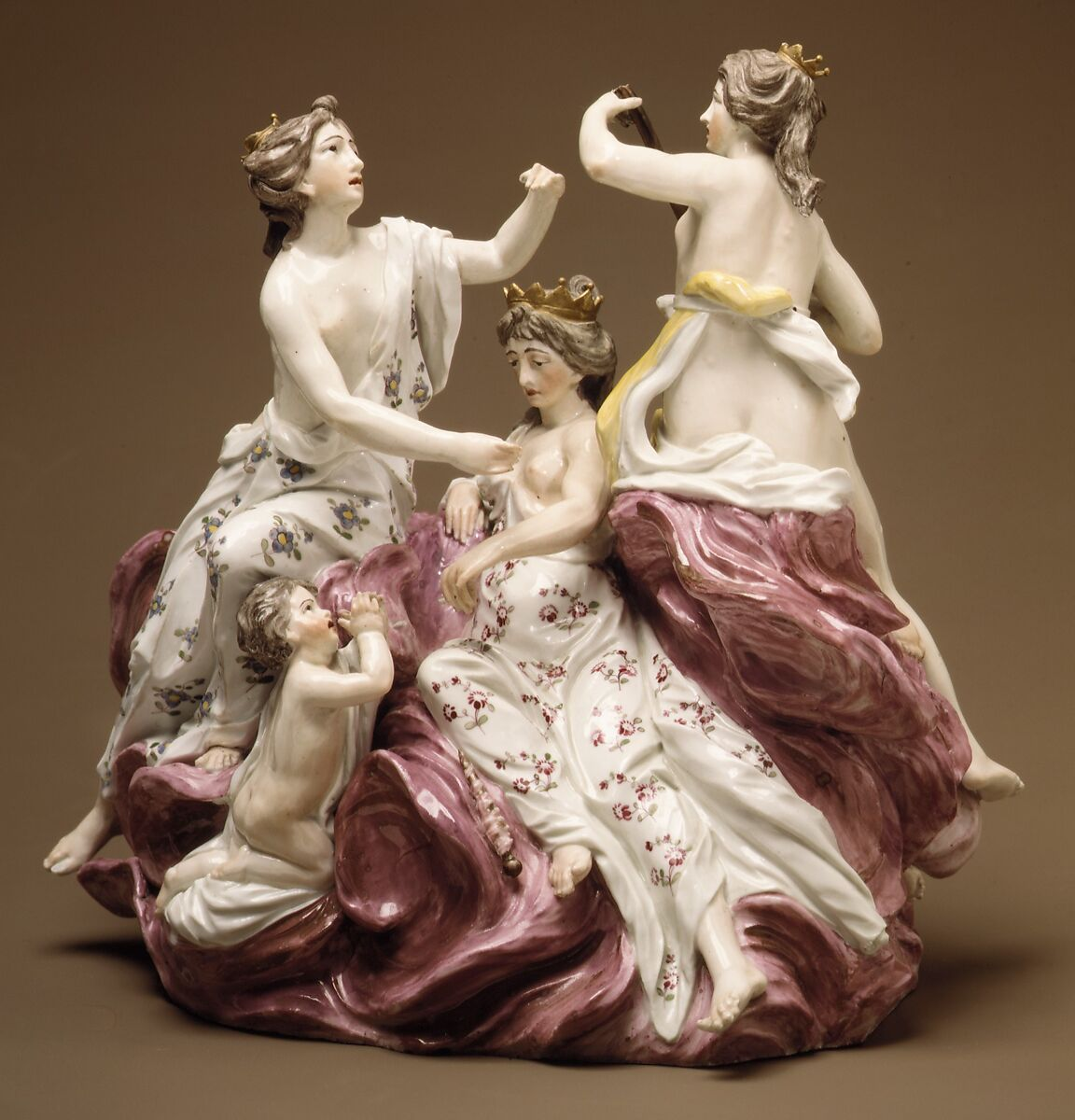
A model can originate earlier than the individual porcelain example. The Met dates this particular Three Fates group to 1773 while identifying Linck as the modeller. Always distinguish model date from production date of the individual object.
Johann Friedrich Lück & Karl Gottlieb von Lück
The Lück name is important in Frankenthal’s sculptural history.
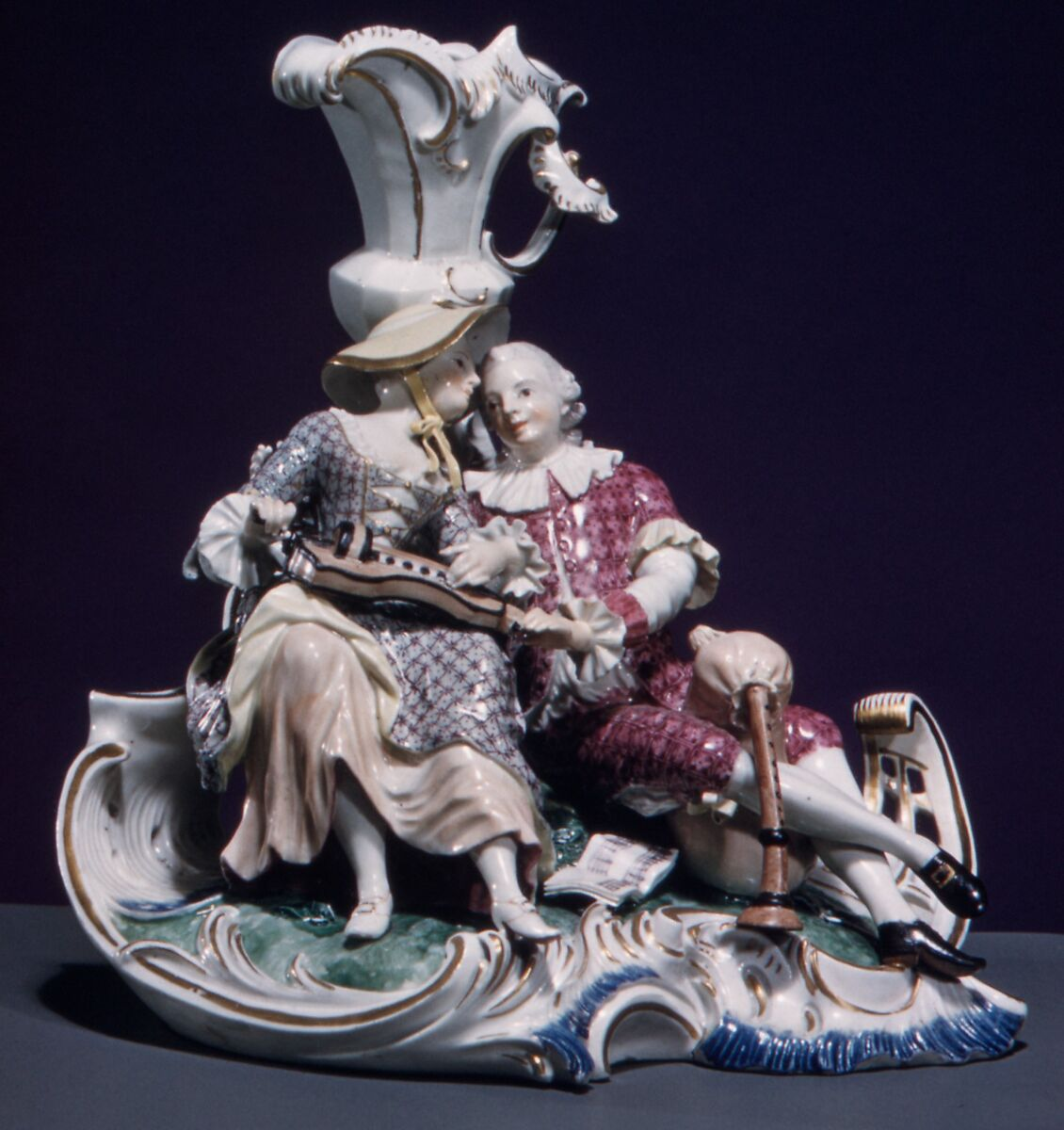
Johann Friedrich Lück’s documented Two Lovers of circa 1760 belongs to the Joseph Adam Hannong years and demonstrates the artistic refinement achieved before the Electoral takeover.
Karl Gottlieb von Lück is associated with later complex groups, including the extraordinary Chinese Pavilion of circa 1770.
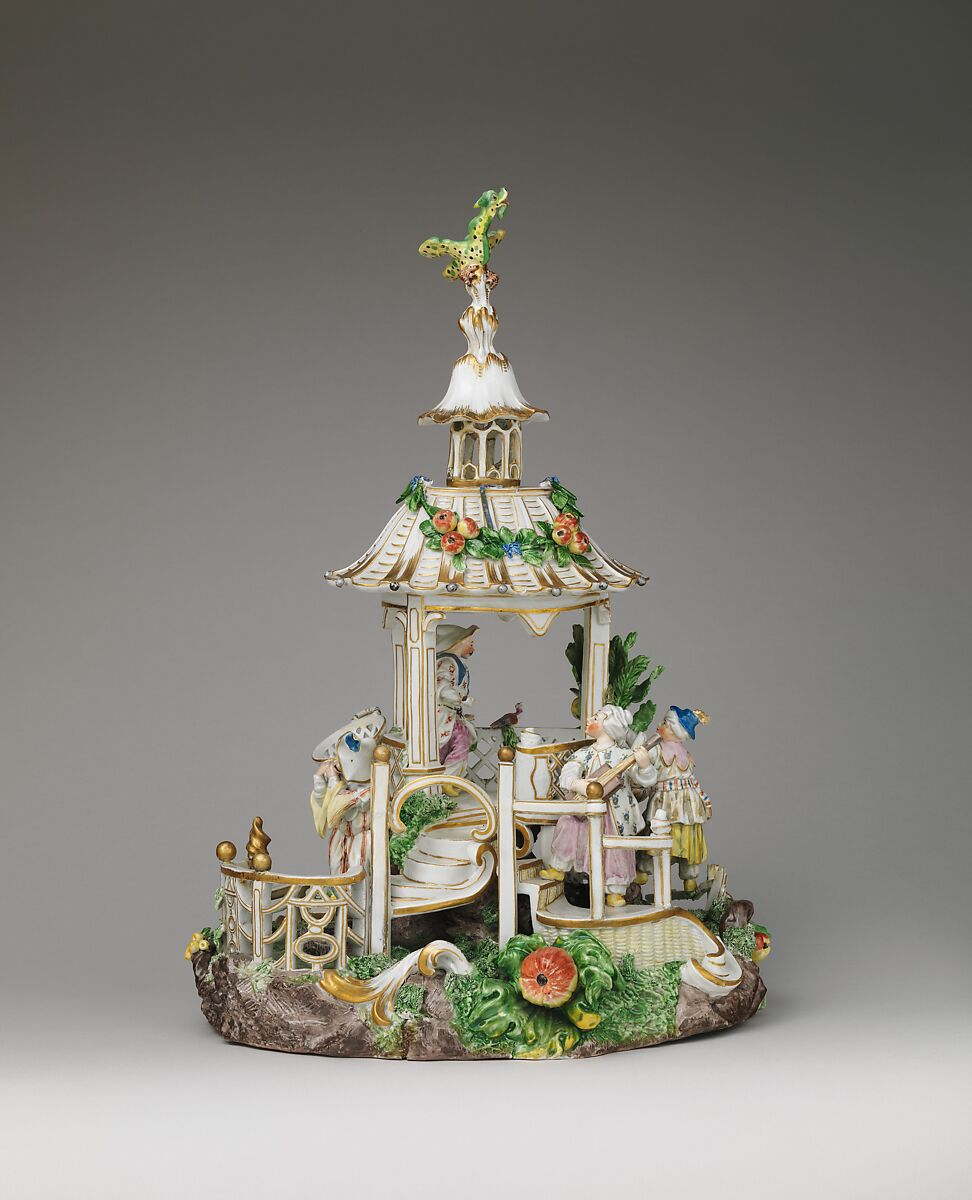
At more than 40 cm high, the museum example demonstrates the technical ambition possible at Frankenthal: architecture, multiple figures, foliage, colour, gilding and a complex sculptural base are combined in a single porcelain composition.
Frankenthal Tableware, Floral Painting & Chinoiserie
Frankenthal’s reputation should not be reduced to figurines. The official history of the manufactory emphasises table culture as a central purpose of production.
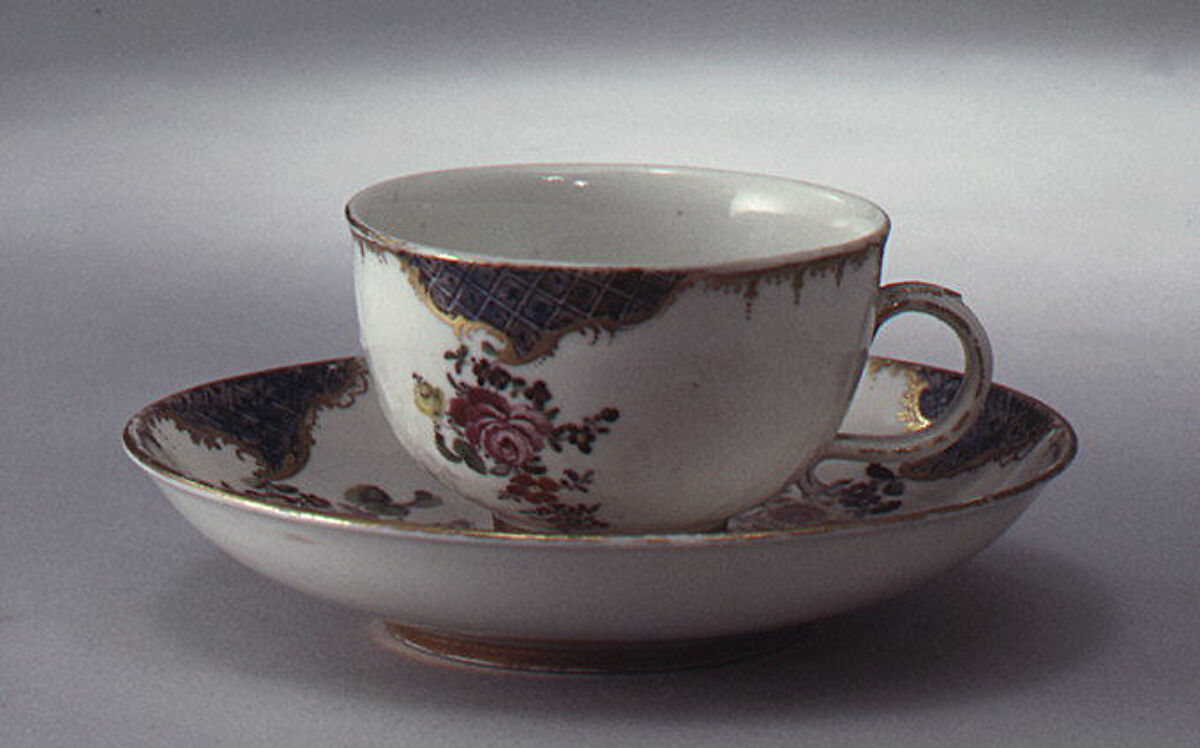
Cups, saucers, plates, jugs, teapots, coffee wares, tureens and complete services could range from relatively restrained decoration to elaborate painting and gilding.
Floral Decoration
Painted flowers appear frequently on eighteenth-century European porcelain, so floral decoration alone cannot identify Frankenthal.
What matters is the combination of brushwork, palette, spacing, gilding, border design, form and factory evidence.
Chinoiserie
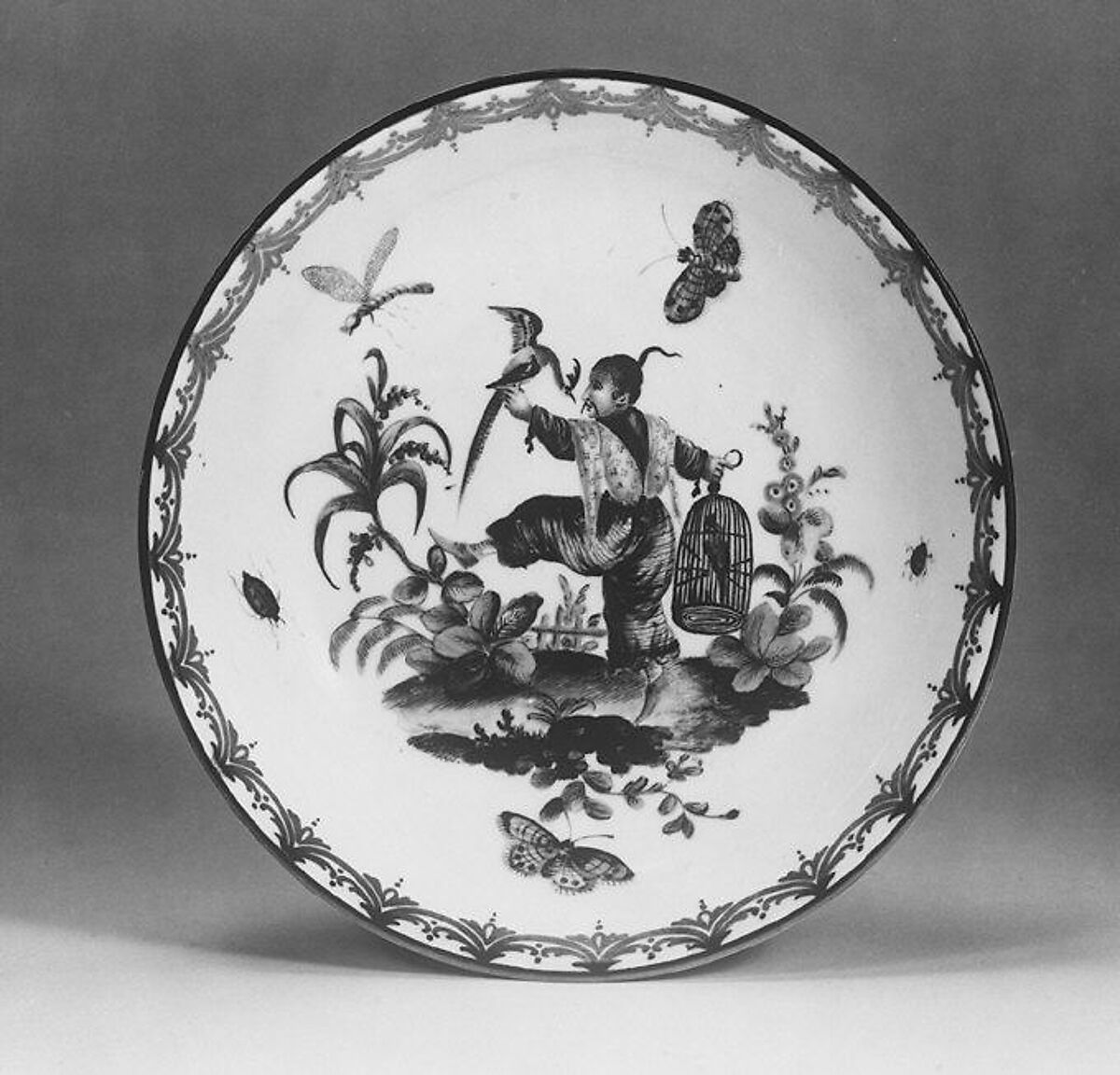
European fascination with Asian art and imagined Asian subjects continued throughout the eighteenth century. Frankenthal painters used chinoiserie figures, exotic plants, insects and other motifs within distinctly European Rococo compositions.
Landscape Painting
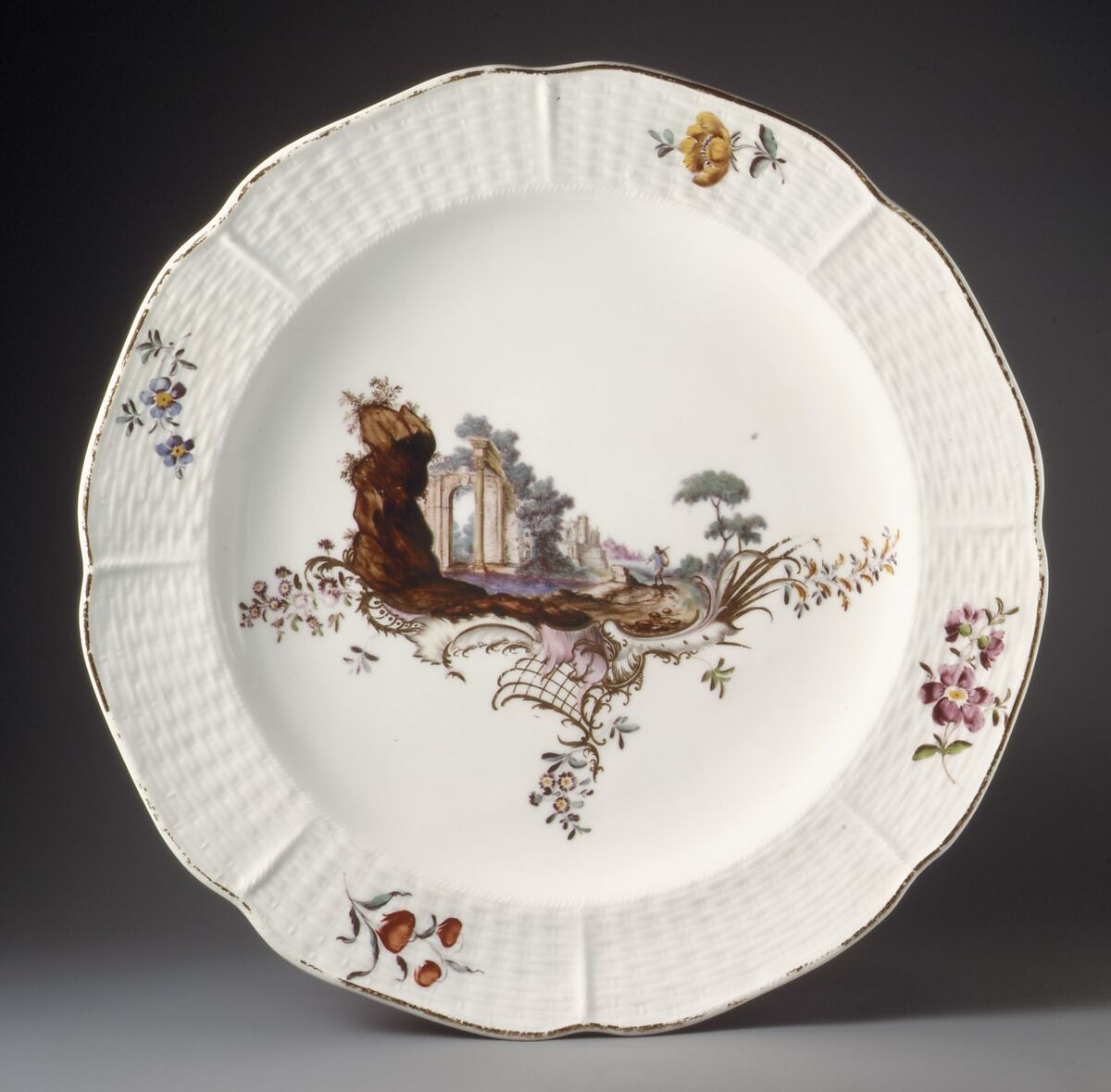
Early Frankenthal also includes refined landscapes and architectural scenes. The 1755–1759 plate shown at the beginning of this guide is especially useful because its spacious painted composition illustrates the French-influenced character of the earliest years.
20 Types of Frankenthal Porcelain Objects
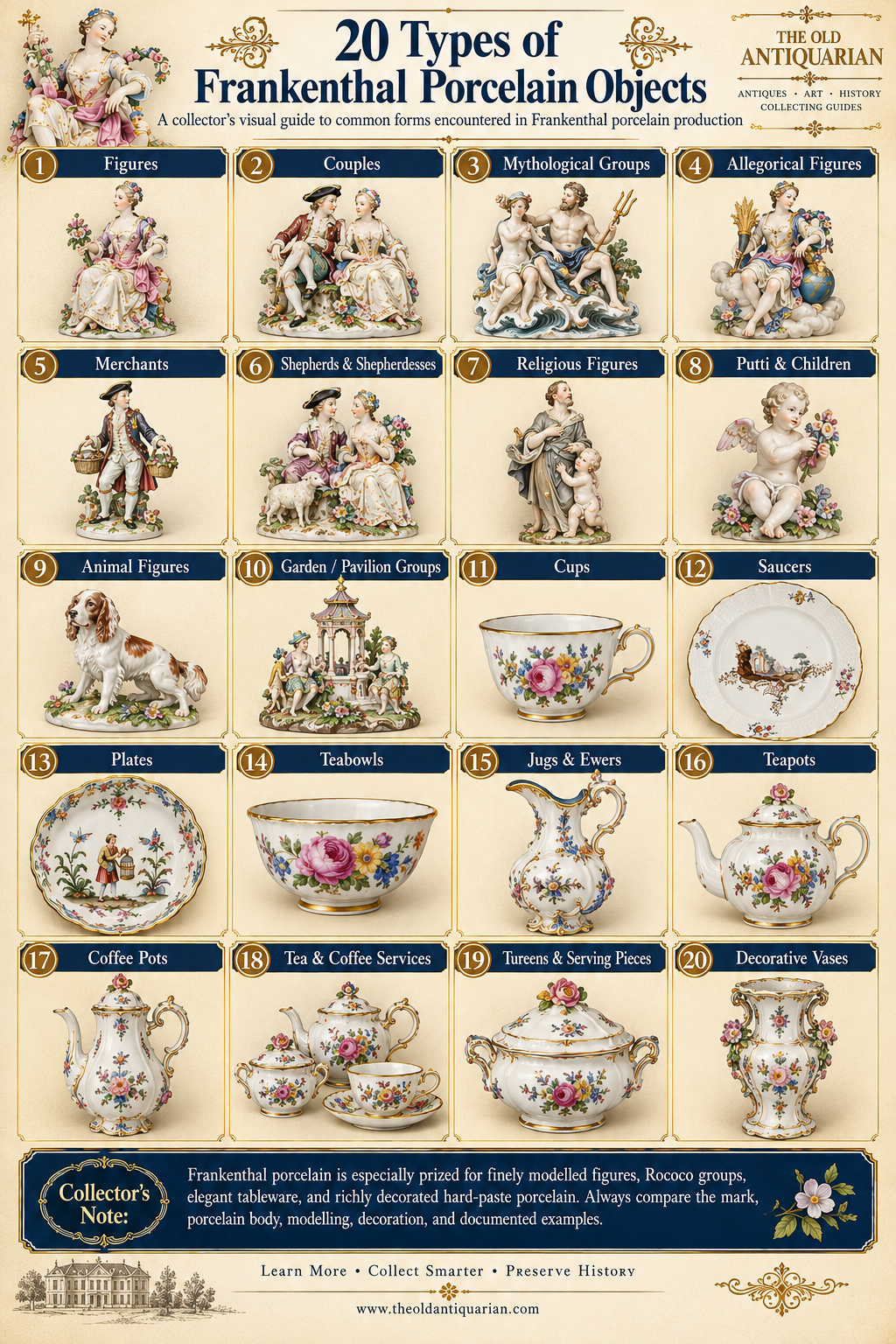
| Figural & Sculptural | Tableware & Decorative |
|---|---|
| Individual figures | Cups |
| Couples | Saucers |
| Mythological groups | Plates |
| Allegorical figures | Teabowls |
| Merchants | Jugs and ewers |
| Shepherds and shepherdesses | Teapots |
| Religious subjects | Coffee pots |
| Putti and children | Tea and coffee services |
| Animals | Tureens and serving pieces |
| Pavilion / garden groups | Decorative vessels and vases |
Frankenthal vs Meissen vs Höchst
Frankenthal, Meissen and Höchst all belong to the history of German hard-paste porcelain, but they should not be identified from a general Rococo appearance.
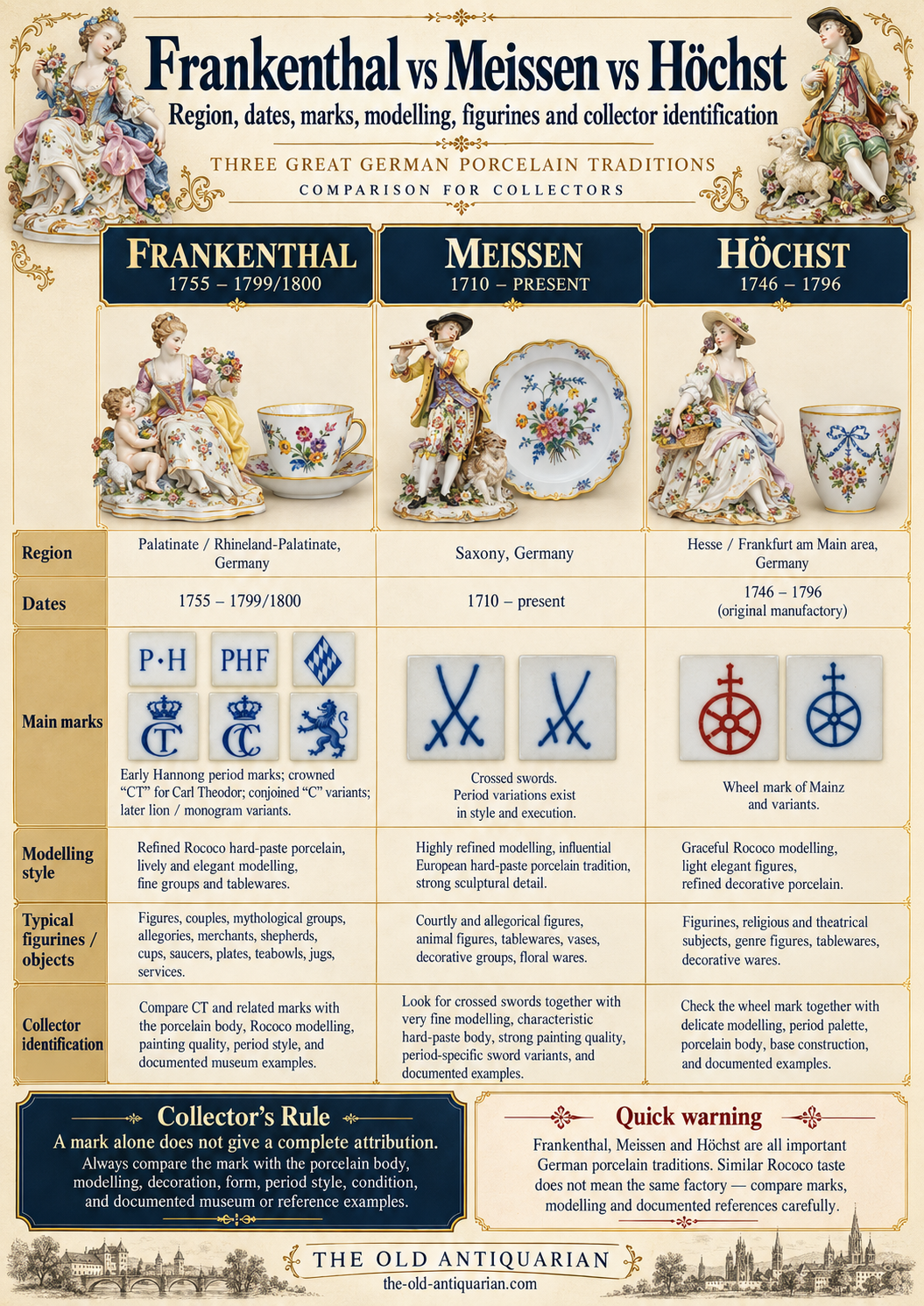
Frankenthal
Established: 1755
Region: Electoral Palatinate
Key mark: Crowned CT from the Carl Theodor period
Strength: Refined Rococo figures, allegories, courtly groups and elegant tableware.
Meissen
Established: 1710
Region: Saxony
Key mark: Crossed swords
Strength: Foundational European hard-paste porcelain tradition, major sculpture and extensive documented production.
Höchst
Founded: 1746
Region: Höchst am Main
Key clue: Wheel mark variants
Strength: Graceful figures, theatrical and religious subjects and important mid-eighteenth-century sculpture.
Compare factory mark, porcelain body, modelling, base construction, decoration and documented examples before attribution.
For a detailed crossed-swords comparison, use our
Meissen Porcelain Identification Guide.
For another major eighteenth-century German tradition, compare
Nymphenburg porcelain
and
Fürstenberg porcelain.
Later Frankenthal Reproductions, Reissues & Misattributions
This is one of the most important sections for anyone searching for a “Frankenthal CT mark.”
The original manufactory closed in 1800, but Frankenthal models and visual language did not disappear.
Nymphenburg Reproductions from Frankenthal Moulds
Official Frankenthal historical research notes that numerous original moulds eventually reached Nymphenburg. From the late nineteenth into the early twentieth century, figures were reproduced from historic Frankenthal forms.
Some later Nymphenburg reproductions can carry a CT-style mark together with the Nymphenburg lozenge shield. Such a piece is not an eighteenth-century Frankenthal original merely because CT appears on it.
F. W. Wessel – Frankenthal, 20th Century
A separate porcelain factory operated in Frankenthal after the Second World War under Friedrich Wilhelm Wessel.
Erkenbert-Museum documents production in Frankenthal from 1949 to 1958. The enterprise attempted to connect itself commercially with the reputation of the famous eighteenth-century manufactory, but it was historically unrelated.
| Object / Mark | Interpretation |
|---|---|
| Original 18th-century crowned CT consistent with period object | Potential Frankenthal attribution; still requires whole-object verification. |
| CT + Nymphenburg lozenge shield | Can indicate later Nymphenburg production from an old Frankenthal model. |
| F. W. Wessel / Frankenthal wording | 20th-century Frankenthal-area manufacture, not the original 1755–1800 factory. |
| CT mark on poor-quality later porcelain | Possible imitation, reproduction or misleading attribution; investigate further. |
Condition & Restoration
Eighteenth-century Frankenthal figures are often complex and fragile. Restoration is therefore common and should be expected as a possibility rather than treated as an exceptional event.
| Area | Typical Risk | Why It Matters |
|---|---|---|
| Hands & fingers | Breaks, replacement fingers, repainting. | Small repairs can be visually subtle but materially affect condition. |
| Flowers & foliage | Losses to petals, leaves and stems. | Applied porcelain flowers are inherently vulnerable. |
| Accessories | Canes, instruments, baskets, staffs and other losses. | Missing attributes may also complicate model identification. |
| Figure groups | Reattached figures or structural joins. | Large compositions carry more mechanical stress. |
| Gilding | Wear or later regilding. | Original surface preservation matters. |
| Painted decoration | Retouching and overpainting. | Can disguise restoration. |
| Base | Grinding, filling, drilled holes or altered marks. | The underside contains crucial authentication evidence. |
Photograph the base, labels, marks and all existing damage. Never remove historical labels or aggressively clean a potentially important eighteenth-century porcelain object before research.
Frankenthal Porcelain Value
There is no useful universal price for “Frankenthal porcelain.”
A documented eighteenth-century Linck figure group, an early Hannong plate, a restored CT-marked figure, a later Nymphenburg casting and an unrelated twentieth-century Wessel piece belong to completely different markets.
Use genuinely comparable completed sales, not ambitious dealer or marketplace asking prices.
exact attribution + period + model + modeller + form + size + decoration + rarity + condition + restoration + completeness + provenance + genuinely comparable completed sales
| Value Factor | Why It Matters |
|---|---|
| Production period | Early Hannong, mature Electoral and late-period pieces belong to different collecting contexts. |
| Model / subject | Important documented groups can attract specialist demand. |
| Modeller | Secure association with Linck, Lück or another important modeller can increase historical interest. |
| Mark | A documented mark can support attribution but must agree with the object. |
| Decoration | Quality of painting, gilding and palette matters. |
| Rarity | Uncommon models and surviving early forms may be more desirable. |
| Condition | Losses, cracks and chips can materially reduce demand. |
| Restoration | Location, extent, quality and reversibility of repair matter. |
| Provenance | Documented collection history can strengthen confidence and historical interest. |
| Comparable sales | Realised prices for truly similar pieces provide stronger market evidence than asking prices. |
Does a Crowned CT Mark Make Frankenthal Valuable?
No, not by itself.
A correct CT mark can be important evidence, but collector value comes from the complete object. A damaged, later or misattributed CT-marked piece can be less desirable than an unassuming but securely documented early Frankenthal object.
For the wider valuation method, see our
Professional Antique Valuation
and the central
Antique Porcelain Guide.
Frankenthal Collector Checklist
- Photograph the complete object from all sides.
- Photograph the entire underside.
- Record the exact factory mark.
- Do not identify every crowned monogram as Frankenthal.
- Distinguish Hannong-period signs from post-1762 crowned CT.
- Record every painted, impressed and incised number.
- Check whether secondary marks fit the proposed period.
- Confirm the body is consistent with hard-paste porcelain.
- Compare form and modelling with documented museum examples.
- Identify the subject or model where possible.
- Look for known modeller associations.
- Inspect fingers, flowers, leaves, accessories and thin extremities.
- Check for restoration under magnification and UV where appropriate.
- Inspect the base for grinding or altered marks.
- Do not assume stylistic similarity to Meissen proves Meissen or Frankenthal.
- Watch for later Nymphenburg casts from Frankenthal moulds.
- Separate F. W. Wessel production from the historic manufactory.
- Preserve old labels and provenance documents.
- Compare with museum objects before marketplace listings.
- Use completed sales when researching value.
Do You Have Frankenthal Porcelain?
Send clear photographs of the complete object, the entire underside, every factory mark and number, dimensions, provenance and any visible restoration. For figurines, include close-ups of the hands, flowers, accessories and base.
Frankenthal · German Porcelain · CT Marks · Figurines · Decorative Arts
Frankenthal Porcelain FAQ
When was the Frankenthal porcelain factory founded?
The manufactory was established in 1755 after Elector Carl Theodor granted Paul Anton Hannong permission to establish a porcelain factory at Frankenthal on May 26, 1755.
When did Frankenthal porcelain production end?
Production effectively ceased in 1799. The historic manufactory was officially closed by decree on May 27, 1800.
What does the Frankenthal CT mark mean?
CT refers to Carl Theodor, the Elector who acquired the manufactory in 1762. His intertwined initials beneath an electoral crown became Frankenthal’s best-known factory mark.
Why is the mark CT and not KT for Karl Theodor?
Historic Frankenthal used CT because Carl was an accepted spelling of the ruler’s name. The Metropolitan Museum of Art specifically notes this point in its Frankenthal research.
Does a crowned CT mark prove genuine Frankenthal?
No. The mark must agree with the porcelain body, form, modelling, decoration, secondary signs and historical period. Later reproductions and imitated CT marks exist.
What marks were used before the CT mark?
Early Hannong-period references document initials such as PH and PHF, heraldic and lion devices, and monograms connected with the Hannong family. The exact execution should always be checked against specialist references.
Is Frankenthal porcelain hard-paste porcelain?
Yes. Museum-documented eighteenth-century Frankenthal objects are identified as hard-paste porcelain.
Who were the most important Frankenthal modellers?
Important names include Johann Friedrich Lück, Franz Konrad Linck, Karl Gottlieb von Lück and Johann Peter Melchior.
How can I date a Frankenthal figurine?
Combine the exact factory mark with secondary numbers, model, porcelain body, modelling style, decoration, condition and comparison with securely dated museum examples.
Are later Nymphenburg Frankenthal models original Frankenthal?
No. Historic Frankenthal moulds were later used at Nymphenburg. Some reproductions can carry both CT-related identification and the Nymphenburg lozenge shield, so the individual production period must be established.
Is F. W. Wessel Frankenthal the same factory?
No. F. W. Wessel was a separate twentieth-century porcelain manufacturer in Frankenthal and was not the original 1755–1800 manufactory.
What determines Frankenthal porcelain value?
Value depends on exact attribution, period, model, modeller, rarity, size, decoration, condition, restoration, completeness, provenance and genuinely comparable completed sales.
Related Guides
Sources & Further Research
-
Stadt Frankenthal / Erkenbert-Museum – Frankenthaler Porzellan
– official local history covering the 1755 foundation, Hannong family, Carl Theodor takeover, artists, Revolutionary decline and closure. -
The Metropolitan Museum of Art – European Porcelain in The Metropolitan Museum of Art
– authoritative overview of Frankenthal’s history, hard-paste production, Carl Theodor ownership and CT monogram. -
The Metropolitan Museum of Art – German Porcelain of the Eighteenth Century
– scholarly context for early Frankenthal and eighteenth-century German porcelain. -
The Met – Frankenthal Plate, 1755–1759
– Paul Hannong period, hard-paste porcelain, Public Domain. -
The Met – Two Lovers, circa 1760
– Johann Friedrich Lück, Joseph Adam Hannong period, hard-paste porcelain. -
The Met – Europe, circa 1765
– Franz Konrad Linck, Karl Theodor period. -
The Met – Journey of a Soul to Heaven, circa 1765
– Franz Konrad Linck, Public Domain. -
The Met – Chinese Pavilion, circa 1770
– Karl Gottlieb von Lück, hard-paste porcelain. -
The Met – Three Fates, 1773
– precisely dated example modelled by Franz Konrad Linck. -
Erkenbert-Museum – Friedrich Wilhelm Wessel Porcelain Factory
– official documentation of the separate twentieth-century Frankenthal factory and its 1949–1958 production.
The infographics in this guide are educational orientation tools. Historical factory marks were hand applied and can vary in drawing, colour, position and associated secondary signs. Exact attribution should prioritise the documented object, museum record, historical factory chronology and specialist mark reference over a simplified redraw.
About The Old Antiquarian
The Old Antiquarian combines more than 35 years of practical experience with antiques and collecting with historical, museum and comparative research.
For Frankenthal porcelain, we treat the factory mark as one element within a larger body of evidence: material, modelling, form, decoration, secondary signs, condition, restoration, provenance and securely documented historical comparisons.
Continue with our
German Porcelain Guide
or explore the
Complete Antique Porcelain Guide.
Conclusion: Frankenthal Identification Requires the Whole Object
Frankenthal’s short history makes it one of the most fascinating areas of eighteenth-century German porcelain.
In less than half a century, the manufactory developed from the Hannong family’s transplanted Strasbourg tradition into a sophisticated Electoral factory producing some of Germany’s most expressive Rococo figures, allegories, chinoiserie groups and tablewares.
The crowned CT mark is central to that story, but it is not enough by itself.
The strongest attribution is one in which the mark, porcelain body, form, modelling, decoration, secondary signs, historical period, condition and documented comparison all point to the same conclusion.
Identify the mark → establish the period → examine the body → match the form and model → study the decoration → inspect condition → compare museum examples → then research value.
