
Wallendorf Porcelain: Marks, Figurines, Ballerinas & Value
German Porcelain Identification Guide
Last Updated: September 29, 2026 | The Old Antiquarian
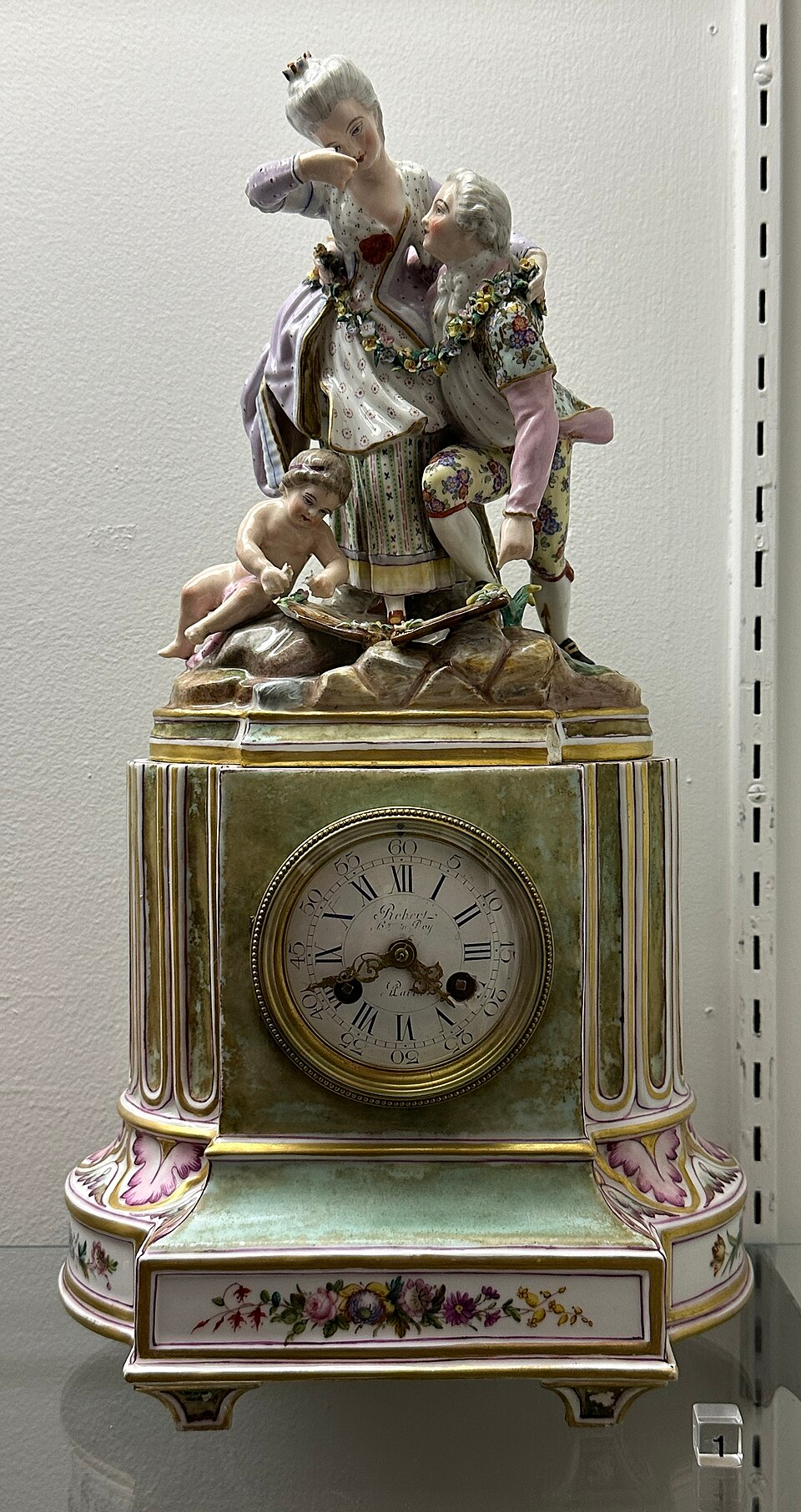
Wallendorf is a historic Thuringian porcelain manufactory officially founded on March 30, 1764. Collectors encounter early eighteenth-century tableware, nineteenth-century decorative porcelain, Schaubach Kunst figurines, Wallendorf ballerinas, GDR-era production and later factory wares. Its marks changed repeatedly as ownership and political circumstances changed. The most recognisable later trademark is a crowned W above 1764, but the number 1764 refers to the founding year of the manufactory and does not mean that a particular piece was made in the eighteenth century. Reliable identification combines the exact mark with the porcelain body, form, modelling, decoration, model numbers, country wording, condition and documented comparisons.
Wallendorf Porcelain at a Glance
| Feature | Collector Reference |
|---|---|
| Manufactory | Wallendorfer Porzellanmanufaktur. |
| Official foundation | March 30, 1764. |
| Region | Wallendorf / Lichte, Thuringia, Germany. |
| Founder | Johann Wolfgang Hammann, working with his son Ferdinand Friedrich Hammann and members of the Greiner family. |
| Material | Hard-paste porcelain. |
| Important material change | From about 1780, purer Bohemian kaolin helped Wallendorf produce a much whiter porcelain body. |
| Early production | Coffee, tea and cocoa services, steins, boxes, pipe-related wares and other functional porcelain. |
| Important later production | Figurines, ballerinas, dancers, female figures, animals, decorative groups, vases and tableware. |
| Schaubach Kunst | 1926–1953. |
| VEB / GDR period | 1953–1990. |
| Famous later mark | Crowned W above 1764, introduced around the manufactory’s 200th anniversary. |
| Main identification risk | Assuming that W / 1764 means a piece was manufactured in 1764. |
| Value | Depends on production period, model, designer or modeller, rarity, decoration, condition, restoration, completeness, provenance and comparable completed sales. |
The mark is the beginning of the research — not its end.
A crowned W and the number 1764 do not by themselves prove eighteenth-century age.
Wallendorf belongs to the wider history of
German porcelain,
alongside major manufactories and regional traditions such as Meissen, KPM Berlin, Fürstenberg, Nymphenburg, Dresden and the many factories of Thuringia.
In This Guide
- What is Wallendorf porcelain?
- History of the Wallendorf manufactory
- Early Wallendorf, 1764–1787
- Why early Wallendorf marks resemble Meissen
- Wallendorf in the 19th century
- Fraureuth period
- Schaubach Kunst
- VEB / GDR production
- Wallendorf porcelain marks
- What does W 1764 mean?
- How to date Wallendorf porcelain
- Wallendorf figurines and ballerinas
- 20 types of Wallendorf objects
- Wallendorf vs Meissen
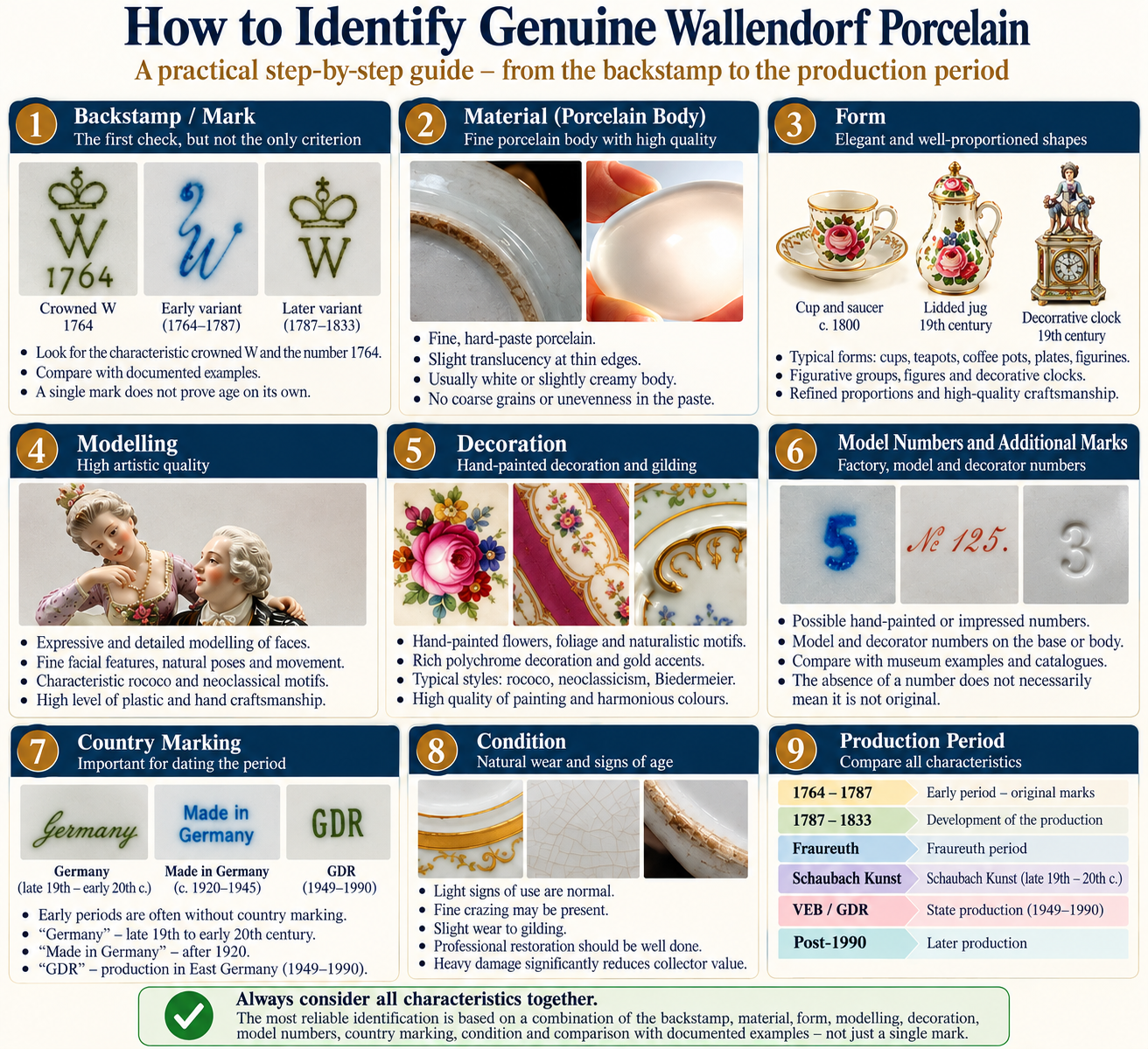
- How to identify genuine Wallendorf
- Antique vs Schaubach vs GDR vs later
- Condition and restoration
- Wallendorf porcelain value
- Collector checklist
- FAQ
- Sources & Further Research
What Is Wallendorf Porcelain?
Wallendorf porcelain is porcelain associated with the historic Wallendorf manufactory in Thuringia, Germany. Its official foundation dates to March 30, 1764, when a licence to manufacture porcelain was granted in the Duchy of Saxe-Coburg.
The factory developed within the broader eighteenth-century German search for high-quality hard-paste porcelain that followed the success of
Meissen.
Over the following centuries, Wallendorf passed through numerous owners and company structures, and this complex history is reflected in its unusually varied backstamps.
“Genuine Wallendorf” identifies the manufacturer or factory tradition. It does not automatically mean “eighteenth-century antique.” Genuine Wallendorf pieces were made during the nineteenth century, the Schaubach Kunst period, the GDR era and after German reunification.
History of the Wallendorf Porcelain Manufactory
Johann Wolfgang Hammann initially sought permission to establish porcelain production in Schwarzburg-Rudolstadt. After an exclusive licence there had already been granted to Heinrich Macheleid, Hammann continued experimenting with porcelain mixtures.
He and his son Ferdinand Friedrich Hammann eventually joined forces with members of the Greiner family. After acquiring the Wallendorf manor and surrounding woodland in late 1763, they received the official manufacturing licence on March 30, 1764.
The early factory produced practical wares as well as decorative porcelain. By about 1780, the use of purer Bohemian china clay markedly improved the whiteness and quality of the Wallendorf body.
| Period | Factory / Ownership Context | Collector Importance |
|---|---|---|
| 1764–1772 | Hamann & Greiner | Foundation period and early functional wares. |
| 1772–1829 | Porzellanmanufaktur Hamann | Improved body quality and increasing figural production. |
| 1829–1833 | Hutschenreuther & Kieser | Transition out of the founding-family era. |
| 1833–1887 | Hutschenreuther, Kämpfe & Heubach | Nineteenth-century expansion and factory development. |
| 1887–1897 | Heubach, Kämpfe & Sontag | Important later nineteenth-century ownership phase. |
| 1897–1915 | Kämpfe & Heubach GmbH | Renewed emphasis on figurines. |
| 1919–1926 | Fraureuth, Wallendorf branch | Wallendorf operated as an art division; Fraureuth marks are important. |
| 1926–1953 | Schaubach-Kunst | Major period for decorative figures, dancers and ballerinas. |
| 1953–1990 | VEB Schaubach Kunst Lichte-Wallendorf | Nationalised East German production, including figurines and tableware. |
| After 1990 | Reprivatised Wallendorf companies | Later genuine production with post-reunification marks. |
Early Wallendorf Porcelain, 1764–1787
The first Wallendorf range included coffee, tea and cocoa services, beer steins, tobacco boxes, pipe bowls and other practical objects.
The earliest body was not always the brilliant white later associated with fine German porcelain. Locally sourced materials could produce a greyer appearance. The adoption of purer Bohemian kaolin around 1780 substantially improved the body and supported more ambitious decorative and figural production.
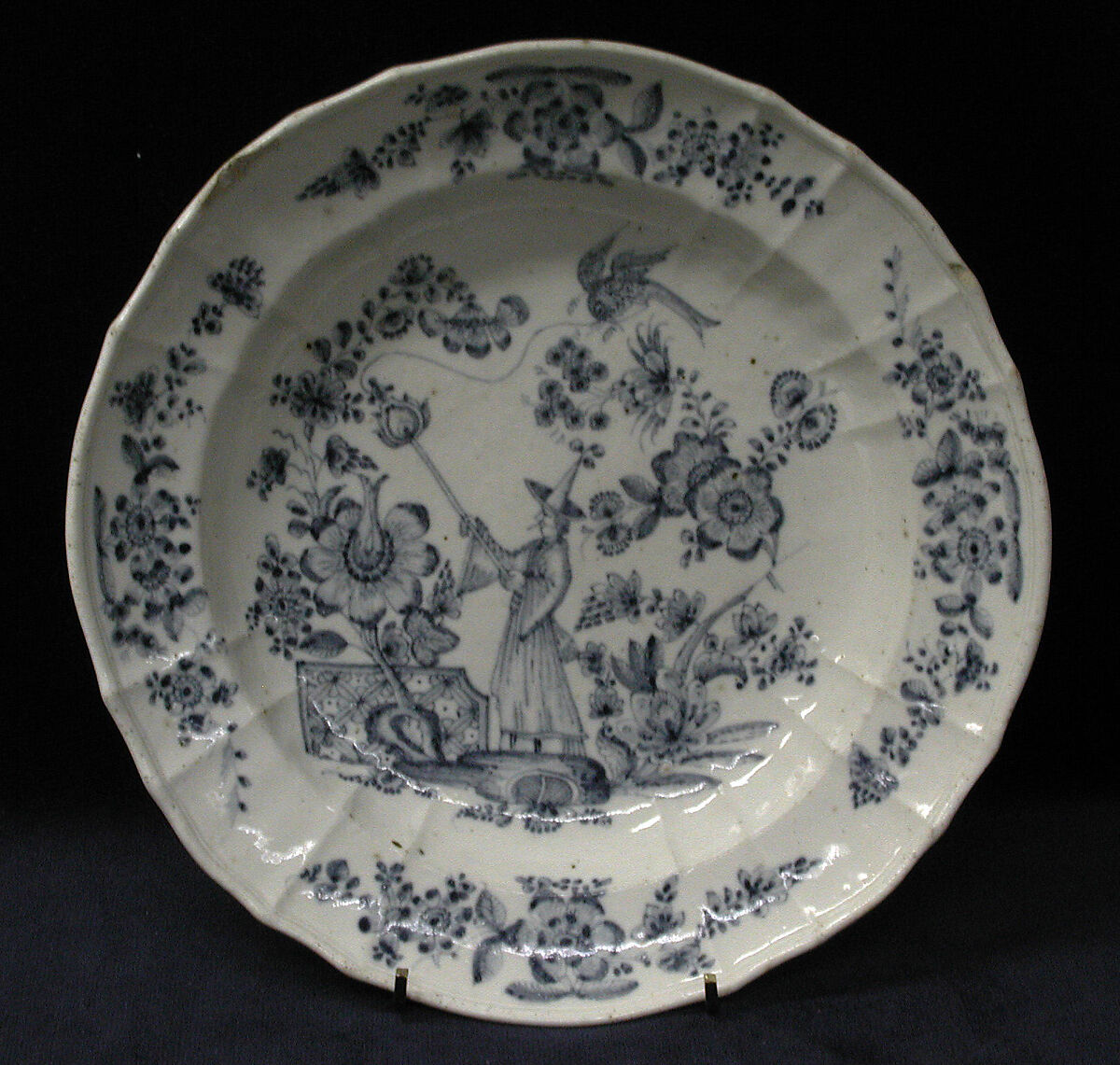
This museum-documented plate is especially useful because it provides a securely catalogued example from the first decade of the manufactory’s history. It demonstrates why documented museum pieces are more valuable for comparative research than anonymous marketplace descriptions.
Why Did Early Wallendorf Marks Resemble Meissen?
One of the most important episodes in Wallendorf mark history concerns its early underglaze signs.
During the eighteenth century, some Wallendorf marks developed elongated central strokes that could resemble the crossed-swords trademark associated with Meissen. The resemblance became sufficiently problematic that Meissen complained, and in 1787 the sovereign Ernst Friedrich of Coburg-Saalfeld required Wallendorf to change its marking system.
From 1787 to 1833, Wallendorf pieces were commonly marked with a form of the letter W, often with crossed central strokes.
An early mark that resembles Meissen is not automatically Meissen.
Mark + porcelain body + form + decoration + period must agree.
If you are comparing the two traditions, see our dedicated
Meissen Porcelain Identification Guide.
Late 18th-Century Wallendorf
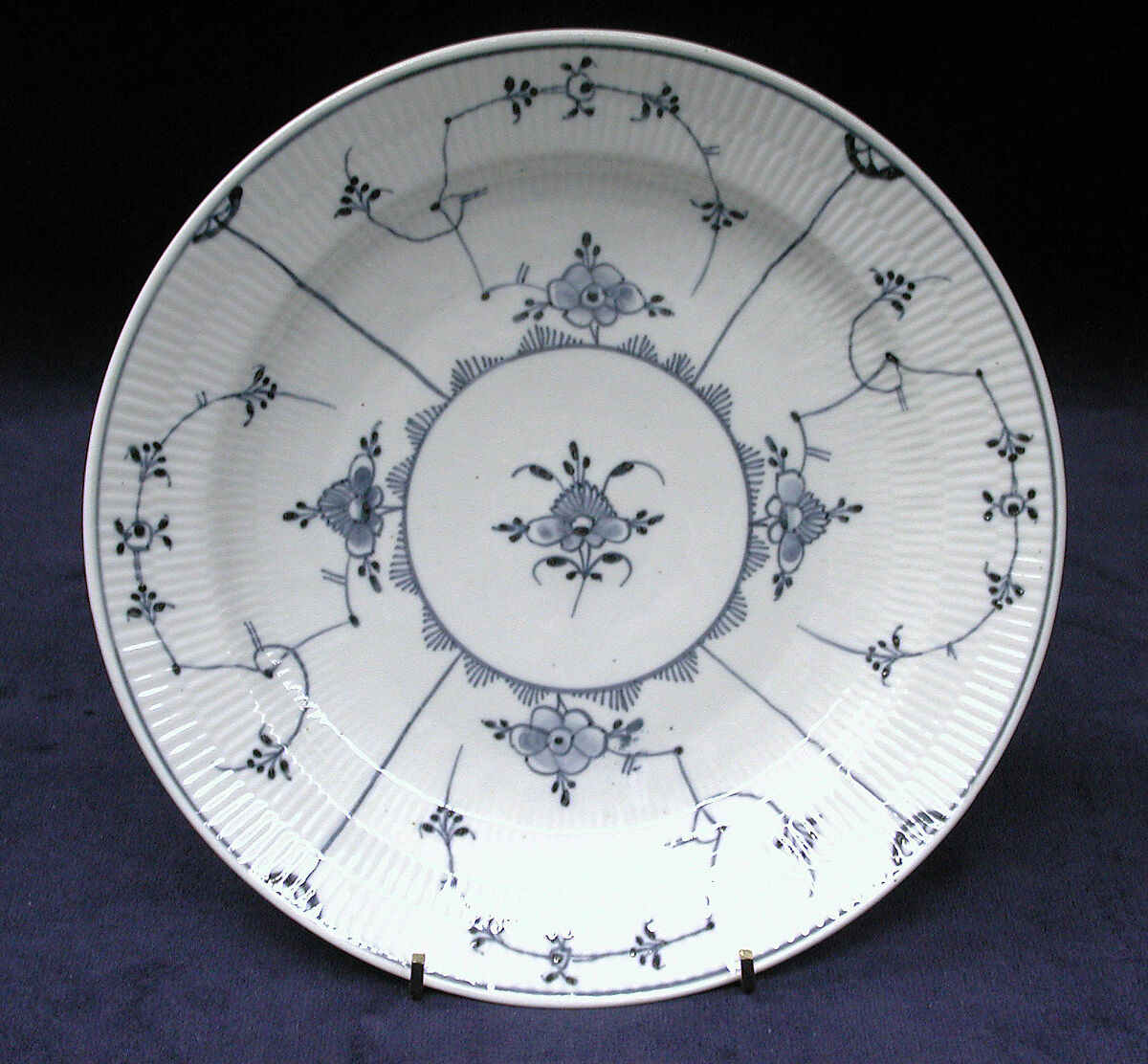
Late eighteenth-century Wallendorf tableware can display restrained monochrome painting, floral decoration and carefully finished forms. The important point for identification is not to search for one universal “Wallendorf look,” but to match the proposed period with documented body, form and decoration.
Wallendorf Around 1800
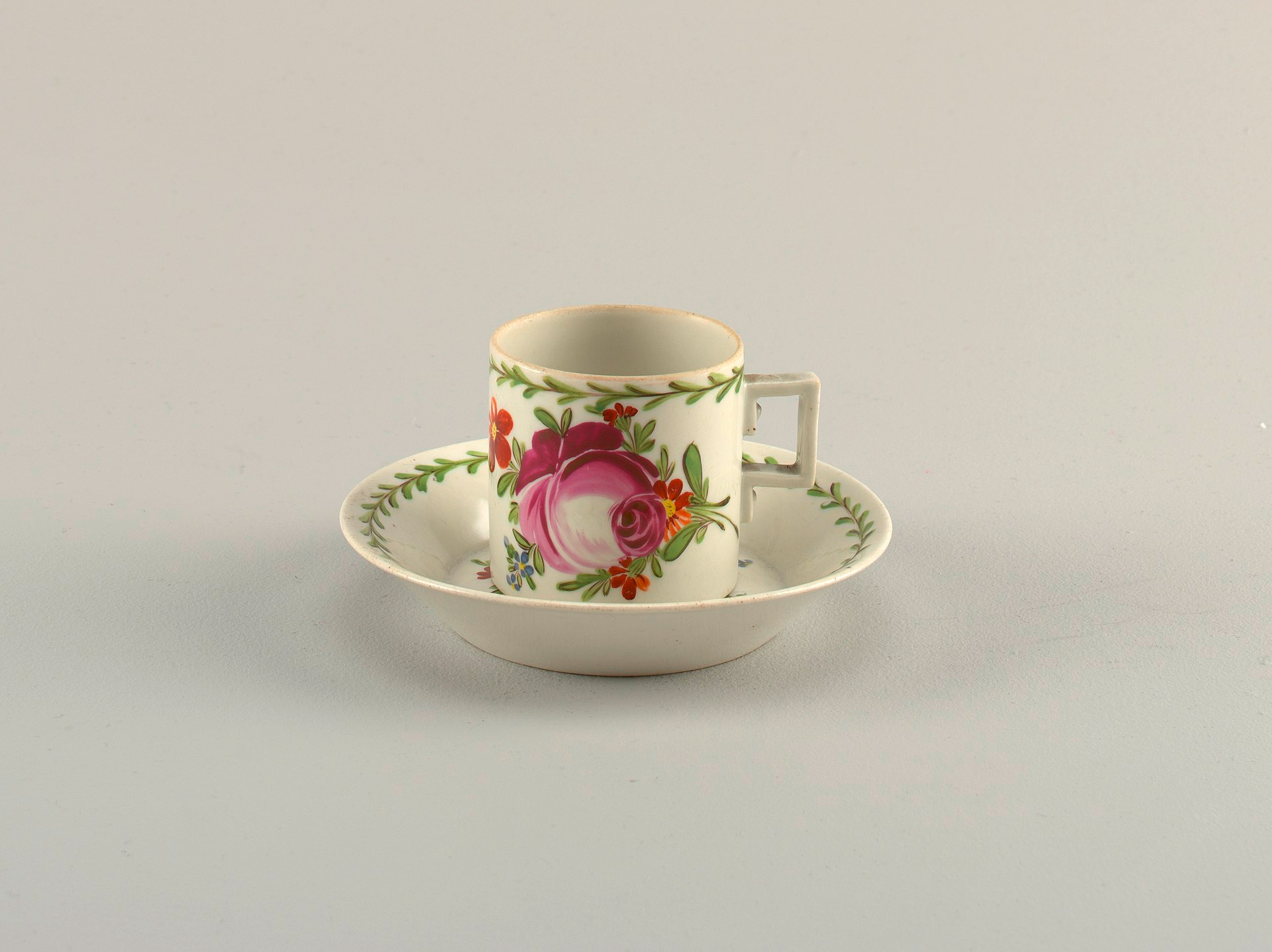
The Metropolitan Museum of Art dates this Wallendorf cup and saucer to circa 1800. Its cylindrical cup, angular handle and hand-painted floral decoration make it a particularly useful reference for the transition from the eighteenth to the nineteenth century.
Wallendorf in the 19th Century
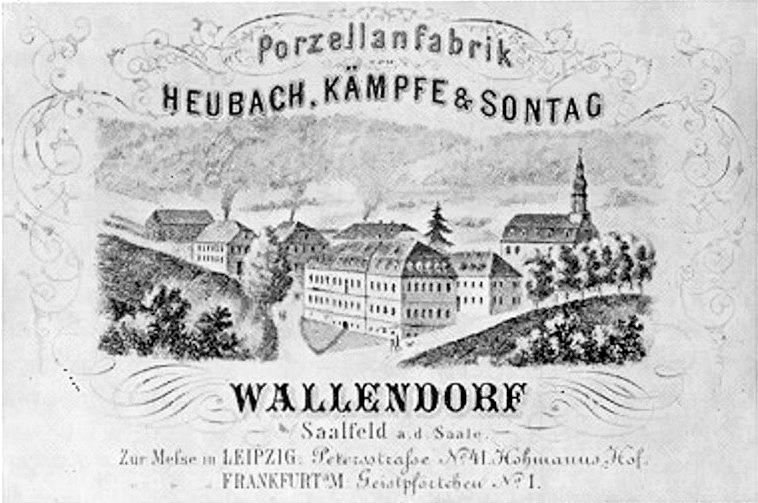
The founding family retained ownership until 1833. After that date, the factory passed through a succession of experienced porcelain manufacturers and entrepreneurs, including names associated with Hutschenreuther, Kämpfe, Heubach and Sontag.
The nineteenth century is important because it demonstrates a principle that applies throughout Wallendorf collecting: historic-looking style does not prove an early production date.
Rococo and eighteenth-century-inspired designs continued to influence later decorative porcelain, while the factory increasingly developed figurines and complex decorative forms.
A Rococo-looking Wallendorf figure may have been manufactured decades or even more than a century after the Rococo period itself. Date the individual object, not merely the artistic style it imitates.
The Fraureuth Period, 1919–1926
Following the interruption of production during the First World War, the Wallendorf factory became a branch of the Fraureuth porcelain company.
Wallendorf functioned as a specialist art division, and Fraureuth marks are therefore important when identifying pieces from this period. Old Fraureuth moulds were also used later, which can create another dating trap.
The age of a mould or model is not necessarily the age of a particular porcelain example. An older form can be reproduced under a later mark.
Schaubach Kunst Wallendorf, 1926–1953
In 1926, Heinz Schaubach acquired the factory and established Porzellanfabrik Schaubach-Kunst.
This period is especially significant for collectors of Wallendorf figurines. Female figures, dancers, ballerinas, decorative groups and elegant sculptural porcelain form an important part of the Schaubach collecting market.
Schaubach marks can include the name Schaubach Kunst, Germany wording and additional model or production numbers.
Schaubach Kunst belongs to twentieth-century Wallendorf history. A Schaubach figure can be genuine, desirable and collectible without being eighteenth- or nineteenth-century porcelain.
Wallendorf During the VEB / GDR Period
In 1953 the factory was nationalised and operated as VEB Schaubach Kunst Lichte-Wallendorf.
The product range included figurines as well as coffee and dinner services. Depending on the period, collectors may encounter VEB-related marks, GDR wording, East German export wording and the later crowned-W factory identity.
| Wording / Marking | Collector Interpretation |
|---|---|
| VEB | Indicates an East German state-owned enterprise context. |
| GDR | German Democratic Republic; useful evidence for East German production. |
| Made in GDR | A later export-oriented country designation seen on some Wallendorf wares. |
| Germany East / East | Additional wording documented on some post-war factory variants. |
| Echt Kobalt | Associated with cobalt decoration on certain later pieces. |
| Goldrelief | Decorative wording associated with raised or enriched gold decoration. |
| Handarbeit / handgemalt | Indicates hand work or hand painting on particular later factory wares. |
Wallendorf Porcelain Marks & Backstamps
Wallendorf porcelain marks are among the strongest reasons to study this factory in depth. There is no single Wallendorf backstamp that can identify every production period.
Before matching a logo, photograph the entire underside. Record every painted, printed, impressed or stamped element: W marks, crowns, numbers, country wording, Schaubach inscriptions, Fraureuth signs, VEB identifiers and paper labels.
For the general method, use our
Porcelain Marks & Backstamps Identification Guide.
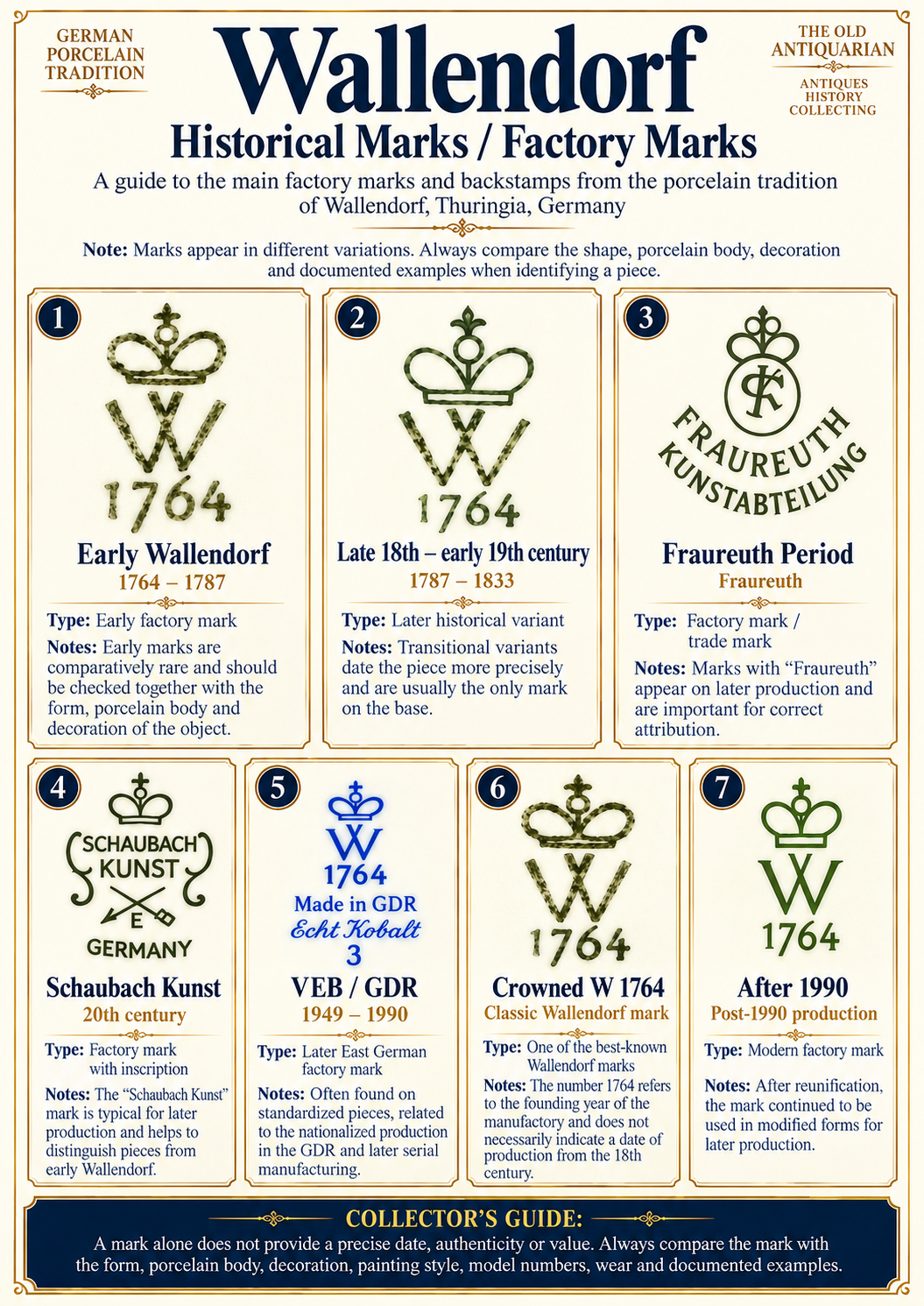
| Period | Mark Context | Collector Note |
|---|---|---|
| 1764–1787 | Several early hand-applied factory marks. | Some variants can visually approach Meissen-style crossed forms. |
| 1772–1829 | Additional Hamann-period marks. | Mark periods can overlap; do not force every piece into one narrow range. |
| 1787–1833 | W variants. | Introduced after the dispute over marks resembling Meissen. |
| 1887–1897 | Later nineteenth-century factory marks. | Useful in combination with form and decoration. |
| 1897–1915 | Older mark type reused. | A strong example of why mark style alone can mislead. |
| 1919–1926 | Fraureuth-associated marks. | Wallendorf operated as a Fraureuth branch and art division. |
| 1926–1953 | Schaubach Kunst marks. | Important for figurines, dancers and ballerinas. |
| 1953–1962 | VEB Schaubach Kunst marks. | State-owned East German production. |
| 1958–1990 | Several later GDR-era variants. | May include country wording and other additions. |
| c. 1963–64 onward | Crowned W with 1764 and related variants. | 1764 is the official founding year, not the production date of the object. |
| After 1990 | Post-reunification marks including Made in Germany variants. | Genuine later Wallendorf should not be described as eighteenth-century antique porcelain. |
What Does the Crowned W / 1764 Wallendorf Mark Mean?
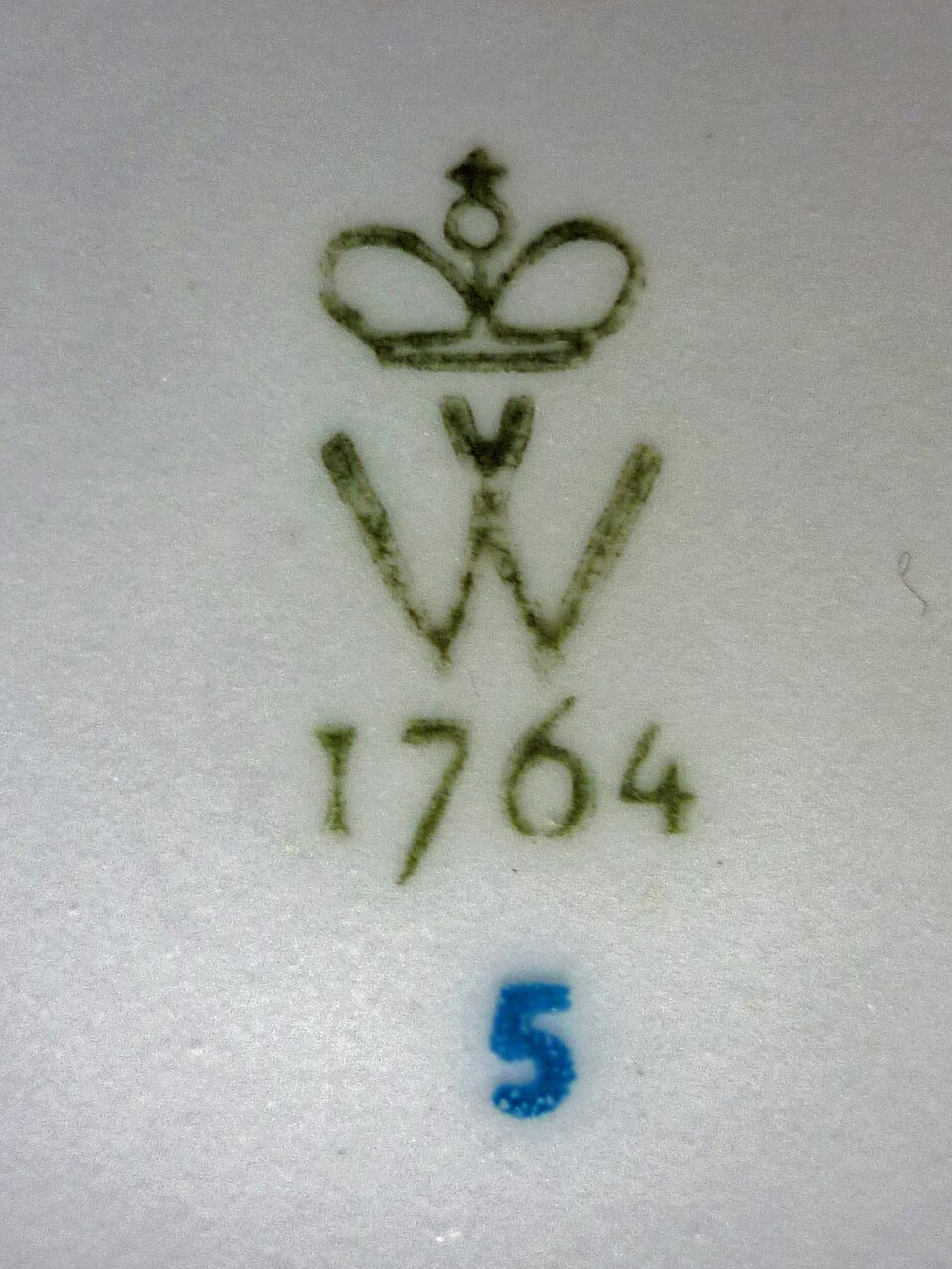
This is one of the most frequently misunderstood Wallendorf marks.
The number 1764 commemorates the official founding year of the manufactory. It is not, by itself, the production date of the individual object.
Schlossmuseum Jever dates the introduction of the familiar crown-W-1764 identity to 1964, the manufactory’s 200th anniversary. Specialist mark documentation records related versions from 1963 onward.
Treat 1764 as part of the later factory identity unless the entire object independently supports an early date.
Important Correction to Illustrated Timelines
Some educational infographics in this guide use the crowned W visually to represent the Wallendorf brand. For exact historical dating, follow the verified mark chronology in the article text and specialist sources rather than interpreting that logo as an early mark.
How to Date Wallendorf Porcelain
Dating Wallendorf porcelain is usually a process of establishing a production range, not identifying one exact year.
Begin with the exact backstamp and then test the proposed period against the porcelain body, form, modelling, decoration, model numbers, country wording and condition.
For the wider method, see
How to Date Antique Porcelain.
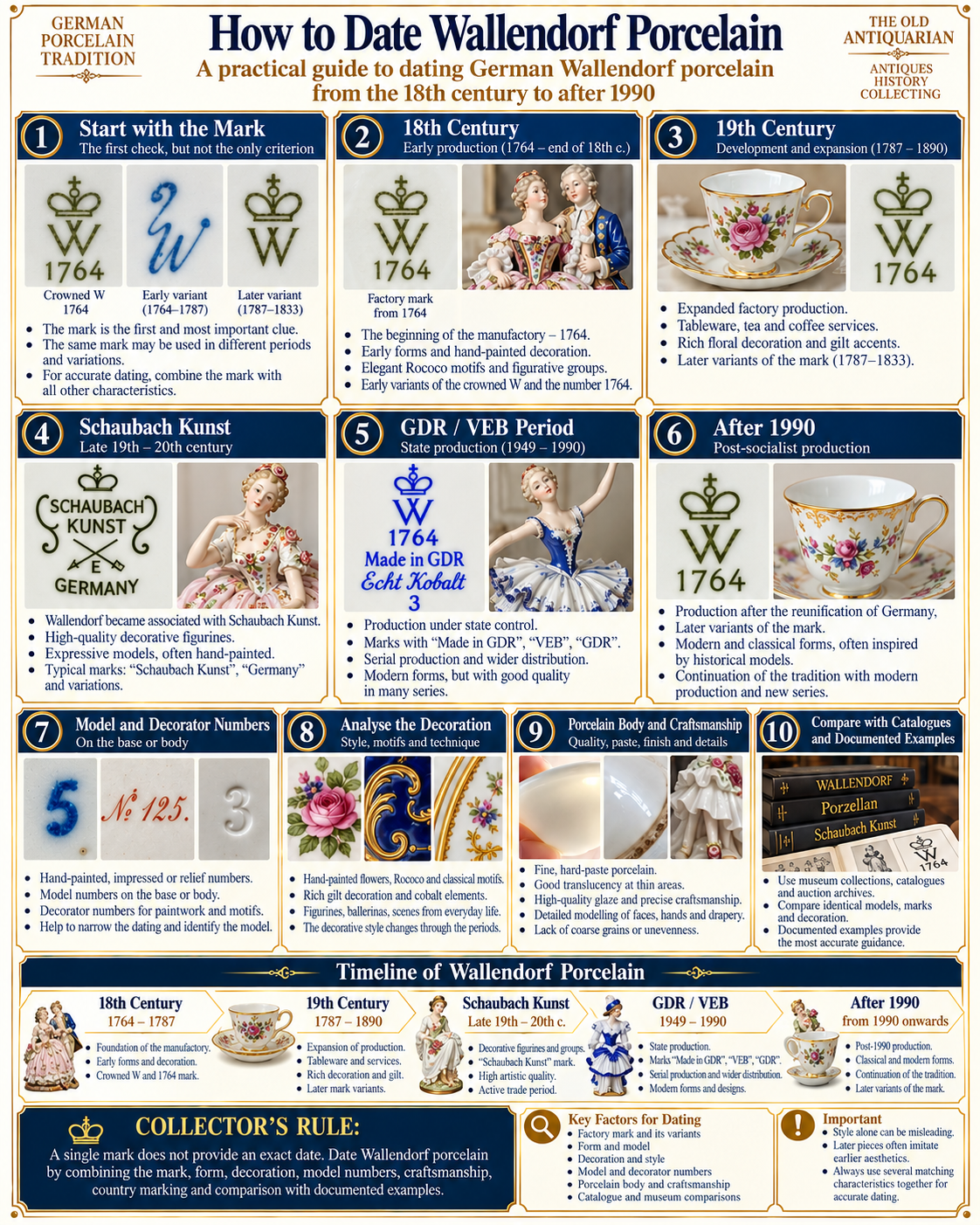
| Dating Clue | What It Can Tell You | What It Cannot Prove Alone |
|---|---|---|
| Exact mark variant | Can narrow the factory period substantially. | One exact year of manufacture. |
| W / 1764 | Can identify later Wallendorf factory identity. | That the piece was made in 1764. |
| Schaubach Kunst | Points toward the 1926–1953 factory period. | The exact year a particular model was produced. |
| VEB / GDR | Supports East German production. | Value or rarity by itself. |
| Germany wording | May help establish later export context. | A universal date applicable to every piece. |
| Model number | May connect a figure or form with a documented model. | A production year unless factory records establish it. |
| Form | Can support Rococo, nineteenth-century, Art Deco or later context. | A date without mark and manufacturing evidence. |
| Decoration | Technique and style can support a proposed period. | Factory identity alone. |
| Wear | May be consistent with long use. | Authentic age on its own. |
Porcelain Body, Glaze and Workmanship
Museum-documented early Wallendorf pieces are hard-paste porcelain. The quality of the body changed during the manufactory’s early development, especially after purer Bohemian kaolin became available around 1780.
When examining a piece, look at the exposed foot, colour of the body, density, glaze, firing quality and translucency where appropriate.
A convincing Wallendorf attribution requires the porcelain body, form, decoration and manufacturing quality to make sense for the production period suggested by the backstamp.
For a broader examination system, see
How to Identify Antique Porcelain.
Wallendorf Decoration and Tableware
Wallendorf production is not limited to figurines. Tea and coffee wares, cups, saucers, plates, jugs, bowls and decorative vessels form an important part of its history.
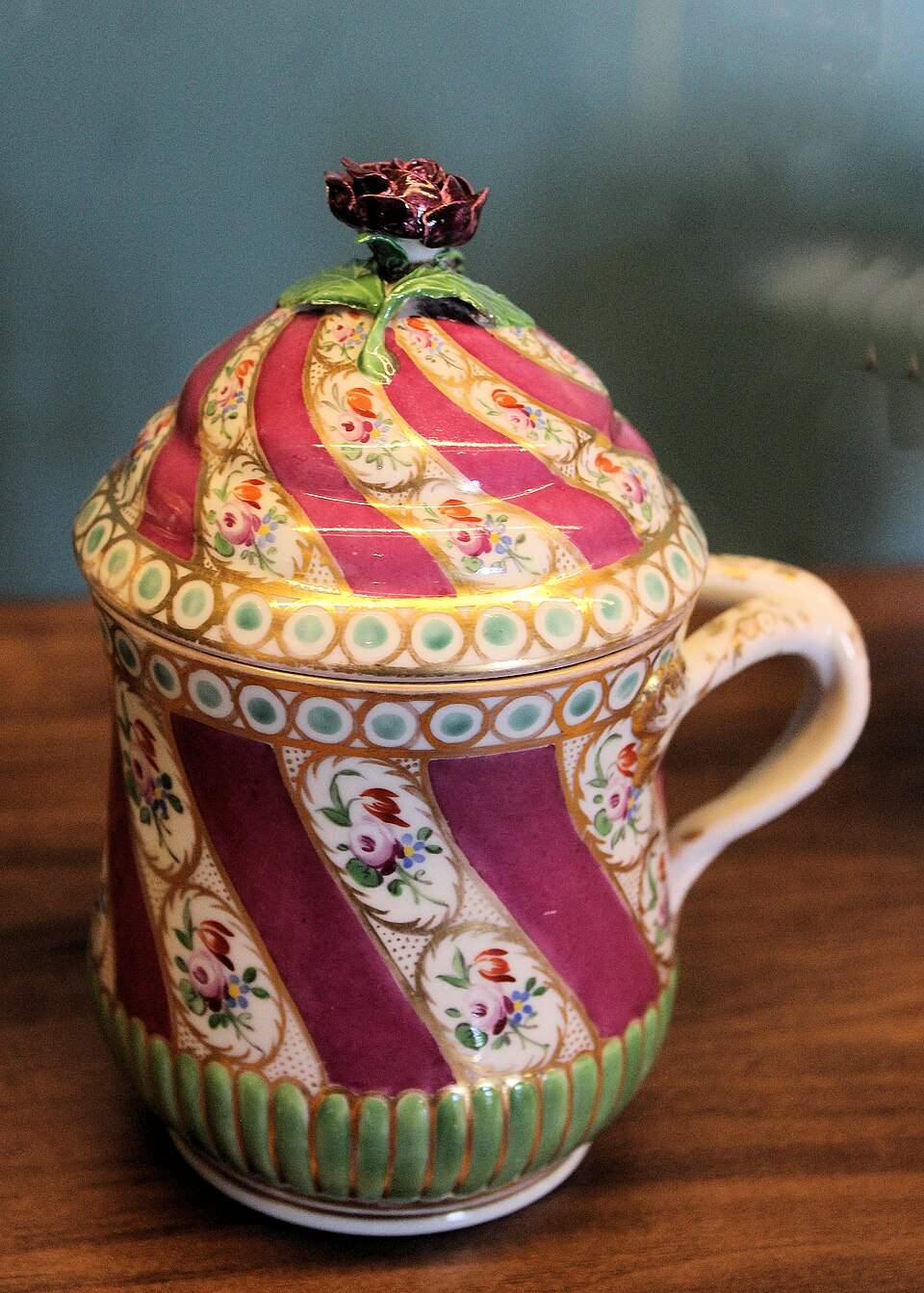
When studying decorated Wallendorf, compare brushwork, gilding, printed elements, ground colours and repeat motifs. A high level of craftsmanship can support attribution, but quality alone cannot establish age.
Wallendorf Figurines, Female Figures & Ballerinas
Today, figurines are one of the strongest Wallendorf collecting categories and an important source of Google Images and identification traffic.
Collectors encounter female figures, dancers, ballerinas, children, couples, nude figures, deer, horses, dogs, birds and decorative groups.
ballerinas · dancers · female figurines · nude figures · children · couples · deer · horses · dogs · birds · decorative groups · Schaubach Kunst figures
Wallendorf Ballerina Figurines
Ballerinas and dancers are particularly associated with twentieth-century Wallendorf and Schaubach Kunst collecting.
When researching a Wallendorf ballerina, do not stop after identifying the factory name. Record the model number, exact mark, height, pose, base shape, decoration and restoration history.
Some models were produced or revived over more than one factory period. The design date and the production date of the individual figure can therefore be different.
A figurine that looks stylistically old is not necessarily early Wallendorf. A nineteenth-century-inspired or Rococo-style figure may have been manufactured during the Schaubach, GDR or later period.
20 Types of Wallendorf Porcelain Objects
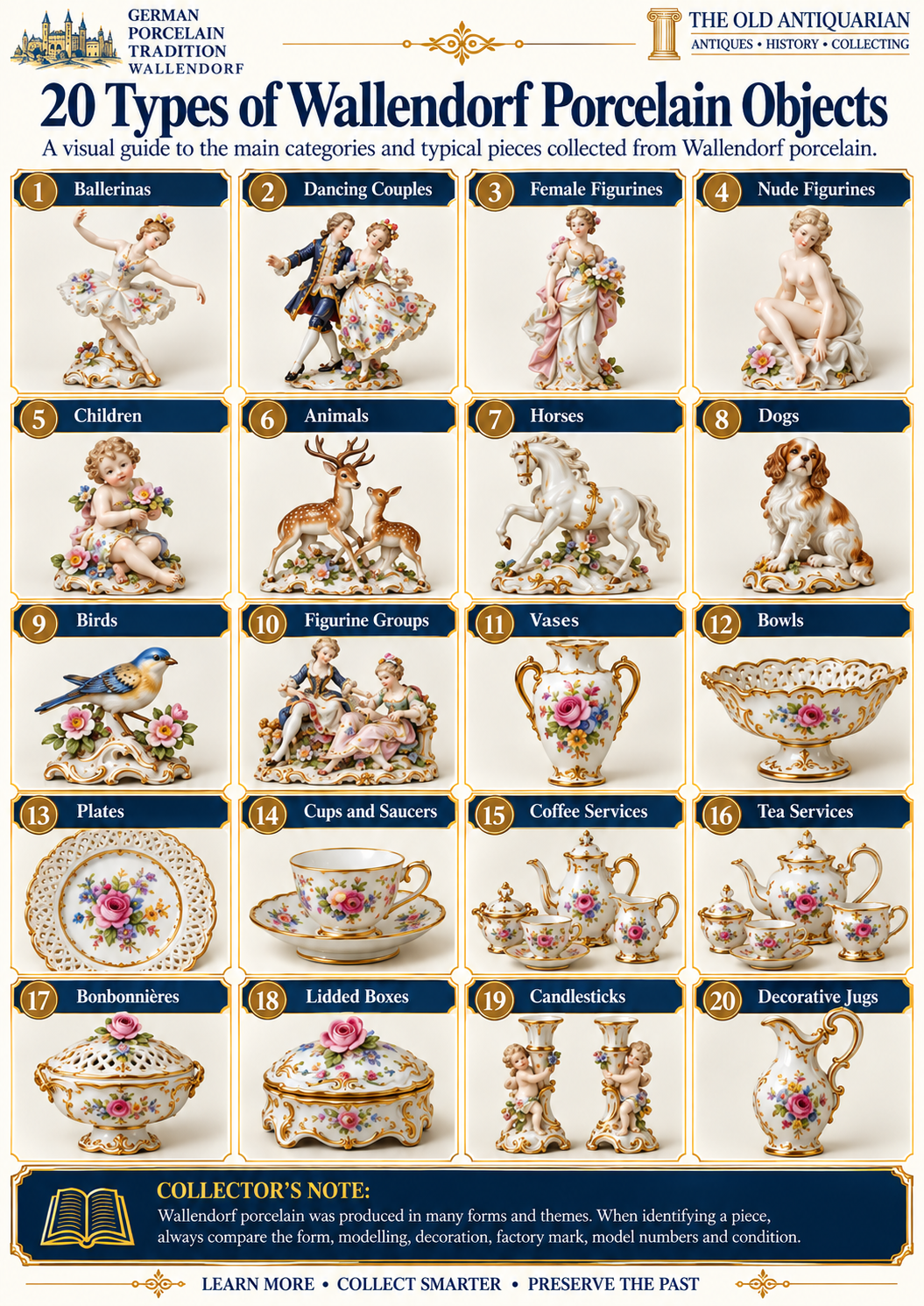
| Object Type | What to Examine |
|---|---|
| Ballerinas | Model number, designer, size, mark, fingers, ankles, skirts and restoration. |
| Dancers | Pose, model number, base, decoration and production period. |
| Female figures | Facial modelling, hands, costume, painting and factory mark. |
| Nude figures | Body modelling, glaze or bisque finish, model and mark. |
| Children | Flowers, fingers, accessories and restoration. |
| Animals | Ears, tails, antlers, legs, base and model number. |
| Figurine groups | Completeness, missing elements and model identification. |
| Vases | Rim, handles, gilding, decoration, base and restoration. |
| Cups & saucers | Matching form, decoration, backstamps and handle profile. |
| Tea & coffee services | Completeness, replacement parts, matching marks and decoration. |
| Lidded boxes & bonbonnières | Original lid, finial, fit, decoration and chips. |
| Candlesticks & decorative wares | Structural repairs, applied decoration and model history. |
Wallendorf vs Meissen Porcelain
Wallendorf and Meissen are separate German porcelain manufactories with different histories and mark systems.
Meissen was founded in Saxony in 1710 and is famous for its crossed-swords trademark. Wallendorf was officially founded in Thuringia in 1764.
They are particularly relevant to compare because some early Wallendorf factory marks visually approached Meissen-style crossed forms and were changed after an official complaint.
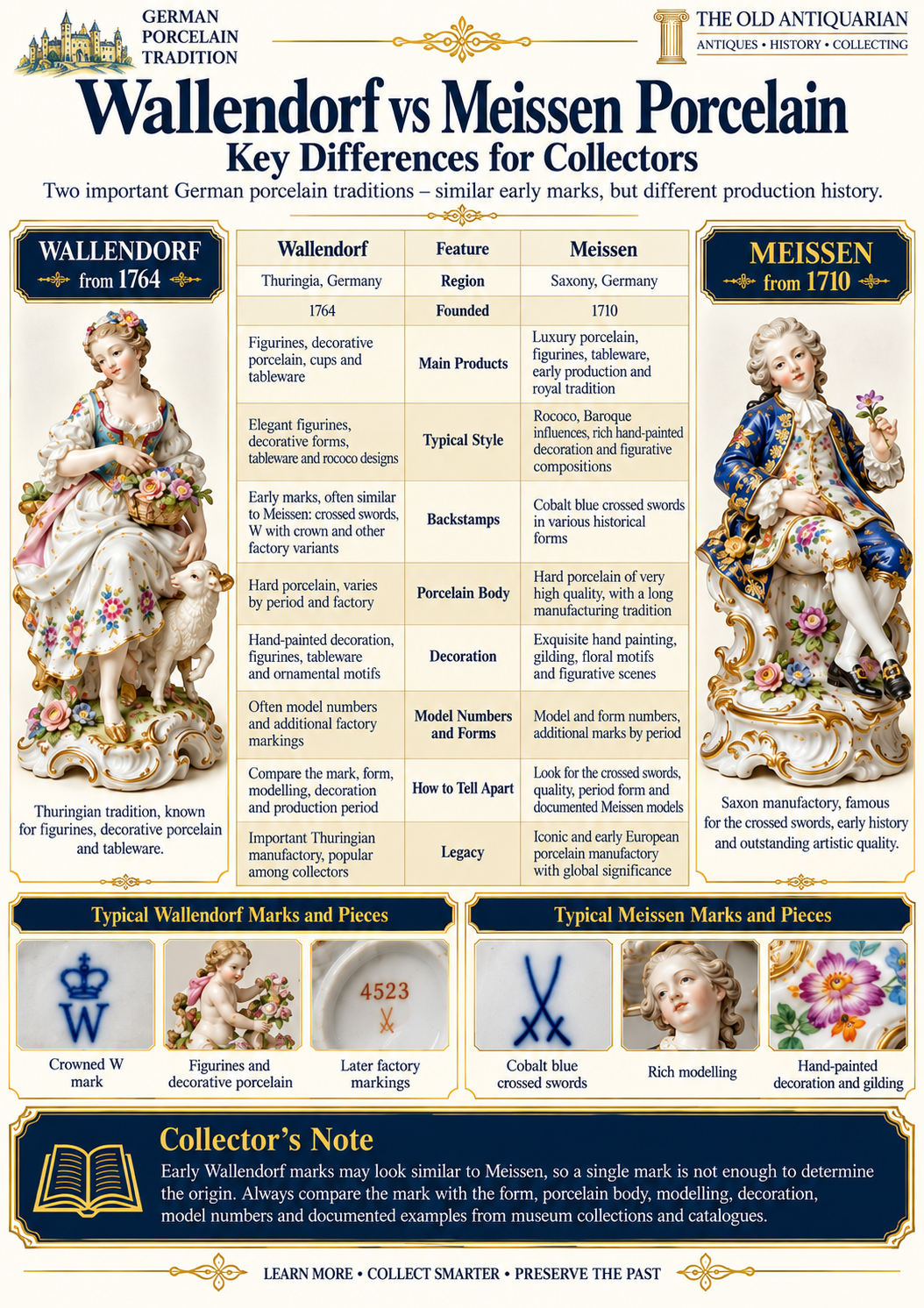
| Feature | Wallendorf | Meissen |
|---|---|---|
| Official foundation | 1764 | 1710 |
| Region | Thuringia | Saxony |
| Material | Hard-paste porcelain. | Hard-paste porcelain. |
| Early marks | Several variants; some became visually close to crossed forms associated with Meissen. | Historical marks evolved into the famous crossed-swords tradition. |
| Later recognisable mark | Crowned W above 1764. | Crossed swords. |
| Figural production | Important in multiple periods, especially Schaubach and later Wallendorf. | Major sculptural tradition from the eighteenth century onward. |
| Ballerinas | Important specialist category, especially in twentieth-century collecting. | Not the principal identification category for the manufactory. |
| Main risk | Confusing early marks with Meissen or interpreting W 1764 as an eighteenth-century date. | Assuming any crossed-swords mark proves genuine Meissen. |
The same whole-object approach applies to other German factories. Compare Wallendorf with
Fürstenberg porcelain
and
KPM Berlin
to see how long-running German manufactories developed different mark systems.
For a different type of regional attribution problem, our
Dresden Porcelain Guide
explains why “Dresden” is a wider production and decorating tradition rather than one universal factory mark.
How to Identify Genuine Wallendorf Porcelain
Record the front, back, sides and every important decorative detail.
Do not crop out impressed numbers, painter’s codes, country wording, labels or old inscriptions.
Distinguish early Wallendorf marks from W variants, Fraureuth, Schaubach, VEB/GDR and later crowned-W marks.
Body colour, density, exposed foot, firing quality and glaze should fit the proposed period.
Handles, feet, rims, lids, bases and proportions often reveal whether the form belongs to early, nineteenth-century or later production.
For figurines, study facial features, hands, fingers, drapery, hair, flowers and sculptural anatomy.
Determine whether motifs are hand painted, printed, gilded or mixed technique and whether the style matches the proposed production period.
A model number can be crucial when distinguishing Schaubach, GDR and later examples of similar figures.
Germany, Made in Germany, East, GDR and Made in GDR can provide useful chronological context.
Check fingers, ankles, flowers, tails, antlers, handles and other vulnerable details.
Museum collections, factory history and specialist catalogues carry more weight than anonymous marketplace descriptions.
mark + body + form + modelling + decoration + numbers + country wording + condition + documented comparison
Antique vs Schaubach vs GDR vs Post-1990 Wallendorf
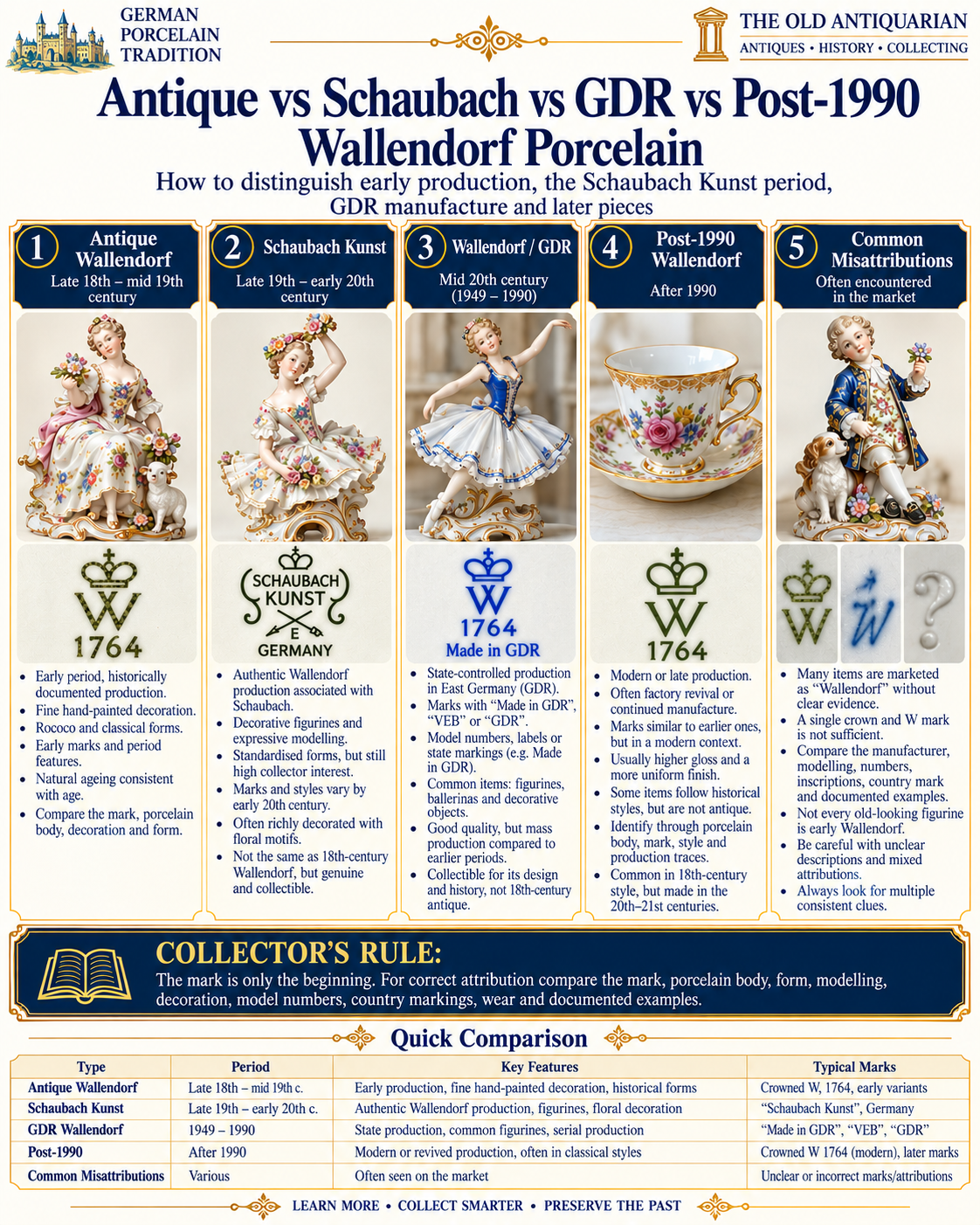
| Category | What It Means | Key Evidence |
|---|---|---|
| Early antique Wallendorf | Individual object made during the eighteenth or early nineteenth century. | Period-correct early mark + body + form + decoration + documented comparison. |
| 19th-century Wallendorf | Genuine later historical factory production. | Ownership period, mark, form, decoration and construction. |
| Schaubach Kunst | Wallendorf-related artistic production, 1926–1953. | Schaubach mark, model number, style and factory-period comparison. |
| VEB / GDR Wallendorf | State-owned East German production after 1953. | VEB/GDR wording, later factory marks and production context. |
| Post-1990 Wallendorf | Later or modern genuine production. | Post-reunification marks, Made in Germany wording and modern manufacturing context. |
| Misattributed piece | An object described as Wallendorf without sufficient supporting evidence. | Failure of mark, body, form, model and period to agree. |
A GDR or post-1990 Wallendorf figure may be completely genuine Wallendorf while having no claim to eighteenth- or nineteenth-century age.
Condition and Restoration
Condition is particularly important for Wallendorf figurines because dancers, ballerinas, flower-decorated figures and animal models often contain vulnerable projecting elements.
| Area | Typical Problem | Why It Matters |
|---|---|---|
| Fingers & hands | Breaks, replaced fingers or repainting. | Common on delicate figurines and dancers. |
| Ballerina ankles | Stress cracks or repaired breaks. | Thin support points can carry much of the figure’s weight. |
| Applied flowers | Missing petals, chips and rebuilt flowers. | Losses are frequent on elaborate decorative models. |
| Animals | Damaged ears, tails, antlers or legs. | Small losses can materially affect completeness. |
| Gilding | Natural wear, regilding or later retouching. | Later intervention can alter both appearance and market value. |
| Base | Grinding, filled cracks or repainted areas. | The base contains crucial identification evidence. |
| Backstamp | Abrasion, alteration or partial removal. | Can complicate dating and attribution. |
Avoid aggressive cleaning, repainting or amateur restoration before completing the identification process. Old labels, numbers and repair evidence may all contribute to the history of the object.
Wallendorf Porcelain Value
There is no meaningful universal price for “Wallendorf porcelain.”
An eighteenth-century museum-comparable plate, a Schaubach Kunst ballerina, a GDR figurine and a post-1990 Wallendorf cup belong to different collecting markets.
Use genuinely comparable completed sales, not optimistic marketplace listings.
exact manufacturer + production period + model + designer / modeller + size + decoration + rarity + condition + restoration + completeness + provenance + comparable completed sales
| Value Factor | Why It Matters |
|---|---|
| Production period | Early Wallendorf, Schaubach and GDR pieces belong to different market categories. |
| Model | Especially important for ballerinas, dancers and figurines. |
| Designer / modeller | Documented authorship can increase specialist interest. |
| Size | The same or similar model may exist in different dimensions. |
| Rarity | Uncommon models and variants may attract stronger demand. |
| Decoration | Hand painting, cobalt decoration and gilding can affect desirability. |
| Condition | Damage is especially important on delicate figures. |
| Restoration | Extent, location and quality of repairs matter. |
| Completeness | Original lids, matching saucers and complete groups are significant. |
| Provenance | Documented collection or ownership history can strengthen historical interest. |
| Completed sales | Actual realised prices provide better market evidence than asking prices. |
For the wider valuation methodology, continue to our
Complete Antique Porcelain Guide
or request a
Professional Antique Valuation.
Wallendorf Collector Checklist
- Photograph the complete object from several angles.
- Photograph the entire underside.
- Record every letter, number and symbol.
- Identify the exact W or factory mark variant.
- Check whether a crown is present.
- Never assume that 1764 is the production date.
- Look for Fraureuth, Schaubach Kunst, VEB or GDR wording.
- Record the model number.
- Photograph impressed and painted secondary numbers.
- Preserve old labels and retailer stickers.
- Examine the porcelain body and exposed foot.
- Study handles, rims, lids and base construction.
- On figurines, inspect fingers, ankles, flowers and accessories.
- Check gilding for regilding or retouching.
- Determine whether decoration is painted, printed or mixed technique.
- Compare the form with documented examples.
- Separate Schaubach production from GDR and post-1990 production.
- Do not date a piece from artistic style alone.
- Use completed comparable sales when researching value.
Do You Have Wallendorf Porcelain?
Send clear photographs of the complete object, the full underside, every factory mark and number, dimensions and any visible damage or restoration. For ballerinas and figurines, photograph the fingers, ankles, flowers, accessories and base carefully.
Porcelain · Figurines · Ballerinas · Tableware · Decorative Arts · Private Collections
Wallendorf Porcelain FAQ
When was Wallendorf porcelain founded?
The Wallendorf porcelain manufactory received its official manufacturing licence on March 30, 1764 in the Duchy of Saxe-Coburg.
What is the Wallendorf porcelain mark?
Wallendorf used many marks during its history. Early marks varied considerably, while the best-known later factory identity is a crowned W above the founding year 1764.
Does W 1764 mean my porcelain was made in 1764?
No. On the familiar later crowned-W mark, 1764 commemorates the official foundation of the manufactory and is not the manufacturing date of the individual object.
When was the crowned W 1764 mark introduced?
The familiar identity was introduced around the manufactory’s 200th anniversary. Schlossmuseum Jever dates the current mark to 1964, while specialist mark documentation records related variants from 1963 onward.
Why can early Wallendorf marks look like Meissen?
Some early Wallendorf signs developed elongated central strokes that resembled Meissen-style crossed marks. Following an official complaint, Wallendorf changed its marking practice in 1787.
What is Schaubach Kunst Wallendorf?
Schaubach Kunst refers to the Wallendorf factory period from 1926 to 1953 under Heinz Schaubach. It is especially important for decorative figurines, dancers and ballerinas.
What does Made in GDR mean on Wallendorf porcelain?
It indicates East German production during the German Democratic Republic period. It should not be confused with eighteenth- or nineteenth-century Wallendorf.
Are Wallendorf ballerina figurines valuable?
Some models attract significant collector interest. Value depends on the exact model, production period, designer, size, condition, restoration, rarity and comparable completed sales.
How do I date a Wallendorf figurine?
Identify the exact factory mark and model number, then compare the form, modelling, decoration, country wording and manufacturing quality with documented examples from the corresponding factory period.
Is every genuine Wallendorf piece antique?
No. Genuine Wallendorf was produced during the Schaubach period, the GDR era and after German reunification. Authentic manufacturer attribution and antique age are separate questions.
Can Wallendorf porcelain be confused with Meissen?
Yes, particularly when studying certain early factory marks. The exact mark, porcelain body, form, modelling and decoration should all be compared before assigning a manufacturer.
How is Wallendorf porcelain valued?
Value depends on production period, exact model, designer or modeller, rarity, size, decoration, condition, restoration, completeness, provenance and evidence from comparable completed sales.
Can I sell Wallendorf porcelain to The Old Antiquarian?
The Old Antiquarian considers porcelain, figurines, decorative arts and other antiques for purchase. Send photographs of the complete object, underside, factory marks, numbers, dimensions and condition through our
We Buy Antiques
page.
Related German Porcelain Guides
Sources & Further Research
The historical chronology and mark interpretation in this guide were checked against the official Wallendorf history, museum research, specialist mark documentation and museum-catalogued objects.
-
Wallendorfer Porzellan – Official History
– official foundation on March 30, 1764, adoption of Bohemian kaolin around 1780, ownership history and later crowned-W identity. -
Schlossmuseum Jever – Wallendorfer Porzellan
– early history, Wallendorf marks, Meissen comparison, 1787 mark change and museum examples. -
Porcelain Marks & More – Wallendorf
– detailed ownership chronology and specialist reference for historical mark variants. -
The Metropolitan Museum of Art – Soup Plate, ca. 1765–1775
– Wallendorf Porcelain Manufactory, hard-paste porcelain, Public Domain. -
The Metropolitan Museum of Art – Plate, late 18th century
– Wallendorf Porcelain Manufactory, hard-paste porcelain, Public Domain. -
The Metropolitan Museum of Art – Cup and Saucer, ca. 1800
– Wallendorf Porcelain Manufactory, hard-paste porcelain, Public Domain.
The infographics in this guide are educational orientation tools. Some illustrated marks are simplified or used symbolically to represent a factory period. In particular, the crowned W / 1764 is a later Wallendorf identity and should not be interpreted as an eighteenth-century backstamp. When an infographic and a documented factory, museum or specialist source differ, the documented historical source should take priority.
About The Old Antiquarian
The Old Antiquarian combines more than 35 years of practical experience with antiques and collecting with historical, museum and comparative research.
When researching porcelain, we treat the factory mark as one part of a wider evidence chain. Porcelain body, form, model, decoration, manufacturing technique, condition, restoration, provenance and documented comparisons should support one another.
Continue with our
Complete Antique Porcelain Guide
or explore the wider
German Porcelain Guide.
Conclusion: Wallendorf Is More Than a Crowned W
Wallendorf is one of the most interesting German manufactories for collectors precisely because its history cannot be reduced to a single factory mark.
An object may belong to the early Hamann period, nineteenth-century production, Fraureuth, Schaubach Kunst, VEB/GDR manufacture or post-reunification Wallendorf.
A ballerina may share a model with an earlier or later production run. A historic-looking figure may be twentieth century. A crowned W with 1764 may be completely genuine while being more than two centuries later than the date printed beneath the crown.
The strongest attribution is therefore the one in which the exact mark, porcelain body, form, model, decoration, numbers, country wording, condition and documented factory history all tell the same story.
Identify the exact mark → establish the factory period → identify the model → examine the whole object → check condition → compare documented examples → then research value.
