
Paragon China Porcelain Identification
Paragon China: History, Marks, Royal Warrants, Patterns, Dating & Value
Last Updated: September 2026 | By The Old Antiquarian
Paragon China was an English fine bone china manufacturer associated with Longton, Staffordshire. Its origins lie in the Star China Company at the end of the nineteenth century, with the trade name Paragon China introduced in 1903. The company became especially known for elegant tea ware, floral patterns, gilding and royal connections.
To identify and date Paragon China, examine the exact backstamp, Royal Warrant wording, porcelain body, shape, pattern, decoration, numbers and condition together. A Paragon mark is an important clue, but a mark alone does not prove authenticity or an exact date.
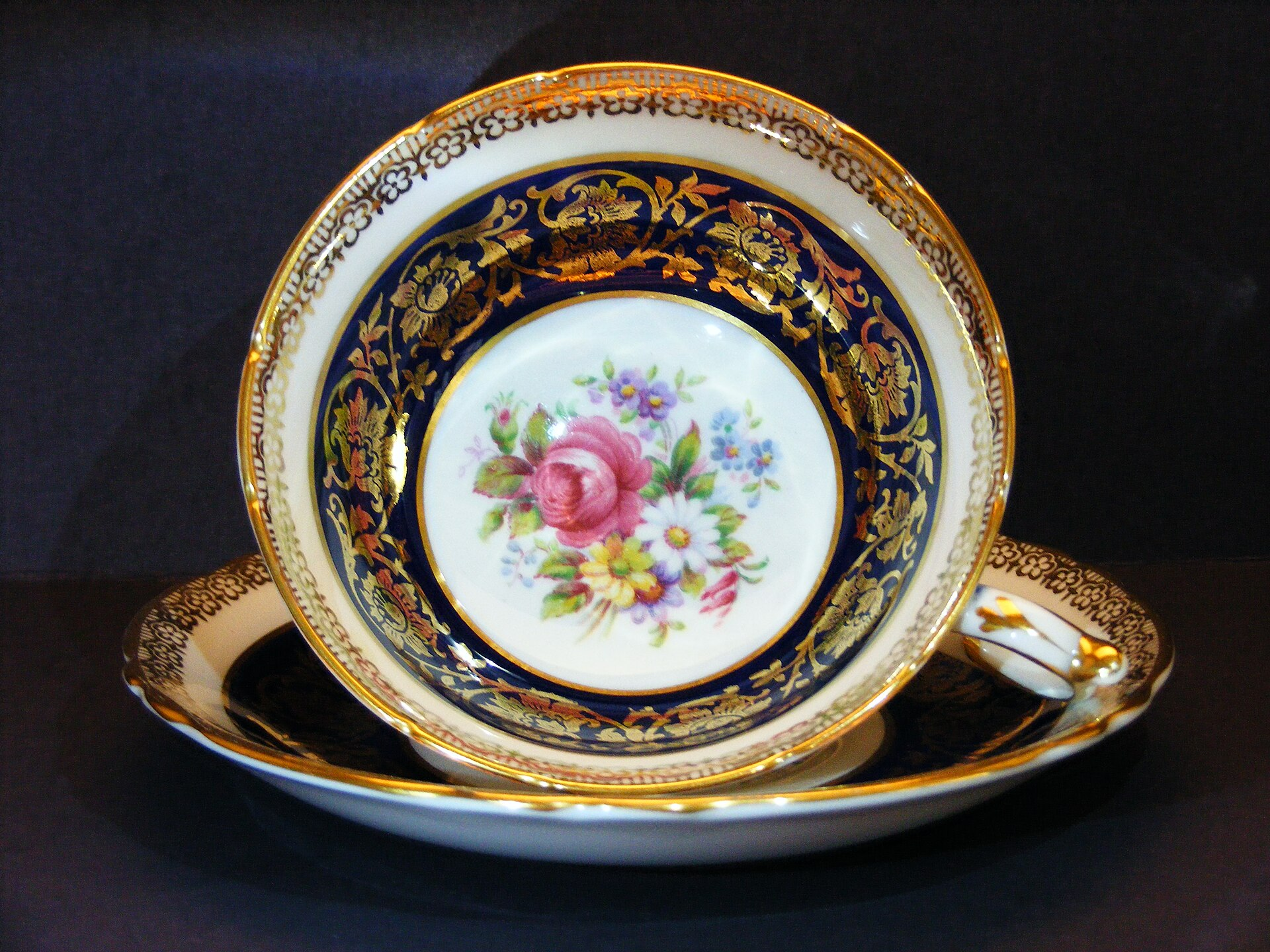
Paragon China at a Glance
| Feature | Collector Reference |
|---|---|
| Origin | Longton, Staffordshire, England |
| Predecessor | Star China Company |
| Paragon trade name | Introduced in 1903 |
| Paragon China Company | Name changed in 1919; operating under the new name from 1920 |
| Paragon China Ltd. | 1930 |
| Royal patronage | Duchess of York, 1926 — not the same as a Royal Warrant |
| Important Royal Warrants | Queen Mary 1933; Queen Elizabeth 1938; Queen Elizabeth II 1955 |
| Later ownership | Thomas C. Wild & Sons → Allied English Potteries → Royal Doulton |
| End of Paragon name | Gradually absorbed into Royal Albert by the late 1980s; discontinued around 1991–1992 |
| Best identification clues | Backstamp + Royal Warrant wording + material + shape + pattern + numbers + condition |
The object must confirm the mark. A correct-looking Paragon backstamp is evidence, not proof. Material, form, decoration, pattern, numbers, workmanship and condition should all be historically consistent.
Paragon belongs to the wider tradition of
English porcelain and bone china,
alongside manufacturers such as Royal Albert, Aynsley, Royal Worcester, Minton and Royal Crown Derby. Understanding that wider context is useful because many British makers produced floral tea ware, gilded services and related shapes during overlapping periods.
In This Guide
- History of Paragon China
- Royal Patronage & Royal Warrants
- Paragon Marks & Backstamps
- How to Date Paragon China
- Patterns, Shapes & Tea Sets
- Pattern Numbers & Other Numbers
- How to Identify Authentic Paragon
- Paragon China Value
- Condition & Restoration
- Paragon vs Other English Makers
- Collector Checklist
- FAQ
The History of Paragon China
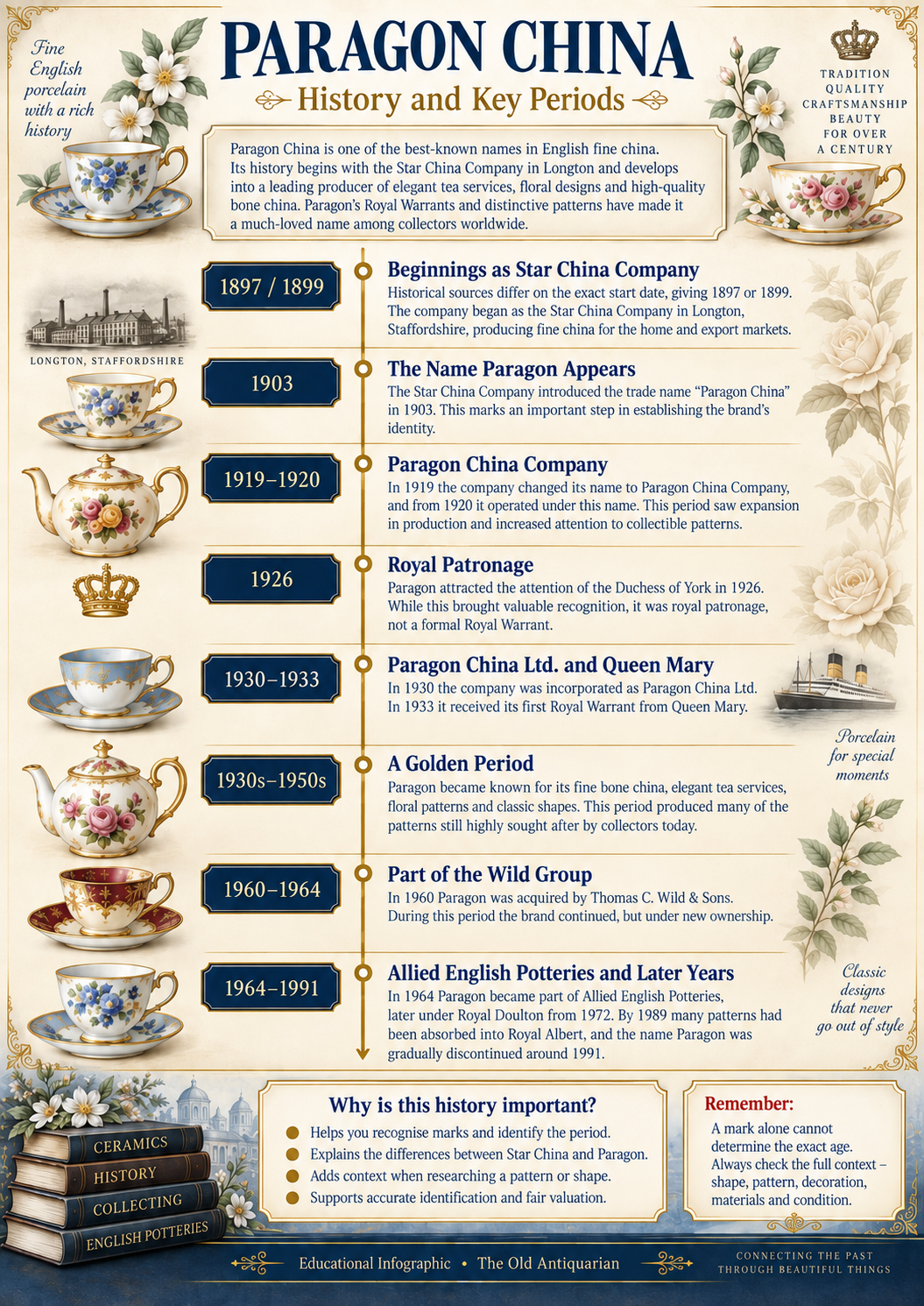
The history of Paragon begins with the Star China Company in Longton, Staffordshire, one of the major centres of the English ceramics industry. Sources differ slightly over the company’s precise starting date. The Potteries’ maker directory gives 1899, while a historical company profile published in 1956 gives 1897. Museum Wales places the beginning more broadly in the final years of the nineteenth century.
For that reason, when an exact source is not being cited, the safest historical description is that Paragon’s predecessor was established in the late nineteenth century.
The decisive date for the brand itself is much clearer: in 1903 the Star China Company introduced the trade name “Paragon China.” The company moved from St Gregory’s Works to the Atlas Works in Longton during the same general period.
From Star China to Paragon China Company
By 1919 the Paragon name had become important enough for the business itself to be renamed. The company changed its name in 1919 and from 1920 operated as the Paragon China Company. In 1930 it became Paragon China Ltd.
This transition matters to collectors because a piece may carry the Paragon name while still belonging to the Star China period. Company history and branding history do not always change on exactly the same day.
A backstamp reading Paragon does not automatically mean that the object was produced after the creation of Paragon China Company. The Star China Company was already using the Paragon trade name before 1920.
The Later Corporate History
Paragon remained under the Irving family’s control until 1960, when it was acquired by Thomas C. Wild & Sons, the group closely associated with Royal Albert. Paragon continued under its own name for a period.
In 1964 the business became part of Allied English Potteries. In 1972 Paragon entered the Royal Doulton group. By the end of the 1980s, much of the Paragon identity and pattern range had been absorbed into Royal Albert.
Museum Wales records that Paragon continued to produce china under its name until 1991, while by 1992 the Paragon name had been discontinued. Some designs continued under Royal Albert.
Paragon Royal Patronage and Royal Warrants
Royal associations are central to Paragon history, but collectors need to distinguish carefully between royal patronage and a formal Royal Warrant of Appointment.
| Year | Event | Collector Significance |
|---|---|---|
| 1926 | The Duchess of York showed interest in Paragon’s “Two for Joy” design and purchased china. | Royal patronage, not a formal Royal Warrant. |
| 1933 | Royal Warrant of Appointment from Queen Mary. | Royal arms and “By Appointment” wording become important dating clues. |
| 1938 | Royal Appointment from Queen Elizabeth, later Queen Elizabeth The Queen Mother. | Helps explain later double-warrant backstamps. |
| 1955 | Royal Warrant from Queen Elizabeth II. | Later marks may refer to H.M. The Queen and “China Potters”. |
What Does “Royal Paragon” Mean?
After the 1933 Royal Warrant, Paragon briefly used the wording Royal Paragon. This does not represent a separate factory or a separate manufacturer.
Museum Wales explains that the company was not entitled to adopt the word “Royal” simply because it held a Royal Warrant, and current evidence suggests that the Royal Paragon wording was no longer being used after the end of 1934.
Royal patronage ≠ Royal Warrant. A member of the Royal Family buying or admiring Paragon does not mean that the company held a formal warrant at that date.
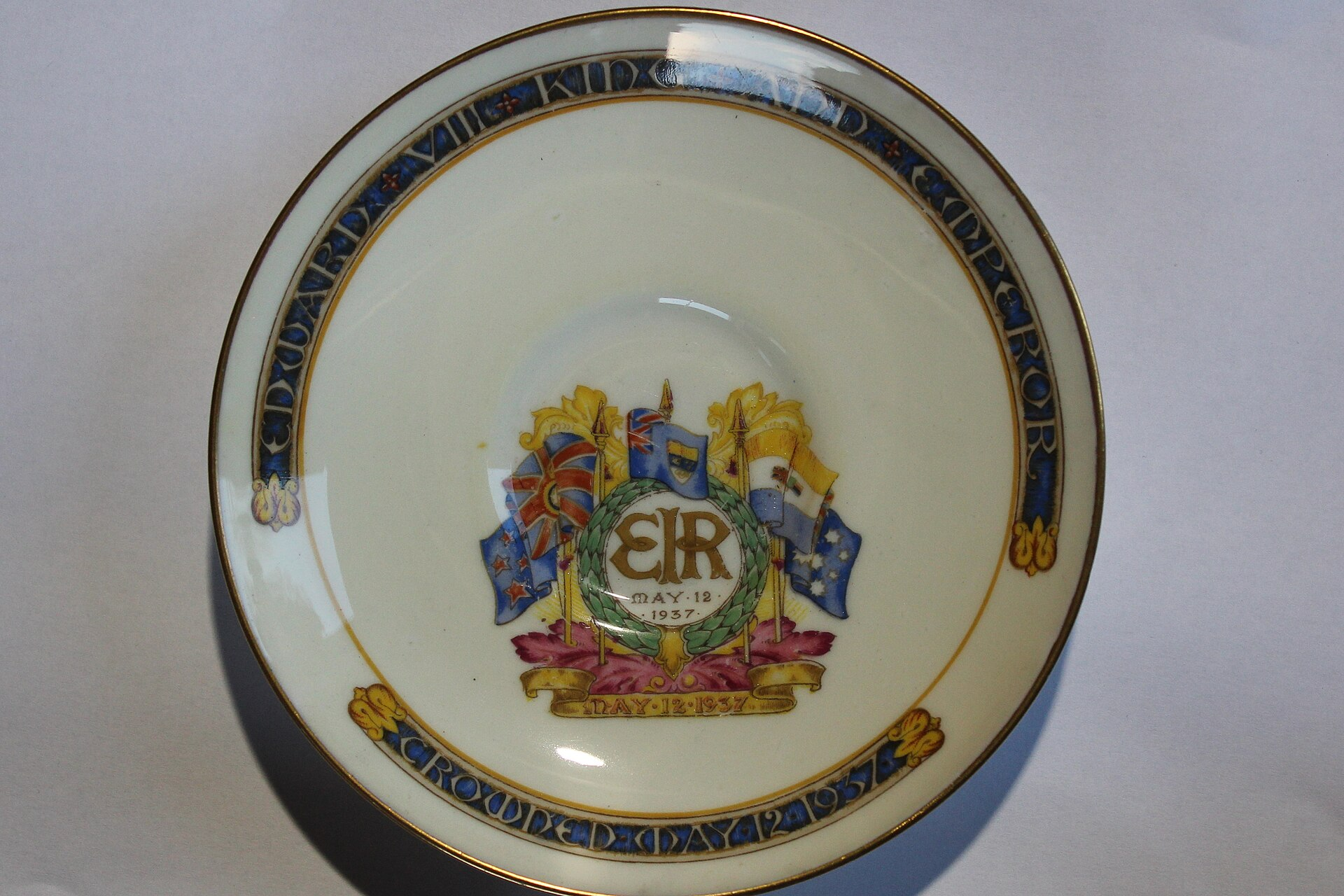
Royal commemorative wares are another part of Paragon collecting. They should not, however, be confused with Royal Warrant marks. A commemorative design may refer to a royal event while the factory backstamp provides a different type of historical evidence.
Paragon China Marks and Backstamps
For most collectors, the underside is the natural starting point. Paragon marks changed with company identity, Royal Warrants and later ownership, making the exact wording useful for approximate dating.
The broader principles in our
guide to porcelain marks and backstamps
apply directly to Paragon: photograph the whole base, record every word and number, and compare the mark with the complete object.
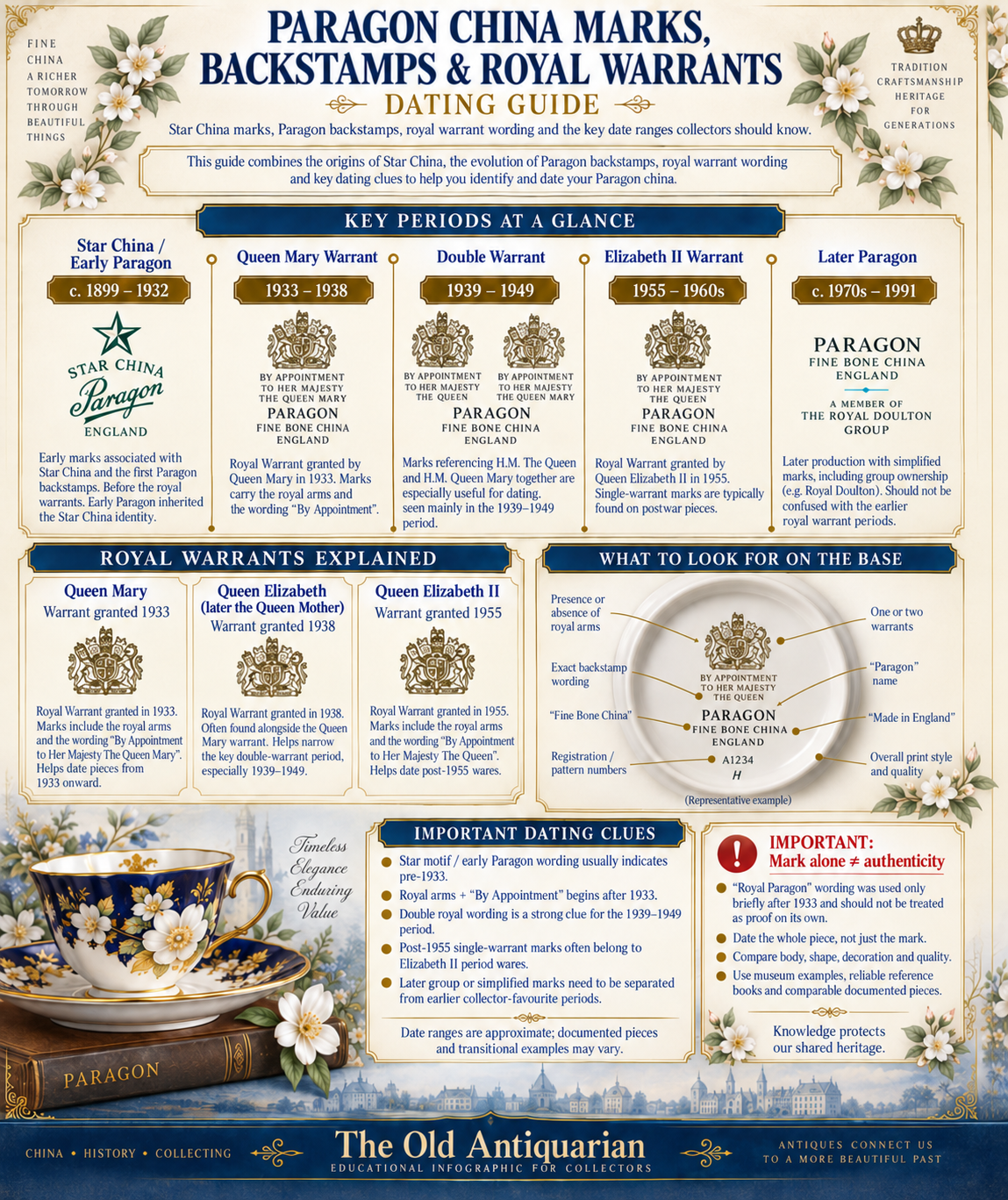
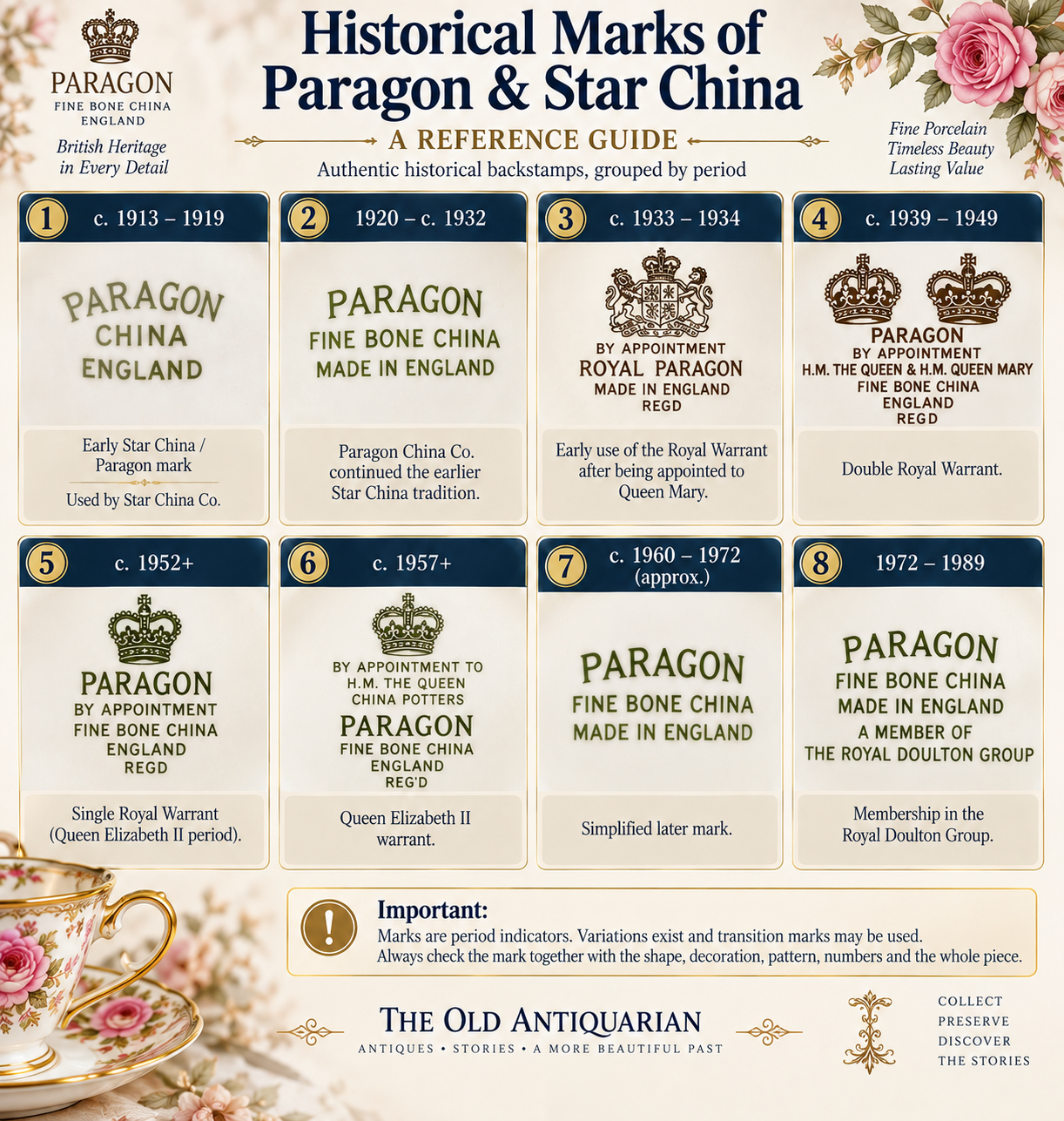
Paragon Marks Dating Table
| Approx. Period | Typical Wording / Feature | How to Interpret It |
|---|---|---|
| c. 1913–1919 | Paragon / China / England | Used during the Star China Company period. |
| 1920–c. 1932 | Paragon / Fine Bone China / Made in England | Associated with the Paragon China Company before the first Royal Warrant. |
| c. 1933–1934 | Royal Paragon / By Appointment / royal arms | Short-lived wording after Queen Mary’s 1933 warrant. |
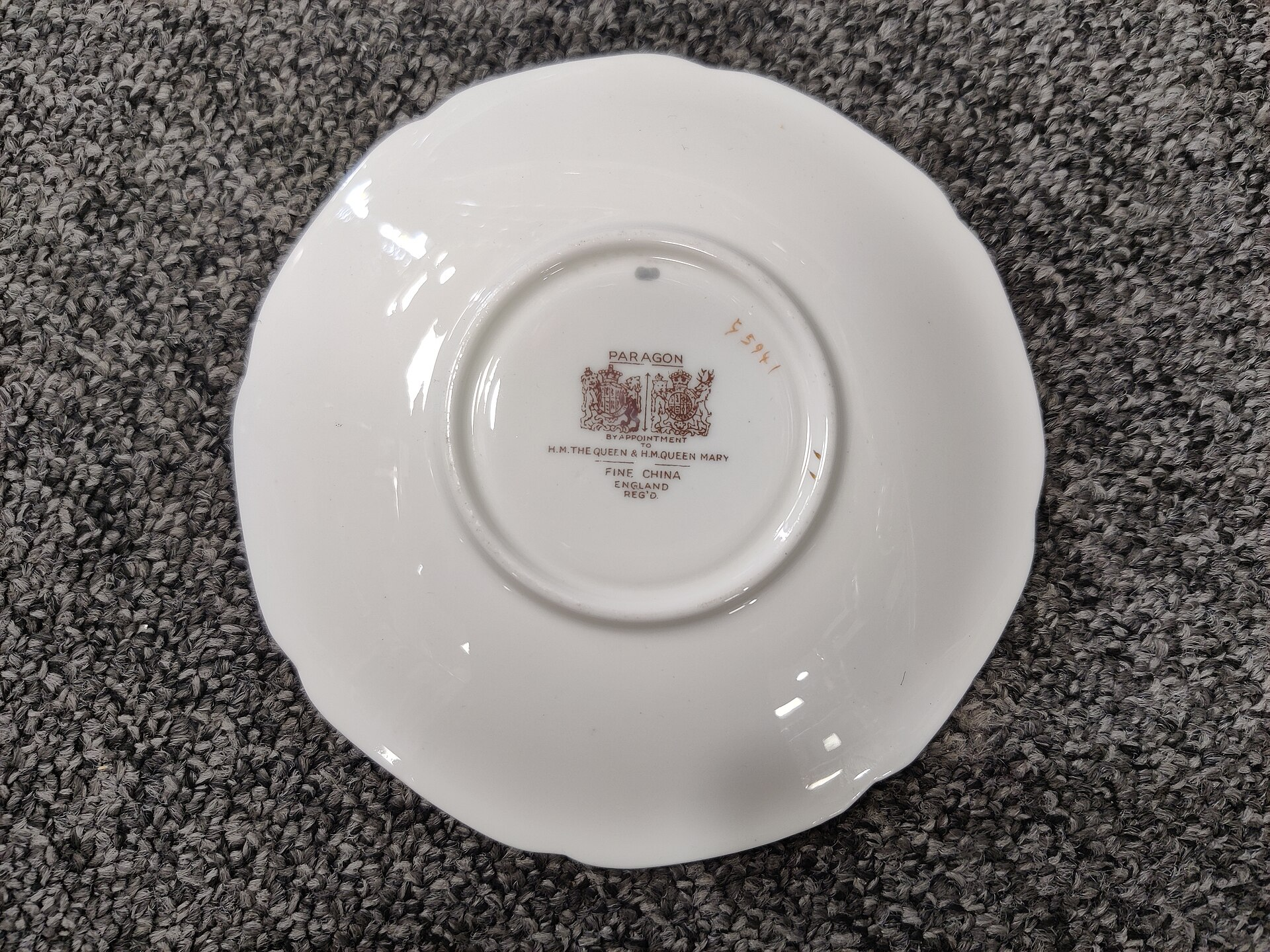
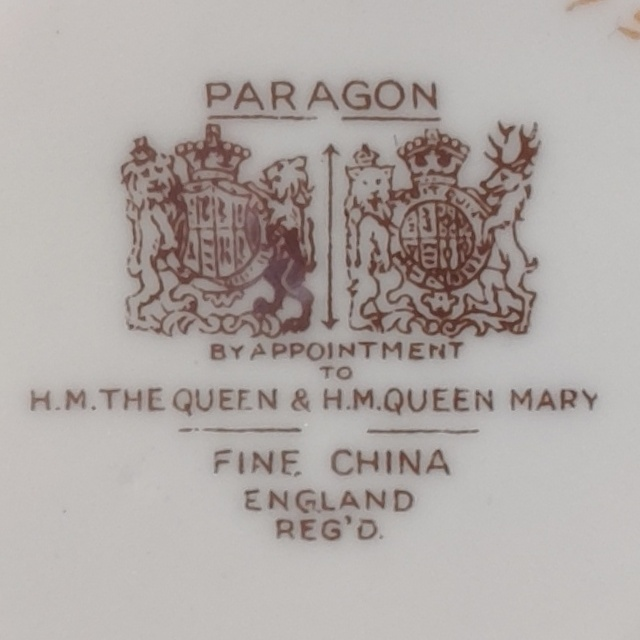
| c. 1939–1949 | By Appointment to H.M. The Queen & H.M. Queen Mary | Important double-warrant period. |
| c. 1952+ | Paragon / By Appointment / Fine Bone China / England | Single-warrant variants occur. |
| c. 1957+ | By Appointment to H.M. The Queen / China Potters / Paragon | Associated with the Queen Elizabeth II warrant era. |
| Probably c. 1960–1972 | Paragon / Fine Bone China / Made in England | Simplified later mark; context is essential. |
| 1972–1989 | A Member of the Royal Doulton Group | Clearly places the piece within the later corporate period. |
Dating note: These ranges are collector reference periods, not universal exact dates for every object. Transitional backstamps and variations exist, so a narrowly dated attribution should ideally be supported by a documented piece, pattern registration, catalogue or other independent evidence.
How to Date Paragon China
Paragon China dating is best treated as a process of narrowing a production period rather than searching for one magical logo that gives an exact year.
The same methodology is explained more broadly in our
complete guide to dating antique porcelain.
| Step | Check | Question |
|---|---|---|
| 1 | Complete backstamp | What does it say exactly? |
| 2 | Royal wording | Is there one warrant, two warrants, “Royal Paragon” or no royal wording? |
| 3 | Material | Does the body correspond to fine bone china? |
| 4 | Pattern | Can the decoration be matched to a documented Paragon design? |
| 5 | Shape | Does the cup, teapot or serving piece fit the proposed period? |
| 6 | Numbers | Are pattern, registration, shape or handwritten codes present? |
| 7 | Condition | Does wear make sense for the proposed age and use? |
| 8 | Documented comparison | Can the object be matched with reliable historical references? |
Paragon China Patterns, Shapes and Tea Sets
Paragon’s reputation was built especially strongly around elegant tea and table wares. Collectors encounter teacups and saucers, trios, breakfast cups, cabinet cups, teapots, sugar bowls, milk jugs, serving dishes and larger matching services.
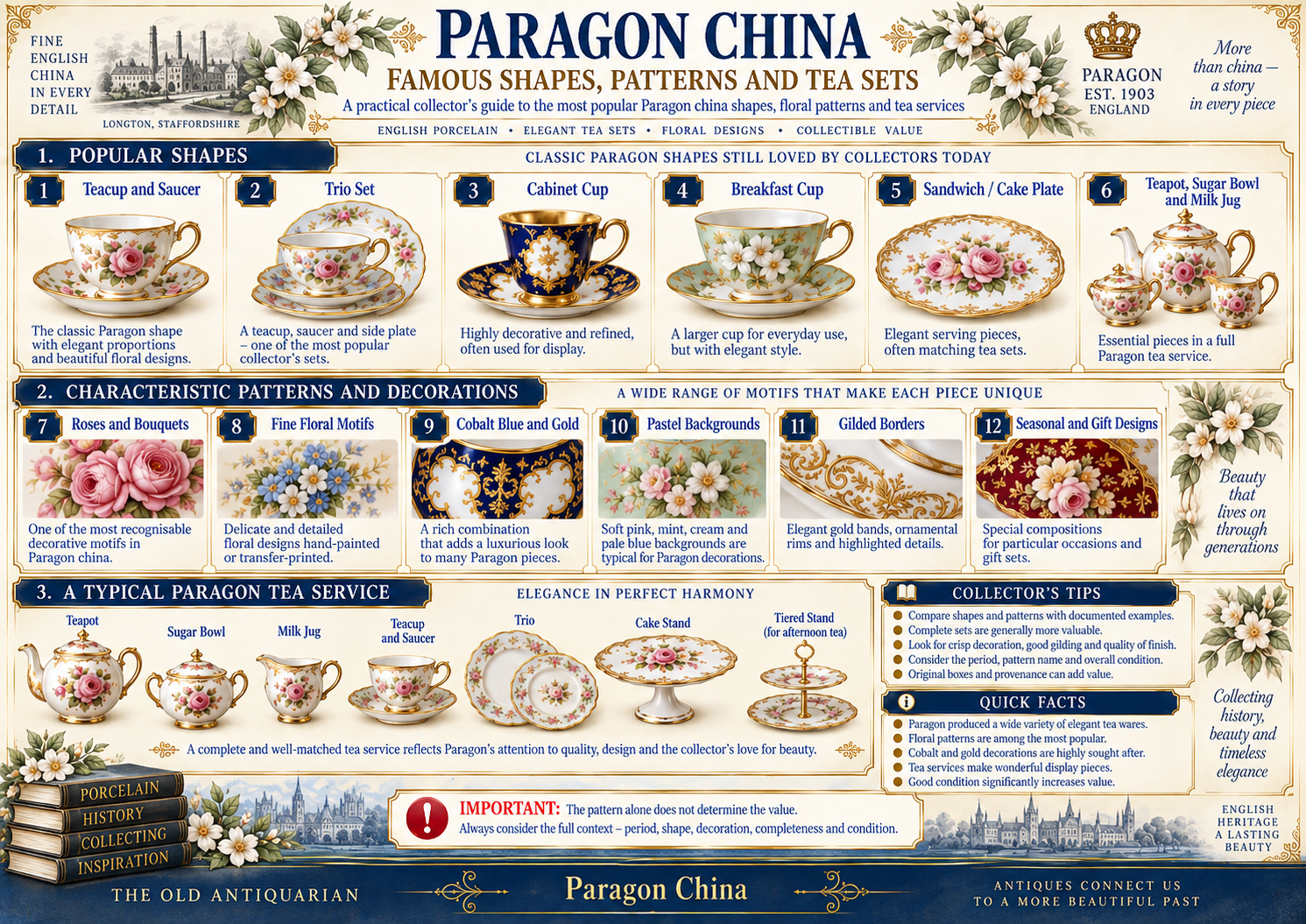
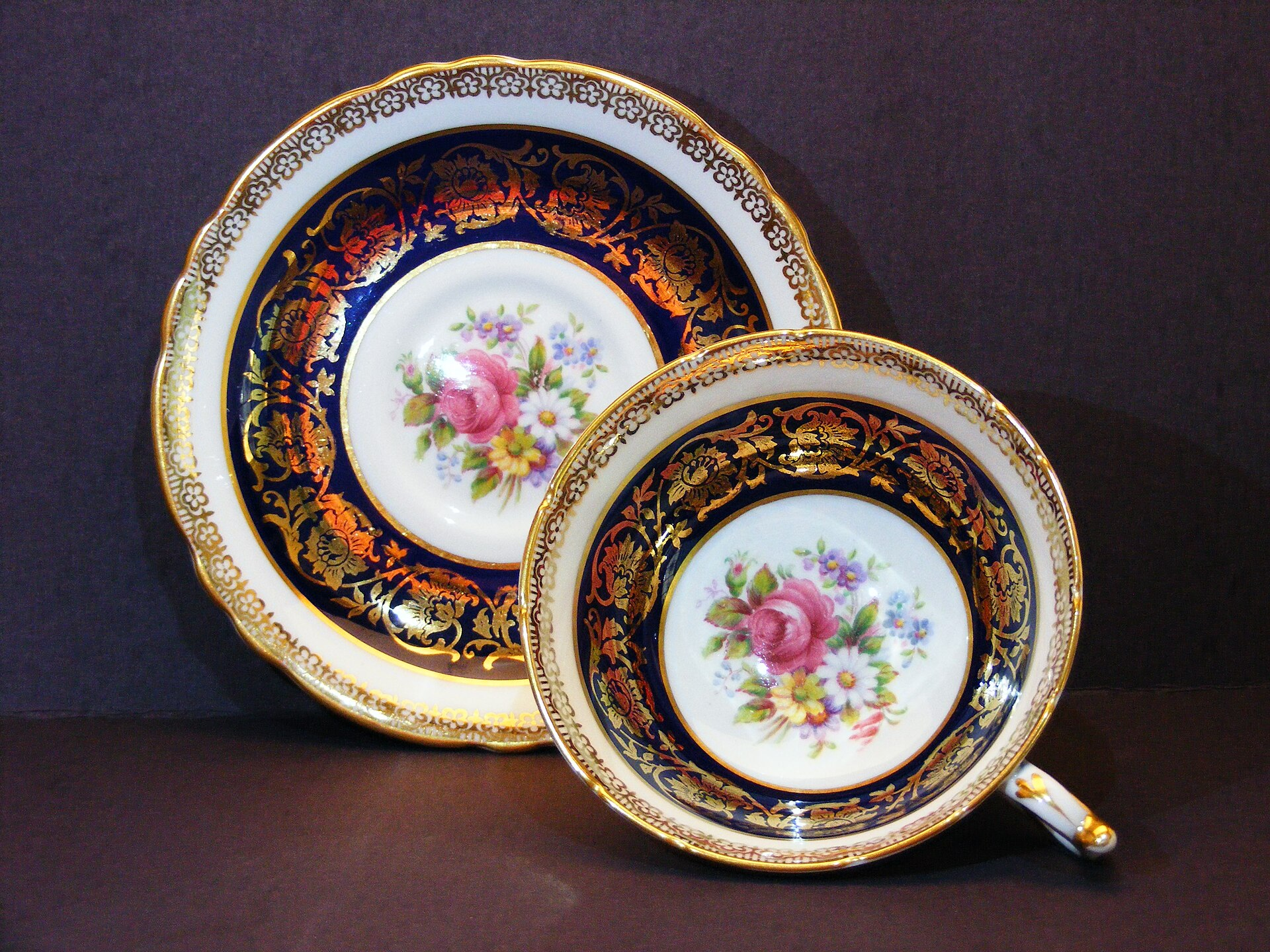
Decoration ranges from comparatively restrained floral borders to richly coloured cabinet pieces using deep cobalt grounds, extensive gilding and elaborate flower painting or printed-and-painted decoration.
Documented and Well-Known Paragon Patterns
Patterns encountered in documented Paragon material include Tapestry Rose, Morning Rose, Bridal Rose, Victoriana Rose, Moss Rose, Indian Tree and Radstock. The Potteries specifically documents several of these, including the particularly familiar Tapestry Rose family.
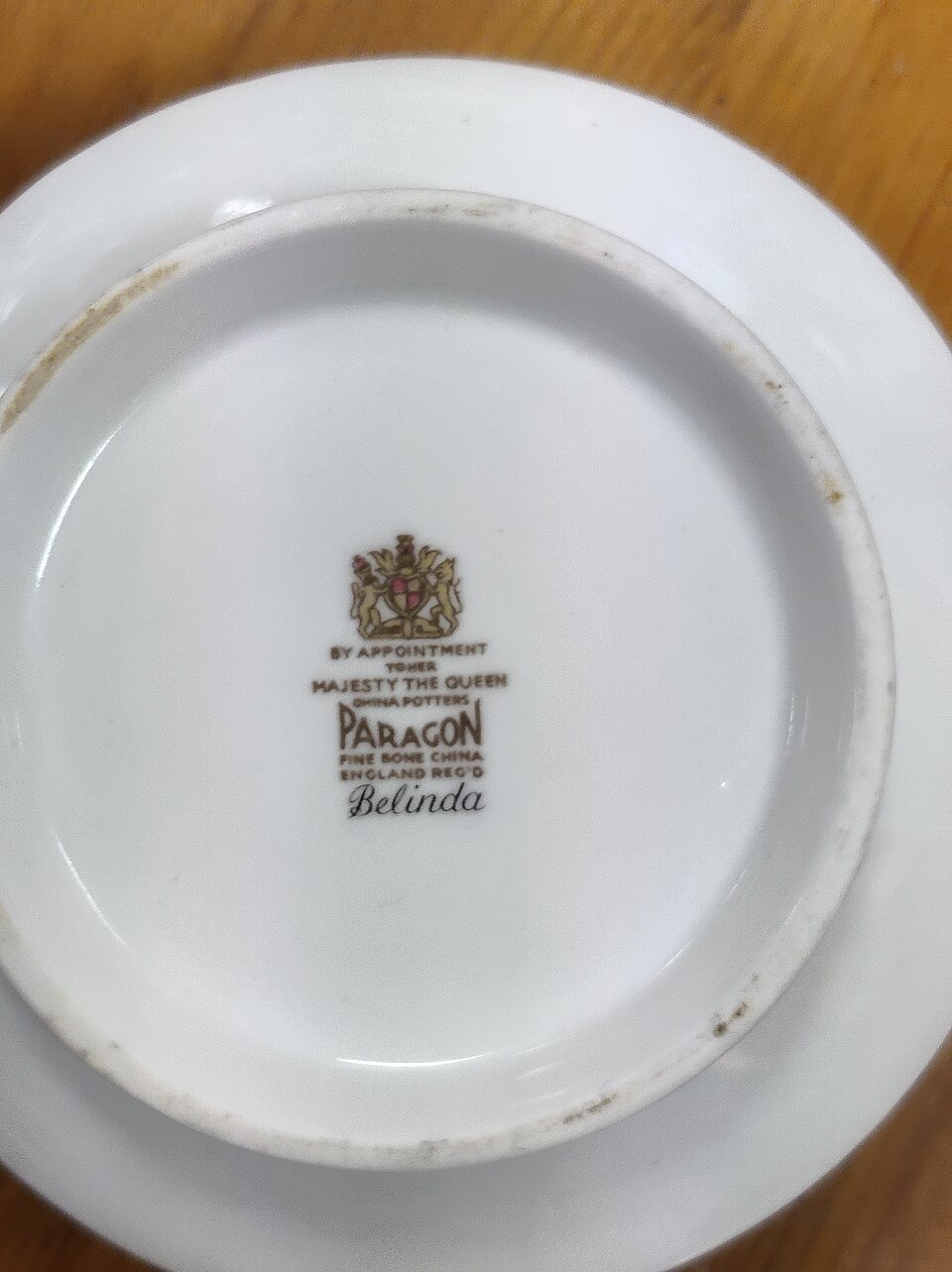
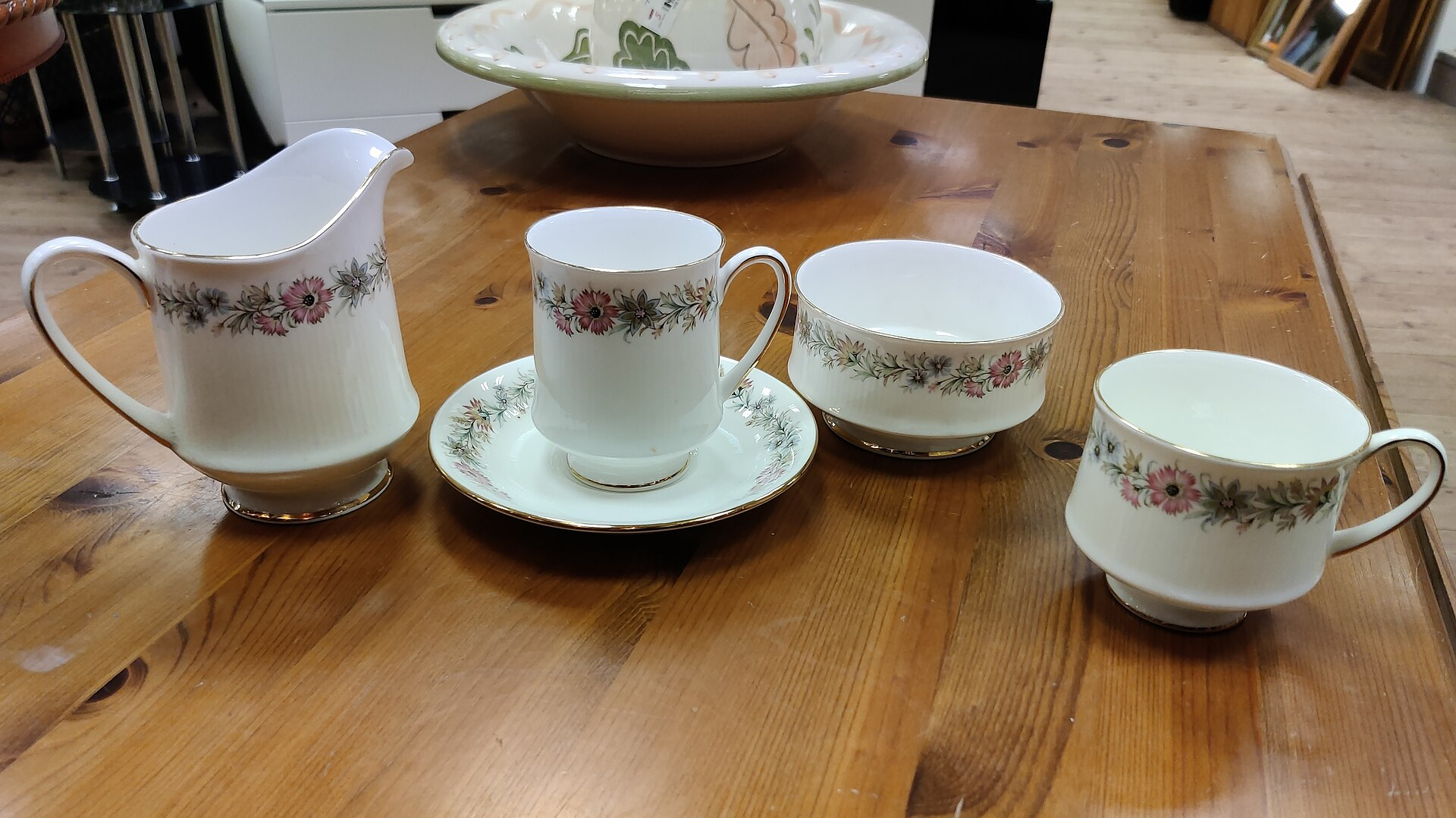
The Belinda pattern provides another useful lesson: when the pattern name is printed directly on the backstamp, it can help narrow research much more effectively than describing a piece merely as “Paragon floral china”.
Why Pattern Identification Matters
Pattern identification can help answer several different questions at once. A known pattern may help establish a production context, distinguish replacement pieces within a set and improve the quality of market comparisons.
But a pattern name is not automatically a date or a value. A design can remain in production for years, move between related companies or exist in different forms and colourways.
Paragon Pattern Numbers, Registration Numbers and Other Codes
Numbers are often among the most misunderstood details on Paragon China. Depending on the object and period, a number may relate to a pattern, registered design, shape, production reference or another factory code.
Record printed, painted, handwritten and impressed numbers exactly as they appear before attempting to interpret them.
When researching a numbered Paragon piece, use the number together with the exact decoration and form. A number that matches a documented pattern is far stronger evidence than a number interpreted without reference to the object.
How to Identify Authentic Paragon China
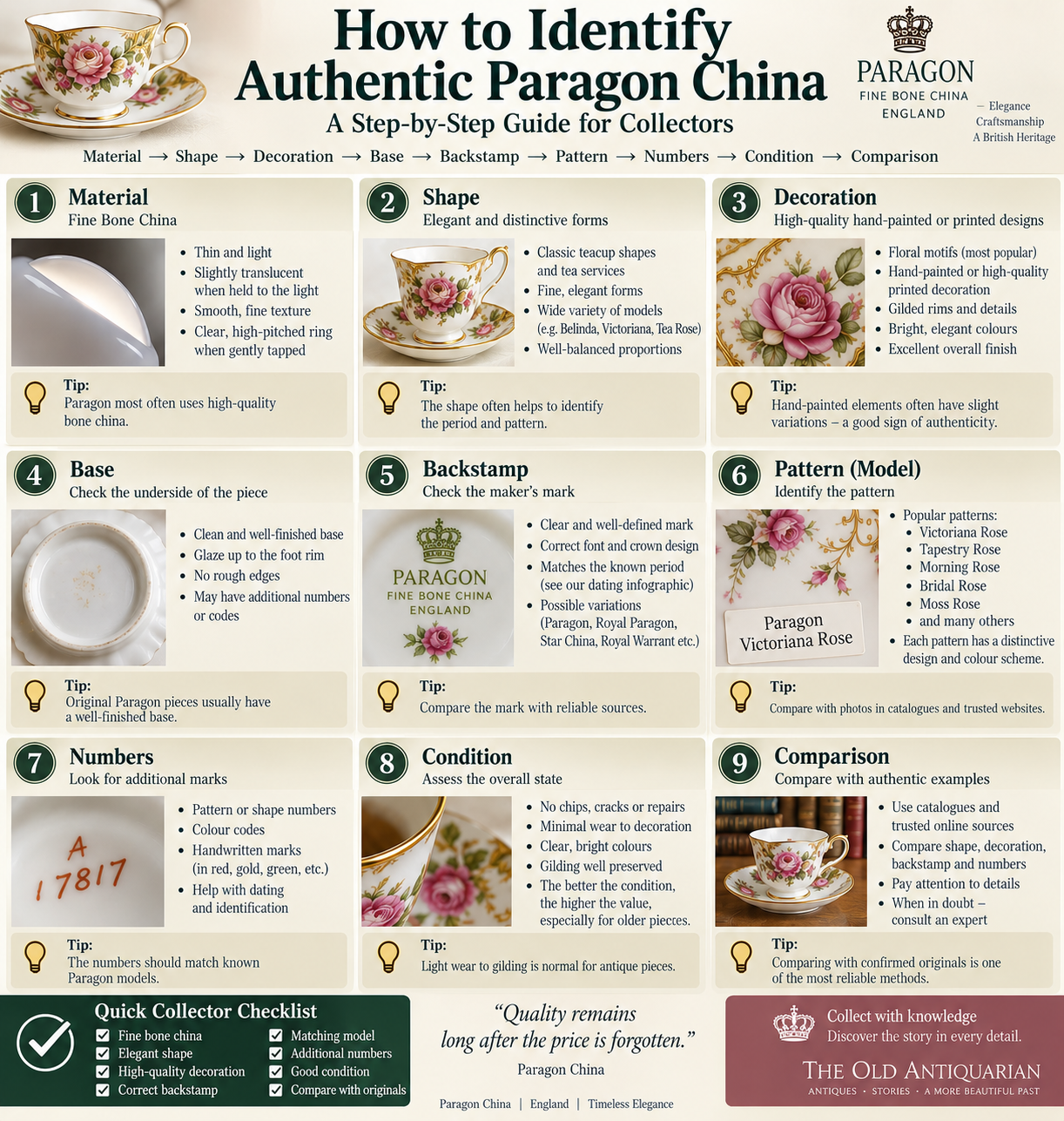
There is no single authenticity test for Paragon. Reliable identification comes from a group of characteristics that support one another.
1. Examine the Bone China Body
Paragon became strongly associated with fine English bone china. Examine the body, colour, refinement, translucency where appropriate, glaze and finish. Material can support an attribution, but it cannot establish age on its own.
2. Examine the Complete Base
Do not crop the backstamp when photographing the underside. The position of the mark, pattern name, registration wording and secondary numbers may all matter.
3. Match the Exact Backstamp
Compare the exact wording rather than merely searching for a crown or the word Paragon. “Royal Paragon”, a double warrant and “A Member of the Royal Doulton Group” belong to very different historical contexts.
4. Study Shape and Construction
Cup profiles, handles, rims, feet, lids and serving forms can help support or challenge a proposed date. A mark associated with one period should make sense on the form carrying it.
5. Study Decoration
Look at floral composition, printing, painted details, gilding, border design and colourway. Similar rose motifs were used by several English manufacturers, so decoration should never be used without the backstamp and form.
6. Compare Documented Examples
Museum collections, factory history, specialist ceramic archives and historical catalogues are preferable to anonymous marketplace descriptions. Our broader
antique porcelain identification guide
explains the same evidence-based method across different manufacturers.
Paragon China Value: What Is It Worth?
There is no reliable universal price list for Paragon China. Two cups carrying apparently similar backstamps can have very different market values because the pattern, exact period, shape, colourway, rarity, condition and collector demand may differ.
A seller’s advertised price shows what they hope to receive. A completed comparable sale shows what a buyer actually paid under those market conditions.
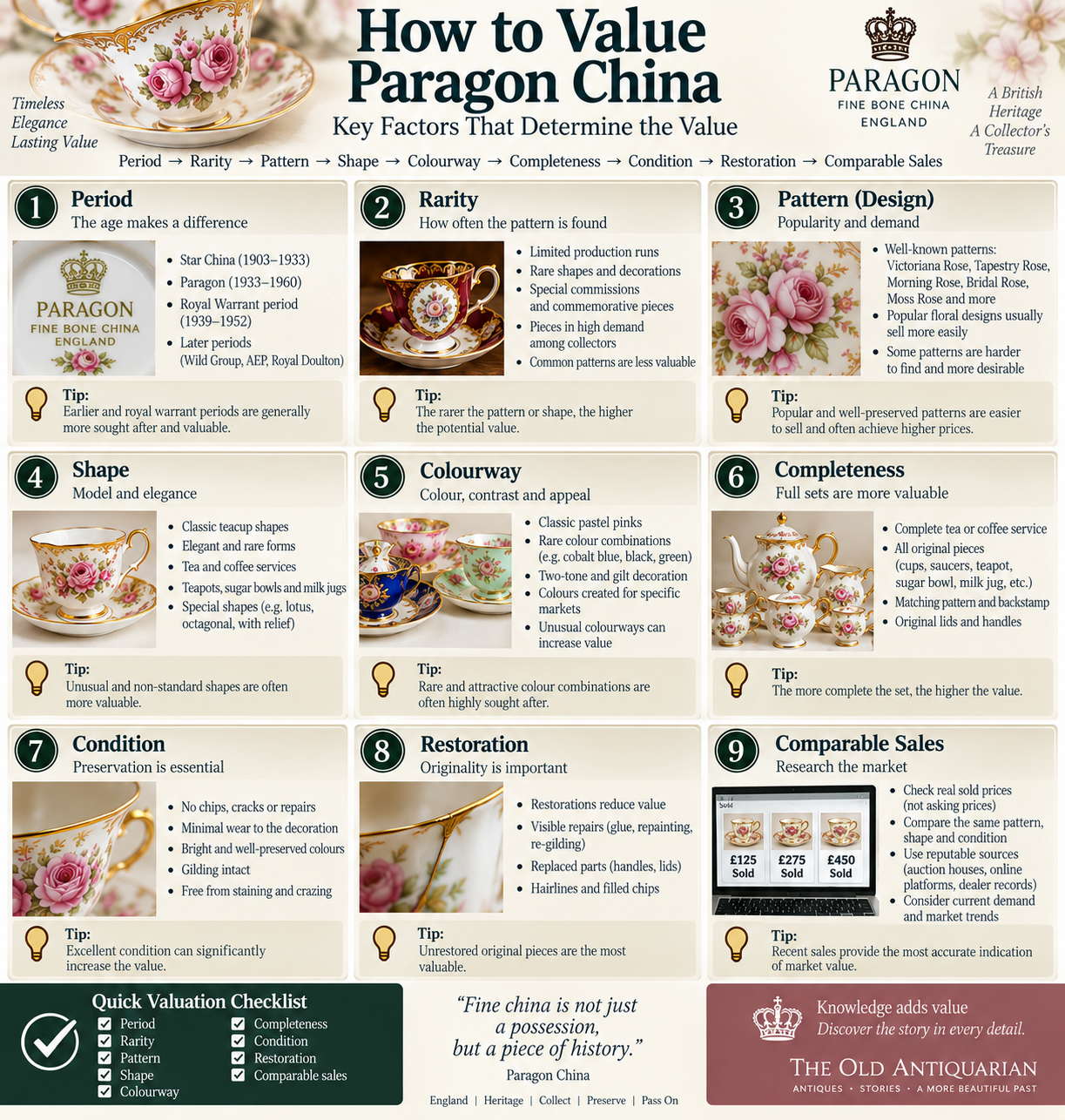
| Value Factor | Why It Matters |
|---|---|
| Exact pattern | Collector demand varies significantly between patterns. |
| Production period | Historically important and earlier periods may attract different demand from later production. |
| Shape | Scarce cabinet cups, teapots and unusual serving forms can differ greatly from standard cups or plates. |
| Colourway | Different colour versions of the same or related pattern may have different availability and demand. |
| Completeness | A genuinely matching service may appeal differently from isolated pieces. |
| Condition | Cracks, chips, staining and severe gilding loss usually reduce desirability. |
| Restoration | Repairs, repainting, replaced handles or regilding must be disclosed and assessed. |
| Provenance | Documented history can strengthen confidence and historical significance. |
| Completed comparable sales | The best evidence of current market behaviour when the comparables are genuinely similar. |
How to Compare Paragon Sales Properly
The strongest comparable is not simply another object marked Paragon. Try to match:
exact pattern + approximate period + form + size + colourway + condition + restoration history + completeness
This is why a high online asking price for a rare-looking cup should never be used as proof that your own Paragon piece has the same value.
Condition, Gilding Wear and Restoration
Condition is especially important with Paragon because many pieces combine thin bone china, projecting handles and extensive gilding. Examine every piece under good light before assigning value.
| Area | What to Check | Why It Matters |
|---|---|---|
| Rim | Chips, hairlines, gilding loss | High-contact and vulnerable area |
| Handle | Cracks, old glue, repainting | Handles are frequently repaired |
| Foot | Chips, grinding, natural wear | Can reveal use and later alteration |
| Decoration | Scratches, fading, repainting | Original decoration is important to collectors |
| Gold | Rubbing, later regilding | Normal light wear differs from heavy loss or restoration |
| Sets | Different marks, colours or shapes | May reveal later replacement pieces |
Perfect condition does not automatically mean modern production. A cabinet piece may have seen almost no practical use. Conversely, heavy wear does not automatically prove great age. Condition is supporting evidence, not a clock.
Paragon vs Other English Porcelain Makers
Paragon becomes easier to understand when placed beside other important British manufacturers. If you are unfamiliar with the wider tradition, begin with our
English Porcelain Guide.
| Maker | Broad Collecting Character | Useful Identification Focus |
|---|---|---|
| Paragon | 20th-century fine bone china, floral tea ware, gilding and Royal Warrant history | Exact warrant wording, backstamp, pattern, form |
| Royal Albert | English bone china, floral tea services and extensive pattern production | Backstamp, pattern, country wording, shape |
| Aynsley | Fine bone china, cabinet cups, floral and fruit decoration | Mark, pattern, body, decoration, form |
| Minton | Much broader 19th- and 20th-century luxury ceramic tradition | Factory marks, pattern numbers, material and technique |
| Royal Worcester | Long English porcelain tradition, decorative art and tableware | Date codes, marks, artists, model numbers |
| Royal Crown Derby | Rich gilding, Imari traditions and luxury bone china | Backstamp, date cipher, pattern and gilding |
| Coalport | Historic English porcelain, decorative wares and later collectibles | Period-specific marks, material, shape and decoration |
| Chelsea | Much earlier 18th-century English soft-paste porcelain | Anchor marks, body, modelling and period decoration |
Collectors can also compare Paragon with
Wedgwood,
although Wedgwood’s ceramic output and material history are substantially broader than Paragon’s fine bone china specialism.
Paragon China Collector Checklist
| ☐ Photograph the complete object | ☐ Photograph the entire underside |
| ☐ Record the exact Paragon wording | ☐ Check Royal Warrant wording |
| ☐ Identify the pattern if possible | ☐ Record all numbers and letters |
| ☐ Examine the shape and handle | ☐ Study decoration and gilding |
| ☐ Inspect chips, cracks and staining | ☐ Look for restoration or regilding |
| ☐ Compare documented examples | ☐ Use completed sales for valuation |
The safest research order
Identify first → date second → value last.
Do You Have Paragon China to Identify or Value?
Send clear photographs of the complete object, the underside and backstamp, pattern details, measurements and any visible damage or restoration. The more precisely the piece can be identified, the more meaningful its valuation can become.
Frequently Asked Questions About Paragon China
Is Paragon China valuable?
Some Paragon pieces are highly collectible, while others are relatively common. Value depends on the exact pattern, period, shape, colourway, rarity, completeness, condition, restoration and current market demand. The Paragon name alone does not establish a high value.
How can I identify old Paragon China?
Start with the complete backstamp, then examine the bone china body, shape, decoration, pattern name or number, Royal Warrant wording and condition. Compare the complete combination with documented historical examples rather than matching the logo alone.
What do Paragon backstamps mean?
Paragon backstamps can indicate company period, country wording, fine bone china, Royal Warrant status, pattern information and later corporate ownership. The exact wording is more useful than simply seeing the Paragon name.
Does a crown on Paragon China prove that it is old?
No. A crown or royal arms must be interpreted as part of a specific documented backstamp. The rest of the object must also correspond with the proposed period.
What is Royal Paragon?
Royal Paragon was brief wording used around the period following the 1933 Royal Warrant from Queen Mary. It was not a separate factory. Museum Wales indicates that use of the “Royal” prefix had ended by the close of 1934.
When did Paragon receive its first Royal Warrant?
Paragon received a Royal Warrant of Appointment from Queen Mary in 1933. The royal interest associated with the Duchess of York in 1926 was patronage, not the same thing as a formal Royal Warrant.
What is a Paragon double Royal Warrant mark?
Backstamps naming both H.M. The Queen and H.M. Queen Mary are associated approximately with the 1939–1949 period. They are useful dating evidence when the rest of the piece is consistent.
What are the best-known Paragon patterns?
Patterns documented in collector and historical references include Tapestry Rose, Morning Rose, Bridal Rose, Victoriana Rose, Moss Rose, Indian Tree and Radstock, among many others.
Is Belinda a Paragon pattern?
Yes. Belinda appears as a named Paragon pattern and can be found directly identified on surviving backstamps.
Can a Paragon mark give an exact date?
Usually it provides a range rather than an exact year. Some wording and Royal Warrant combinations can narrow the period considerably, but pattern history, form, numbers and other evidence should also be checked.
Are Paragon pattern numbers dates?
Not necessarily. Numbers may represent patterns, shapes, registered designs or other factory information. They should never automatically be interpreted as production years.
When did Royal Doulton own Paragon?
Paragon became part of Royal Doulton in 1972. Marks referring to Paragon as a member of the Royal Doulton Group are associated with the later production period, approximately 1972–1989.
When was the Paragon name discontinued?
By the end of the 1980s many Paragon patterns and the brand identity were being absorbed into Royal Albert. Production under the Paragon name continued into about 1991, and Museum Wales records the name as discontinued by 1992.
How should I value a Paragon tea set?
Identify the exact pattern, period, forms and colourway; establish whether all components genuinely match; inspect condition and restoration; then compare with recent completed sales of genuinely similar sets. Asking prices alone are not reliable market evidence.
Related Guides
English Porcelain: History, Bone China, Marks & Identification
How to Identify Porcelain Marks & Backstamps
Explore more specialist terminology and manufacturer guides in the
Antique & Collector’s Glossary.
Sources & Further Research
The history of Paragon contains several transitional periods and one notable disagreement over the exact starting year of the Star China Company. For that reason, this guide distinguishes between firmly documented dates and approximate collector date ranges.
-
Amgueddfa Cymru – Museum Wales: Paragon China Ltd.
— company history, royal patronage, Royal Warrants and later ownership. -
The Potteries: Paragon China Ltd.
— historical company chronology, patterns and backstamp examples. -
The Potteries: Star China Company
— predecessor company, early Paragon trade name and Star China marks. -
The Potteries: 1956 Historical Profile of Paragon China Ltd.
— contemporary mid-century company profile; useful especially for understanding the differing 1897 origin date.
Historical backstamps may overlap, wording can vary, patterns can remain in production across ownership changes and old shapes may be reused. Narrow date ranges should therefore be treated as approximate unless the individual object has additional documentary evidence.
The Old Antiquarian
The Old Antiquarian combines more than 35 years of practical experience with antiques and collecting with historical, museum and comparative research. When examining porcelain, we consider the manufacturer, material, exact mark, pattern, form, decoration, craftsmanship, condition, restoration and provenance as interconnected evidence rather than relying on any single characteristic.
Conclusion: How to Understand Paragon China
Paragon China is an important part of twentieth-century English bone china history. Its evolution from the Star China Company to an internationally recognised maker of elegant tea ware, its unusually well-documented Royal Warrant history and its later connection with Royal Albert and Royal Doulton make the brand especially rewarding to research.
For collectors, however, the most important lesson is methodological. Do not stop when you recognise the word Paragon. Identify the exact mark. Read the Royal Warrant wording. Find the pattern. Study the shape and decoration. Record every number. Inspect the condition and look for restoration. Then compare the object with documented historical examples.
