
The Seltmann Brothers: Johann, Christian & Porcelain History
Behind the name Seltmann lies more than a famous German porcelain manufacturer. It is the story of an entrepreneurial family, two brothers, a shared factory, a business disagreement and two porcelain enterprises that eventually followed remarkably different paths.
The historical connection between Johann Seltmann of Vohenstrauß and Christian Wilhelm Seltmann of Weiden is particularly important for collectors. Both names belong to Bavaria’s porcelain-making heritage, yet porcelain associated with their respective companies should not automatically be attributed to the same manufacturer, production period or factory.
Their shared business history began in 1901. Their separation came in 1910. Both founders died in 1921, but their descendants continued the businesses. Johann Seltmann’s original manufacturing operation at Vohenstrauß eventually closed, while Seltmann Weiden continues producing German porcelain today.
This guide follows the family history from its earlier roots in Schlottenhof to the development of two porcelain dynasties, with special attention to Johann Seltmann Vohenstrauß, its documented factory marks, surviving porcelain and industrial legacy.
Quick Answer: Who Were the Seltmann Brothers?
Johann Seltmann (1856–1921) and his younger brother Christian Wilhelm Seltmann (1870–1921) were German entrepreneurs connected with porcelain manufacturing in Bavaria. In 1901, Johann established the porcelain factory in Vohenstrauß, with Christian Wilhelm responsible for its factory management and production.
In 1910, disagreement over the future structure of the business led Christian Wilhelm to establish his own porcelain factory in Weiden. Johann continued the original business in Vohenstrauß, which passed to his heirs after his death in 1921.
The Vohenstrauß facility became part of SKV-Porzellan-Union in 1993, with a closure decision announced on October 27, 1995. Seltmann Weiden, meanwhile, developed into a manufacturing group and remains active. The two producers share family origins but have distinct factory histories and porcelain marks.
The Seltmann Brothers at a Glance
| Historical Detail | Essential Information |
|---|---|
| Family | Seltmann, a family associated with German porcelain manufacturing |
| Earlier family venture | Gebrüder Seltmann, established at Schlottenhof in 1897 by Karl and Wilhelm Seltmann |
| Johann Seltmann | 1856–1921; founder of the Vohenstrauß porcelain factory |
| Christian Wilhelm Seltmann | 1870–1921; manager at Vohenstrauß and founder of Seltmann Weiden |
| Shared factory | Vohenstrauß, Upper Palatinate, Bavaria, from 1901 |
| Separation | 1910, following differences over the proposed company structure |
| Johann’s company | Porzellanfabrik Johann Seltmann, Vohenstrauß |
| Christian’s company | Porzellanfabriken Christian Seltmann, Weiden |
| Vohenstrauß closure | Closure decision in 1995; cessation of production in the final 1995–1996 period |
| Weiden today | An active family-owned German porcelain manufacturer |
| Collector significance | Different factory marks, corporate histories, tableware and decorative porcelain |
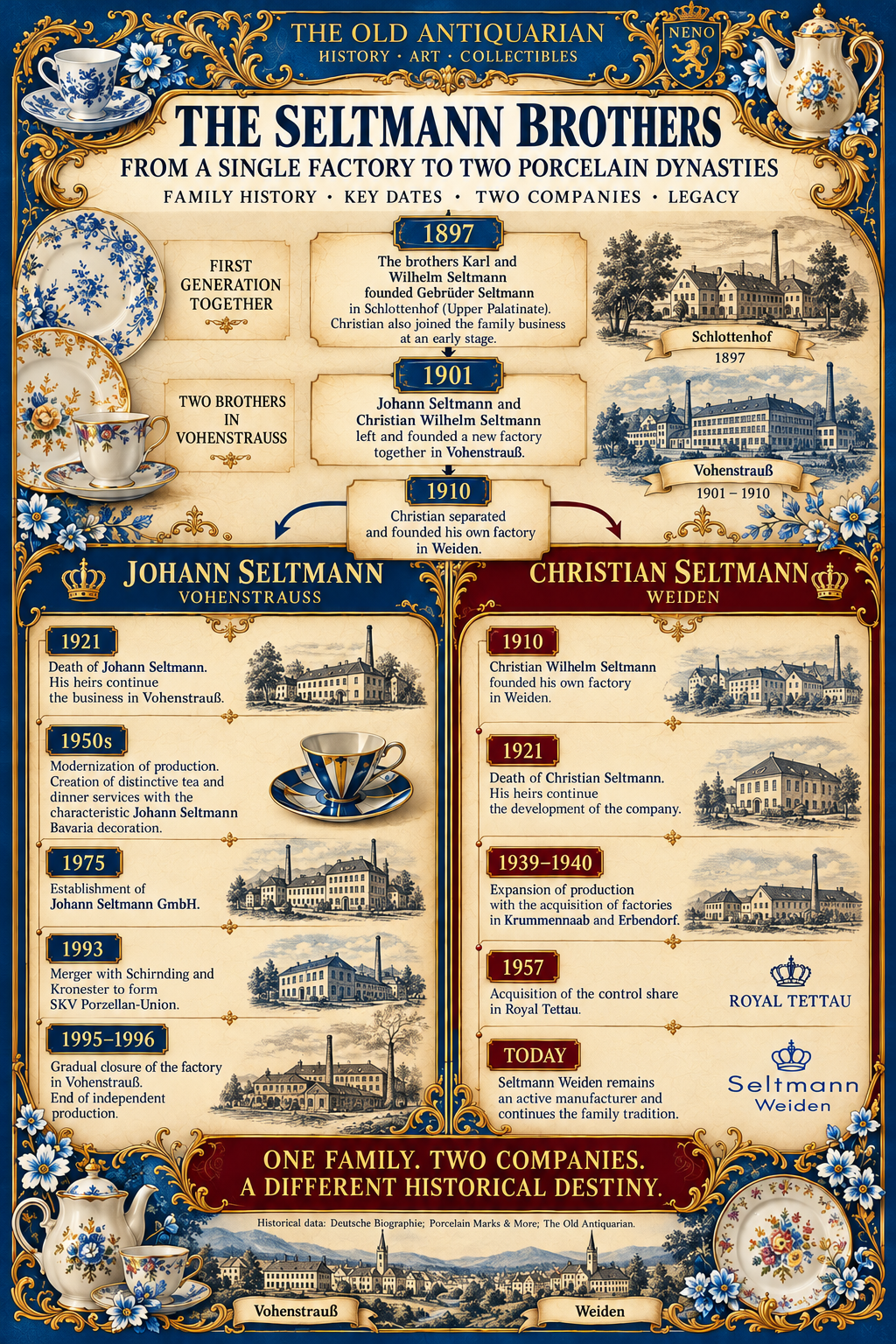
Johann Seltmann Vohenstrauß and Seltmann Weiden belong to the same family history, but they were separate manufacturing companies. A shared surname does not prove the same factory, original mark, production date or collector value.
1. The Seltmann Family Before 1901 – The Schlottenhof Origins
The Seltmann story did not begin in Weiden in 1910, nor even at Vohenstrauß in 1901. Its earlier industrial connections can be traced to Schlottenhof, a community associated with Arzberg in Upper Franconia, northern Bavaria.
According to the Neue Deutsche Biographie, the brothers Karl Seltmann (1858–1927) and Wilhelm Seltmann (1862–1935) founded a porcelain business known as Gebrüder Seltmann in Schlottenhof in 1897. Their younger brother Christian Wilhelm also participated in this family enterprise.
This matters because the Seltmann family included several brothers involved in porcelain-related business. Karl and Wilhelm’s earlier Schlottenhof venture should not be confused with the later Vohenstrauß operation associated with Johann and Christian Wilhelm.
The wider Upper Franconian porcelain industry provided an environment in which technical skills, decorative methods, commercial relationships and factory management experience could circulate between nearby manufacturers. These connections helped prepare the ground for the new Vohenstrauß undertaking.
The early history involves Karl, Wilhelm, Johann and Christian Wilhelm Seltmann. Understanding the family relationships prevents confusion between the Schlottenhof venture of 1897, the Johann Seltmann factory established in 1901 and the independent Seltmann Weiden company founded in 1910.
2. Johann and Christian Wilhelm Seltmann – Two Brothers, Two Approaches
Johann Seltmann (1856–1921)
Johann Seltmann was born in 1856 in Schlottenhof. His early professional life followed an agricultural and entrepreneurial path rather than the specialist technical training pursued by his younger brother. Nevertheless, the family’s connection with porcelain decoration and manufacture formed part of his wider commercial background.
In 1901, Johann became the founder of a new porcelain factory at Vohenstrauß. His business ambitions, combined with his brother’s production experience, established a partnership that expanded rapidly during the years before World War I.
Christian Wilhelm Seltmann (1870–1921)
Christian Wilhelm Seltmann was born in 1870 in Schlottenhof. He trained in porcelain turning and attended the specialist porcelain school at Teplitz-Schönau. By 1896, he was managing a porcelain factory in Arzberg, giving him valuable practical experience in industrial production.
When he joined Johann in the Vohenstrauß venture, Christian Wilhelm was particularly well qualified to direct manufacturing. His knowledge of equipment, kiln technology, raw materials and factory organisation would become essential to the early success of the business.
| Feature | Johann Seltmann | Christian Wilhelm Seltmann |
|---|---|---|
| Born | 1856, Schlottenhof | 1870, Schlottenhof |
| Background | Landowner and entrepreneur | Porcelain craftsman and factory manager |
| 1901 role | Founder of the Vohenstrauß factory | Production and factory management |
| After 1910 | Continued the original factory | Founded his own factory in Weiden |
| Died | 1921 | 1921 |
3. The First Factory in Vohenstrauß – 1901
In 1901, Johann and Christian Wilhelm began their joint enterprise in Altenstadt, part of Vohenstrauß, in the Upper Palatinate region of Bavaria. The location offered advantages for industrial manufacturing, including access to workers and a railway connection between Vohenstrauß and Waidhaus.
The railway was an important asset. Porcelain production depended on dependable delivery of raw materials and fuel, while finished tableware had to be transported to retailers and customers. The factory initially obtained raw materials from the Upper Palatinate region and considered supplies from Bohemia.
Specialist historical records describe an initial production operation with three kilns. Experienced porcelain specialists from Thuringia were recruited to train local workers, and Christian Wilhelm managed the technical side of the factory.
The venture developed quickly. By 1914, the Vohenstrauß factory employed approximately 500 workers, with around one-third of its production intended for export. Its expansion made the company a major regional employer.
| Factory Feature | Vohenstrauß in 1901 |
|---|---|
| Location | Altenstadt, Vohenstrauß, Bavaria |
| Founder | Johann Seltmann, with his brother Christian Wilhelm |
| Production manager | Christian Wilhelm Seltmann |
| Initial equipment | Three kilns, according to historical factory references |
| Skilled workforce | Specialists from Thuringia trained local workers |
| Transport | Railway access supported supplies and distribution |
| Workforce by 1914 | Approximately 500 employees |
4. Why Did the Seltmann Brothers Separate in 1910?
Despite the factory’s strong early performance, Johann and Christian Wilhelm developed different ideas about the future organisation of the business.
According to specialist factory histories, in 1909 Johann considered converting the company into a joint-stock corporation. Christian Wilhelm opposed this plan because he wanted the company to remain a family-owned enterprise.
The disagreement could not be resolved. In 1910, Christian Wilhelm established an independent porcelain factory in Weiden in der Oberpfalz, while Johann continued the original factory in Vohenstrauß.
Johann subsequently abandoned the proposed conversion, but the relationship between the brothers had already been damaged. The decision created two different manufacturing histories that collectors must still distinguish today.
Johann Seltmann
Vohenstrauß · From 1901
Continued the original porcelain factory. His descendants maintained the company until its final reorganisation and closure in the 1990s.
Christian Wilhelm Seltmann
Weiden · From 1910
Founded a separate porcelain company that expanded through later generations and remains a family-owned manufacturer.
5. The Year 1921 – Two Founders, Two Successor Families
An unusual coincidence gives the Seltmann family history an especially memorable chapter: both Johann and Christian Wilhelm Seltmann died in 1921. By that time, however, the companies were established enough for their descendants to continue operating them.
Johann’s Successors – Robert and Christian Seltmann
Following Johann’s death, the Vohenstrauß company passed into the hands of his sons Robert and Christian Seltmann. They continued the business through the interwar period, maintaining the factory’s importance as a regional industrial employer.
By the company’s twenty-fifth anniversary, the workforce was approximately 600 people. The size of the operation demonstrates that Johann Seltmann Vohenstrauß had become a substantial industrial manufacturer rather than a small decorative workshop.
Christian’s Successors – The Next Generation in Weiden
Christian Wilhelm’s family also continued the Weiden business. His son Wilhelm Christian Seltmann (1896–1967) became particularly important in the further development and expansion of the company.
The names must be read carefully: Christian Wilhelm Seltmann was the founder born in 1870, while Wilhelm Christian Seltmann was his son, born in 1896. Reversing the order of their given names is a common source of confusion in family histories.
6. Johann Seltmann Vohenstrauß – From Industrial Growth to Factory Closure
The Interwar Factory and World War II
Under the next generation, Johann Seltmann Vohenstrauß continued to produce porcelain tableware and practical household ceramics. The factory served both domestic customers and export markets, supplying ordinary and decorative products across a range of price levels.
During World War II, the factory also manufactured technical ceramics and electrical insulators. Its buildings sustained serious damage, and manufacturing was interrupted after the war until essential repairs could be completed.
Post-War Recovery and Modernisation
The factory recovered gradually with the return of workers and renewed production. Specialist historical records indicate that 556 people were employed in 1949, showing the continuing industrial importance of the Vohenstrauß business.
A major technical improvement followed during the 1950s. Shortly before his death in 1956, Robert Seltmann initiated the replacement of eight traditional kilns with two modern gas-fired tunnel kilns. Such changes reflected wider efforts to increase efficiency in German industrial porcelain manufacture.
Eberthal – A Lesser-Known Johann Seltmann Name
One especially useful collecting clue is Eberthal, a secondary brand introduced by the Vohenstrauß company to serve a more affordable market segment. Although marketed differently, specialist sources describe Eberthal porcelain as closely related to the main factory’s production.
This means that porcelain marked Eberthal may belong within the historical Johann Seltmann manufacturing network. The name should not automatically be interpreted as proof of an independent porcelain factory.
1975 – Johann Seltmann GmbH
During the later twentieth century, German porcelain manufacturers faced increasing international competition and changes in consumer demand. In 1975, the original company was restructured as Porzellanfabrik Johann Seltmann GmbH.
Despite efforts to modernise and remain competitive, industrial conditions became increasingly challenging during the 1980s and early 1990s. For medium-sized German manufacturers, continued production often depended on cooperation, restructuring or consolidation.
1993–1995 – SKV-Porzellan-Union and the End of Vohenstrauß Production
In 1993, Johann Seltmann GmbH joined Schirnding AG and J. Kronester GmbH to form SKV-Porzellan-Union GmbH. This consolidation was intended to improve the group’s ability to compete in a difficult market.
For Vohenstrauß, the merger did not provide a lasting solution. On October 27, 1995, SKV-Porzellan-Union announced its final decision to close the facility for economic reasons. The cessation of production is generally associated with the 1995–1996 period.
The Vohenstrauß factory has a defined historical production period. An object bearing a familiar Johann Seltmann-style mark should be evaluated against that manufacturing history, especially when a seller claims an unusually late or precisely dated example.
7. The Weiden Branch – How Christian Seltmann’s Company Survived
While the Vohenstrauß enterprise eventually disappeared, Christian Wilhelm’s independent business at Weiden followed a different industrial path. Founded in 1910, Seltmann Weiden gradually developed into a substantial producer of household and professional porcelain.
Its subsequent history includes the expansion of production through Krummennaab in 1939 and Erbendorf in 1940. In 1957, the group incorporated the historically important Royal Tettau porcelain manufacturer, further enlarging its industrial network.
Seltmann Weiden remains an active German porcelain manufacturer. The company’s contemporary information identifies Weiden and Erbendorf as important manufacturing locations and emphasises production in Germany.
For collectors interested in how the 1957 expansion links this family history to another major German manufacturer, our Royal Tettau and Royal Bayreuth historical guide examines that separate porcelain tradition.
For detailed Seltmann Weiden factory marks, U.S. Zone inscriptions, W. Germany backstamps, patterns, identification and collector value, read our complete Seltmann Weiden porcelain guide. This historical article intentionally concentrates on the family and Johann Seltmann Vohenstrauß rather than repeating that specialist reference.
8. Johann Seltmann vs Seltmann Weiden – Historical Comparison
| Characteristic | Johann Seltmann Vohenstrauß | Seltmann Weiden |
|---|---|---|
| Founded | 1901 | 1910 |
| Founder | Johann, with Christian Wilhelm as factory manager | Christian Wilhelm Seltmann |
| Main location | Vohenstrauß, Bavaria | Weiden, Bavaria |
| Corporate development | Independent factory, GmbH and SKV membership | Family-owned manufacturing group |
| Related brands | Eberthal; later SKV-Porzellan-Union | Seltmann Weiden; Royal Tettau and other group businesses |
| Factory status | Original production ended in the mid-1990s | Continues to manufacture porcelain |
| Research priority | Historical Vohenstrauß marks and objects | Separate factory chronology, marks and patterns |
9. The Seltmann Family – Historical Timeline, 1897 to Today
| Year | Historical Milestone |
|---|---|
| 1897 | Karl and Wilhelm Seltmann establish Gebrüder Seltmann in Schlottenhof, Upper Franconia; Christian Wilhelm participates in the early family venture. |
| 1901 | Johann establishes porcelain production at Vohenstrauß with Christian Wilhelm managing the factory. |
| 1909 | Disagreement arises over a proposal to turn the company into a joint-stock corporation. |
| 1910 | Christian Wilhelm leaves and establishes his independent company in Weiden. |
| 1914 | The Johann Seltmann factory employs approximately 500 workers. |
| 1921 | Both founding brothers die; their respective families continue the businesses. |
| 1939–1940 | The Weiden branch expands through Krummennaab and Erbendorf. |
| 1945–1949 | Vohenstrauß rebuilds and resumes production after wartime damage; post-war U.S. Zone marks appear on documented porcelain. |
| 1950s | Johann Seltmann modernises production; Eberthal becomes associated with a more affordable product segment. |
| 1957 | Royal Tettau becomes part of the expanding Seltmann Weiden group. |
| 1975 | The Vohenstrauß company is reorganised as Johann Seltmann GmbH. |
| 1993 | Johann Seltmann, Schirnding and Kronester combine in SKV-Porzellan-Union. |
| 1995–1996 | Final closure period of the Vohenstrauß manufacturing facility, following the decision announced in October 1995. |
| Today | Seltmann Weiden remains active, preserving a separate branch of the family’s porcelain-making legacy. |
10. Johann Seltmann Vohenstrauß – Original Porcelain Marks and Backstamps
Collectors researching Johann Seltmann Bavaria porcelain marks can encounter a variety of historical factory symbols and inscriptions. These include monograms, crowned designs, the name Johann Seltmann, Vohenstrauß or Vohenstrauss, Bavaria, Germany, U.S. Zone and other additional markings.
The correct identification depends on the complete backstamp: its lettering, layout, colour, secondary numbers, place-name and documented period of use. The words Bavaria or Germany alone cannot identify Johann Seltmann, because they also appear on porcelain made by numerous other German factories.
The two following photographs illustrate actual Johann Seltmann factory marks and provide an important visual comparison with the later educational infographic.
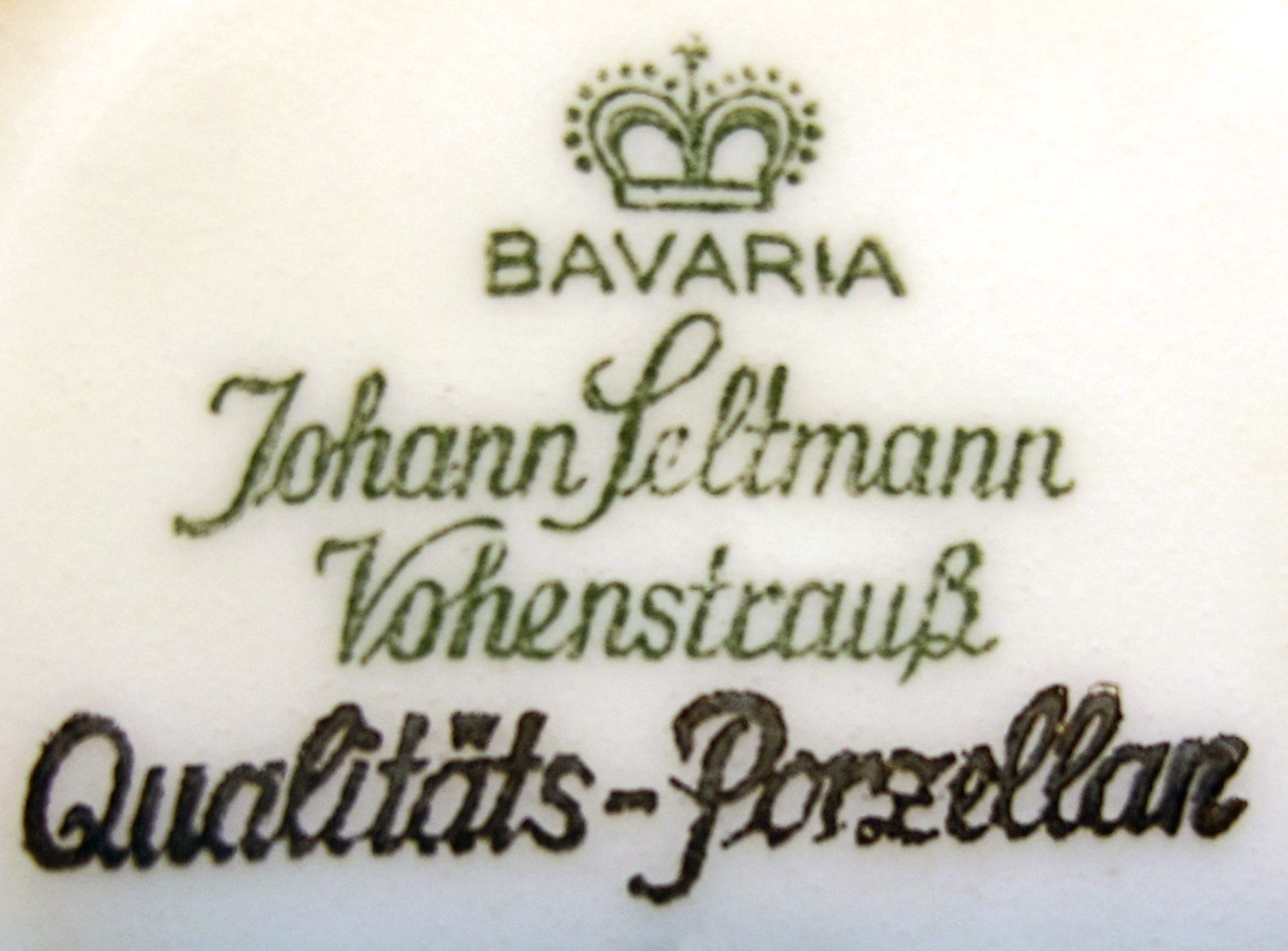
Original Crown Backstamp with Qualitäts-Porzellan
The first photographed mark contains a green crown, BAVARIA, the name Johann Seltmann, the location Vohenstrauß and the expression Qualitäts-Porzellan, meaning “quality porcelain” in German.
The image is associated in its Wikimedia description with approximately 1955. However, specialised porcelain-mark catalogues describe certain related Qualitäts-Porzellan variants around the early 1960s. The date of an individual porcelain object should therefore be treated as approximate until supported by more complete evidence.

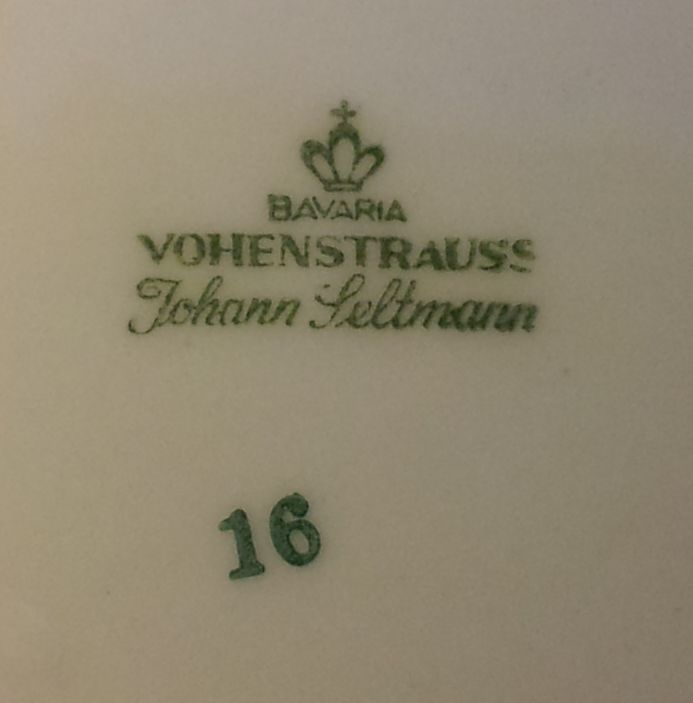
Original Crown Backstamp with Number 16
The second photograph shows a different arrangement: a crown, BAVARIA, VOHENSTRAUSS, the Johann Seltmann name and a separate green number 16.
This example has been described as possibly dating to the late 1960s, but the number 16 is not independently documented as a production-year code. It may have served another factory purpose. Collectors should record such numbers without assigning a meaning unsupported by reliable documentation.

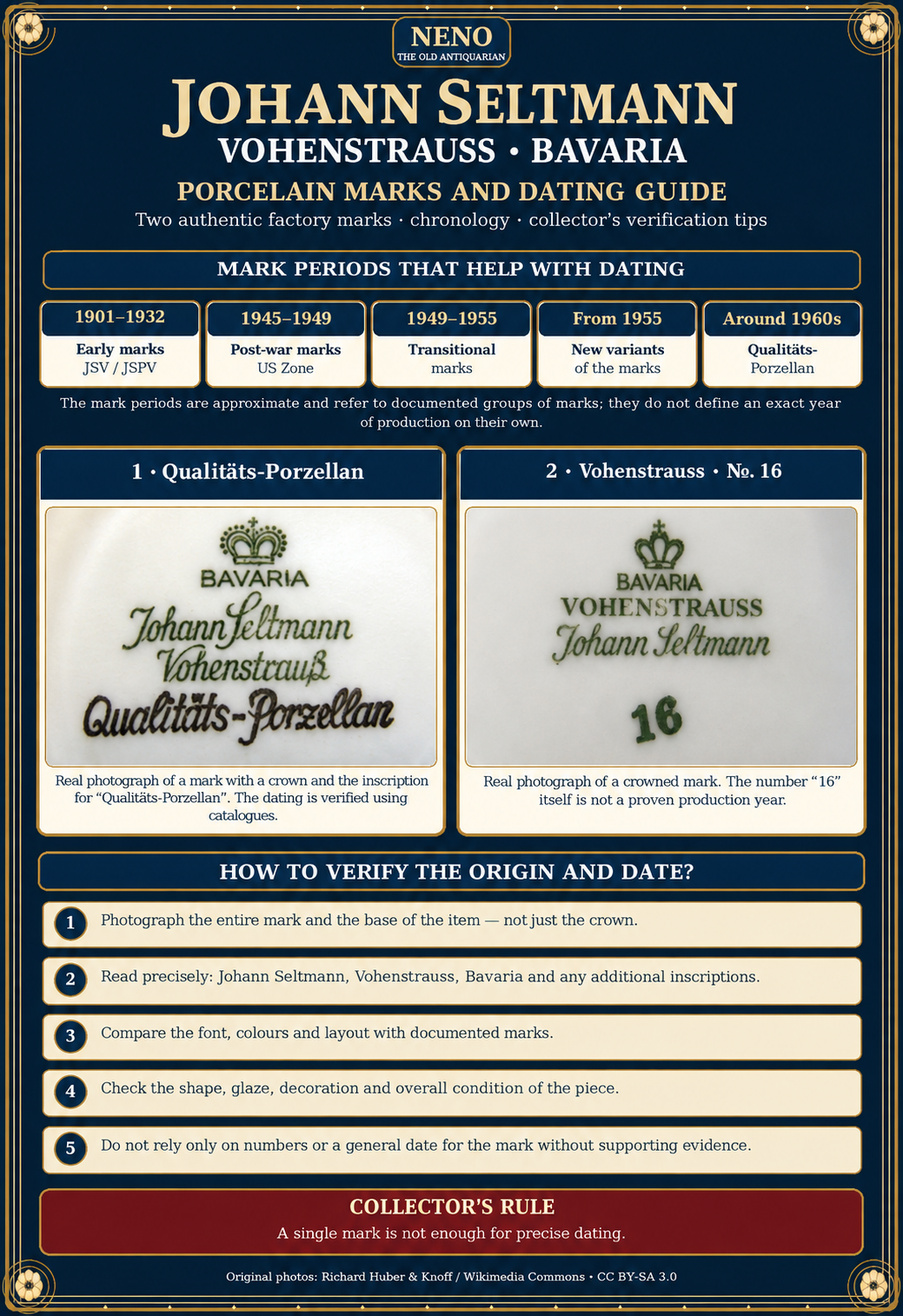
Compare the exact historical mark with the porcelain body, shape, decoration, glaze, manufacturing technique and documented factory history. A crown, country name or isolated number is not sufficient evidence for an exact year of production.
11. How to Date Johann Seltmann Bavaria Porcelain
Reliable dating begins with the precise historical mark rather than a general assumption about old German porcelain. The specialist reference Porcelain Marks & More documents multiple Johann Seltmann mark families, including early initials, pre-war stamps, U.S. Zone examples and several post-war variants.
The following table is a collector reference to documented groups of marks. Different designs and inscriptions may overlap in time, and one marking period should not be applied indiscriminately to every piece carrying the name Johann Seltmann.
| Approximate Period | Documented Mark Clues | Collector Caution |
|---|---|---|
| 1901–1912 | Early factory initials, including documented monogram families. | Compare the exact design and wording. |
| 1901–1932 | Early marks with Bavaria, Germany and additional inscriptions. | Several variants overlap. |
| 1911–1932 | Registered factory-mark families, including different colours. | Registration date is not the date of each object. |
| 1917–1932 | Additional registered designs with occasional hand-painted and distributor wording. | Verify all inscriptions, not only the initials. |
| 1933–1945 | Documented pre-war marks including JS over V and Bavaria variants. | Exact design remains important. |
| 1945–1949 | Post-war marks with U.S. Zone wording. | A useful broad period rather than a precise date. |
| 1949–1955 | Transitional marks and series-specific additions such as Echt Kobalt. | Check the named series and exact layout. |
| From 1955 | New documented mark groups and variants. | Different layouts can coexist. |
| Around early 1960s | Certain variants featuring Qualitäts-Porzellan. | Do not date all marks with this wording identically. |
| From around 1965 | Later marks, including versions referring to Western Germany and Germany. | Later backstamps require factory-specific comparison. |
For original historical examples and more detailed mark-by-mark chronology, consult Porcelain Marks & More – Johann Seltmann Vohenstrauß. Our Porcelain Marks and Backstamps Guide explains the wider identification method.
What Do Johann Seltmann Backstamp Inscriptions Mean?
| Inscription | Meaning |
|---|---|
| Johann Seltmann | Name of the historical porcelain manufacturer. |
| Vohenstrauß / Vohenstrauss | Town associated with the manufacturing company. |
| Bavaria | Regional designation, not the name of a separate factory. |
| Germany | Country-of-origin wording; not an exact production date. |
| U.S. Zone | Useful post-war occupation-zone dating evidence. |
| Western Germany | West German geographical and historical wording. |
| Qualitäts-Porzellan | German for “quality porcelain”; not a certificate or precise dating code. |
| Echt Kobalt | “Genuine cobalt”; associated with certain documented decorative and mark variants. |
| Numbers and letters | May be shape, production or other internal references; interpretation must be documented. |
12. Johann Seltmann Porcelain – Objects, Shapes and Decorative Styles
The Vohenstrauß company manufactured a broad range of household and decorative porcelain. Collectors may encounter coffee and tea services, cups, saucers, plates, milk jugs, sugar bowls, serving vessels and decorative objects attributed to Johann Seltmann.
Its long production history included classical decorative traditions and more contemporary twentieth-century designs. Geometric motifs, gilding, floral decoration and commemorative or decorative plates help demonstrate how factory porcelain adapted to changing tastes.
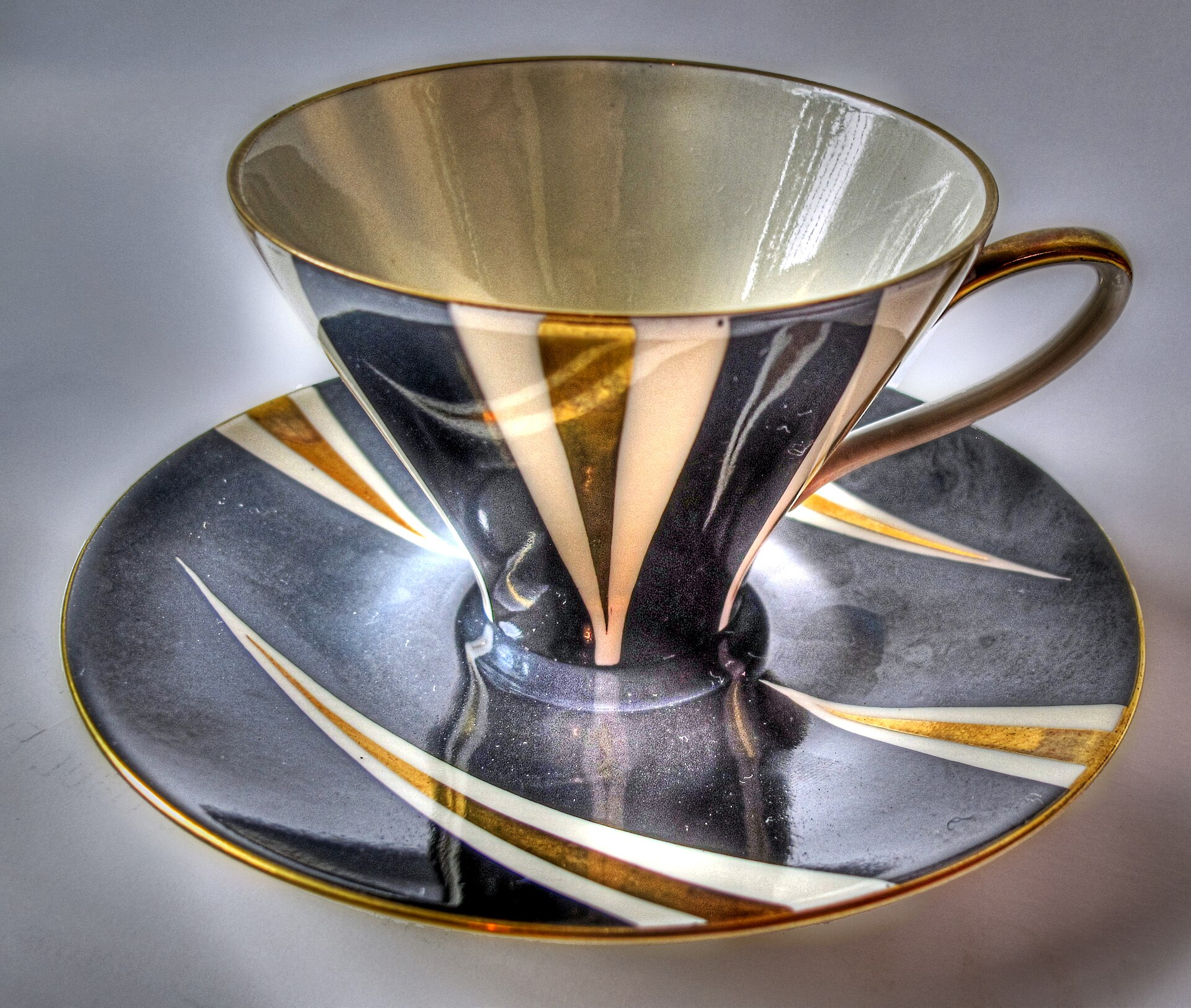
A 1950s Johann Seltmann Mocha Cup and Saucer
A photographed Johann Seltmann mocha cup and saucer from approximately the mid-1950s provides an attractive example of German post-war design. Its flared shape and contrasting charcoal, cream and gold geometric patterns reveal a modern aesthetic distinct from traditional floral dinnerware.

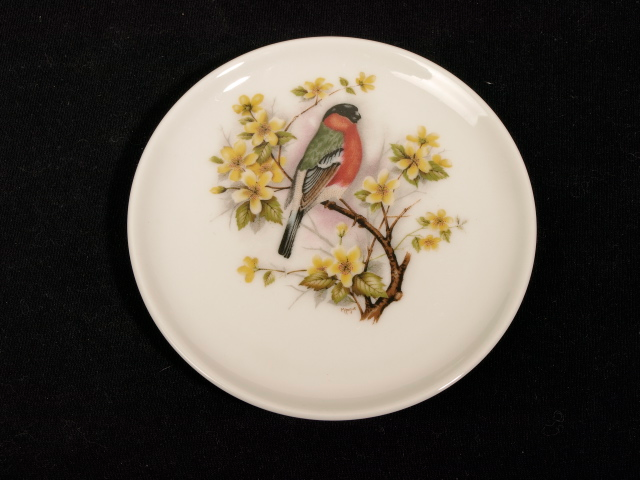
Decorative Plates with Birds and Floral Motifs
Johann Seltmann porcelain also appears in decorative forms, including plates with birds, flowers and botanical compositions. One photographed example features a bird with reddish breast feathers perched among yellow blossoms, demonstrating a very different decorative vocabulary from the modernist mocha cup.

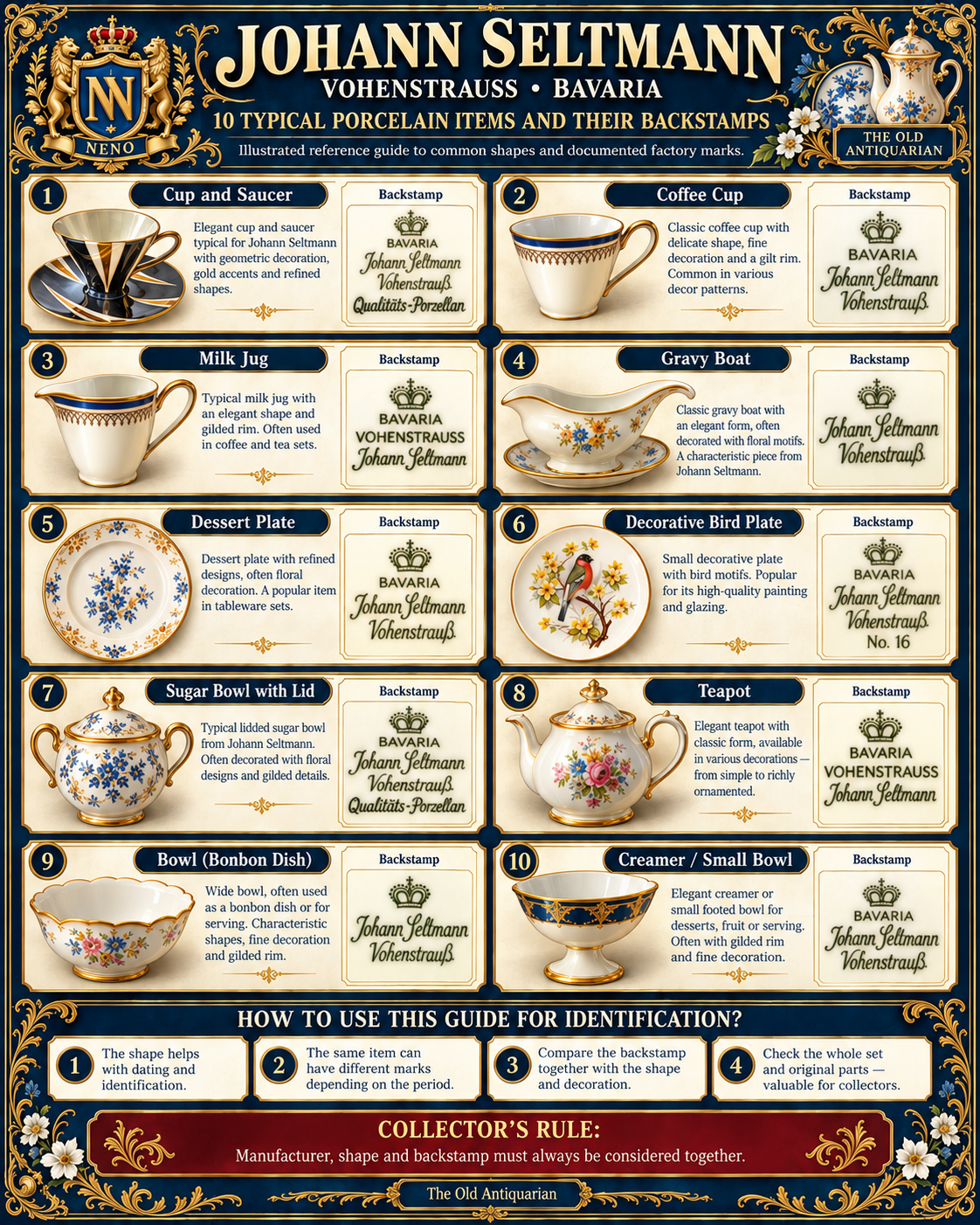
10 Typical Porcelain Item Types and Their Identification Clues
The following illustrated guide introduces ten common porcelain item categories relevant to the study of the Vohenstrauß manufacturer’s tableware and decorative production. It also shows illustrative backstamp styles. These should not be mistaken for ten individually authenticated original factory items with proven corresponding underside marks.
| Porcelain Form | What Collectors Should Examine |
|---|---|
| Cup and Saucer | Matching decoration, cup profile, handle and saucer shape. |
| Coffee Cup | Capacity, proportions, handle design and complete factory mark. |
| Milk Jug | Spout, rim, handle, height and decoration. |
| Gravy Boat | Vessel shape, handle, stand and completeness. |
| Dessert Plate | Diameter, rim profile and decorative arrangement. |
| Decorative Plate | Subject, decoration technique, condition and provenance. |
| Sugar Bowl | Original lid, shape, handles and service relationship. |
| Teapot | Body, spout, lid, finial, handle and possible repairs. |
| Bowl / Bonbon Dish | Size, profile, intended function and decorative details. |
| Footed Dessert Bowl | Foot, stem, bowl shape, gilding and construction. |
A factory can produce the same form with several decorations, and a similar decorative style may appear on porcelain from multiple manufacturers. The mark, object and historical record must support the same attribution.
13. Johann Seltmann Bavaria Porcelain – Collector Interest and Value
Is Johann Seltmann porcelain valuable? Some pieces may have collector interest, but age, the Seltmann name or a crowned backstamp does not automatically make an individual item rare or expensive. Market value depends on the exact piece, factory period, decoration, rarity, completeness, preservation and genuine demand.
Early factory production, unusual decorative forms, carefully preserved matching services and distinctive twentieth-century designs may deserve further research. The importance of a particular object should be established through documented examples rather than assumed from the general reputation of Bavarian porcelain.
Collector value is also affected by condition. Chips, hairline cracks, worn gilding, replacement lids, extensive restoration and missing components may change how an item compares with other surviving examples.
| Value Factor | Why It Matters |
|---|---|
| Factory attribution | The precise manufacturer establishes the correct historical comparison. |
| Production period | Earlier and later production may appeal to different buyers. |
| Rarity | Uncommon shapes and documented variants may attract specialist interest. |
| Decoration | Pattern, technique, colour and gilding can affect desirability. |
| Condition | Original, undamaged examples are generally more useful for comparison. |
| Completeness | Matching services differ from mixed or incomplete groups. |
| Provenance | Original documentation, labels or family history can support identification. |
| Completed sales | Comparable realised sales are more informative than unsold asking prices. |
Compare completed sales of objects with similar maker, shape, date range, decoration, dimensions, condition and completeness. A common cup cannot automatically be valued using the asking price of an unusual decorative vase.
For object-specific questions, The Old Antiquarian offers professional antique valuation guidance, including porcelain and decorative ceramics.
14. Johann Seltmann Collector Checklist – 10 Steps Before Buying or Selling
If you own an inherited porcelain service or have discovered an object marked Johann Seltmann, begin with careful documentation. A clear record of the entire item is much more useful than an approximate date or a price copied from an unrelated online listing.
The 10 Essential Collector Checks
- Photograph the complete porcelain object from multiple angles.
- Photograph the entire underside and all factory markings.
- Record exact inscriptions, letters, numbers and symbols.
- Distinguish Johann Seltmann Vohenstrauß from Seltmann Weiden.
- Compare the complete mark with documented historical examples.
- Measure the item and identify its precise shape and function.
- Examine the porcelain body, glaze, decoration and gilding.
- Inspect chips, cracks, repairs, repainting and replacement parts.
- Record the completeness of any service and preserve provenance.
- Compare similar completed sales before estimating collector value.
Avoid aggressive cleaning, polishing or amateur repairs before completing your research. The shape, original decoration and historical mark should be documented in their existing condition. For broader techniques, see our complete antique porcelain identification guide.
Do You Own Johann Seltmann Bavaria Porcelain?
Have you inherited a Johann Seltmann coffee set, porcelain plate, serving dish, decorative object or collection? Send photographs of the complete item, its base, factory marks, dimensions and condition for an initial review.
The Old Antiquarian combines more than 35 years of practical experience in antiques and collecting with historical research and market comparison.
An initial photographic review is not a certificate of authenticity or a guarantee of purchase.
Frequently Asked Questions About the Seltmann Brothers and Johann Seltmann Porcelain
Who were Johann and Christian Wilhelm Seltmann?
Johann and Christian Wilhelm Seltmann were German entrepreneurs who developed a porcelain factory in Vohenstrauß in 1901. Christian later founded his own company in Weiden in 1910.
Were Johann Seltmann and Seltmann Weiden the same factory?
No. They shared family origins but became separate companies, associated respectively with Vohenstrauß and Weiden.
Why did the Seltmann brothers separate in 1910?
The brothers disagreed over the proposed conversion of their business into a joint-stock corporation. Christian Wilhelm favoured continued family ownership and established an independent factory in Weiden.
When was Johann Seltmann Vohenstrauß founded?
The porcelain factory was established in 1901 by Johann Seltmann, with his younger brother Christian Wilhelm managing production.
What happened to the brothers in 1921?
Both brothers died in 1921. Their descendants continued the separate porcelain businesses.
Who inherited the Johann Seltmann factory?
Johann’s sons Robert and Christian continued operating the Vohenstrauß factory following his death.
When did Johann Seltmann Vohenstrauß close?
The closure decision was announced on October 27, 1995, after the company had joined SKV-Porzellan-Union. The final cessation of manufacturing is associated with the mid-1990s.
Is Seltmann Weiden still producing porcelain?
Yes. Seltmann Weiden continues as a family-owned German porcelain manufacturer with production facilities in Germany.
What is the Eberthal porcelain brand?
Eberthal was a secondary brand associated with the Johann Seltmann Vohenstrauß company and aimed at a more affordable market segment.
What does Qualitäts-Porzellan mean on Johann Seltmann porcelain?
It means “quality porcelain” in German. The inscription appears on certain documented factory marks but does not establish an exact production year or collector value by itself.
Does the number 16 on a Johann Seltmann backstamp indicate the year?
No verified evidence establishes that the number 16 in the photographed example is a production-year code. The number should be recorded and investigated rather than automatically interpreted as a date.
Is Johann Seltmann Bavaria porcelain valuable?
Some pieces may be collectible, depending on their historical period, factory attribution, shape, rarity, decoration, condition, completeness and comparable realised sales.
How can I identify original Johann Seltmann porcelain?
Compare the complete factory backstamp with documented historical examples and examine the porcelain body, shape, glaze, decoration and condition. A crown or Bavaria inscription alone is insufficient.
Where can I sell Johann Seltmann porcelain?
You can submit photographs, factory-mark details and information about your porcelain through The Old Antiquarian’s antique valuation or porcelain buying pages for an initial review.
Related Guides and Continue Exploring
Royal Tettau and Royal Bayreuth
Heinrich & Co. Selb Bavaria
Bavaria Porcelain Identification
Complete Guide to Antique Porcelain
How to Date Antique Porcelain
Professional Antique Valuation
Porcelain, Ceramics and Tableware We Buy
Sources, Historical References and Further Research
This historical guide draws on German biographical research, specialist porcelain-mark catalogues, manufacturer information and original photographic references. Approximate dates, factory closures and illustrated mark charts are identified carefully rather than presented as definitive dating evidence for every surviving object.
- Deutsche Biographie – Wilhelm Christian Seltmann – biographical information on Christian Wilhelm Seltmann, Johann Seltmann, family relationships, Schlottenhof and the founding of the Weiden factory.
- Deutsche Biographie – Christian Wilhelm Seltmann – historical identification of the founder of Seltmann Weiden.
- Porcelain Marks & More – Vohenstrauß – Johann Seltmann factory history, documented backstamps, Eberthal, the SKV merger and closure chronology.
- Porcelain Marks & More – Schirnding – additional research on the 1993 SKV-Porzellan-Union merger.
- Seltmann Weiden – Company History – information on the 1910 establishment, later expansion and Royal Tettau.
- Seltmann Weiden – Official Website – contemporary information about the active German porcelain manufacturer.
- Wikimedia Commons – Johann Seltmann Qualitäts-Porzellan Mark – original photograph by Richard Huber.
- Wikimedia Commons – Johann Seltmann Crown Mark – original photograph by Knoff.
- Wikimedia Commons – Johann Seltmann 1950s Mocha Cup – photographic example by Richard Huber.
- Wikimedia Commons – Johann Seltmann Decorative Bird Plate – photographic reference credited to Banffy / Rainer Wermke.
The photographs of porcelain pieces and original factory marks are documentary references. The three infographics are educational illustrations created for The Old Antiquarian. Illustrated factory buildings, stylised mark details and sample porcelain forms must not be represented as authenticated archival factory photographs or catalogued original models. Original photographs by Richard Huber, Knoff and Banffy / Rainer Wermke remain subject to their stated Creative Commons attribution and share-alike terms; adaptations should be identified.
About the Author – The Old Antiquarian
The Old Antiquarian combines more than 35 years of practical experience in antiques, decorative arts and collecting with historical research, factory identification and comparative market study.
Our approach to historic porcelain considers the complete factory mark, material, form, decoration, manufacturing process, condition, provenance and available documentation. This article is intended as an educational reference and does not replace an object-specific professional appraisal.
Conclusion: One Family, Two Porcelain Dynasties and Different Historical Destinies
The history of Johann and Christian Wilhelm Seltmann illustrates how one family enterprise could develop into two separate industrial traditions. Their shared venture began in Vohenstrauß in 1901, but differing ideas about ownership and company management led to the separation of the brothers in 1910.
Following their deaths in 1921, their descendants continued the businesses along different paths. Johann Seltmann Vohenstrauß experienced decades of growth, post-war reconstruction, modernisation and eventual closure, while Seltmann Weiden expanded and continues producing porcelain in Germany.
For collectors, this family history is more than a story of factories and business decisions. It provides essential context for distinguishing manufacturers, understanding the evolution of porcelain backstamps and identifying the historical background of surviving cups, plates, tea services and decorative objects.
Family history + exact manufacturer + complete factory backstamp + porcelain body + shape + decoration + historical period + condition + documented comparison = a stronger foundation for identifying Johann Seltmann and other German porcelain.
