
How to Identify Royal Copenhagen Porcelain
Quick Answer
Royal Copenhagen porcelain is one of the most important historic traditions in Danish porcelain. Founded in Copenhagen in 1775, the manufactory is best known for its Three Blue Waves trademark, fine hard-paste porcelain, hand-painted underglaze decoration, Blue Fluted patterns, Flora Danica, figurines and collector porcelain.
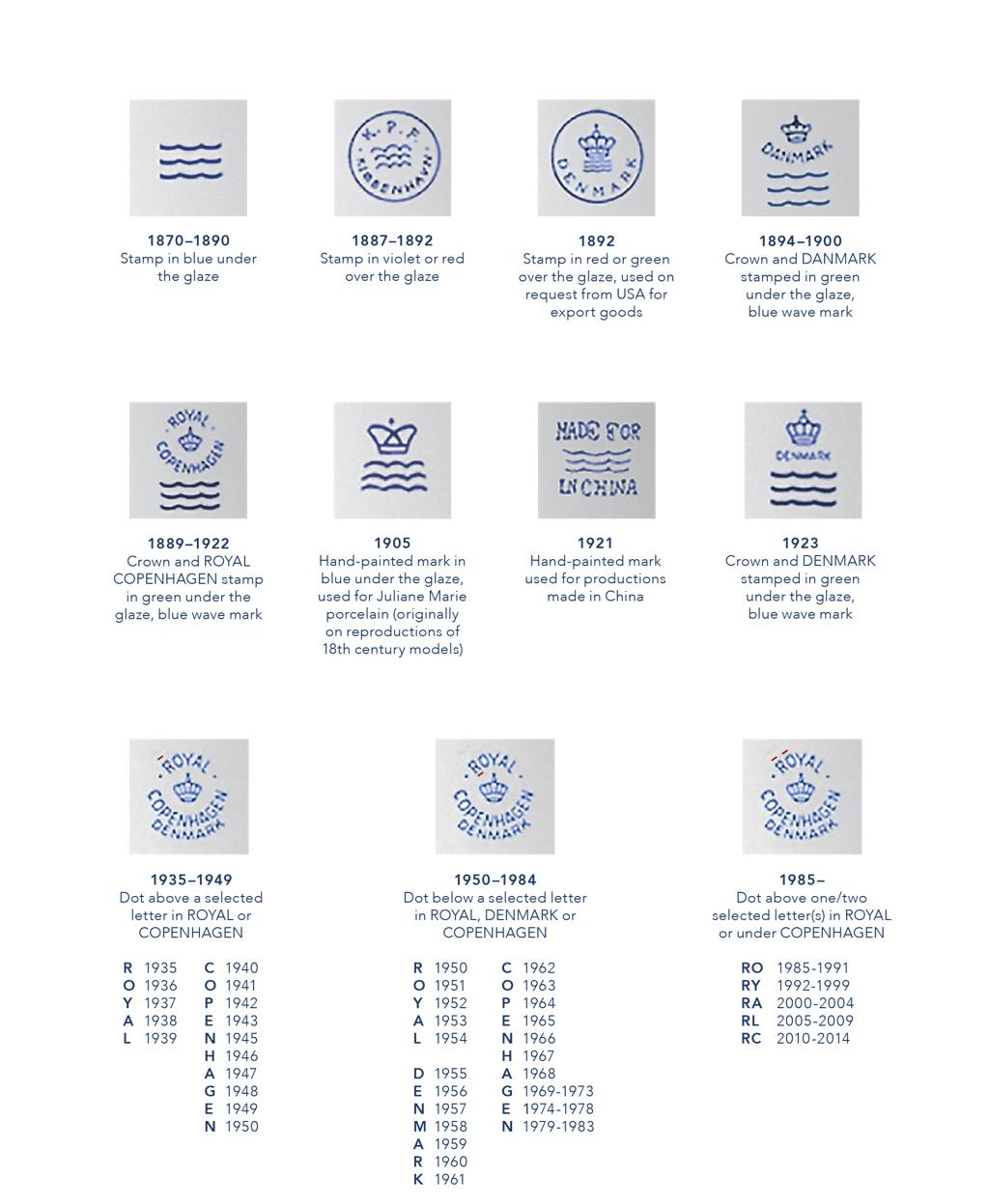
To identify Royal Copenhagen porcelain, examine the Three Blue Waves, crown, complete factory backstamp, dating marks, model and pattern numbers, painter’s initials, porcelain body, decoration, quality grade and condition. A factory mark is an important clue, but authenticity and age should never be determined from the mark alone.
Royal Copenhagen porcelain is one of the world’s most prestigious and recognizable types of
Danish porcelain
.
Founded in 1775 in Copenhagen, Denmark, the Royal Copenhagen Porcelain Manufactory became internationally famous for exceptionally fine porcelain, hand-painted decoration, underglaze blue designs and the iconic factory mark with the three blue wavy lines.
Whether you own a Blue Fluted plate, a Flora Danica serving dish, a Christmas plate, a vase or a Royal Copenhagen figurine, identifying the exact model and production period is the first step toward understanding authenticity, historical significance and collector value.
This guide focuses specifically on Royal Copenhagen identification, marks, dating, model numbers, collections and value. For the wider history of Danish makers and Scandinavian porcelain traditions, use our
Danish Porcelain Guide
.
At a Glance
Royal Copenhagen Porcelain – Key Facts
| Feature | Collector Reference |
|---|---|
| Founded | 1775 |
| Location | Copenhagen, Denmark |
| Historic Trademark | Three Blue Waves |
| Material | Fine hard-paste porcelain |
| Famous Decoration | Hand-painted underglaze blue |
| Famous Collections | Blue Fluted, Flora Danica, figurines and collector porcelain |
| Dating Clues | Backstamp, crown, dating line or mark, model number, decoration and typography |
| Historic Danish Rival | Bing & Grøndahl |
| Merger | Royal Copenhagen and Bing & Grøndahl merged in 1987 |
Definition
What Is Royal Copenhagen Porcelain?
Royal Copenhagen is known for producing premium hard-paste porcelain with a refined porcelain body, high-quality glaze, elegant forms and sophisticated hand-painted decoration.
The company became internationally famous for its distinctive blue underglaze painting. In this technique, decoration is applied before the final transparent glaze, producing a soft and integrated visual effect.
Among its best-known collections are Blue Fluted Plain, Blue Fluted Half Lace, Blue Fluted Full Lace, Flora Danica, figurines and annual collector porcelain.
THE MARK IDENTIFIES THE DIRECTION — THE OBJECT CONFIRMS IT.
A Three Blue Waves mark is important evidence, but authenticity requires the porcelain body, model, decoration, craftsmanship and production period to be historically consistent.
History
The History of Royal Copenhagen
The Royal Copenhagen Porcelain Manufactory was founded in 1775 in Copenhagen. It developed during the great European expansion of hard-paste porcelain manufacture and became one of Scandinavia’s leading luxury porcelain producers.
Over the following centuries the manufactory built an international reputation for table services, hand-painted porcelain, decorative objects and figurines.
Royal Copenhagen became particularly important in the broader development of
Danish porcelain
,
alongside other important Danish ceramic manufacturers.
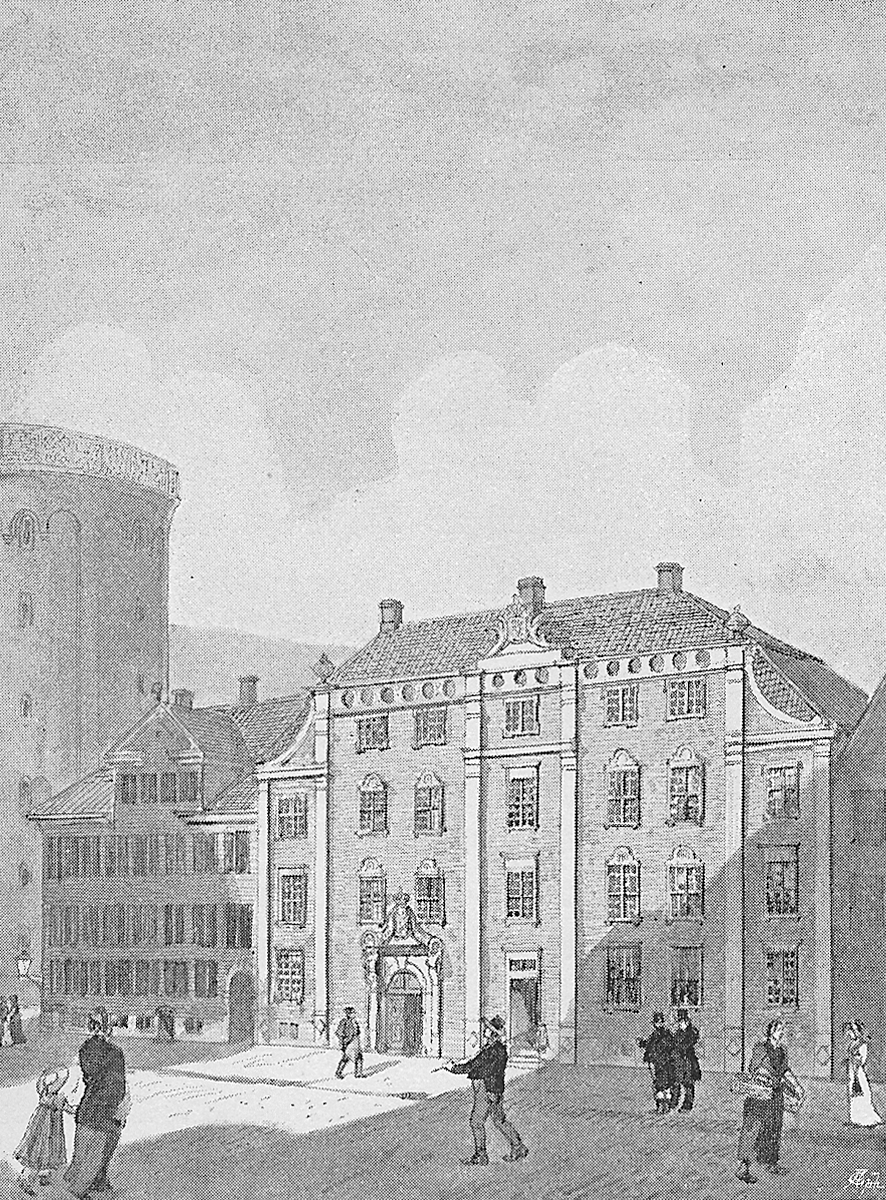
Image credit: Public Domain – Wikimedia Commons.
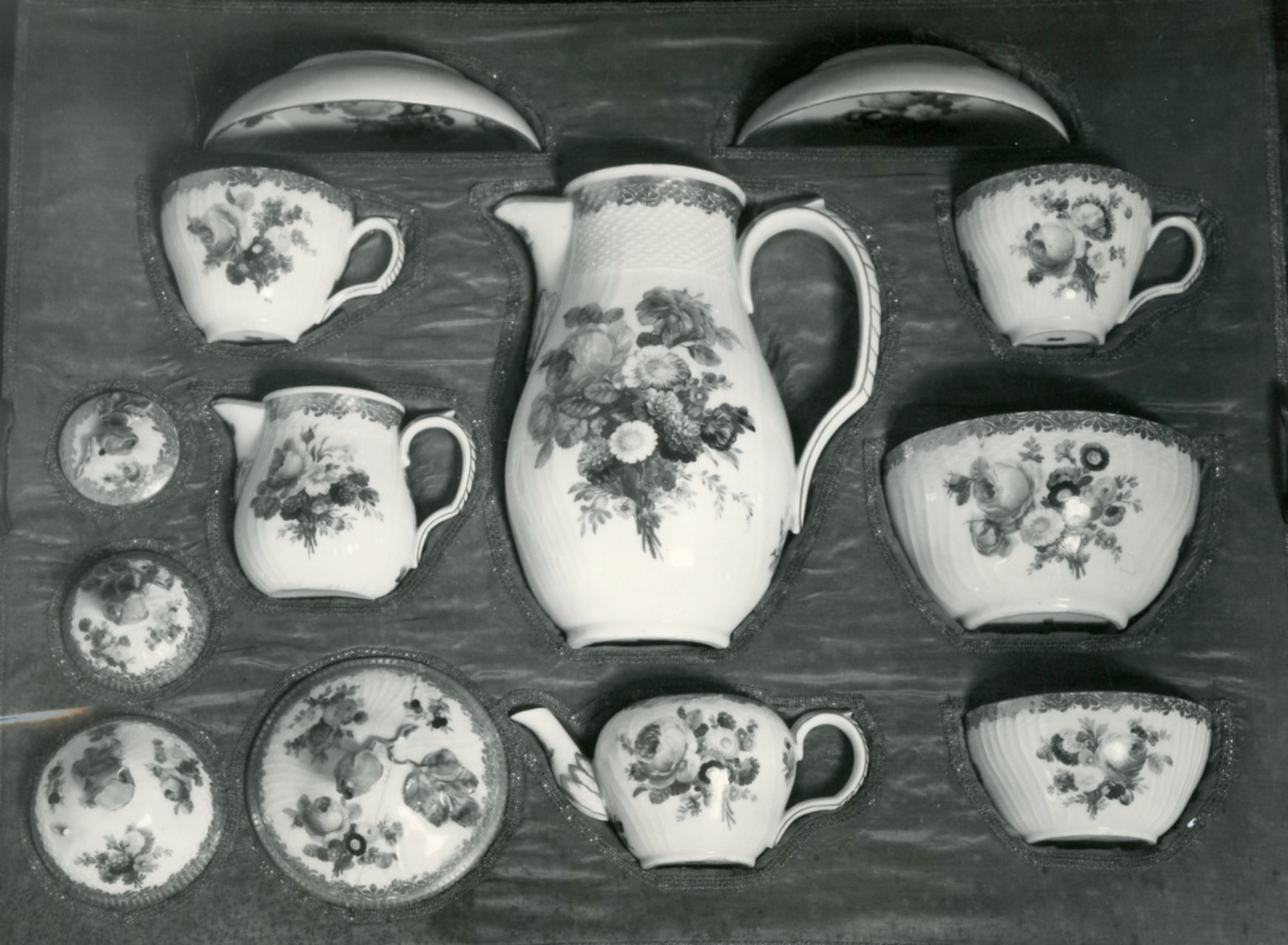
Image: Municipal Archives of Trondheim / Wikimedia Commons, CC BY 2.0.
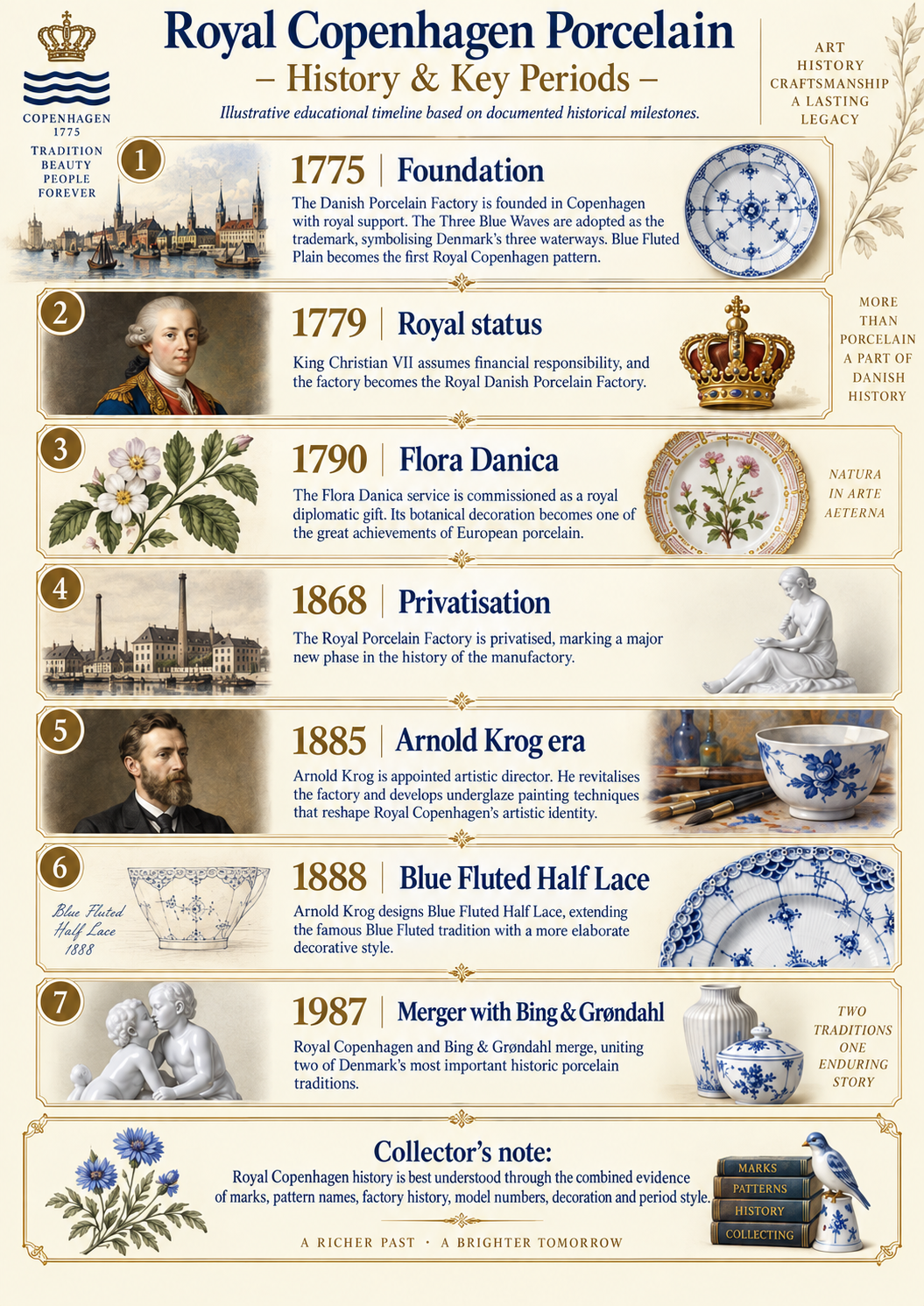
1987 – Royal Copenhagen and Bing & Grøndahl
In 1987 Royal Copenhagen merged with
Bing & Grøndahl
,
bringing together Denmark’s two most internationally recognised historic porcelain manufacturers.
The two factories had distinct histories and identification systems before the merger. Royal Copenhagen is traditionally associated with the Three Blue Waves, while Bing & Grøndahl used B&G initials and later the Three Towers trademark.
Marks & Backstamps
Royal Copenhagen Marks and Backstamps
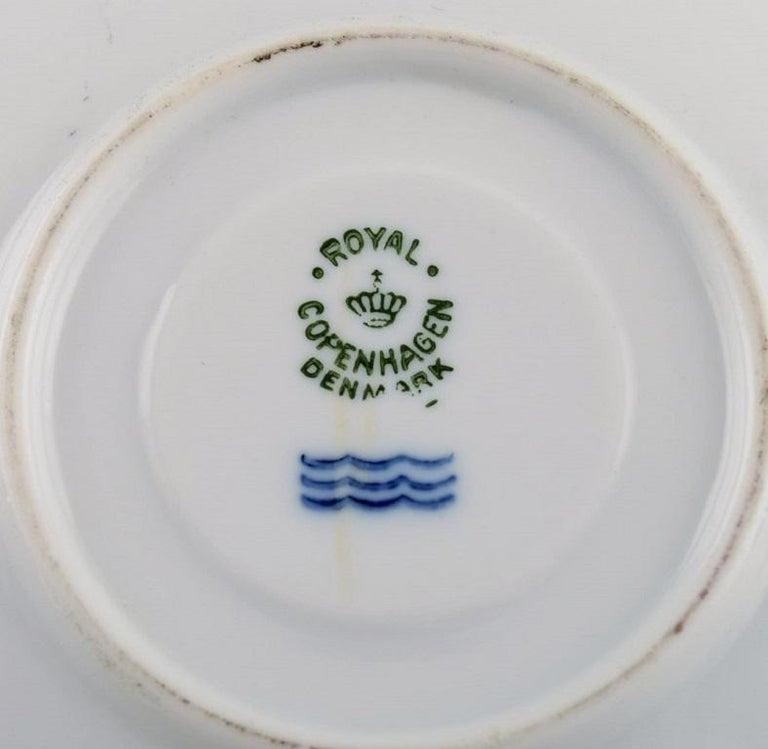
The most recognizable historic symbol on Royal Copenhagen porcelain is the Three Blue Waves.
The waves traditionally represent Denmark’s three historic waterways:
- Øresund;
- Storebælt (Great Belt);
- Lillebælt (Little Belt).
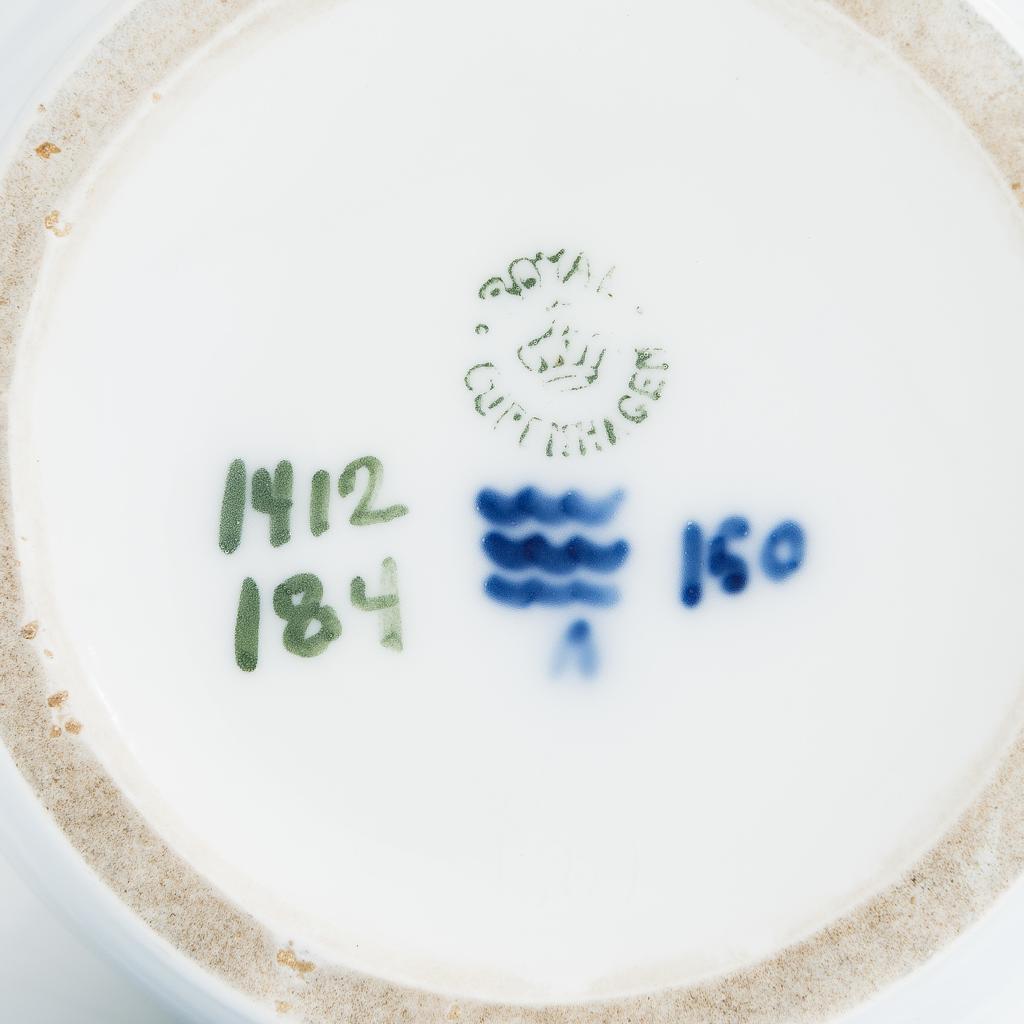
Depending on the production period, the underside may also contain a crown, Royal Copenhagen wording, Denmark, model numbers, pattern numbers, painter’s initials and other factory information.
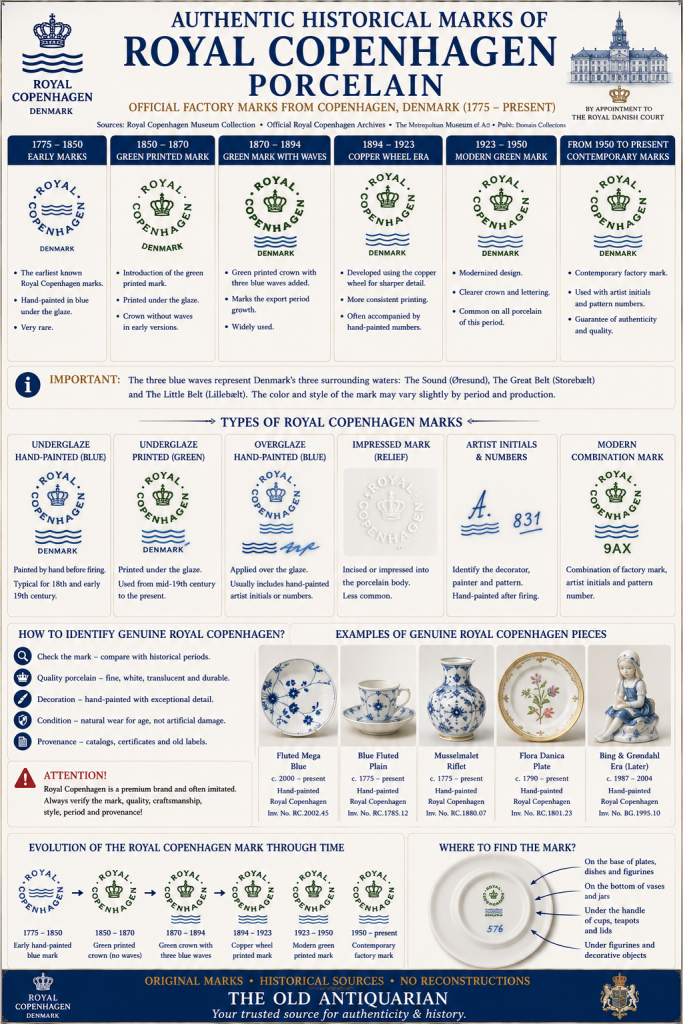
How to Read a Royal Copenhagen Backstamp
| Marking | Possible Meaning | Collector Use |
|---|---|---|
| Three Blue Waves | Historic factory trademark | Primary identification clue. |
| Crown | Part of later factory marks | Design changes can assist dating. |
| Royal Copenhagen wording | Factory identity | Typography and layout may narrow period. |
| Model Number | Specific form or figurine | Helps identify the exact model. |
| Pattern / Decoration Number | Decoration or pattern | Useful for distinguishing variants. |
| Painter’s Initials | Painter or decorator | Useful when supported by documented factory references. |
Three Blue Waves or Three Towers?
Do not confuse the Royal Copenhagen Three Blue Waves with the Three Towers trademark used by Bing & Grøndahl. If your piece carries B&G initials or a Three Towers mark, use our
Bing & Grøndahl identification guide
.
Dating
How to Date Royal Copenhagen Porcelain
Royal Copenhagen is particularly interesting to collectors because many factory marks contain useful chronological information.
On many pieces, the position of a small line, stroke or other dating indicator in relation to letters in the factory wording can help establish a production period.
Other useful dating clues include:
- style of the Three Blue Waves;
- crown design;
- factory wording;
- typography;
- model number;
- pattern number;
- painter’s initials;
- quality marks;
- manufacturing technique.
ROYAL COPENHAGEN DATING FORMULA
exact mark + crown + wording + dating indicator + model + decoration + technique + documented comparison
For general chronological principles, see our
Guide to Dating Antique Porcelain
.
What Do Royal Copenhagen Numbers Mean?
Royal Copenhagen pieces often carry several numbers. These can be extremely useful for identification, but not every number is a production year.
| Number or Mark | Possible Meaning | Collector Use |
|---|---|---|
| Model Number | Specific form or figurine | Identify the exact object. |
| Pattern Number | Decorative pattern | Distinguish decorative variants. |
| Decoration Code | Specific decoration | Helps identify the precise version. |
| Painter Mark | Painter or decorator | Use documented attribution only. |
Authenticity
How to Identify Authentic Royal Copenhagen Porcelain
Authenticity should never be determined solely by the Three Blue Waves. Copies, reproductions and counterfeit factory marks can appear on the antiques market.
A stronger identification compares:
- the Three Blue Waves;
- complete factory backstamp;
- crown design;
- model number;
- pattern or decoration number;
- painter’s initials;
- porcelain body;
- glaze;
- underglaze painting;
- overall craftsmanship;
- age-consistent wear;
- documented comparisons.
Professional identification also considers whether a piece is an
original
,
a later
copy,
a
replica
or a deliberately deceptive
fake.
First Quality and Factory Second Royal Copenhagen
Royal Copenhagen also used factory quality grading. Some authentic pieces were sold as Factory Seconds because they did not fully meet first-quality standards.
A factory quality mark may appear as a deliberate interruption or scratch through part of the trademark. The exact form should be compared with documented examples from the relevant production period.
| Quality | Meaning | Collector Effect |
|---|---|---|
| First Quality | Accepted as normal first-quality factory production. | Generally preferred when all other characteristics are equal. |
| Factory Second | Original Royal Copenhagen piece with a factory quality classification. | Usually less valuable than an otherwise identical first-quality example. |
Important:
Factory Second does not mean fake, and it should not be confused with later accidental damage or restoration.
Collector Highlights
The Most Collectible Royal Copenhagen Porcelain
Royal Copenhagen produced an enormous range of porcelain over more than two centuries. Collector interest varies greatly between patterns, models and periods.
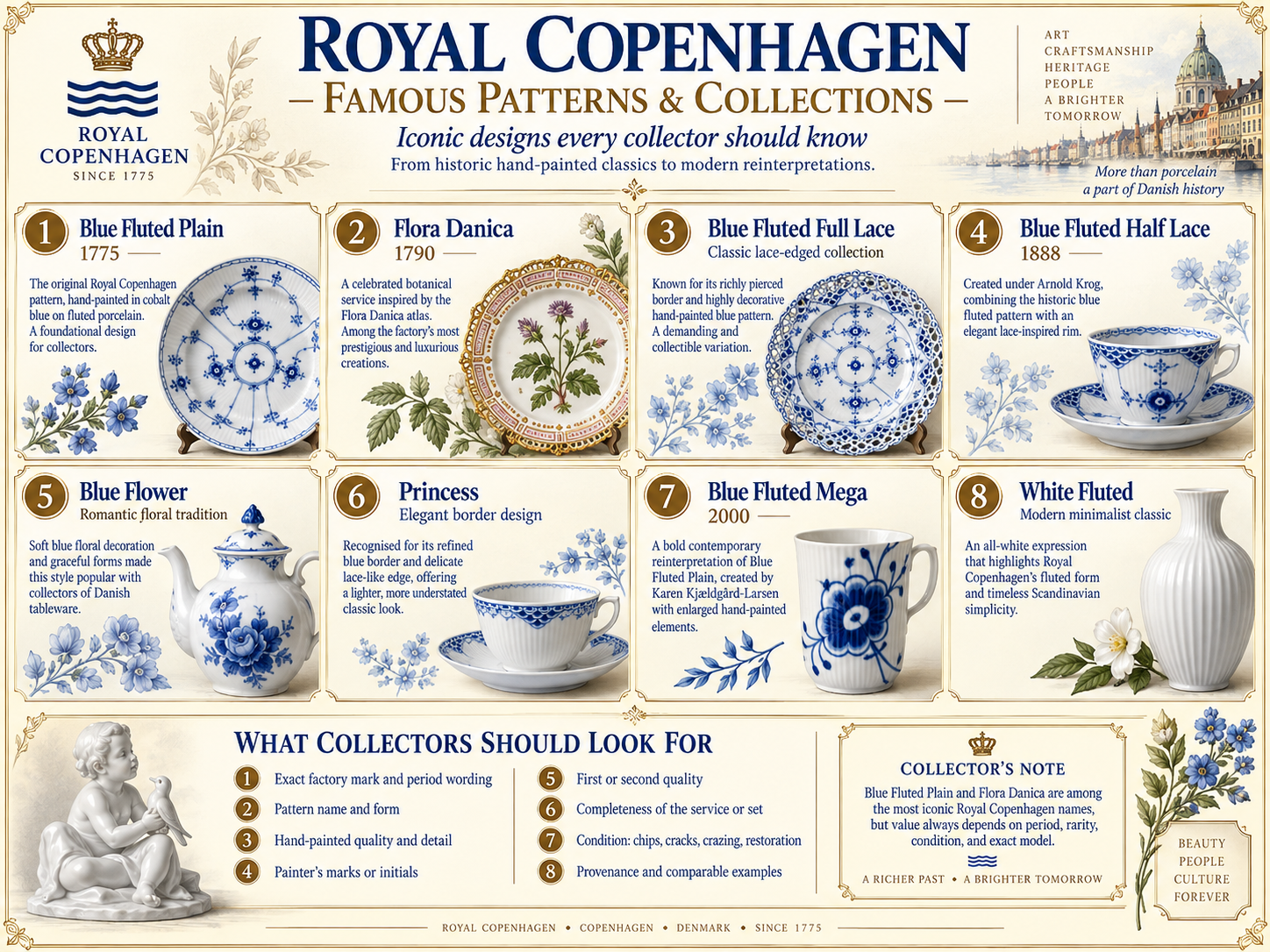
| Collection / Type | Collector Interest |
|---|---|
| Blue Fluted Plain | Historic underglaze blue pattern and one of the brand’s defining designs. |
| Blue Fluted Half Lace | More elaborate relief and decorative detail. |
| Blue Fluted Full Lace | Highly complex pierced and relief decoration. |
| Flora Danica | Prestigious botanical decoration and extensive hand painting. |
| Figurines & Animals | Collector interest depends heavily on model, artist, period and rarity. |
| Collector & Annual Porcelain | Interest varies substantially according to year, scarcity and production quantity. |
A famous collection name alone does not determine value. The exact model, date, quality and condition remain essential.
Figurines & Animal Models
Royal Copenhagen Figurines & Animal Models
Royal Copenhagen produced a wide range of sculptural porcelain, including figures of children, women, men, couples, classical subjects, birds, dogs, cats, horses, polar bears, deer, farm animals, fish and other naturalistic subjects.
For collectors, the most important step is to identify the exact model rather than valuing a figurine only by subject. Model number, sculptor or artist attribution, production period, size, colour variation, quality grade, condition and restoration can all materially affect collector interest.
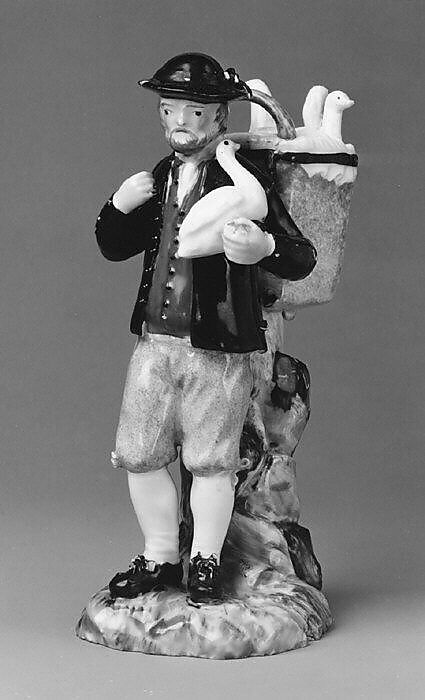
The Metropolitan Museum of Art, The Jack and Belle Linsky Collection, 1982 – Public Domain.
The documented museum example above should be distinguished from the educational infographic below, which groups broad collecting subjects rather than identifying specific historical catalogue models.
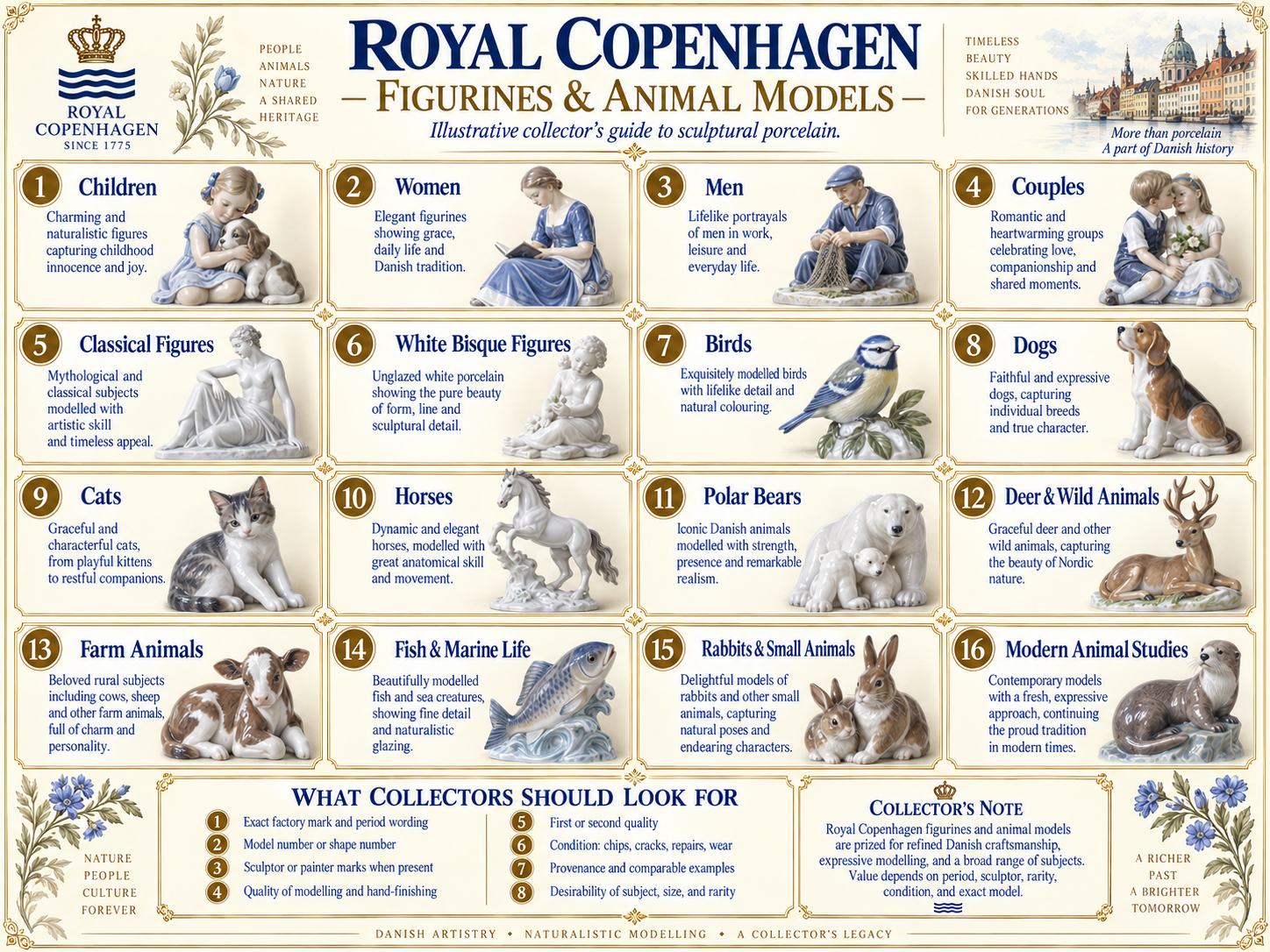
Illustration note:
the figures shown in the infographic represent broad collector categories and should not be interpreted as a catalogue of specific documented Royal Copenhagen model numbers.
What Should Collectors Check on a Royal Copenhagen Figurine?
- exact factory mark and production period;
- model or shape number;
- documented sculptor or artist attribution;
- height, dimensions and pose;
- first or second quality;
- original underglaze or hand-painted decoration;
- chips, cracks and losses to fragile details;
- restoration, repainting or replacement parts;
- provenance, original box and comparable sold examples.
Danish Porcelain Comparison
Royal Copenhagen vs Bing & Grøndahl
Royal Copenhagen and Bing & Grøndahl were historically separate Copenhagen manufacturers and should be identified independently when researching pre-merger porcelain.
| Feature | Royal Copenhagen | Bing & Grøndahl |
|---|---|---|
| Founded | 1775 | 1853 |
| Historic Mark | Three Blue Waves | B&G initials / Three Towers |
| Famous Lines | Blue Fluted, Flora Danica | Seagull Service, Christmas Plates |
| Figurines | Extensive figurine and animal production | Especially recognised for naturalistic animal models |
| Merger | The companies merged in 1987. | |
If your porcelain carries B&G initials, Three Towers, Seagull Service decoration or a Bing & Grøndahl backstamp, continue with our dedicated
Bing & Grøndahl Porcelain Identification Guide
.
Collector Value
What Determines the Value of Royal Copenhagen Porcelain?
Two Royal Copenhagen pieces with similar factory marks may have very different values because market value depends on much more than the Three Blue Waves.
| Factor | Why It Matters |
|---|---|
| Production Period | Historically important periods may be scarcer. |
| Exact Model | Some forms attract much stronger demand. |
| Collection / Pattern | Pattern can significantly influence collector interest. |
| Artist / Painter | Documented artistic attribution may add importance. |
| Rarity | Scarce models and variants can command greater demand. |
| Quality Grade | First-quality pieces are generally preferred. |
| Condition | Chips, cracks, losses and heavy wear can reduce value. |
| Restoration | Repairs and repainting can materially affect collector interest. |
| Provenance | Documented ownership can strengthen significance. |
| Comparable Sold Examples | Completed sales give a more realistic market reference than asking prices. |
ASKING PRICE ≠ MARKET VALUE
Compare completed sales of the same model, production period, pattern, size, quality and condition whenever possible.
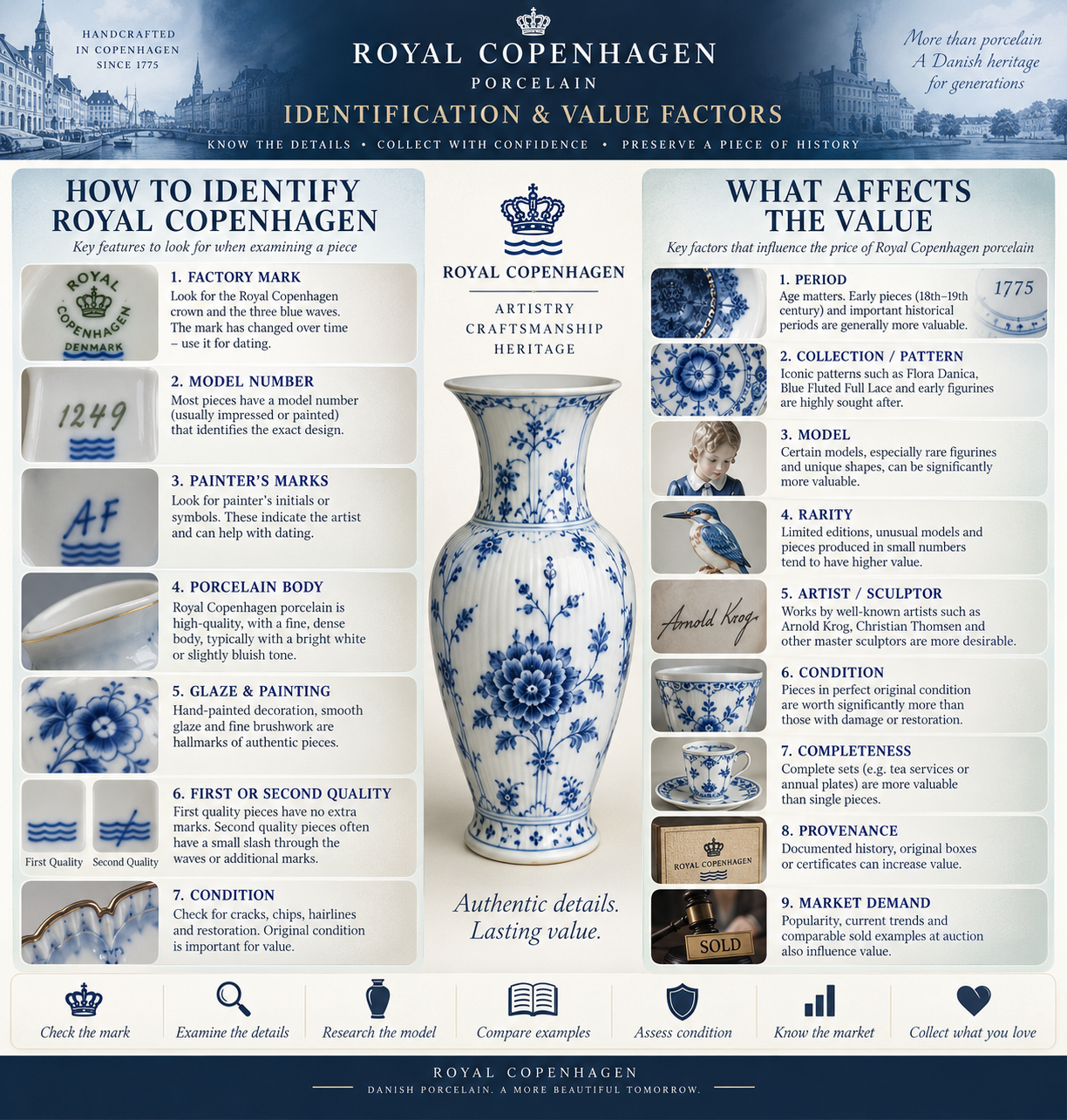
Illustrative educational collector guide. Identification and value should be based on the complete object, documented factory references, condition and comparable sold examples.
How to Care for Antique Royal Copenhagen Porcelain
Historic Royal Copenhagen porcelain is durable but brittle. Careless handling can cause more damage than normal ageing.
- Handle porcelain with clean, dry hands.
- Support objects from their strongest structural points.
- Never lift pieces by handles, finials, wings, tails or applied flowers.
- Avoid sudden temperature changes.
- Keep valuable pieces away from prolonged direct sunlight.
- Protect figurines and plates from vibration and accidental impacts.
- Use padded or stable shelving.
- Avoid abrasive cleaners and harsh household chemicals.
- Never place antique porcelain in a dishwasher.
If damage occurs, professional
conservation
may be preferable to unnecessary
restoration.
Collector Checklist
12 Steps for Examining Royal Copenhagen Porcelain
| 1. Photograph the complete object | Front, back and sides. |
| 2. Photograph the complete underside | Include all numbers and marks. |
| 3. Examine the Three Blue Waves | Compare shape and execution. |
| 4. Examine the crown | Compare with documented period marks. |
| 5. Record factory wording | Royal Copenhagen, Denmark and related text. |
| 6. Record all numbers | Model, pattern and decoration numbers. |
| 7. Check painter marks | Use documented attribution only. |
| 8. Measure the object | Size can distinguish related models. |
| 9. Check factory quality | First Quality or Factory Second. |
| 10. Inspect condition | Cracks, chips, losses and wear. |
| 11. Look for restoration | Glue, filler, overspray or repainting. |
| 12. Compare completed sales | Use the same or closely comparable model. |
The Old Antiquarian
Do You Have Royal Copenhagen Porcelain?
Send clear photographs of the complete object, the underside, Three Blue Waves, factory backstamp, all numbers and signatures. For figurines, include measurements and photographs from several angles.
Frequently Asked Questions
Royal Copenhagen Porcelain FAQ
When was Royal Copenhagen founded?
Royal Copenhagen was founded in Copenhagen in 1775.
What is the Royal Copenhagen trademark?
The most famous historic Royal Copenhagen trademark is the Three Blue Waves.
What do the Three Blue Waves represent?
They traditionally represent Øresund, Storebælt and Lillebælt, three important Danish waterways.
How can I date Royal Copenhagen porcelain?
Compare the complete factory backstamp, crown, dating indicators, typography, model numbers, painter marks, decoration and production characteristics.
What do Royal Copenhagen numbers mean?
Numbers may identify the model, pattern, decoration or another factory reference. They should not automatically be interpreted as a manufacturing date.
What is a Royal Copenhagen Factory Second?
A Factory Second is an authentic factory-made piece that did not meet the manufacturer’s first-quality standard. It may carry a deliberate factory quality mark through part of the trademark.
Is a Factory Second fake?
No. It is original Royal Copenhagen production, but it was classified below first quality by the factory.
What is the difference between Royal Copenhagen and Bing & Grøndahl?
They were historically separate Danish porcelain manufacturers. Royal Copenhagen is associated with the Three Blue Waves, while Bing & Grøndahl used B&G initials and later the Three Towers trademark. They merged in 1987. Read our
Bing & Grøndahl Porcelain Guide
for detailed B&G identification.
Which Royal Copenhagen patterns are most famous?
Blue Fluted Plain, Blue Fluted Half Lace, Blue Fluted Full Lace and Flora Danica are among the best-known historic Royal Copenhagen collections.
Is Flora Danica valuable?
Flora Danica is one of Royal Copenhagen’s most prestigious porcelain traditions, but the value of an individual piece depends on age, form, decoration, condition, rarity and comparable market sales.
Are Royal Copenhagen figurines valuable?
Some figurines and animal models can be highly collectible, but value depends on the exact model, period, modeller or artist, rarity, quality and condition.
Can the Three Blue Waves alone prove authenticity?
No. The mark must be consistent with the porcelain body, model, decoration, manufacturing technique and documented examples from the proposed period.
Continue Exploring
Related Porcelain Guides
For the wider national history, manufacturers and characteristics of Danish ceramics, read
What Is Danish Porcelain?
.
If your porcelain carries B&G initials or the Three Towers trademark, continue with
Bing & Grøndahl Porcelain: Marks, Figurines, Dating & Collector Guide
.
For unfamiliar porcelain backstamps and maker marks, see our
Porcelain Marks Guide
.
For general chronological research, use our
Guide to Dating Antique Porcelain
.
Sources & Further Research
Research and Reference Material
- Royal Copenhagen historical and collection resources;
- Danish museum collections and design archives;
- historic factory catalogues and documented backstamp references;
- museum and comparative examples of Royal Copenhagen porcelain.
Research note:
Royal Copenhagen factory marks changed over time and some transitional variants can overlap. Do not assign an exact production year from one isolated feature without checking the complete object and documented comparative examples.
About the Author
The Old Antiquarian
The Old Antiquarian combines more than 35 years of practical experience with antiques and collectible objects with historical, museum and comparative research. When examining porcelain, we consider the manufacturer, exact factory mark, material, model, decoration, artist attribution, quality, condition, restoration and provenance as interconnected evidence.
With Royal Copenhagen, the Three Blue Waves are only the beginning.
Reliable identification comes from the complete backstamp, crown, dating system, model number, decoration, porcelain quality, condition and historical consistency of the entire object.
Last Updated: September 2026
