
Guide to Antique Porcelain: History, Identification, Marks, Manufacturers & Collecting
Last Updated: October 13, 2026 | By The Old Antiquarian
Quick Answer
Antique porcelain is best understood by combining several kinds of evidence: the porcelain body, glaze, decoration, factory mark, model or pattern information, manufacturing technique, condition and documented historical context. No single mark, colour, country name or sign of wear can identify every piece.
This page is the central map of The Old Antiquarian porcelain library. It gives collectors a concise overview of porcelain history, materials, countries, manufacturers, identification, dating and value, then directs each specialist question to a dedicated guide. Explore the Porcelain Manufacturers A–Z for factory-specific marks, dating and collecting research.
Porcelain has travelled farther than almost any other decorative art. Developed in China over centuries, admired and traded across Asia and the Islamic world, coveted by European courts, and eventually produced by manufactories from Saxony and France to England, Denmark, Russia, Central Europe and the Balkans, porcelain records a history of technology, trade, artistic exchange and changing political borders.
For collectors, that long history creates a practical challenge. An unidentified cup, vase, plate or figurine may carry a factory mark, a country name, a model number, a painter’s initial or no obvious mark at all. Correct identification therefore begins with the whole object rather than one isolated clue.
If you are completely new to the material, start with
What Is Porcelain?.
For the major porcelain bodies and related materials, continue with
Types of Porcelain Explained.
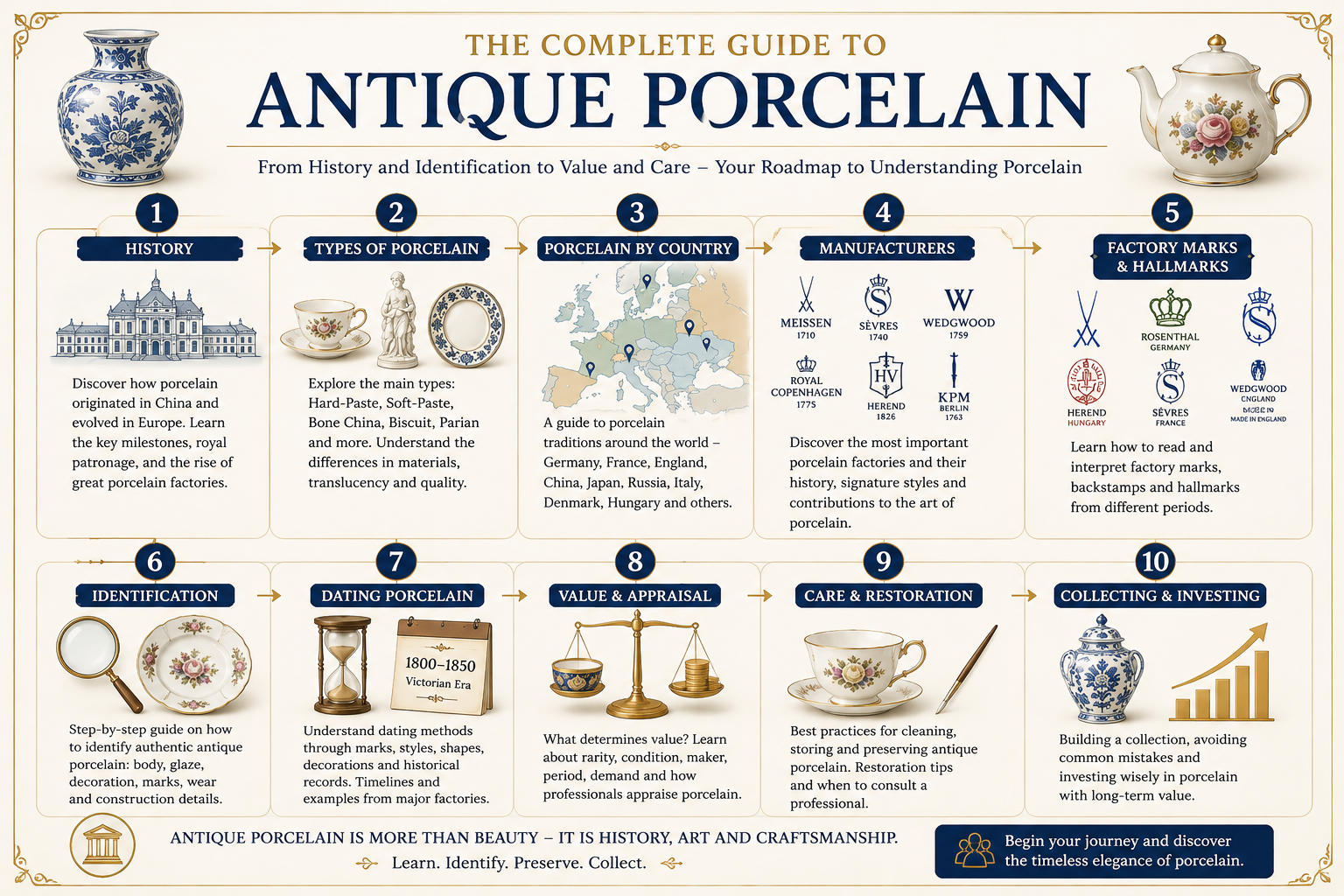
At a Glance
Antique Porcelain – Collector Reference
| Question | Collector’s Answer |
|---|---|
| Where did porcelain originate? | China, where high-fired porcelain developed over centuries before the technology was successfully reproduced in Europe. |
| When did European hard-paste porcelain begin? | Meissen became Europe’s first successful hard-paste porcelain manufactory in 1710. |
| What identifies a porcelain maker? | Factory mark, model or pattern information, body, glaze, form, decoration, technique and documented comparison. |
| Does a mark prove authenticity? | No. Marks can be copied, misunderstood, reused or altered. The object must support the mark. |
| Is every old ceramic object porcelain? | No. Earthenware, stoneware, faience, bone china and other ceramic bodies must be distinguished correctly. |
| Does old automatically mean valuable? | No. Maker, model, period, rarity, artistic quality, condition, restoration, provenance, completeness and market demand all matter. |
| Best first step? | Photograph the complete object and underside, record every mark and number, measure it, then research from broad origin toward the exact manufacturer and model. |
Start Here
How to Use This Antique Porcelain Guide
A central guide should help you find the right specialist answer—not duplicate every specialist article. Use this page to establish the broad direction of your research, then follow the relevant internal link when you need exact marks, factory history, dating systems, country-specific clues or model information.
Begin with What Is Porcelain? and the
Types of Porcelain guide.
Use the Porcelain Marks Guide.
Jump to the manufacturer directory below and use the dedicated factory guide.
Definition
What Is Antique Porcelain?
Porcelain is a high-fired, vitrified ceramic valued for its density, strength, refined surface and, in many bodies, a degree of translucency. Different porcelain traditions use different recipes and firing methods, so there is no single visual test that works for every object.
In many collecting contexts, the word antique is commonly used for objects roughly a century old or more, but it is a practical market convention rather than a scientific property of porcelain. Historically important twentieth-century porcelain can also be highly collectible even when it falls outside that convention.
Need the material explained in depth?
Read What Is Porcelain?.
If you are deciding whether an object is porcelain, faience or another ceramic body, use
Porcelain vs Faience vs Ceramic.
A Short History
From Chinese Porcelain to a Global Collecting Field
The history of porcelain begins in China, where ceramic technology developed through long experimentation with refined raw materials, high firing temperatures and sophisticated kiln control. Chinese porcelain became one of the most admired luxury commodities in international trade and profoundly influenced artistic taste far beyond East Asia.
European courts and craftsmen spent generations attempting to reproduce true hard-paste porcelain. The decisive European breakthrough is associated with Saxony, where the Meissen manufactory was established in 1710. Its success accelerated the creation of other porcelain centres across Europe.
During the eighteenth and nineteenth centuries, porcelain became closely tied to royal courts, aristocratic dining culture, scientific experimentation, industrial development and international trade. France developed the prestige of Sèvres and Limoges; England became central to bone china and industrial ceramic innovation; Denmark built distinctive underglaze traditions; Russia combined court production with later Soviet design; and Central and Eastern Europe developed a dense network of regional factories.
That history cannot always be understood through modern national borders. A Bohemian mark may reflect Austria-Hungary, Czechoslovakia or the Czech Republic; Yugoslav marks can refer to factories now located in several independent states; and late Ottoman porcelain belongs to a cultural and political world different from the borders of modern Turkey. For collectors, historical geography is part of identification.
Explore the origins in greater depth through our
Chinese Porcelain Guide
and the European breakthrough through our
Meissen Porcelain Guide.
Materials
Porcelain Types at a Glance
Material identification can narrow the likely country, factory and period, but this hub intentionally keeps the subject concise. The dedicated
Types of Porcelain Explained
guide owns the detailed material comparison.
| Body / Material | Collector Orientation |
|---|---|
| Hard-paste porcelain | Dense, highly vitrified porcelain central to Chinese production and many major continental European manufactories. |
| Soft-paste porcelain | European porcelain-like bodies developed before or alongside widespread hard-paste production; composition varied by factory. |
| Bone china | A major English tradition using bone ash; especially important in British tableware and decorative production. |
| Bisque / biscuit porcelain | Unglazed porcelain with a matte surface, widely used for figures and sculptural work. |
| Parian | A nineteenth-century sculptural ceramic body developed to evoke the appearance of marble; closely associated with British decorative art. |
Be cautious with names that sound like porcelain categories but are technically different ceramic bodies. For example, Wedgwood’s famous Jasperware is a fine stoneware rather than true porcelain. Correct material terminology improves both identification and valuation.
Identification Roadmap
How to Identify Antique Porcelain – The 8-Clue Method
Identification works best as a sequence. Do not begin and end with the backstamp. Build an attribution from several independent clues and ask whether they all point to the same origin and period.
| Clue | What to Examine |
|---|---|
| 1. Material | Body colour, density, exposed foot, translucency where appropriate and firing quality. |
| 2. Factory mark | Complete backstamp, symbol, wording, typography, application method and colour. |
| 3. Numbers | Model, shape, pattern, decoration, mould, date or control numbers—never assume the function without factory documentation. |
| 4. Form | Shape, proportions, moulding, handles, foot, rim, sculptural anatomy and construction. |
| 5. Decoration | Hand painting, transfer decoration, enamels, underglaze work, gilding and stylistic consistency. |
| 6. Technique | How the object was formed, fired, glazed, assembled and decorated. |
| 7. Condition & wear | Natural use, chips, cracks, regilding, repainting, replacement parts and restoration. |
| 8. Documentation | Factory catalogues, museum examples, archival references, provenance and reliable comparable objects. |
THE OBJECT MUST CONFIRM THE MARK
mark + material + form + decoration + technique + condition + documented comparison
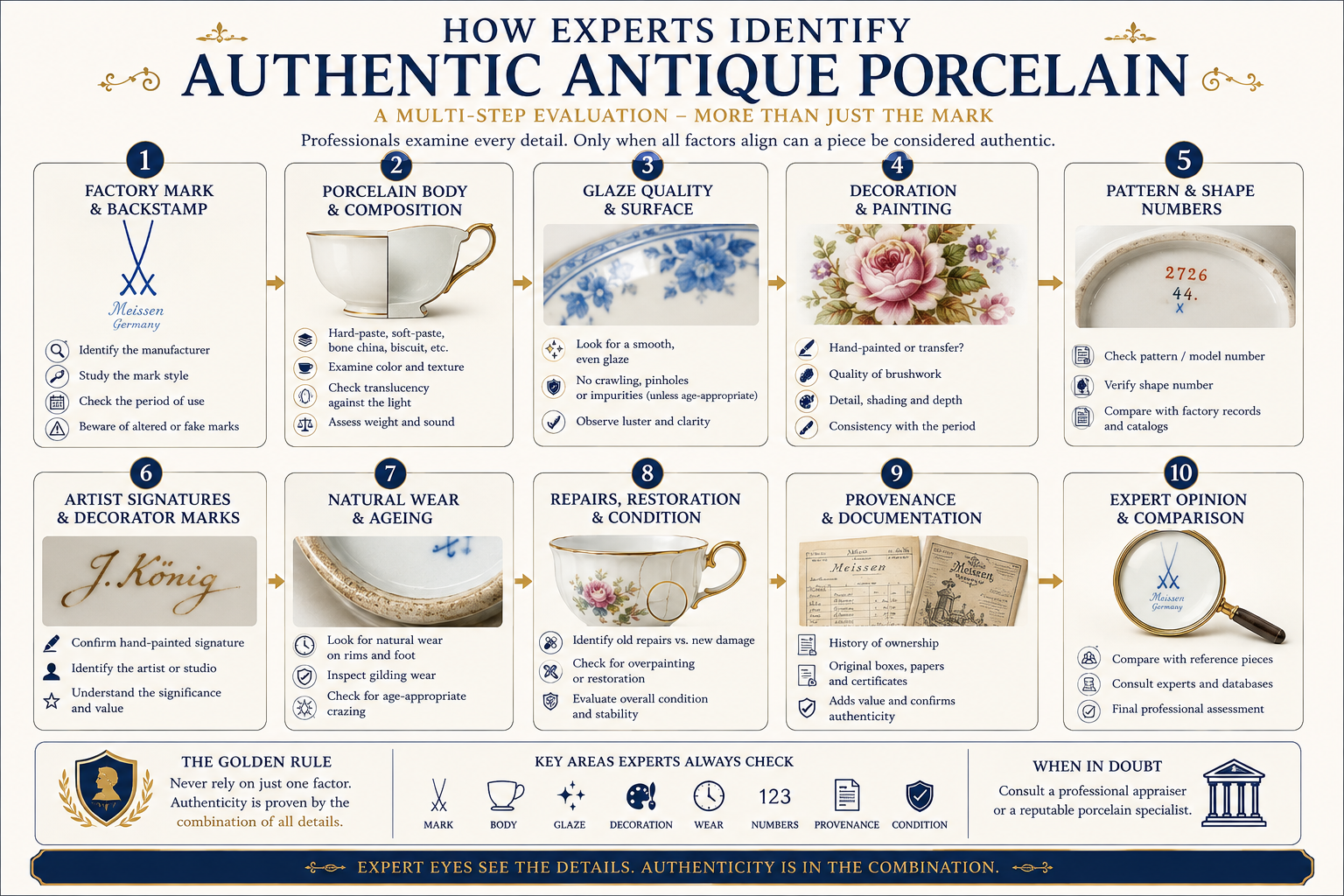
For the detailed process, use
How to Identify Antique Porcelain – Complete Collector’s Guide.
Marks & Backstamps
Porcelain Marks Are Clues, Not Proof
A porcelain mark may identify a factory, country, decorator, pattern, model, quality grade or production period. But different factories used very different systems, and famous marks have often been copied or imitated.
Photograph the entire underside, not only the central logo. Small painted initials, impressed numbers, retailer marks, country wording and quality symbols can be as important as the main trademark.
For marks research:
Start with
What Are Porcelain Marks?.
For a more procedural approach to matching backstamps, use
How to Identify Porcelain Marks & Backstamps.
Dating
How Antique Porcelain Is Dated
Dating porcelain usually requires a range rather than an instant exact year. Factory mark changes, country wording, model numbers, pattern registrations, artists, manufacturing techniques and documented design history can all contribute chronological evidence.
Political geography can also be useful. Words such as Bohemia, Czechoslovakia, Yugoslavia, USSR or later national designations may help establish a broad historical context—but should never be used as an exact date by themselves.
DATING FORMULA
exact mark + country wording + model/pattern + form + decoration + technique + documented factory history
For the full methodology, read
How to Date Antique Porcelain.
Global Porcelain Library
Explore Porcelain by Country & Historical Region
Country identification is useful because materials, factory networks, decorative traditions, export wording and political history often narrow the search. The descriptions below are deliberately short: each link leads to the specialist guide where history, marks, factories and identification are treated in depth.
| Country / Region | Collector Orientation | Specialist Guide |
|---|---|---|
| China | The foundational porcelain tradition; dynasty, reign, kiln, body, glaze and decoration require specialist study. | Chinese Porcelain |
| Japan | Arita, Imari, Kakiemon, Kutani and other traditions; material and terminology should be checked carefully. | Japanese Porcelain |
| Germany | Meissen, KPM Berlin, Rosenthal, Nymphenburg, Hutschenreuther, the Dresden decorating tradition and a vast network of regional factories. | German Porcelain |
| Bavaria | A region, not normally one brand; especially useful when a backstamp says Bavaria, Selb, Weiden or another Bavarian centre. | Bavaria Porcelain |
| Austria & Vienna | Vienna porcelain includes the historic Imperial Vienna tradition as well as later Vienna-style wares; the exact maker and mark must be distinguished carefully. | Royal Vienna Porcelain |
| France | Sèvres, Limoges and important luxury, decorative and tableware traditions. | French Porcelain |
| England | Early soft-paste porcelain, bone china and a major network of historic porcelain and ceramic manufacturers. | English Porcelain |
| Denmark | Royal Copenhagen and Bing & Grøndahl, with important underglaze and figurine traditions. | Danish Porcelain |
| Finland | Arabia Finland is central to Finnish ceramic collecting, with porcelain, faience and other ceramic bodies requiring material-specific identification. | Finnish Porcelain & Ceramics |
| Hungary | Herend and other ceramic traditions; hand decoration and factory-specific marks are central to research. | Hungarian Porcelain |
| Italy | Capodimonte, Doccia/Ginori and a broad field of regional porcelain and ceramics. | Italian Porcelain |
| Russia & Soviet Union | Imperial, revolutionary and Soviet periods with changing factory names, state symbols, artists and marks. | Russian & Soviet Porcelain |
| Czech Lands & Bohemia | Bohemia, Austria-Hungary, Czechoslovakia and the Czech Republic create especially rich backstamp and border-history clues. | Czech & Bohemian Porcelain |
| Romania | Important twentieth-century tableware and decorative production including makers such as IRIS, Apulum, ARPO and STIPO. | Romanian Porcelain |
| Former Yugoslavia | Factory history now crosses several modern states; city names, Yugoslav wording and manufacturer marks should be read together. | Yugoslav Porcelain |
| Bulgaria | A twentieth-century regional collecting field where maker, material and historical production context matter more than national style alone. | Bulgarian Porcelain |
| Greece | Modern Greek porcelain and ceramics include several materials; Rhodes and ICARO/IKAROS are important twentieth-century research areas. | Greek Porcelain & Ceramics |
| Ottoman Empire & Turkey | For true late Ottoman porcelain, Yıldız Imperial Porcelain is central; İznik and much Kütahya production belong to different ceramic traditions. | Ottoman & Turkish Porcelain |
Factory Reference Library
Porcelain Manufacturers A–Z: Marks, Dating & Identification
This alphabetical directory connects the specialist guides in The Old Antiquarian porcelain library. Choose a maker to explore documented factory history, marks, patterns, dating and value. Some entries cover ceramics beyond porcelain; always check the individual object’s body before attributing its material.
Do you know only the country, city or regional name? See Historic Porcelain Centres & Regional Names below. For an unknown backstamp, begin with our porcelain marks identification guide.
A
| Maker / Collecting Name | Origin | Guide & Main Clues |
|---|---|---|
| Arabia Finland | Finland | Identification guide → — Finnish ceramics, factory marks and material identification |
| Aynsley | England | Identification guide → — Fine bone china, marks and patterns |
B
| Maker / Collecting Name | Origin | Guide & Main Clues |
|---|---|---|
| Beswick | England | Identification guide → — Figurines, animals and related ceramics |
| Bing & Grøndahl | Denmark | Identification guide → — Underglaze marks, figurines and tableware |
C
| Maker / Collecting Name | Origin | Guide & Main Clues |
|---|---|---|
| Capodimonte | Italy | Identification guide → — Royal history, crowned N marks and later imitations |
| Chelsea | England | Identification guide → — Eighteenth-century London porcelain and marks |
| Coalport | England | Identification guide → — English porcelain, marks and patterns |
F
| Maker / Collecting Name | Origin | Guide & Main Clues |
|---|---|---|
| Frankenthal | Germany | Identification guide → — Eighteenth-century Palatinate porcelain and figurines |
| Fürstenberg | Germany | Identification guide → — Historic factory marks, figurines and dating |
G
| Maker / Collecting Name | Origin | Guide & Main Clues |
|---|---|---|
| Goebel | Germany | Identification guide → — Porcelain and ceramic figurines, factory marks |
H
| Maker / Collecting Name | Origin | Guide & Main Clues |
|---|---|---|
| Haviland & Co. (Limoges) | France | Identification guide → — Limoges porcelain, backstamps and pattern research |
| Heinrich & Co. Selb | Germany | Identification guide → — Bavaria marks, Gemmo and dating |
| Herend | Hungary | Identification guide → — Hand-painted Hungarian porcelain and factory marks |
| Hutschenreuther | Germany | Identification guide → — Selb and Bavarian porcelain, marks and figurines |
J
| Maker / Collecting Name | Origin | Guide & Main Clues |
|---|---|---|
| Johann Haviland | Germany | Identification guide → — Bavarian tableware and Johann Haviland marks; distinct from French Haviland |
K
| Maker / Collecting Name | Origin | Guide & Main Clues |
|---|---|---|
| KPM Berlin | Germany | Identification guide → — Prussian royal porcelain and blue sceptre marks |
L
| Maker / Collecting Name | Origin | Guide & Main Clues |
|---|---|---|
| Lladró | Spain | Identification guide → — Porcelain figurines, maker marks and model dating |
M
| Maker / Collecting Name | Origin | Guide & Main Clues |
|---|---|---|
| Meissen | Germany | Identification guide → — Crossed-swords marks and Saxon hard-paste porcelain |
| Minton | England | Identification guide → — Staffordshire porcelain and wider ceramics |
N
| Maker / Collecting Name | Origin | Guide & Main Clues |
|---|---|---|
| Noritake | Japan | Identification guide → — Noritake backstamps, patterns and Old Noritake |
| Nymphenburg | Germany | Identification guide → — Bavarian royal porcelain and Bustelli figurines |
P
| Maker / Collecting Name | Origin | Guide & Main Clues |
|---|---|---|
| Paragon | England | Identification guide → — Fine bone china, backstamps and patterns |
| Porsgrund | Norway | Identification guide → — Norwegian factory marks, patterns and dating |
R
| Maker / Collecting Name | Origin | Guide & Main Clues |
|---|---|---|
| R.S. Prussia | Germany | Identification guide → — Reinhold Schlegelmilch-related marks and collector terminology |
| Richard Ginori / Doccia | Italy | Identification guide → — Doccia factory history, Ginori marks and dating |
| Rosenthal | Germany | Identification guide → — Bavaria backstamps, patterns and dating |
| Royal Albert | England | Identification guide → — Fine bone china and vintage patterns |
| Royal Copenhagen | Denmark | Identification guide → — Three waves marks, dating and porcelain figures |
| Royal Crown Derby | England | Identification guide → — Derby marks, Imari-style decoration and dating |
| Royal Doulton | England | Identification guide → — Factory marks, porcelain and related ceramic bodies |
| Royal Dux | Czech lands / Bohemia | Identification guide → — Pink-triangle marks, figurines and dating |
| Royal Naples | Italy | Identification guide → — Neapolitan royal porcelain, crowned N and history |
| Royal Tettau / Royal Bayreuth | Germany | Identification guide → — Distinct Bavarian manufacturers examined together |
| Royal Worcester | England | Identification guide → — Worcester porcelain, registered marks and dating |
S
| Maker / Collecting Name | Origin | Guide & Main Clues |
|---|---|---|
| Schumann Arzberg | Germany | Identification guide → — Bavarian porcelain backstamps and dating |
| Seltmann Weiden | Germany | Identification guide → — Seltmann porcelain and Weiden factory marks |
| Sèvres | France | Identification guide → — Royal French manufactory, interlaced Ls and later marks |
| Shelley | England | Identification guide → — Fine bone china, factory marks and shape numbers |
| Sitzendorf | Germany | Identification guide → — Thuringian porcelain figurines and makers’ marks |
| Spode | England | Identification guide → — Spode and Copeland marks, patterns and dates |
V
| Maker / Collecting Name | Origin | Guide & Main Clues |
|---|---|---|
| Villeroy & Boch | Germany / Luxembourg | Identification guide → — Mettlach marks and porcelain alongside wider ceramics |
| Vincennes | France | Identification guide → — French royal porcelain predecessor of Sèvres |
| Volkstedt | Germany | Identification guide → — Thuringian porcelain marks and figurines |
W
| Maker / Collecting Name | Origin | Guide & Main Clues |
|---|---|---|
| Wallendorf | Germany | Identification guide → — German porcelain marks, figures and ballerinas |
| Wedgwood | England | Identification guide → — Marks, patterns and porcelain alongside Jasperware stoneware |
| Winterling | Germany | Identification guide → — Bavarian factory marks and twentieth-century production |
A regional name or familiar symbol does not always identify one maker. For example, Haviland porcelain from Limoges and Johann Haviland Bavaria are different collecting subjects; a Royal Vienna-style beehive mark does not automatically establish Imperial Vienna manufacture; and not every product bearing a Capodimonte-style crowned N belongs to the eighteenth-century royal factory.
Historic Porcelain Centres & Regional Names
These places and terms matter in porcelain identification, but they should not all be treated as individual manufacturers. Each guide explains the relevant history, marks, makers and materials.
| Name | Important distinction | Reference |
|---|---|---|
| Bavaria | German regional mark; many different factories | Open guide |
| Czech & Bohemian Porcelain | Historical region crossing successive states and border changes | Open guide |
| Delft Blue & Delftware | Dutch decorative ceramic tradition; often tin-glazed earthenware, not porcelain | Open guide |
| Dresden | Saxon porcelain and decorating centre, not one single factory | Open guide |
| Limoges | French porcelain production centre with numerous makers and decorators | Open guide |
| Norwegian Porcelain & Ceramics | National and material guide including Porsgrund | Open guide |
| Old Paris / Vieux Paris | Collecting term spanning numerous Paris-area makers and decorators | Open guide |
| Royal Vienna | Historic Vienna manufactory vs later Vienna-style wares and marks | Open guide |
| Russian & Soviet Porcelain | Historic factory systems, changing national names and state marks | Open guide |
Related Figurine Collecting Guides
Not every collectible figurine line is a porcelain manufactory. For individual figures and factory-specific research, see M.I. Hummel Figurines and Precious Moments Figurines. Compare the actual body, marks and model information rather than relying on the collectible name alone.
For the wider historical context, continue to our German Porcelain Guide, English Porcelain Guide, French Porcelain Guide or the full Country & Historical Region directory above.
Start with material and factory identification, then follow the detailed maker guides. This A–Z directory grows as new specialist research is published by The Old Antiquarian.
Europe’s Historic Crossroads
Porcelain Beyond Modern Borders
Some of the most interesting porcelain is difficult to understand through modern country names alone. Central and Southeastern Europe repeatedly changed political borders, factory ownership, export terminology and national identity. A backstamp can therefore preserve a small piece of political history.
For example, Bohemia may appear within an Austrian or Austro-Hungarian context before later Czechoslovakia wording; Yugoslav porcelain may come from factories now located in Serbia, Croatia, Slovenia, North Macedonia or other successor states; Romanian and Bulgarian twentieth-century production reflects changing industrial systems; and late Ottoman porcelain belongs to the imperial world of Yıldız, while celebrated İznik and Kütahya wares require different ceramic terminology.
Explore:
Czech & Bohemian Porcelain,
Romanian Porcelain,
Yugoslav Porcelain,
Bulgarian Porcelain,
Greek Porcelain & Ceramics,
and
Ottoman & Turkish Porcelain.
Collecting
What Makes Antique Porcelain Collectible?
Collector interest rarely comes from age alone. A later twentieth-century design by an important factory can sometimes attract more demand than an older but common object. What matters is the relationship between historical importance, maker, model, quality, rarity and preservation.
| Factor | Why Collectors Care |
|---|---|
| Manufacturer | A documented factory establishes context and access to catalogues, marks and models. |
| Exact model / pattern | Demand can differ dramatically within the same factory. |
| Period | Historically important artistic or production periods may be scarcer or better documented. |
| Artist / modeller | Verified authorship can add artistic and historical significance. |
| Rarity | Uncommon models, variants, sizes or documented short production runs can increase interest. |
| Decoration | Fine hand painting, specialist gilding and difficult techniques may distinguish exceptional production. |
| Condition | Original condition is usually preferred, especially on fragile sculptural pieces. |
| Provenance | Reliable ownership, exhibition or collection history can strengthen significance. |
Condition & Preservation
Condition, Restoration & Conservation
Condition can materially affect both historical integrity and market demand. Examine rims, handles, spouts, feet, finials, flowers, fingers, tails, horns and other vulnerable areas. Look for hairline cracks, chips, regilding, repainting, glue, filler, overspray and replaced elements.
Restoration and conservation are not the same concept. Restoration may seek to recover visual or structural completeness, while conservation focuses on preserving and stabilising the object. The appropriate treatment depends on the object, damage and historical importance.
For care and storage, read
How to Store Porcelain.
For terminology and decision-making, see
What Is Restoration?
and
What Is Conservation?.
Authenticity Vocabulary
Original, Replica, Copy or Fake?
These words describe different questions and should not be treated as synonyms. A later legitimate factory production of an old model, a decorative copy, a disclosed replica and an object deliberately altered to deceive collectors are not the same thing.
| Term | Use the Dedicated Guide |
|---|---|
| Original | What Is an Original? |
| Replica | What Is a Replica? |
| Copy | What Is a Copy? |
| Fake | What Is a Fake? |
Market Value
How Is Antique Porcelain Valued?
There is no reliable universal price chart for antique porcelain. Two objects from the same manufacturer can have very different market values because the exact model, production period, artist, rarity, quality grade, condition and restoration history may differ.
A useful valuation compares the object with genuinely comparable completed sales: the same model or a closely related one, similar date, size, decoration, quality grade and condition. High asking prices are not evidence that an object has actually sold at that level.
ASKING PRICE ≠ MARKET VALUE
Compare like with like: exact maker + model/pattern + period + size + colourway/decoration + condition + restoration + completeness + recent completed sales.
For the broader appraisal process, continue to
Professional Antique Valuation.
Navigation Hub
Choose Your Next Porcelain Guide
What is this material?
Who made it?
How old is it?
How should I preserve it?
What could it be worth?
Collector Checklist
12 Steps Before Identifying or Valuing Porcelain
| 1. Photograph the whole object | Front, back, sides and important details. |
| 2. Photograph the complete base | Do not crop secondary marks or numbers. |
| 3. Record every mark exactly | Letters, crowns, swords, shields, towers, waves, monograms and wording. |
| 4. Record every number | Printed, painted and impressed numbers may serve different functions. |
| 5. Measure accurately | Height, width, diameter and depth where relevant. |
| 6. Identify the material | Porcelain, bone china, earthenware, stoneware or another ceramic body. |
| 7. Study the decoration | Hand-painted, transfer, underglaze, enamel, gilded or mixed technique. |
| 8. Identify country / historical region | Use wording and political context as clues, not automatic proof. |
| 9. Identify the exact maker | Then move to the manufacturer-specific marks and dating guide. |
| 10. Inspect condition | Chips, cracks, wear, losses and missing parts. |
| 11. Look for restoration | Glue, filler, overspray, repainting, regilding and replacements. |
| 12. Compare documented examples and sold results | Use museum/factory references for identity and genuinely comparable completed sales for market context. |
The Old Antiquarian
Do You Have Unidentified Antique Porcelain?
Send clear photographs of the complete object, the underside, every factory mark and number, together with dimensions and information about chips, cracks or restoration. Good photographs are the starting point for meaningful identification and valuation.
Frequently Asked Questions
Antique Porcelain FAQ
How can I tell if porcelain is antique?
No single feature proves age. Examine the complete factory mark, material, form, decoration, manufacturing technique, model or pattern information and natural condition, then compare them with documented examples from the suspected maker and period. Use our
dating guide
for the full process.
Can a porcelain mark tell me exactly when a piece was made?
Sometimes a factory used a documented date code or a tightly datable mark, but many marks only establish a broad period. Model numbers, country wording, decoration and factory history should be checked alongside the backstamp.
Does a famous factory mark prove authenticity?
No. Famous marks can be copied or misapplied. The porcelain body, form, modelling, decoration, manufacturing quality and age must be compatible with the proposed factory and mark period.
Is all white translucent ceramic porcelain?
No. Material identification requires more than colour or translucency. Bone china, porcelain, stoneware, earthenware and other bodies have different compositions and properties.
Why does country wording matter?
Country and regional wording can help establish historical context, especially in places where borders changed. Terms such as Bohemia, Czechoslovakia, Yugoslavia or USSR may narrow a period, but should not be treated as exact dating codes by themselves.
What does Bavaria mean on porcelain?
Bavaria is usually a regional designation rather than the name of one factory. Identify the actual maker and exact backstamp before assigning a date or value. See our
Bavaria Porcelain Guide.
Are all British ceramics porcelain?
No. English and British manufacturers worked in many ceramic materials. Wedgwood Jasperware, for example, is stoneware, and much historic Beswick production belongs to earthenware and other ceramic bodies. Identify the material of the individual object before describing it as porcelain or bone china.
Are all Greek or Ottoman ceramics porcelain?
No. Both fields include important non-porcelain ceramic traditions. In late Ottoman porcelain, Yıldız is especially important, while İznik and much Kütahya production belong to other ceramic bodies. Greek collecting similarly includes porcelain, earthenware, stoneware and studio ceramics.
Does restoration always destroy value?
No, but restoration can materially affect collector demand and must be disclosed and evaluated. Its effect depends on rarity, historical importance, location, extent and quality of the work.
What makes antique porcelain valuable?
Manufacturer, exact model or pattern, production period, rarity, artist or modeller, quality, condition, restoration, completeness, provenance and current market demand all matter. Age alone is not enough.
Should I use asking prices to value porcelain?
Not by themselves. Asking prices show what sellers hope to receive. Completed sales of genuinely comparable objects are more useful evidence of current market behaviour.
Continue Exploring
The Old Antiquarian Knowledge Library
For definitions used across antiques and collecting, browse the
Antique & Collector’s Glossary.
For longer identification, history and collecting resources, browse
Antique Guides.
Sources & Further Research
How Porcelain Research Should Be Verified
A central collector guide can establish the research method, but exact attributions should be checked against the strongest available evidence for the individual object. Useful sources include:
- official porcelain manufactory histories and historical mark archives;
- museum collection records and object catalogues;
- historic factory catalogues, pattern books and price lists;
- documented exhibition and collection catalogues;
- specialist reference books on individual factories and regions;
- credible provenance records and old collection labels;
- completed auction results for genuinely comparable objects.
Research note:
Porcelain marks, political borders, factory ownership and production systems changed over time. Transitional marks can overlap, historic models can remain in production for decades or centuries, and country wording may reflect export requirements rather than an exact manufacturing date. Strong identification uses several independent clues.
About the Author
The Old Antiquarian
The Old Antiquarian combines more than 35 years of practical experience with antiques and collecting with historical, museum and comparative research. Our porcelain guides are designed to help collectors move from broad identification toward documented factory, model and period research—without relying on a single mark or visual clue.
Final Collector Principle
Start Broad. Identify Precisely. Verify Everything.
The strongest porcelain attribution is reached when the material, factory mark, model, form, decoration, manufacturing technique, condition and documented history all point toward the same maker and period.
