
What Is Original Spode? How to Identify Authentic Spode Porcelain
What Is Spode Porcelain? History, Marks, Identification and Collecting Guide
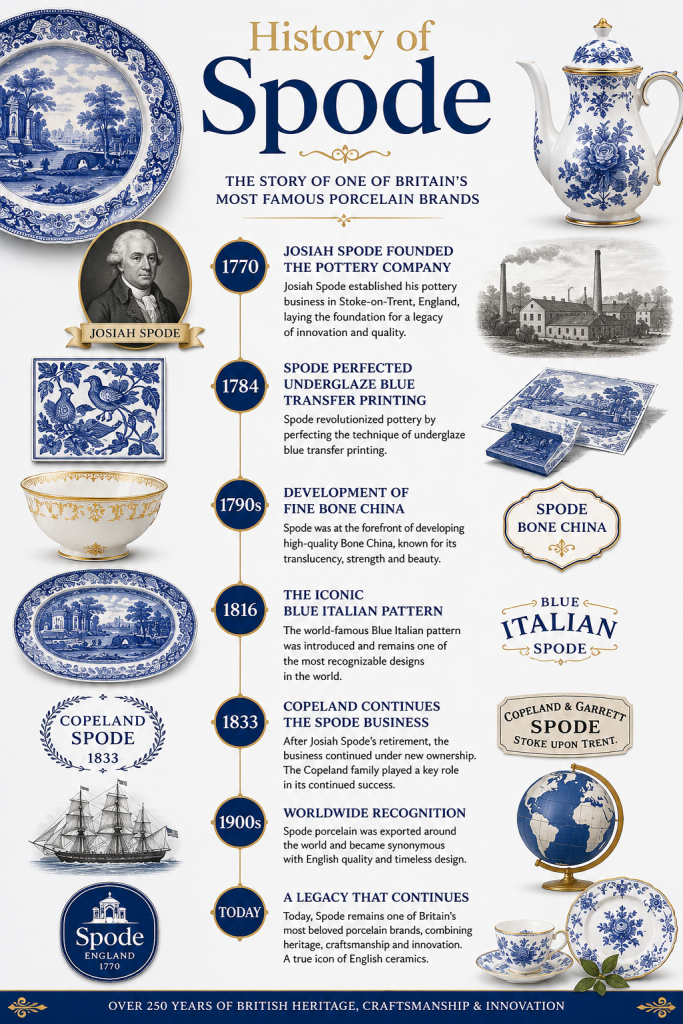
Spode is one of England’s most influential and respected porcelain manufacturers. Founded in 1770 by Josiah Spode in Stoke-on-Trent, Staffordshire, the company transformed the British ceramics industry through technical innovation, artistic excellence and world-famous designs. Today, antique Spode porcelain is highly sought after by collectors for its exceptional craftsmanship, historical significance and timeless elegance.
Spode is best known for introducing bone china as a commercially successful porcelain body and for perfecting blue underglaze transfer printing, a technique that changed European ceramic decoration forever. Iconic patterns such as Blue Italian, first introduced in 1816, continue to be produced and collected around the world.
Whether you own an antique dinner service, a decorative plate, a tea set or a porcelain figurine, understanding Spode’s history, factory marks and production methods can help you identify authentic pieces and estimate their historical and collector value.
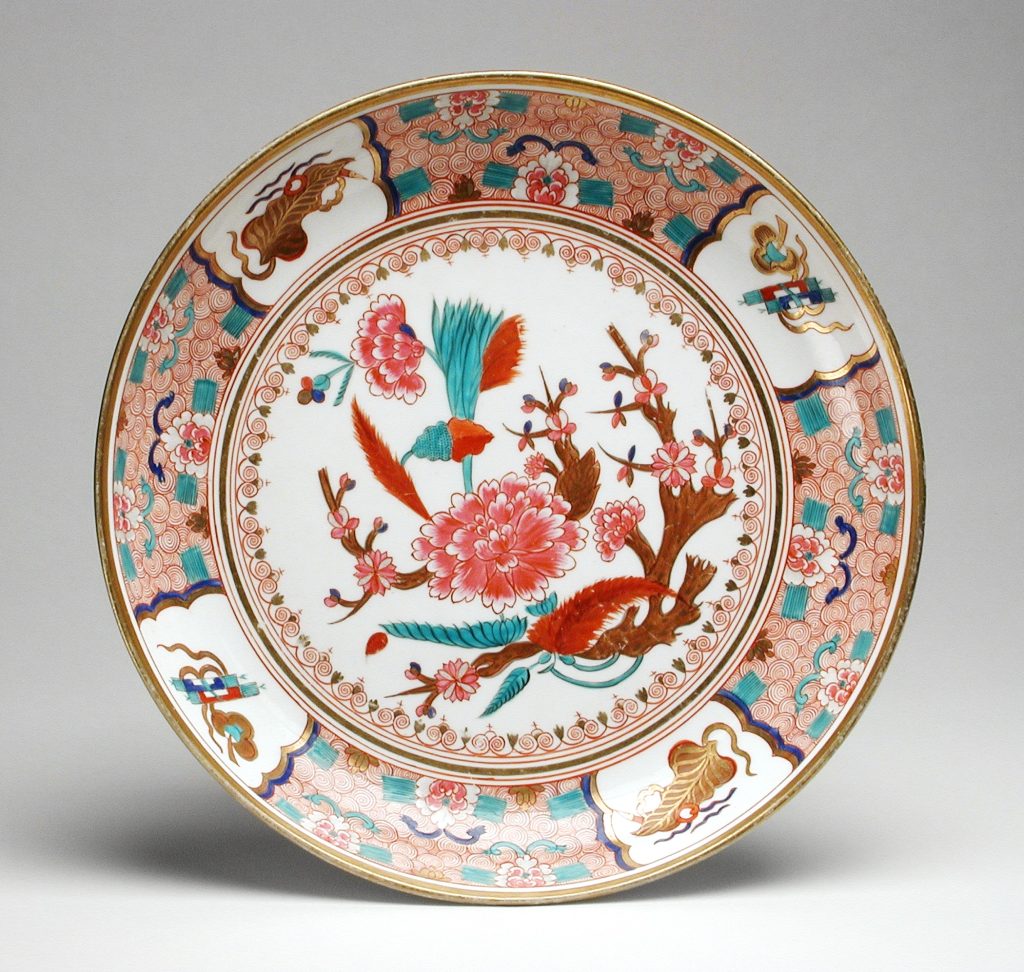
Collectors often compare Spode with renowned English manufacturers such as Wedgwood, Royal Doulton and Minton. While each factory developed its own artistic style, Spode earned a unique place in ceramic history through continuous innovation and outstanding production quality.
The History of Spode
The story of Spode began in 1770 when Josiah Spode I established his pottery business in Stoke-on-Trent, the heart of England’s ceramic industry. During the eighteenth century, Staffordshire became Europe’s leading centre for pottery production, bringing together skilled craftsmen, abundant raw materials and an expanding international market.
Josiah Spode quickly gained a reputation for producing exceptionally fine earthenware and porcelain. His workshop combined traditional craftsmanship with scientific experimentation, constantly improving materials, glazes and firing techniques. These innovations helped establish Spode as one of Britain’s most respected ceramic manufacturers.
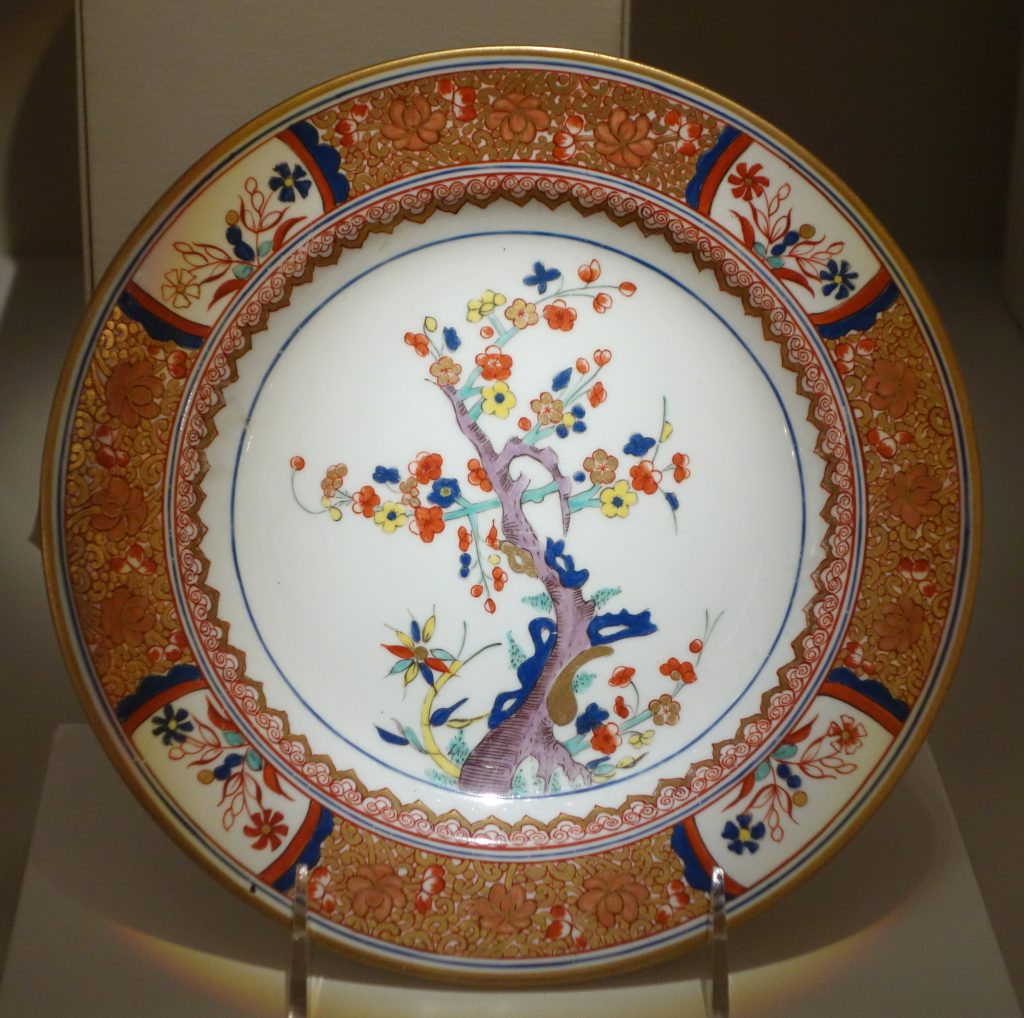
The company’s greatest technological achievements came under the leadership of Josiah Spode II. By refining the composition of bone china and developing improved transfer-printing methods, he created products that combined beauty, durability and affordability. These advances allowed Spode to compete successfully across Europe and the growing export markets of North America.
Throughout the nineteenth century, Spode supplied aristocratic households, prestigious institutions and customers across the British Empire. Its tableware, decorative objects and fine porcelain became symbols of quality and refined taste.
Who Was Josiah Spode?
Josiah Spode is regarded as one of the pioneers of the English ceramics industry. His dedication to quality and innovation laid the foundations for one of the world’s most famous porcelain manufacturers. Unlike many potters of his time, Spode invested heavily in experimentation, seeking better materials and more efficient production techniques.
His work influenced generations of ceramic manufacturers and contributed significantly to Britain’s leadership in porcelain production during the eighteenth and nineteenth centuries. Today, collectors still regard early Spode pieces as some of the finest examples of English craftsmanship.
Spode and the Invention of Bone China
One of Spode’s greatest contributions to ceramic history was the successful commercial development of bone china. Although experiments with bone ash had already begun elsewhere, Josiah Spode II perfected a formula that produced porcelain with exceptional whiteness, translucency and strength.
Bone china contains a high percentage of calcined animal bone ash mixed with kaolin and feldspathic materials. This composition creates porcelain that is lighter, stronger and more resistant to chipping than many traditional hard-paste porcelains.
If you would like to understand how bone china differs from other ceramic materials, you may also enjoy reading our guide What Is the Difference Between Porcelain, Faience and Ceramic?.
Blue Transfer Printing: A Revolution in Decoration
Spode also revolutionised ceramic decoration through the perfection of underglaze blue transfer printing. Instead of painting every design by hand, engraved copper plates transferred intricate blue designs onto porcelain before glazing and firing.
This innovation allowed highly detailed decoration to be reproduced consistently while making elegant tableware more affordable. The technique quickly became popular across Europe and influenced countless manufacturers during the nineteenth century.
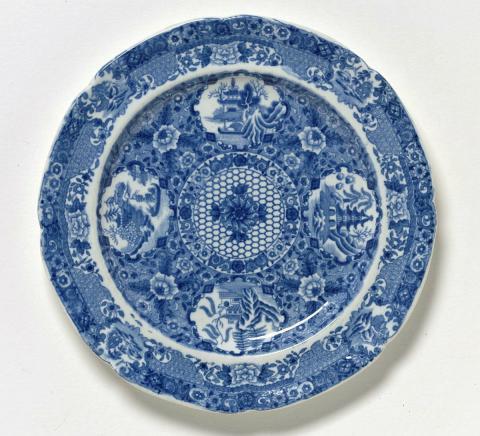
Many antique Spode pieces combine transfer printing with delicate hand-painted finishing, creating objects that demonstrate both industrial precision and artistic craftsmanship. These subtle details remain one of the characteristics collectors examine when identifying authentic Spode porcelain.
Learning to recognise these manufacturing techniques becomes even easier when combined with an understanding of porcelain marks, factory backstamps and production dates, all of which will be explored in the following sections of this guide.
The Famous Spode Collections
Over more than two centuries, Spode produced hundreds of porcelain patterns and decorative collections. Some were created for aristocratic households, while others became everyday tableware admired for their beauty and durability. Today, several classic Spode designs remain among the most collected English ceramics in the world.
Collectors generally value early production pieces most highly, especially those dating from the late eighteenth and early nineteenth centuries. Original factory marks, excellent condition and complete services often command significantly higher prices than individual replacement pieces.
Blue Italian
Without question, Blue Italian is Spode’s most iconic pattern. Introduced in 1816, it combines romantic Italian landscapes with an oriental-inspired border, all printed in deep cobalt blue using the famous underglaze transfer-printing process perfected by Spode.
More than two hundred years after its introduction, Blue Italian remains in continuous production, making it one of the world’s longest-running porcelain patterns. Antique examples, however, are considerably more valuable than modern reproductions and can often be identified through their factory marks, body characteristics and decoration quality.
Other Important Spode Patterns
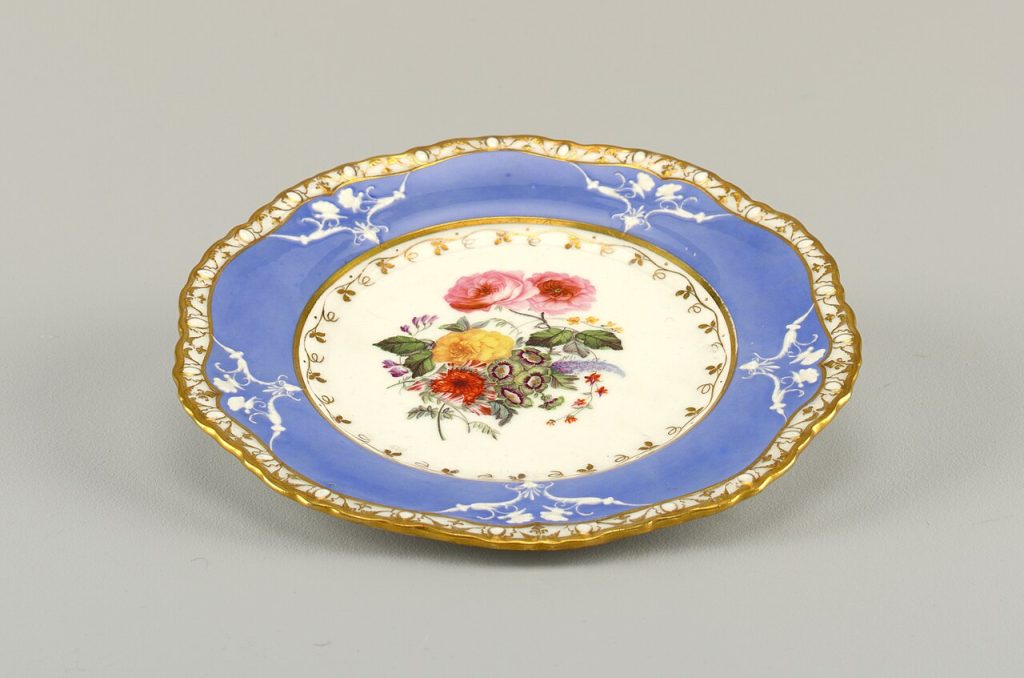
Although Blue Italian is undoubtedly the best-known, Spode produced numerous celebrated collections throughout the nineteenth and twentieth centuries. Floral dinner services, Imari-inspired decoration, richly gilded cabinet plates and elegant white Bone China all became synonymous with the Spode name.
Many collectors specialise in a single pattern, while others focus on early production periods or unusual limited editions. Complete tea services, dinner sets and decorative display pieces are especially desirable when they remain in excellent original condition.
Spode Factory Marks
Factory marks are one of the most reliable tools for identifying authentic Spode porcelain. During more than two centuries of production, the company used numerous printed, impressed and painted backstamps that evolved alongside changes in ownership and manufacturing techniques.
Early examples may simply bear the word “Spode”, while later pieces often include Copeland, Copeland & Garrett, or Spode Copeland’s China England. Modern pieces frequently include additional trademarks, registration numbers and country-of-origin markings.
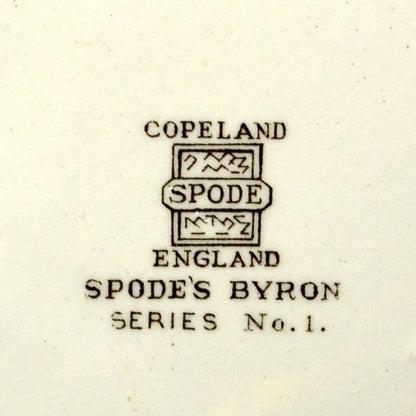
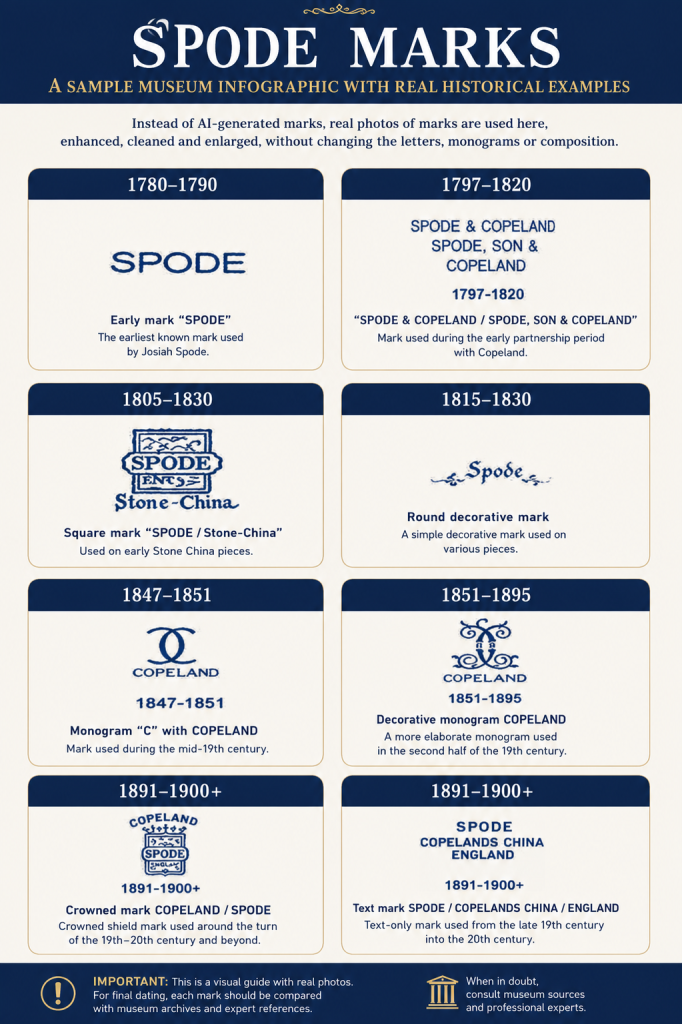
Understanding these backstamps is essential because they often reveal the approximate production period and help distinguish antique porcelain from later reproductions. However, collectors should never rely solely on the factory mark. The porcelain body, glaze, decoration, pattern number and natural wear must also be considered together.
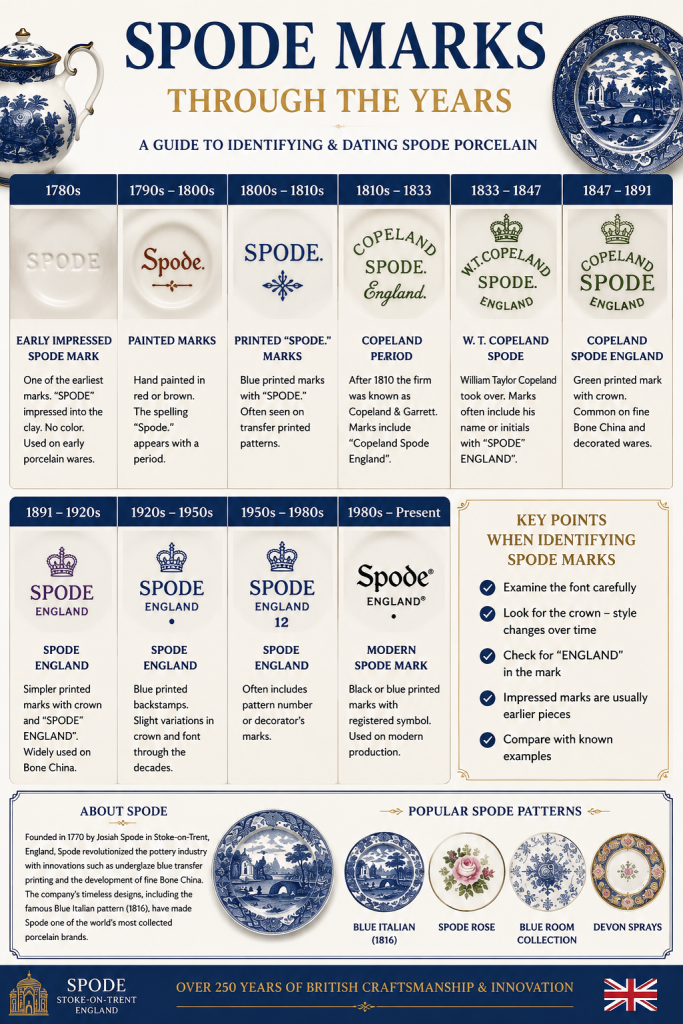
If you are unfamiliar with porcelain backstamps, our guides What Are Porcelain Marks? and How to Identify Porcelain Marks explain how manufacturers used marks to identify factories, production periods and decorators.
Why Spode Is So Popular Among Collectors
Spode occupies a unique position in the history of European ceramics because it successfully combined scientific innovation with artistic excellence. The introduction of commercial Bone China, the perfection of blue transfer printing and the creation of timeless patterns such as Blue Italian ensured the company’s international reputation.
Collectors appreciate Spode not only for its beauty but also for its historical importance. Many antique examples remain surprisingly durable despite their age, making them attractive both as display pieces and as functional tableware.
Today, museums, antique dealers and private collections around the world continue to preserve Spode porcelain as an outstanding example of British craftsmanship. Whether collecting early Bone China, nineteenth-century transferware or decorative cabinet pieces, Spode offers remarkable variety for collectors at every level.
How to Identify Original Spode Porcelain
Identifying authentic Spode porcelain requires much more than finding the word “Spode” on the base. Because the company has existed for more than 250 years and continues to produce ceramics today, collectors must evaluate several characteristics together before determining whether a piece is genuinely antique.
Professional appraisers typically examine the factory mark, porcelain body, glaze, decoration, pattern number, manufacturing quality and natural signs of age. When these elements are consistent with the known production period, they provide strong evidence of authenticity.
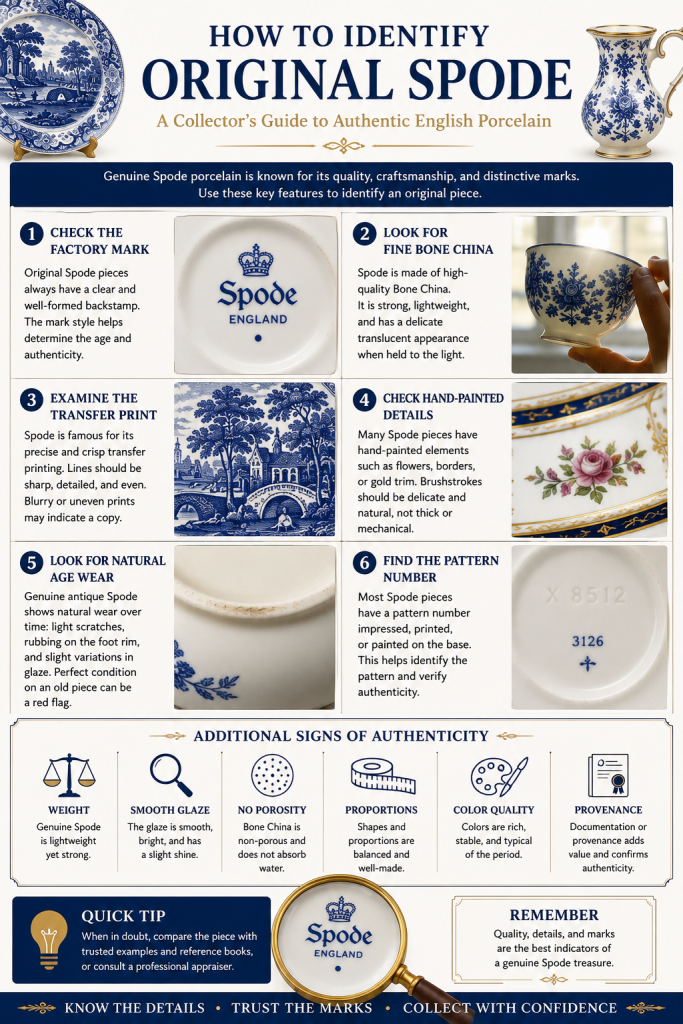
1. Examine the Factory Mark
The first step is to inspect the backstamp carefully. Original Spode marks evolved throughout the company’s history and often include names such as Spode, Copeland, Copeland & Garrett or Spode Copeland’s China England. The style, typography and additional markings help narrow down the production period.
Keep in mind that the mark alone does not prove authenticity. Counterfeiters occasionally reproduce famous factory names, making it essential to compare the mark with the overall quality of the porcelain.
2. Evaluate the Porcelain Body
Authentic antique Spode Bone China is known for its fine texture, elegant translucency and exceptional strength. When held against a bright light, many genuine pieces allow light to pass softly through the body while maintaining remarkable durability.
If you are unfamiliar with the characteristics of porcelain itself, our guide What Is Porcelain? explains how high-quality porcelain differs from other ceramic materials.
3. Look at the Decoration
Decoration is another important clue. Antique Spode pieces often display remarkably crisp transfer printing combined with subtle hand-painted finishing touches. Fine gilding, carefully painted floral motifs and precisely aligned decorative borders usually indicate high manufacturing standards.
Poor-quality printing, blurred details or uneven decoration may suggest a later reproduction rather than an early antique example.
4. Inspect the Glaze and Foot Ring
Original antique porcelain usually develops natural signs of age. The glaze should remain smooth and glossy while showing gentle wear consistent with decades of careful use. The foot ring often displays light abrasion from resting on tables and shelves over many years.
Artificial ageing frequently produces scratches or discoloration that appear inconsistent with genuine long-term use. Experienced collectors learn to distinguish natural wear from intentionally created damage.
How to Date Spode Porcelain
Dating Spode porcelain involves combining information from factory marks, pattern numbers, decorative style and manufacturing techniques. No single feature should be used independently, as several designs remained in production for many decades.
Changes in backstamps are often the most useful starting point. Ownership transitions, export regulations and evolving branding resulted in numerous variations that specialists use to estimate production dates.
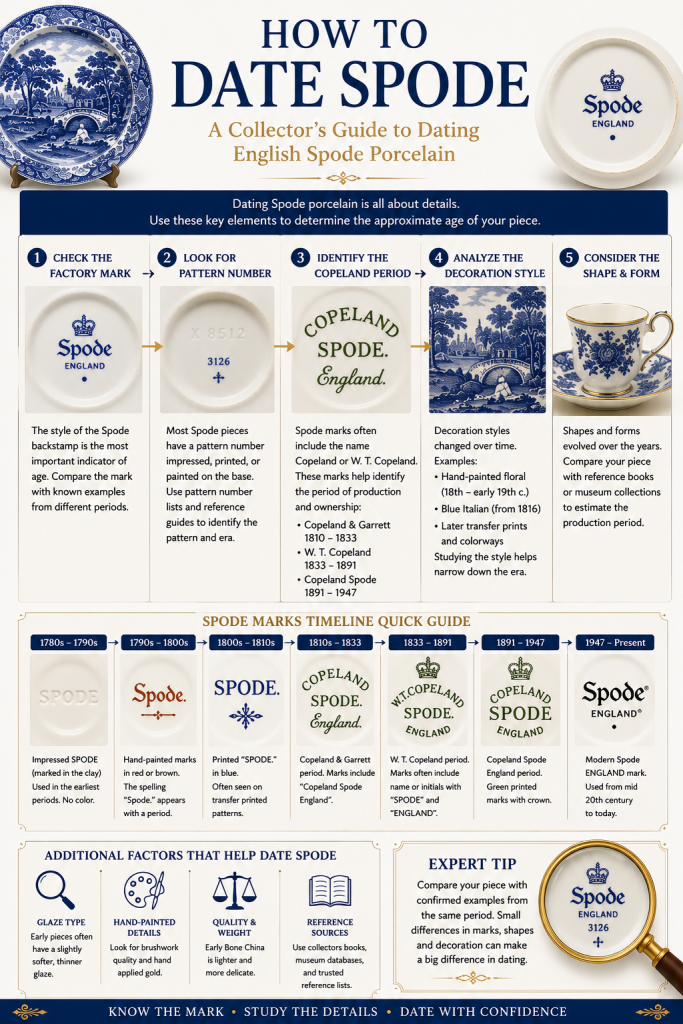
Collectors should also examine whether the decoration matches the period indicated by the factory mark. Certain colours, transfer-printing methods and gilding styles became popular only during specific decades, helping to confirm or question an estimated production date.
For a broader understanding of antique porcelain dating, you may also find our guide How to Identify Antique Porcelain helpful.
10 Checks for Authentic Spode
Before purchasing an expensive piece of antique Spode, experienced collectors often work through a simple authentication checklist. While no individual feature guarantees authenticity, evaluating all of these characteristics together provides a much more reliable assessment.
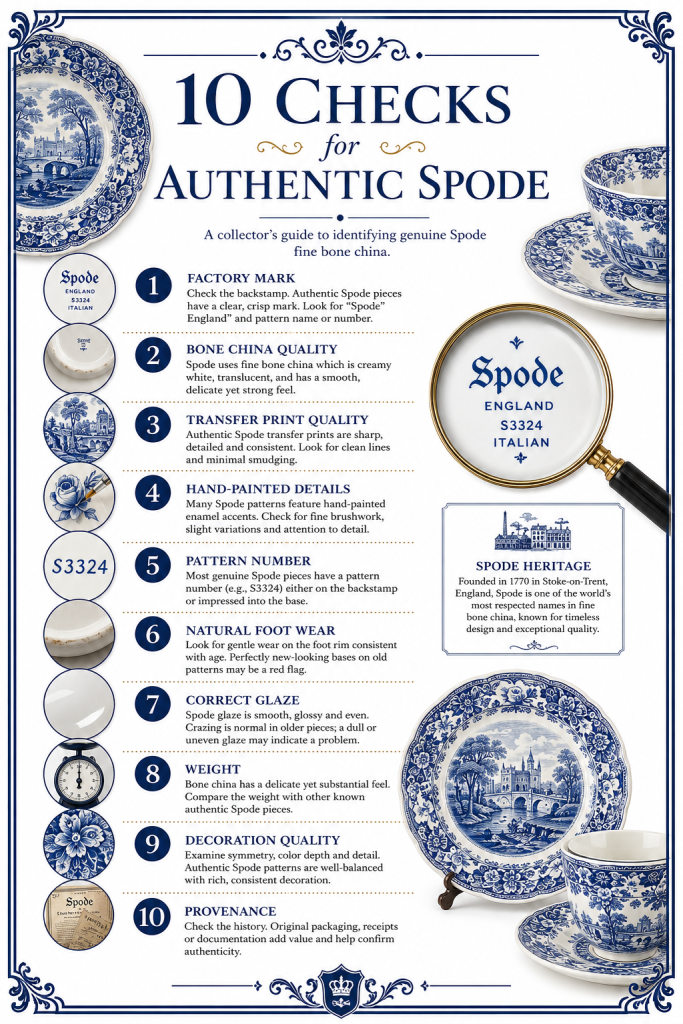
- ✓ Authentic factory mark
- ✓ High-quality Bone China body
- ✓ Crisp transfer printing
- ✓ Fine hand-painted decoration
- ✓ Correct pattern number
- ✓ Natural foot ring wear
- ✓ Smooth original glaze
- ✓ Appropriate weight and balance
- ✓ Excellent manufacturing quality
- ✓ Reliable provenance or documented history
The more of these characteristics a piece demonstrates, the greater the likelihood that it is an authentic example of antique Spode porcelain rather than a later reproduction.
Quick Facts About Spode
| Founded | 1770 |
|---|---|
| Founder | Josiah Spode I |
| Country | England |
| Region | Stoke-on-Trent, Staffordshire |
| Most Famous Innovation | Commercial Bone China and Blue Underglaze Transfer Printing |
| Best-Known Pattern | Blue Italian (introduced in 1816) |
| Collectibility | Very High |
| Still Produced Today | Yes |
| Most Collected Items | Dinner services, tea sets, plates, vases and decorative porcelain |
Spode remains one of the world’s most recognised names in English ceramics. Its influence extends far beyond Britain, with antique and modern pieces collected throughout Europe, North America, Australia and Asia. Because of its long production history, collectors have the opportunity to study more than two centuries of continuous porcelain development within a single manufacturer.
Timeline of Spode
Understanding the company’s history makes it much easier to identify antique pieces and place factory marks into their correct historical context.
1770 — The Beginning
Josiah Spode establishes his pottery business in Stoke-on-Trent, laying the foundations for what would become one of Britain’s greatest porcelain manufacturers.
1770s–1780s — Building a Reputation
The company quickly earns recognition for producing exceptionally high-quality earthenware and experimenting with improved ceramic bodies and glazes.
1790s — Bone China Revolution
Under Josiah Spode II, the company perfects the commercial formula for Bone China, creating stronger, whiter and more translucent porcelain than previous English production.
Early 1800s — Transfer Printing Perfected
Spode refines underglaze blue transfer printing, allowing highly detailed decoration to be reproduced consistently while maintaining exceptional quality.
1816 — Blue Italian Introduced
One of the world’s most famous porcelain patterns is launched. More than two centuries later, Blue Italian continues to be produced and remains one of the company’s signature designs.
1833 — The Copeland Era
William Taylor Copeland becomes closely associated with the company, and later factory marks begin incorporating the Copeland name alongside Spode.
Late Nineteenth Century
Spode exports porcelain throughout the British Empire, Europe and North America, becoming one of the leading names in luxury tableware.
Twentieth Century
Production expands while preserving many traditional patterns. New collections are introduced alongside classic designs that continue to attract collectors today.
Today
Spode remains one of the world’s best-known English porcelain brands, admired for both its historic antiques and its continuing production.
The Most Collectible Spode Patterns
Although thousands of patterns have been produced since 1770, only a relatively small number have achieved international recognition among collectors. Rarity, artistic quality, historical importance and condition all influence which patterns are considered the most desirable.
Blue Italian
Blue Italian remains the undisputed icon of Spode. Introduced in 1816, its romantic Italian landscape framed by an oriental-inspired border has become one of the most recognisable porcelain designs ever created. Early nineteenth-century examples are especially sought after.
Imari Patterns
Inspired by Japanese export porcelain, Spode’s Imari patterns combine cobalt blue, rich iron-red and luxurious gilding. Antique examples display remarkable craftsmanship and remain highly desirable among collectors of English porcelain.
Early Floral Bone China
Hand-painted floral services from the late eighteenth and early nineteenth centuries demonstrate the extraordinary skill of Spode decorators. Fine botanical painting and elegant gilding often make these pieces some of the most valuable examples of early English Bone China.
Woodland Collection
Although considerably newer than early Bone China, the Woodland collection has become extremely popular with collectors who appreciate detailed wildlife scenes and traditional British country themes.
Christmas Tree
Introduced during the twentieth century, the Christmas Tree pattern has become one of the world’s best-selling holiday dinnerware collections. Vintage examples continue to attract collectors, particularly complete table services.
Collectors often compare Spode with other prestigious European manufacturers such as Meissen, Sèvres, Herend and Wedgwood. Each manufacturer developed its own distinctive artistic style, but Spode’s contribution to Bone China and transfer printing remains unique within ceramic history.
Common Mistakes Collectors Make
Even experienced collectors occasionally make mistakes when evaluating antique Spode porcelain. Understanding these common pitfalls can help avoid expensive purchasing errors.
- Assuming every Spode mark is antique. Modern production also bears the Spode name, making factory marks only one part of the identification process.
- Ignoring restoration. Professional repairs may be difficult to detect but can significantly affect collector value.
- Judging only by appearance. Beautiful decoration alone does not guarantee authenticity.
- Overlooking the foot ring. Natural wear patterns often reveal much about a porcelain object’s true age.
- Ignoring provenance. Original receipts, family history or documented ownership frequently add confidence when authenticating valuable pieces.
- Confusing reproduction with counterfeit. Many reproductions are legitimate decorative pieces and are not intended to deceive collectors.
Perhaps the most important lesson is to examine every object as a whole. Authenticity should always be determined by combining factory marks, porcelain quality, decoration, glazing, manufacturing techniques, historical consistency and provenance rather than relying on a single feature.
Buying Antique Spode Porcelain
Purchasing antique Spode can be extremely rewarding, provided buyers approach the market with patience and careful research. Before making a significant purchase, collectors should inspect the porcelain under good lighting and examine every detail carefully.
Look closely at the factory mark, overall condition, glaze, decoration and foot ring. Compare the piece with documented examples from reliable reference books or museum collections whenever possible. Small differences in colour, printing quality or porcelain body can often distinguish an authentic antique from a later reproduction.
Buying from established antique dealers generally provides greater confidence than purchasing unidentified pieces with little supporting information. If provenance, invoices or previous collection records accompany an object, they can significantly strengthen its historical credibility.
Finally, remember that condition remains one of the most important factors affecting collector value. Small chips, hairline cracks or extensive restoration may reduce desirability, while complete services in excellent original condition remain among the most sought-after examples of antique Spode porcelain.
Original Spode or Fake?
One of the most common questions asked by collectors is how to distinguish an authentic piece of antique Spode from a later reproduction. Fortunately, genuine Spode porcelain displays a combination of characteristics that are difficult to reproduce convincingly. Rather than relying on a single feature, experienced collectors evaluate every aspect of the object before reaching a conclusion.
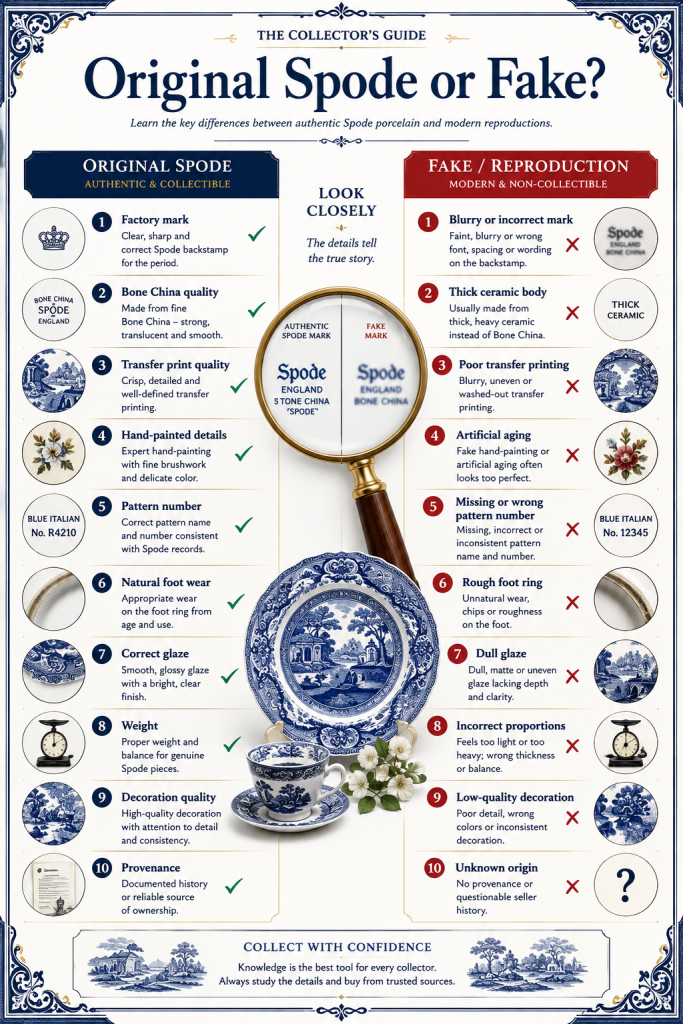
Original Spode porcelain typically features a finely made Bone China body, crisp transfer printing, carefully executed hand-painted decoration, smooth glossy glaze and naturally worn foot rings that reflect decades of genuine use. Factory marks correspond to known historical production periods and should always agree with the style of decoration and porcelain body.
By contrast, reproductions often reveal blurred or inaccurate backstamps, heavier ceramic bodies, lower-quality printing, artificial ageing and inconsistent decoration. While many modern reproductions are honestly sold as decorative pieces, others may be mistakenly described as antiques, making careful examination essential before purchasing.
For collectors who wish to deepen their knowledge of originality, our articles What Is an Original?, What Is Authenticity?, What Is a Replica? and What Is a Fake? explain the differences between genuine antiques, reproductions and counterfeits in greater detail.
Are Antique Spode Pieces Valuable?
Yes. Many antique Spode objects are highly desirable among collectors, museums and specialist dealers. However, value depends on several important factors rather than age alone.
The most valuable examples generally date from the late eighteenth and early nineteenth centuries, particularly those produced during the lifetime of Josiah Spode I and Josiah Spode II. Rare decorative patterns, early Bone China, unusual cabinet pieces and complete dinner services often command the strongest prices at auction.
Collectors also pay close attention to condition. Hairline cracks, chips, heavy crazing or extensive restoration can reduce market value significantly. Conversely, complete services with original gilding, vibrant decoration and documented provenance are often considered investment-quality antiques.
If you are interested in understanding how specialists assess porcelain values, you may also find our guides How Is Antique Porcelain Valued? and What Determines the Value of an Antique? useful.
Frequently Asked Questions
Is all Spode porcelain antique?
No. Spode has continued producing porcelain for more than two centuries. Only pieces over 100 years old are generally considered antiques.
Is every piece marked “Spode” valuable?
No. Age, rarity, condition, pattern, provenance and collector demand all influence value. A factory mark alone does not determine desirability.
What is the most famous Spode pattern?
Blue Italian, introduced in 1816, is widely regarded as Spode’s most iconic and recognisable pattern.
What makes early Spode so collectible?
Early production demonstrates exceptional craftsmanship and includes the successful commercial development of Bone China and the perfection of underglaze blue transfer printing.
Can damaged Spode still have value?
Yes. Rare early examples may remain valuable despite minor damage, although condition always affects collector demand and market price.
How can I identify the age of my Spode porcelain?
Examine the factory mark, pattern number, porcelain body, glaze, decoration and overall manufacturing characteristics together. No single feature should be used independently.
What is Bone China?
Bone China is a porcelain body containing bone ash, giving it exceptional strength, whiteness and translucency. Spode played a major role in perfecting its commercial production. Learn more in our article What Is Bone China?.
Can factory marks be copied?
Yes. Reproductions sometimes imitate historic backstamps, which is why experts evaluate the entire object rather than relying solely on the mark.
Should antique Spode be restored?
Minor conservation performed by a professional may help preserve important pieces, but excessive restoration can reduce collector value. Read more in What Is Conservation? and What Is Restoration?.
Is Spode still produced today?
Yes. Modern Spode continues to manufacture many classic patterns, including Blue Italian, although antique examples remain the most sought after by collectors.
Conclusion
For more than 250 years, Spode has shaped the history of English porcelain through innovation, exceptional craftsmanship and timeless design. From the perfection of Bone China to the worldwide success of Blue Italian, the company has earned a permanent place among the greatest names in European ceramics.
Whether you are researching a family heirloom, building a collection or considering your first purchase, understanding Spode’s history, factory marks and production techniques will help you recognise authentic pieces and appreciate their historical significance with greater confidence.
Need Help Identifying Your Spode Porcelain?
If you own a piece of Spode porcelain and would like to know whether it is authentic, determine its approximate age or receive a professional opinion regarding its collector value, we would be pleased to assist you.
Contact The Old Antiquarian for a professional antique porcelain assessment.
Continue Exploring
- Guide to Antique Porcelain
- What Is Porcelain?
- What Is Bone China?
- What Are Porcelain Marks?
- How to Identify Porcelain Marks
- How to Identify Antique Porcelain
- How Is Antique Porcelain Valued?
- How to Store Antique Porcelain and Ceramics
- How to Restore Porcelain
- What Is Wedgwood?
- What Is Royal Doulton?
- What Is Meissen Porcelain?
